
Rating:
⭐⭐⭐⭐ (4.3 out of 5)
I have read leadership books for years, and if I’m being honest, many of them start blending into each other after a point. New frameworks. New acronyms. New models. Better slides, sharper language, more polished certainty.
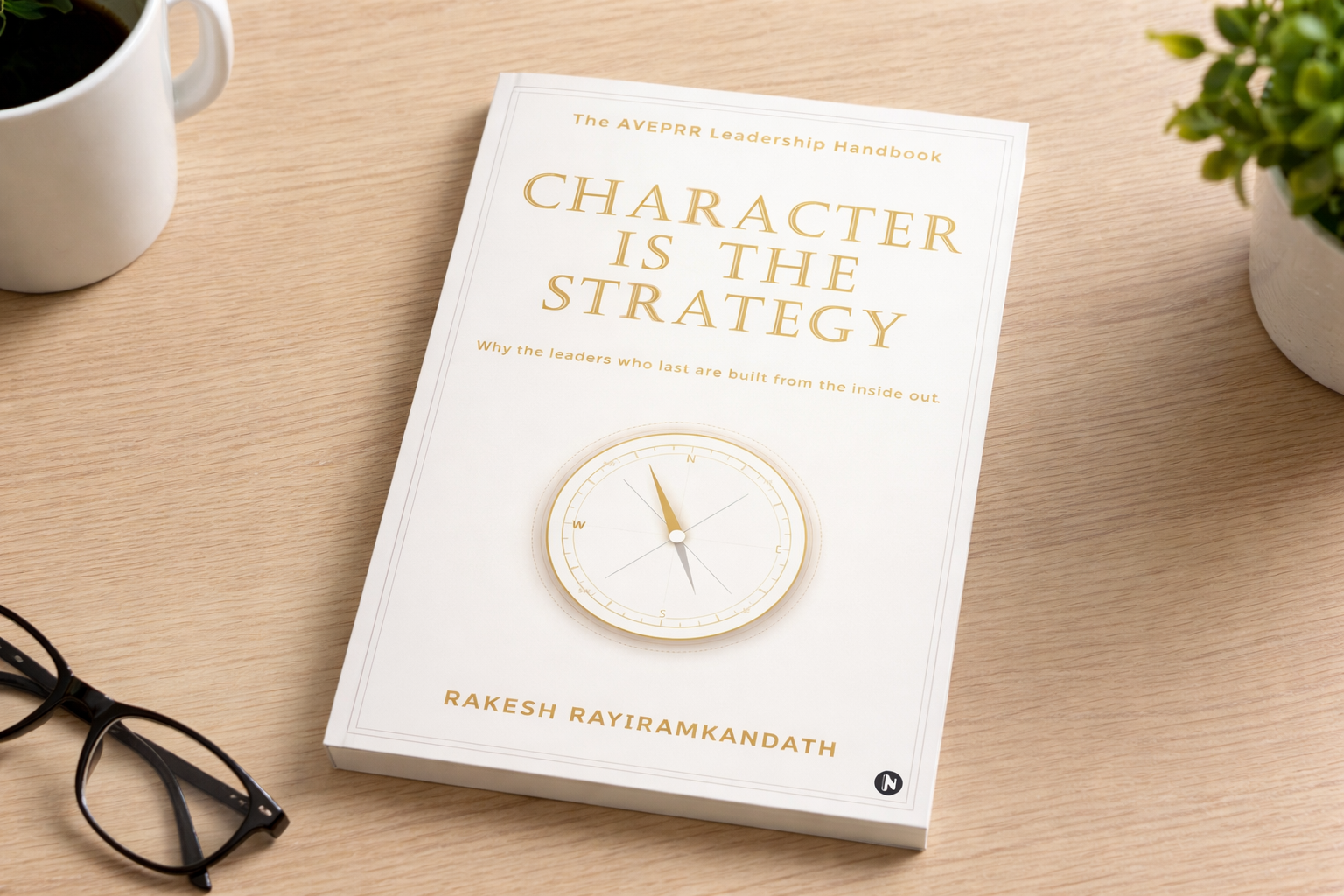
So when I first looked at CHARACTER IS THE STRATEGY: The AVEPRR Leadership Handbook by Rakesh Rayiramkandath, what immediately stayed with me was not the promise of “better leadership.” It was the deeper question sitting underneath it: who are you becoming while you lead?
That shift matters.
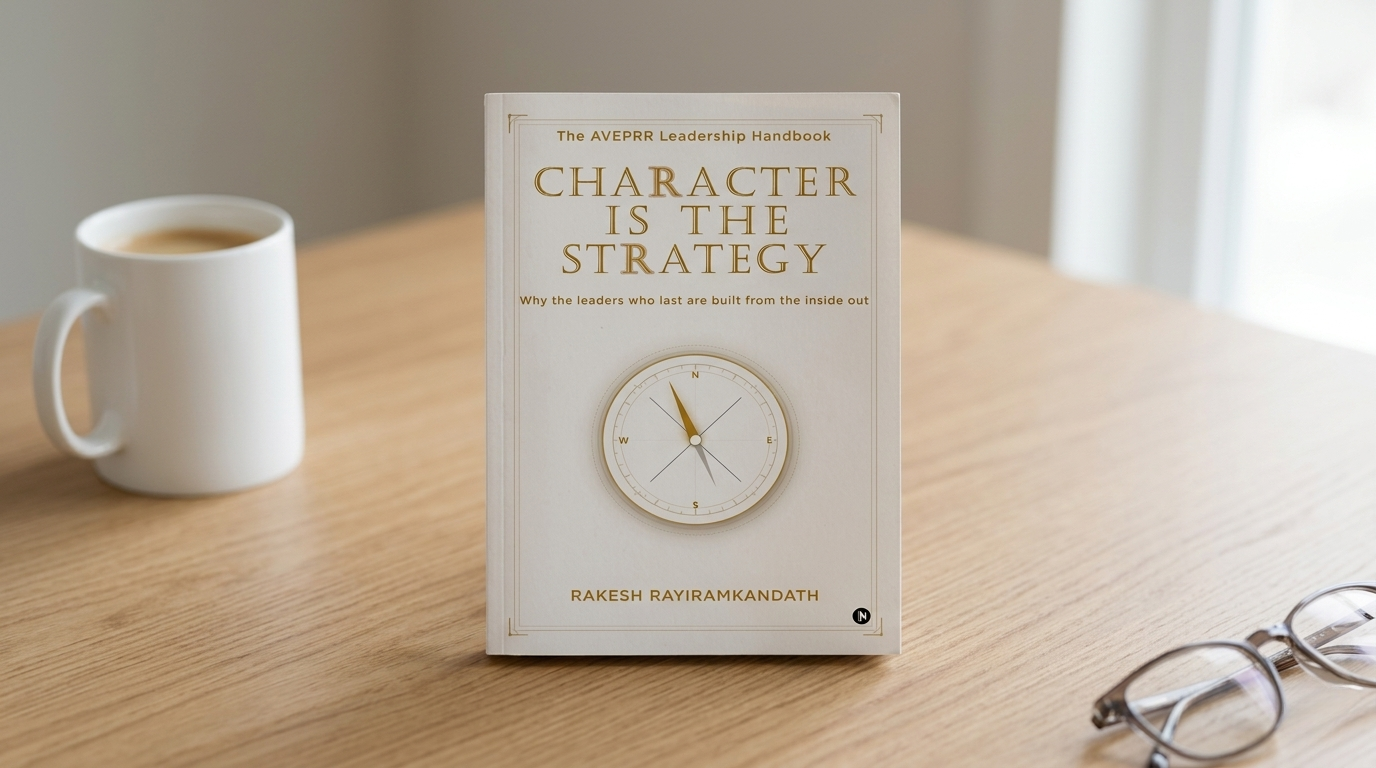
From the cover itself, with the compass imagery and the calm gold typography, the book already signals something inward. Not hustle. Not dominance. Orientation. Direction. Moral center. And once I went through the table of contents, chapter previews, the AVEPRR framework pages, the sections on VUCA, BANI, RUPT, mental health, and the 90-day leadership journey, it became clear that this is trying to do something more human than most books in the category.
I think that’s what stood out to me first. This book does not seem interested in producing louder leaders. It seems interested in producing steadier human beings.
And in 2026, that feels especially relevant.
What the Book Is About: leadership from the inside out
At its heart, Character Is the Strategy Book Review begins with a simple but powerful premise: in turbulent environments, strategy alone is not enough.
From the visible chapters, Rakesh Rayiramkandath structures the book in a very deliberate way.
It starts with the world leaders now inhabit: VUCA, BANI, and RUPT. That immediately grounds the book in the reality of modern organisations, where volatility, brittleness, anxiety, unpredictability, and tangled systems are not abstract ideas but everyday workplace experience.
I liked that the book doesn’t stop at naming the chaos. It asks what leaders must become in response.
That’s where the AVEPRR model comes in:
- Authenticity
- Values
- Emotional Intelligence
- Purpose
- Resilience
- Responsiveness
From the chapter flow and visible worksheets, the book appears to move from context into character, then into application, then into a 90-day leadership practice plan. That’s smart structural design. It means the author is not only offering philosophy, but also rhythm and repetition, which is where real leadership habits are formed.
The Indian context also gives this book its own identity. The references to Tata, Mahindra, Aravind Eye Care, and ideas like svadharma, satyagraha, and seva make this feel rooted rather than borrowed.
Honestly, that may be one of the book’s biggest strengths.
A lot of management writing in India still feels imported, translated from Western corporate anxieties into Indian boardrooms. This one, from what’s visible, feels like it was born from Indian realities.
What Stood Out to Me: structure, seriousness, and moral texture
In my years reviewing books, I often look at how a book is built, not just what it says.
Here, the architecture itself gives confidence.
The progression from environmental turbulence to leadership character, then to organisational case studies, and finally to a 90-day self-assessment workbook suggests that Rakesh Rayiramkandath respects the reader’s process. He seems to understand that insight without repetition rarely changes behavior.
The chapter on “The Crisis No One Talks About: Leadership and Mental Health” especially caught my attention from the sample pages.
That felt grounded in real life.
I’ve seen this happen in organisations, especially in India. Teams rarely burn out because of “workload” alone. They burn out because leadership uncertainty, emotional inconsistency, and silence create invisible stress taxes. So the book’s insistence that the leader is a “health variable” inside an organisation feels not just intelligent, but true.
Another thing I appreciated was the 90-day leadership journey section.
This wasn’t presented like a motivational sprint. It looked more like a disciplined self-examination practice:
- Days 1 to 30: know thyself
- Days 31 to 60: know others
- Days 61 to 90: lead systemically
That pacing feels psychologically realistic.
Change rarely happens because someone read one strong chapter on a Sunday afternoon. It happens when reflection becomes a recurring practice. The worksheets and self-assessment tools shown in the pages reinforce that.
If I had one mild hesitation, it would be this: because the framework is so structured, some readers who prefer looser, story-led leadership books may initially find the model-heavy sections a bit dense.
Not a flaw, exactly. More a matter of reading temperament.
But for readers who like clarity and practice, this is likely a strength.
The Emotional Core: the pressure of becoming
The emotional center of this book, at least from the material shared, is not ambition.
It is responsibility.
There’s a line in the “How to Use This Handbook” page that stayed with me: “Am I enough? Am I doing this right?” That felt deeply human.
I think many first-time managers, founders, senior executives, and even people leading families carry some version of that question.
What I felt here was that Character Is the Strategy by Rakesh Rayiramkandath is speaking to the loneliness of leadership, not just its techniques.
That’s rare.
The emphasis on authenticity, resilience, and responsiveness suggests that leadership is being treated as an ethical and emotional practice, not merely a performance function.
And the India-specific sections around workplace stigma and mental health gave the book another layer of emotional honesty. Those pages felt especially relevant because they acknowledge what so many professionals experience but don’t articulate: the emotional climate of a workplace is often set by the character of its leaders.
I wasn’t expecting that aspect to hit as strongly as it did from just the preview pages.
It made me think of teams I’ve worked with where one leader’s emotional steadiness changed everything. Deadlines stayed hard, yes. But people felt safer. More honest. Less afraid of being human.
That’s the kind of leadership this book seems to be advocating.
Who This Book Is For: who should read it and is it worth it?
If someone asks me “Should you read Character Is the Strategy?”, I’d say yes, but with the right expectation.
This is for:
- first-time managers in Indian organisations
- founders scaling teams under pressure
- HR and L&D professionals
- senior leaders dealing with burnout culture
- readers interested in leadership philosophy with practical tools
- people who want a workbook-style self-renewal process
This might not be for readers looking for fast hacks, persuasion tricks, or negotiation shortcuts.
The tone and structure suggest something slower and more demanding: self-confrontation before team transformation.
And honestly, that’s why I think it may have a longer shelf life than trend-driven business books.
The Character Is the Strategy book summary is simple: better leadership begins with better inner architecture.
That’s timeless.
Final Thoughts: a grounded Indian voice in leadership literature
As someone who reads across business, psychology, and reflective nonfiction, I found Character Is the Strategy Book Review surprisingly refreshing.
Not because it promises revolutionary novelty, but because it seems serious about making leadership humane again.
Rakesh Rayiramkandath appears to be offering something rare: a leadership handbook that is intellectually structured, emotionally aware, and culturally rooted in India’s own philosophical traditions.
I also appreciate that it doesn’t pretend leadership is only about outcomes. From the pages shown, it repeatedly returns to the kind of person one becomes under uncertainty, stress, ambiguity, and responsibility.
That’s the real test, isn’t it?
I think readers who are tired of performative leadership language and want something more lived-in, more ethically grounded, will find genuine value here.
FAQ: Quick reader questions
Is Character Is the Strategy worth reading?
Yes, especially if you lead teams and feel that mindset and character matter as much as systems.
Who should read Character Is the Strategy?
Managers, founders, HR leaders, coaches, and anyone stepping into people leadership.
What’s Character Is the Strategy about?
It focuses on the AVEPRR model and argues that leadership strength comes from character built under pressure.
Is this book practical or philosophical?
From the visible 90-day worksheets and self-assessments, it appears to balance both quite well.

With over 11 years of experience in the publishing industry, Priya Srivastava has become a trusted guide for hundreds of authors navigating the challenging path from manuscript to marketplace. As Editor-in-Chief of Deified Publications, she combines the precision of a publishing professional with the empathy of a mentor who truly understands the fears, hopes, and dreams of both first-time and seasoned writers.