
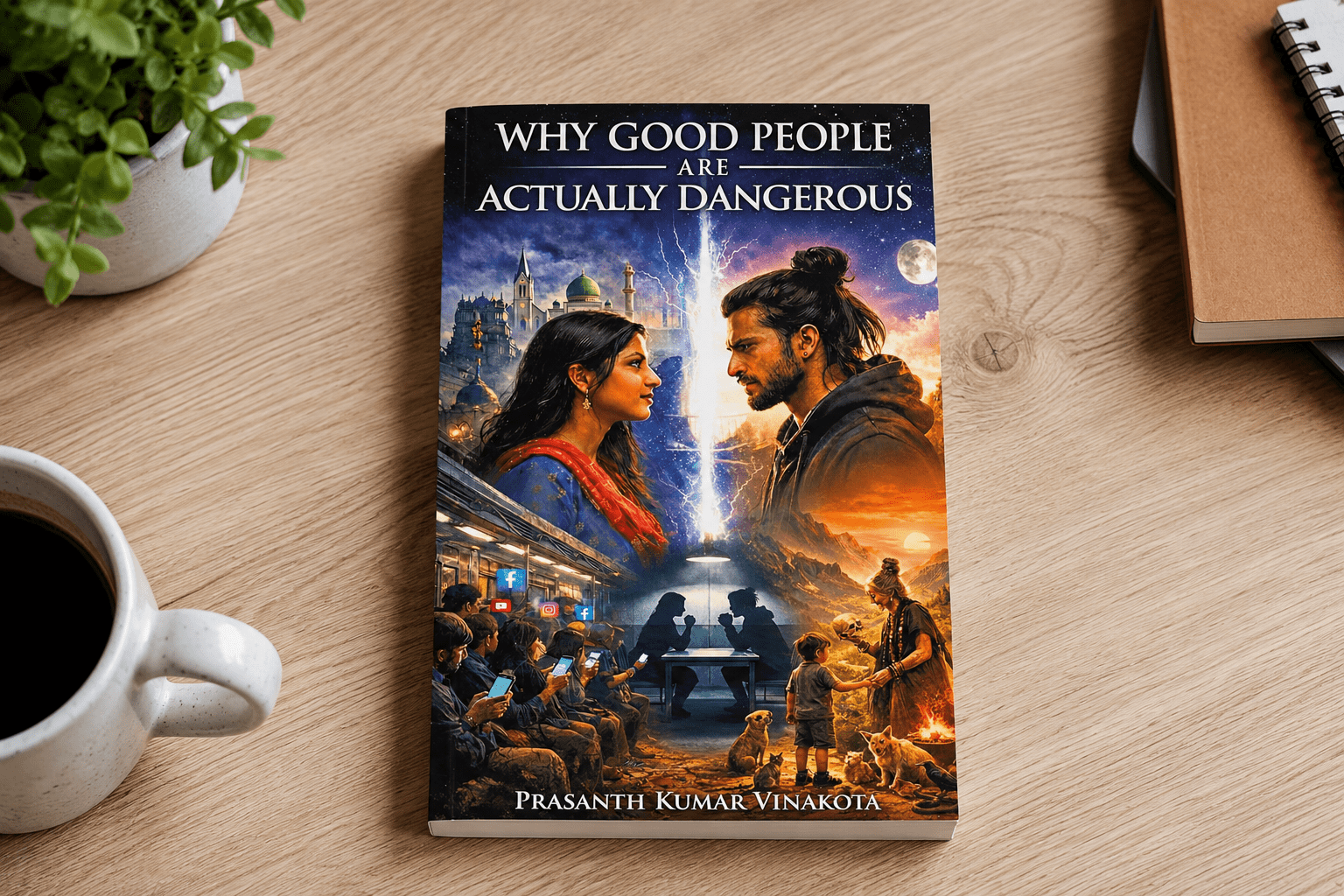
Rating:
⭐⭐⭐⭐ (4.3 out of 5)
Over the years, I have read hundreds of books that attempt to explain human behavior. Some focus on psychology. Others focus on morality, leadership, relationships, or personal growth. Most of them begin with a comforting assumption that people generally know the difference between right and wrong and that the challenge is simply choosing the right path.
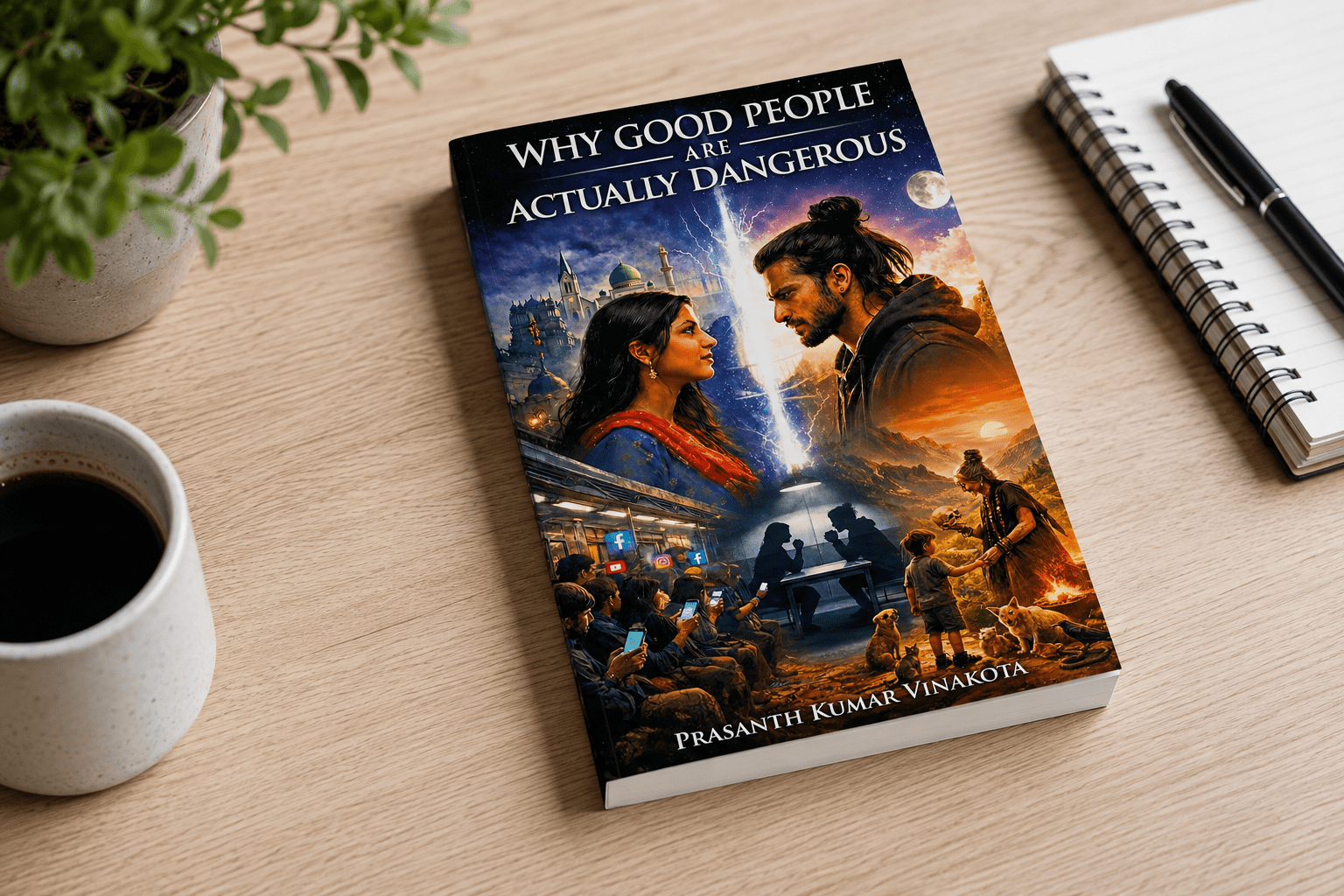
Why Good People Are Actually Dangerous: The Hidden Cost of Moral Certainty by Prasanth Kumar Vinakota begins from a very different place.
Instead of asking whether people are good, it asks something far more unsettling: what happens when people become absolutely convinced that they are good?
I think that question is what makes this book memorable. It is not trying to expose villains. It is trying to examine ordinary people. The people who follow rules. The people who believe they are helping. The people who see themselves as moral, responsible, and trustworthy. According to the author, certainty itself can become dangerous, especially when it prevents us from seeing the consequences of our actions.
What impressed me most was that the book never feels like a lecture. It uses a narrative centered around Saira and Pashi to explore these ideas, allowing readers to experience the arguments emotionally rather than simply reading them as abstract philosophy. By the time I finished the book, I found myself thinking less about the characters and more about my own assumptions. That is not something every book can accomplish.
What the Book Is About
At its heart, Why Good People Are Actually Dangerous is a work of narrative philosophy. It combines storytelling with psychological and philosophical inquiry, creating a reading experience that sits somewhere between a novel, a thought experiment, and a social commentary.
The story revolves around Saira and Pashi, two individuals whose lives intersect in unexpected ways. Early events, particularly the metro incident, establish a central theme that runs throughout the book: human beings often make judgments long before they have enough information to justify them.
What initially appears straightforward gradually becomes more complicated. Each new revelation forces readers to revisit earlier conclusions. The author repeatedly demonstrates how certainty is often built on incomplete understanding. People observe, assume, judge, and then construct explanations that support those judgments.
Alongside the narrative, the book introduces original concepts such as MIST and TRIL. Rather than presenting them as academic theories, Prasanth Kumar Vinakota integrates them into the story itself. These frameworks help explain how awareness collapses when certainty becomes dominant and why individuals can unintentionally harm others while believing they are acting morally.
As Saira and Pashi’s story unfolds, larger questions emerge. What makes a person good? Can good intentions justify harmful outcomes? How much of our morality is genuinely our own, and how much is inherited from culture, family, fear, and social conditioning?
The book does not provide simple answers. Instead, it encourages readers to examine the assumptions underlying their own beliefs.
What Stood Out to Me
One of the strongest aspects of the book is its ability to transform familiar situations into philosophical inquiries. The metro incident is a perfect example. On the surface, it appears to be an ordinary event. Yet the author uses it as a foundation for exploring how quickly people reach conclusions and how difficult it becomes to abandon those conclusions once they feel morally justified.
I also appreciated the way the narrative reveals information gradually. The structure mirrors the book’s central argument. Readers are encouraged to believe they understand what is happening, only to discover later that their understanding was incomplete. This creates a subtle but effective relationship between form and theme.
Pashi’s childhood chapters deserve special mention. The hostel environment, the emotional isolation, and the formative experiences that shape his worldview add depth to the story. These sections prevent the book from becoming purely intellectual. They remind readers that ideas do not exist in isolation. Every belief system develops within the context of lived experience.
Another element I found fascinating was the discussion surrounding moral certainty itself. The author argues that many harmful behaviors emerge not from malice but from conviction. People often believe they are protecting, helping, teaching, correcting, or guiding others. Yet those same actions can produce unintended consequences. This idea appears repeatedly throughout the book and serves as its philosophical backbone.
The discussions around cultural morality were equally interesting. The author points out that moral standards are not as fixed as many people assume. Behaviors celebrated in one era may be condemned in another. Practices accepted in one society may be rejected elsewhere. These observations challenge the notion that morality is always clear and universal.
As someone who has reviewed books for many years, I appreciate authors who trust readers to think for themselves. Prasanth Kumar Vinakota does exactly that. He presents ideas without forcing conclusions, leaving room for interpretation and debate.
The Emotional Core
Although the book is philosophical, its emotional center lies in vulnerability.
Many readers may expect a book about morality to focus on judgment. Instead, this book repeatedly reveals the fears that often exist beneath judgment. Fear of uncertainty. Fear of being wrong. Fear of losing identity. Fear of confronting uncomfortable truths.
One concept that particularly resonated with me was the author’s discussion of justification. The idea that people often make emotional decisions first and rationalize them afterward feels remarkably accurate. I have seen this pattern in workplaces, friendships, family conflicts, and public debates. Most people genuinely believe they are being rational, even when their reasoning is simply defending a conclusion they already reached emotionally.
The relationship between Saira and Pashi adds another layer to the book’s emotional impact. Their interactions transform abstract ideas into personal experiences. Readers are not simply evaluating theories. They are witnessing how those theories affect real lives.
There were several moments where I found myself reconsidering my own assumptions. Not because the author told me I was wrong, but because the narrative demonstrated how easily certainty can become a substitute for understanding.
That is what gives the book its emotional weight. It is not interested in making readers comfortable. It is interested in making readers aware.
Who This Book Is For
This book is ideal for readers who enjoy philosophical fiction, psychological exploration, and stories that challenge conventional thinking. If you enjoy books that combine narrative with big ideas, there is a good chance you will find this rewarding.
Readers interested in morality, human behavior, social psychology, and cognitive bias will likely appreciate the book’s themes. It is also a strong choice for those who enjoy discussing books long after finishing them because many of its ideas naturally invite conversation and disagreement.
However, this may not be the right book for everyone. Readers looking for fast paced entertainment, action driven storytelling, or clear-cut moral resolutions may find it demanding. The book asks readers to sit with ambiguity and uncertainty rather than resolving every question neatly.
Personally, I think its ideal audience includes thoughtful readers who enjoy examining how people think rather than simply what they do.
Final Thoughts
As Editor in Chief at Deified Publication, I encounter many books that attempt to explain human nature. Some succeed through research. Some succeed through storytelling. A few manage to do both.
Why Good People Are Actually Dangerous belongs in that latter category.
What impressed me most was its willingness to challenge assumptions that many readers rarely question. Rather than presenting morality as a battle between good and evil, the book examines how certainty itself can become a source of harm. Through the intertwined stories of Saira and Pashi, the author creates a narrative that encourages reflection without becoming preachy.
I did not agree with every conclusion, and there were moments when I wanted certain ideas to be explored with greater nuance. Some readers may also wish for more character development in places where philosophical discussions take center stage. Yet these are relatively minor criticisms when compared with the originality of the book’s central argument.
In a publishing landscape filled with books offering easy answers, this one stands out because it is willing to ask difficult questions. It challenges readers to examine not only what they believe but why they believe it.
And honestly, that may be the most valuable thing a book can do.
FAQs
Is Why Good People Are Actually Dangerous worth reading?
Yes, especially for readers who enjoy philosophical fiction and psychological exploration. It offers ideas that encourage reflection without simplifying complex issues.
What is Why Good People Are Actually Dangerous about?
The book follows Saira and Pashi while examining morality, certainty, judgment, self justification, and the hidden ways good intentions can cause harm.
Who should read Why Good People Are Actually Dangerous?
Readers interested in philosophy, psychology, human behavior, and intellectually challenging fiction will likely appreciate it most.
Is this a philosophy book or a novel?
It is best described as narrative philosophy. It combines storytelling with philosophical inquiry and psychological observation.

With over 11 years of experience in the publishing industry, Priya Srivastava has become a trusted guide for hundreds of authors navigating the challenging path from manuscript to marketplace. As Editor-in-Chief of Deified Publications, she combines the precision of a publishing professional with the empathy of a mentor who truly understands the fears, hopes, and dreams of both first-time and seasoned writers.