
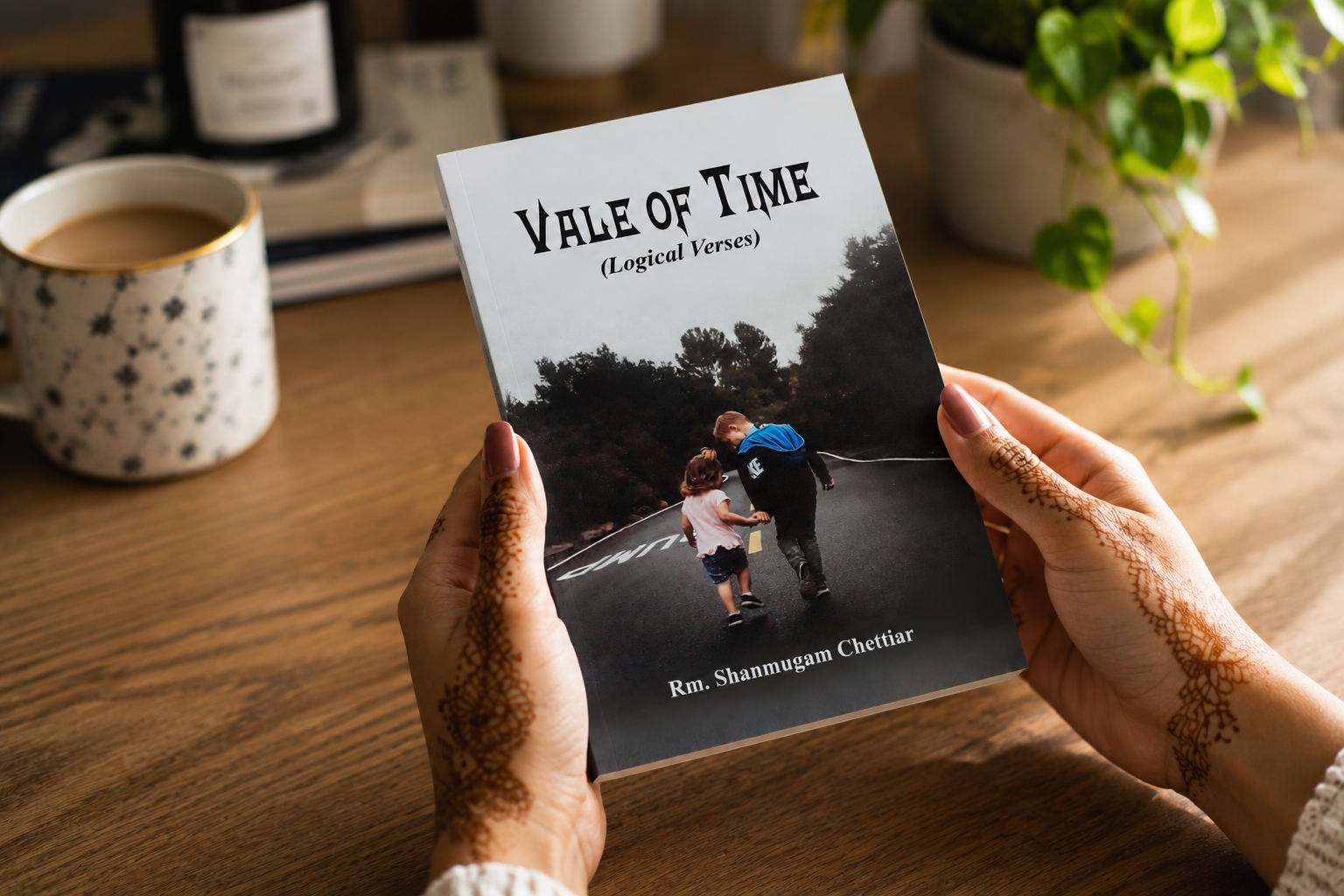
Rating: ⭐⭐⭐⭐ (4.2 out of 5)
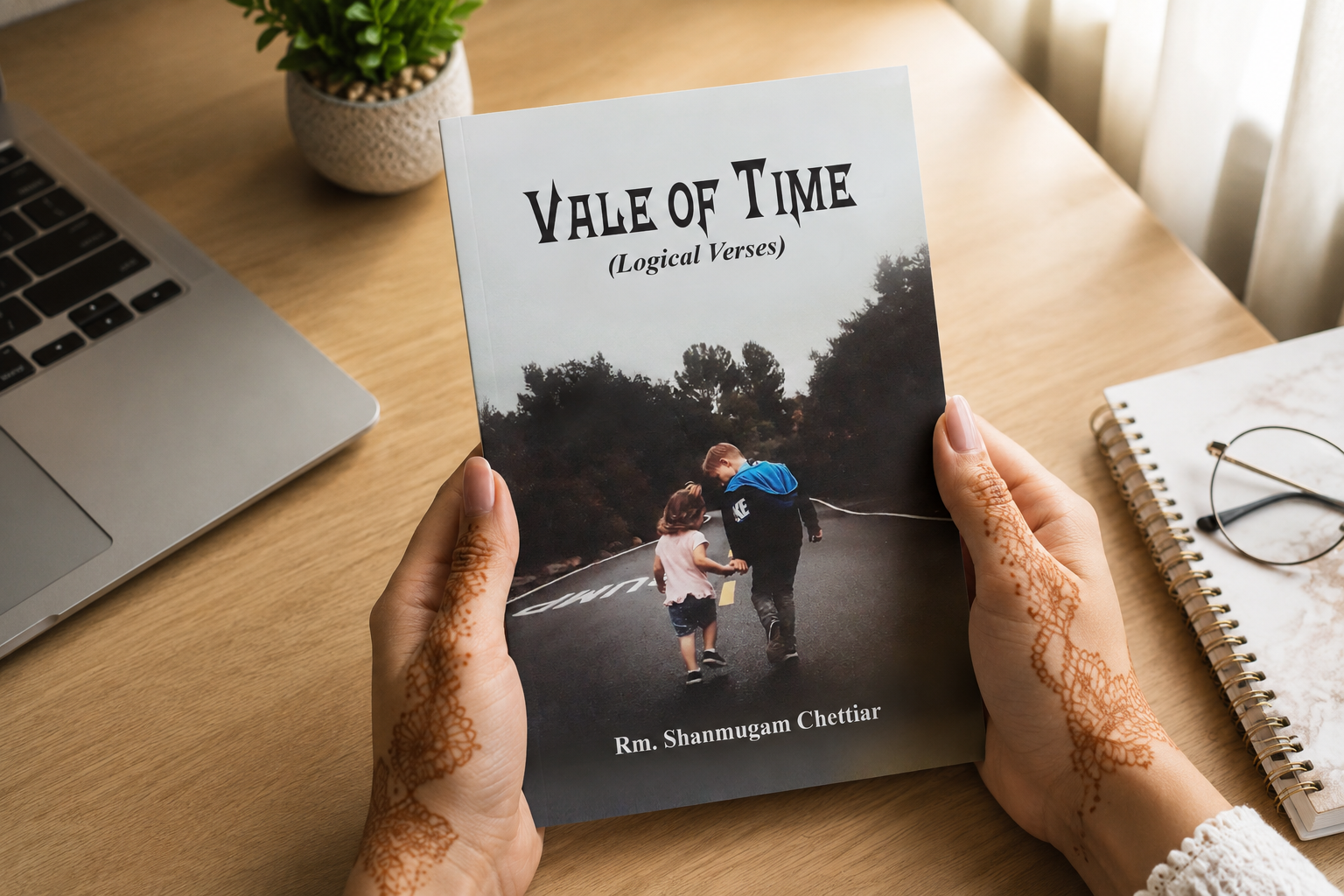
I have been reading books for over fifteen years, ranging from dense classic novels to contemporary self-published collections. As Priya Srivastava, Editor-in-Chief at Deified Publication, my desk is often piled high with manuscripts, but every now and then, a book comes along that demands my full attention. When I sat down with a warm cup of chai to read VALE OF TIME by RM SHANMUGAM CHETTIAR, I did not know what to expect. This collection of four hundred and forty-four poems, written between 1995 and 2005, felt entirely different from the flowery, highly metaphorical collections that dominate the shelves. It made me look up and think about how we structure our lives, stripping away the usual decorative language to present something deeply rational.
VALE OF TIME Book Review: What Is It About?
If you are searching for a comprehensive book summary of this collection, it is helpful to look at how the author organizes his work. The book is divided into distinct sections, grouping verses under general logical themes, family dynamics, abstract concepts, and societal structures. When we ask what is it about, the answer lies in the author’s background as a scientist and government official who views the human condition through a very practical lens. RM SHANMUGAM CHETTIAR brings his training in botany and his years of service to the page, examining love, mortality, social rules, and religion without any supernatural assumptions. In this VALE OF TIME Book Review, we see a writer who is openly an atheist, yet deeply concerned with the moral constructs that hold our communities together.
I found myself drawn to the sheer breadth of topics he tackles in these brief, sharp verses. Some poems are only a few lines, while others stretch out to examine historical and mythic narratives. Honestly, it feels like a personal diary of observations, where the poet watches the world and notes down the underlying laws governing our actions. If you are wondering should you read this book, it depends heavily on your tolerance for unadorned, straightforward language. The pacing is rapid, switching from a reflection on a leaf to a sharp critique of political systems. It is the kind of book that sits with you, causing you to question the daily habits we often take for granted.
The Unfiltered Strength of the Written Word
There is a distinct style in this collection that stood out to me from the very first pages. In the poem It evens out on page three, the author writes about how our actions and interactions naturally balance over time, suggesting that we let down some people and some people let down us. This simple, mathematical view of human relationships might seem cold at first, but it carries a strange sense of comfort. I kept thinking about this piece because it refuses to romanticize our disappointments. Instead, it frames our social failures as part of a larger, natural equation that eventually reaches equilibrium, helping us let go of long-held grudges.
When we look closer at family and physical existence, the tone shifts into something far more clinical yet deeply observant. In the poem Merciless Men on page sixty-seven, the author presents a striking contrast between the lives of domesticated farm animals and human beings. He notes how bullocks are castrated and cows are artificially inseminated solely for human benefit, separated from natural desire, while humans use modern devices to enjoy physical coupling without the consequence of reproduction. This content analysis reveals a sharp critique of how humans manipulate nature for convenience, showing how we have decoupled passion from its biological purposes. It is a bold, unsentimental observation that many traditional poets would shy away from, but here it is laid bare.
The author also writes with incredible honesty about the passage of generations, which is beautifully captured in Doing Is Enjoyment on page thirty. Here, he reflects on the immense energy parents spend raising their children, watching shows, attending concerts, and pouring out their life blood. He asks what gain we get from these sacrifices, answering that the pleasure is found in the doing of the deeds themselves, rather than any expected return. This sentiment links closely with the poem on page thirty-three regarding sweet memories, where he notes that even as our physical bodies decay, fading sweet memories fill the heart like a rare perfume. I was not expecting to feel so moved by these practical arguments, but they offer a very realistic comfort.
Challenging Dogmas and Social Realities
The section focusing on abstract concepts and society contains some of the most challenging writing in the book. In Who is My God? on page one hundred and one, the author describes a dark, heavy scene where a black goat is prepared for a blood sacrifice to the goddess Kali. We feel the tension of the peasants and the priest, the smearing of sandal paste, and the sudden, merciless stroke of the blade. The poem ends with a chilling question from the perspective of the beheaded animal, asking the goddess if it is not also her child. This piece serves as a severe indictment of religious rituals that rely on violence, forcing the reader to confront the cruelty hidden beneath sacred traditions.
This critical eye extends to political and economic systems in Where Is Socialism? on page one hundred and thirty-two. The author compares human political theories to the effortless distribution of resources in nature, pointing out how a banyan tree or a simple onion distributes water to all its parts without discrimination. He argues that while human socialists often fail to live up to their ideals, nature practices perfect distribution without ever studying political theory. I have seen this dynamic in real life, where the grandest human plans fall apart due to greed, while the natural world around us continues to function in peaceful harmony.
We also see this focus on self-reliance in the poem Be Not A Beggar on page one hundred and seventy-four. RM SHANMUGAM CHETTIAR warns the reader to avoid asking for help unless it is absolutely necessary, suggesting that offered assistance can sometimes be a hidden bait. He makes the provocative claim that being a miser is actually better than being greedy, because the greedy person always seeks to take from others, while a beggar is worse than a slave. This is a tough, uncompromising view of personal independence, but it highlights the author’s core belief that dignity is the most valuable thing a person can possess.
Generational Sorrow and Historical Identity
Grief and the passage of time are explored through a deeply personal lens in A Painful Passage on page seventy-seven. The author describes weeping endlessly upon reading Margaret Atwood’s The Blind Assassin, which reminded him of his own mother’s death. He watches his granddaughters and their mother, feeling a heavy dread of the mortality that looms over his family. It is a rare moment of exposed vulnerability in a book that is otherwise dominated by rigorous logic. This raw emotion is balanced by We Are The Adivasis on page hundred and eighty-one, where he chronicles the historical suppression of India’s indigenous tribes. He details how these ancient peoples lived with democracy and solidarity before incoming groups labeled them as demons and branded them as untouchables, showing a deep compassion for marginalized histories.
Other pieces, such as The Solitude, Tensionless on page eleven, and Roof Is The Floor Of Upper House on page twelve, continue this thread of realistic family observation. In Roof, the father reflects on building a loving home for his son, only to realize too late that the child wants to use that space for his own new family rather than providing a sanctuary for his aging parent. Honestly, some parts hit differently depending on your own life stage, and this particular poem made me think about my own family dynamics for days. The collection does not offer easy answers, but it forces us to look at our relationships with absolute clarity.
Who Should Read This Collection?
If you are asking is it worth it to buy this book, the answer depends on what you seek from poetry. If you want lush, romantic verses filled with complex metaphors and emotional hand-holding, this book will likely disappoint you. The author’s style is spare and occasionally repetitive, and some might find his logical deductions to be overly dry or clinical. However, for readers who appreciate a rational, philosophical approach to the mysteries of life, this collection is a refreshing change of pace. It acts as an honest reader review of the human condition, offering a perspective that is rarely found in contemporary literature.
I think this book is particularly suited for those who enjoy philosophy, rationalism, and free thought. It is a great companion for reflective afternoons when you want to read something that challenges your assumptions rather than merely soothing your mind. It is a work that deserves to be read slowly, allowing each brief logical proof to settle in your thoughts. As we look forward to new literary discussions in the year 2026, older collections like this remain highly relevant, offering timeless observations that do not fade with changing trends.
FAQs
What is the central theme of RM SHANMUGAM CHETTIAR’s collection?
The collection focuses on applying rational, logical analysis to the regular events of life. Rather than relying on emotional or supernatural explanations, the author breaks down family dynamics, societal expectations, and abstract concepts into simple, clear formulas. This unique perspective helps readers view daily interactions and historical narratives through a lens of clinical objectivity, making it stand out from typical emotional poetry books.
Is VALE OF TIME suitable for traditional poetry lovers?
It depends on what you enjoy in a book. If you prefer highly decorated prose, complex metaphors, and romanticized descriptions, you might find this style somewhat dry and overly direct. However, if you appreciate a clean, philosophical, and scientific approach to the written word, this collection offers a refreshing alternative to standard emotional verses, stripping away unnecessary flourishes to reveal core human truths.
How does the author handle religious and spiritual themes?
As a rationalist and an atheist, the author approaches religious rituals and beliefs with a highly critical eye. In pieces like the Kali sacrifice poem, he highlights the inherent violence and contradictions of certain traditions, asking difficult questions about morality and empathy. He focuses on natural laws and human ethics, arguing that we do not need supernatural belief systems to maintain our moral integrity or find meaning in our lives.

With over 11 years of experience in the publishing industry, Priya Srivastava has become a trusted guide for hundreds of authors navigating the challenging path from manuscript to marketplace. As Editor-in-Chief of Deified Publications, she combines the precision of a publishing professional with the empathy of a mentor who truly understands the fears, hopes, and dreams of both first-time and seasoned writers.