

Rating:
⭐⭐⭐⭐ (4.2 out of 5)
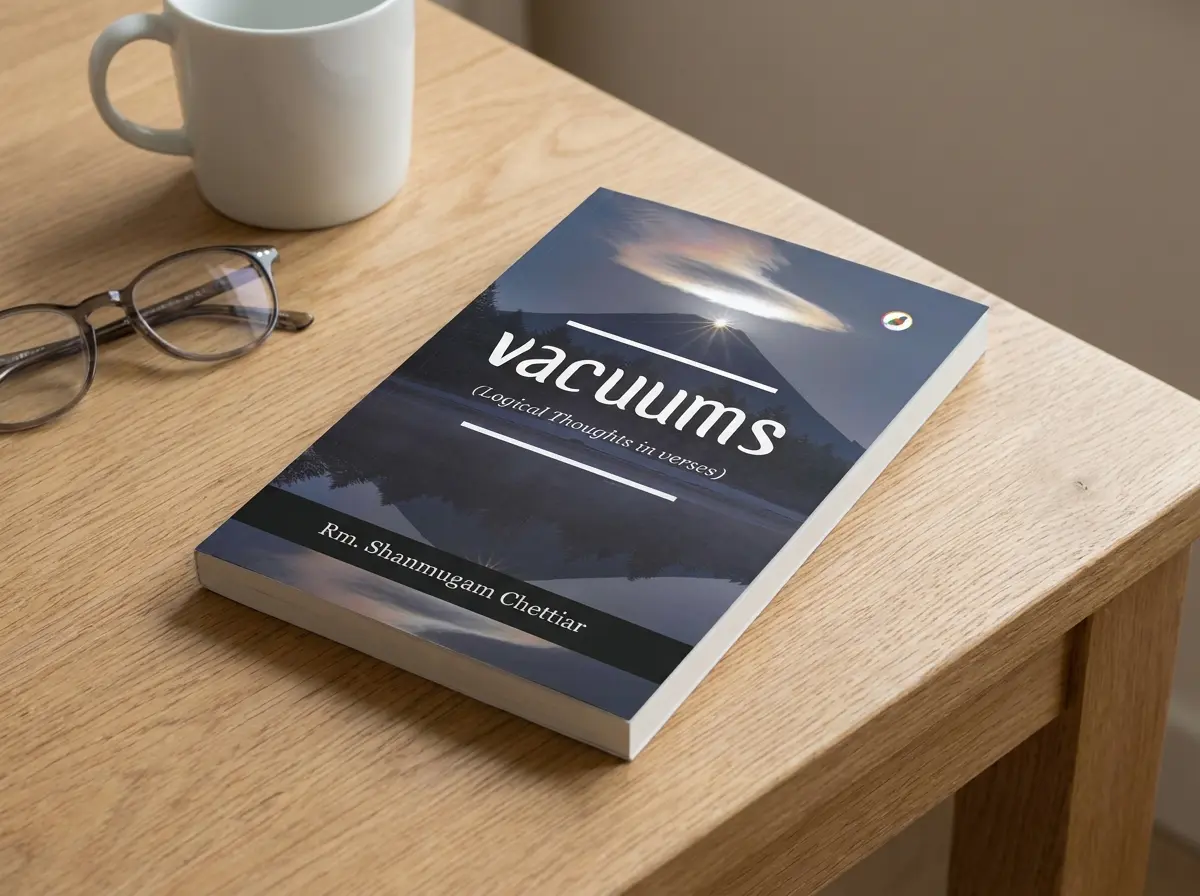
I’ll be honest with you. When someone hands you a book of 550 poems by a man in his seventies, a retired Deputy Rubber Production Commissioner from Tamil Nadu, you expect a certain kind of poetry. You expect nostalgia, maybe some quiet reflection on a life well-lived. You do not expect to be confronted, across page after page, with some of the sharpest, most unflinching observations about human behaviour, society, civilization, and the self that you’ve read in a long time. And yet, that is exactly what Vacuums: Logical Thoughts in Verses by RM Shanmugam Chettiar delivers.
I have spent my years at Deified Publication reading across genres, from commercial fiction to experimental verse, and I’ll say this plainly: Chettiar is not trying to be beautiful. He is trying to be true. That is a rarer ambition than it sounds, and one that I found genuinely refreshing in a literary landscape that often confuses prettiness with depth.
This is the third volume in his series of logical poetry, containing 550 poems written between 2010 and 2013. The collection is divided into four sections: Logical Thoughts General, Logical Thoughts on Society, Logical Thoughts on Abstract Things, and Logical Thoughts on Family. Most poems are crisp, compressed, four to eight lines long. They don’t breathe slowly. They land.
What the Book Is About
Vacuums is not a book about one thing. It’s a book about everything a thoughtful, atheist, socially conscious man noticed about the world around him across three or four years of sustained writing. Chettiar writes about greed and need, about civilization’s narcissism, about the gap between qualifications and real knowledge, about what it means to respect the people who do the work others consider beneath them. He writes about identity, about family obligations, about why man invented marriage, about the role instincts play in human life, about the bio-force that drives all living things without knowing sin or God.
The title itself, Vacuums, points to something the poet’s own preface hints at: there is always more hidden beneath these short, crisp poems than what surfaces on first reading. The word vacuum implies not emptiness but negative space, a charged absence. And that’s how many of these poems work. They say something in four lines, and you feel the weight of everything they chose not to say pressing in around the edges.
Dr. P. Geetha, a Professor of English (Retired) who writes the foreword, puts it well when she notes that the poet blends art and authenticity in a way that makes this collection ‘an exquisite rendering of contemporary reality.’ I agree with her, though I’d add that this is contemporary reality with a philosophical spine, observed by someone who has clearly read widely, thought deeply, and decided that sentimentality is not his style.
What Stood Out to Me: Poems Worth Your Full Attention
Let me walk you through some specific poems, because that’s the only honest way to review a collection like this. You cannot summarize 550 poems into a theme. You have to show up at the particular.
“Authenticity Is Not Art” opens the collection and immediately stakes out Chettiar’s aesthetic philosophy. He argues that raw reality, narrated authentically without any artistic shaping, produces something lifeless. A cartoon, he says, differs vastly from the real but still reminds you of the real. That’s art. It’s a provocation. And it’s also, interestingly, the operating principle of his own poetry: he takes reality, strips it down to its logical skeleton, and presents that. Which is, in its own way, a form of artistic selection. What I found interesting is that this poem was cited in a research publication from the UCLA COTSEN Institute of Archaeology Press, which tells you something about how seriously scholars have taken his ideas. That’s not a small thing for a self-published Indian poet.
“The Clown and the Fool” is one that I kept thinking about for days after reading it. The clown and con-man hide under colourful coats; the fool and charlatan ride with powerful quotes; the con-man and charlatan pride themselves on awful feats; and the clown and the fool glide with their lowly acts. In eight lines, Chettiar draws a taxonomy of social performance and deception that feels completely relevant to the India of 2026, to the world of 2026. We are surrounded by people performing roles, and the poem refuses to let us feel comfortable about it.
“Qualifications” is possibly the poem I would most want to pin on the wall of every university in the country. He writes that qualifications give the holder a license to treat themselves as knowing more than they actually know, and give others a notion that the holder knows more than they truly know. Then comes the sharpest line: “Qualifications are sold for a price.” In under eight lines, he has dismantled the entire mythology of credentialism. And he does it without ranting, without moralizing. He just states the mechanism and lets you sit with it.
“The Role of Instincts,” found around page 76, takes an almost biological view of human drives. Rage is inborn to guard the self; love is inborn to care for others; fear is inbuilt to save the self; pride is inbuilt to tend others. He includes sex, lust, want, luck, all presented as forces given to us with a purpose. The final two lines are the key: employ them judiciously, and earn a name for your life. There’s no judgment here, no shaming. Just an acknowledgment that our instincts are tools, and the question is whether we use them well.
“Respect the Doer of Mean Works” is one that moved me more than I expected. He argues that you should respect those who do work that commands no respect more than those who do work that commands reverence. Then he gives examples: as a doctor serves you, a barber too serves you; as a teacher serves you, a sweeper too serves you. I’ve seen this in real life. I’ve watched people in my own social circle speak differently to domestic workers than to doctors. This poem is a small, quiet rebuke to that, and it lands because it doesn’t perform its morality. It simply points.
“Modern Civilization” stopped me completely. It’s not what I expected from that title. He writes about narcissism, specifically identifying six tentacles of narcissism: the inability to process shame, thinking you can do no wrong, overvaluing yourself, undervaluing others, lacking altruism, and seeking admirers. Then the closing line: “We civilize ourselves towards this goal.” That inversion, the idea that civilization is not the antidote to narcissism but its destination, felt almost prophetic for 2026. Social media has made that argument for us every single day.
“Illusion and Ignorance” sits in the section on abstract things and deals with how we construct reality through what we believe rather than what is. “The Need and the Greed,” one of the longer poems in the collection, is remarkable for its length alone since most of Chettiar’s poems are compressed. Here he expands. He distinguishes need from greed not just as degrees of desire but as different in nature: need is for survival, greed is for ego’s gratification. Possessiveness is the sign of greed. The closing lines tell you to live simple, live humble, be proud to own a bicycle rather than a car, and value one who owns a bicycle over one who owns a car. It’s almost Gandhian in its austerity. And honestly, some parts of it hit differently when you read them in a country where consumerism has become the primary religion.
“The Bio-Force” is one of the more philosophically ambitious poems. He describes life as a force that lives in each cell, in continuity from unicellular organisms to multi-organ bodies. The bio-force is different from other forces because it has a drive to grow. Then, the line that I couldn’t shake: “It knows no sin, no God.” That’s a bold thing to write. He’s an atheist, and this poem is essentially his secular creation myth, the idea that life is a force that operates by its own logic entirely outside moral categories.
“Is Man a Winner or a Loser?” is the longest poem I encountered in the collection, and also one of the most structurally interesting. He traces the entire arc of patriarchy back to one thing: the man’s identity crisis. Woman has proof that the child is hers; man does not. That anxiety drove him to invent marriage, to impose chastity, to build patriarchal systems, to become scholar, sculptor, poet, assigning to woman the role of entertainer. The poem ends almost tenderly: tired of heat outside, man needed shade and sheltered himself in woman’s coolness. There’s no easy villain here, which I appreciated. It’s a structural analysis, not a screed.
“Not to Wither” is perhaps the most emotionally resonant poem in the family section. He moves through the roles we occupy: offspring, sibling, parent, spouse. Each stanza acknowledges the imperfections of those we are tied to (fatuous parents, selfish siblings, prodigal offspring, worn-out spouses) and then says: they are still your root, your branch, your shoot, your stalk. You must do your duties toward them. The final lines say that we desperately need this assistance from them, failing which we’ll wilt and wither. I found this genuinely affecting. Not sentimental, never sentimental, but honest about the structural reality of family.
The Emotional Core: What This Book Asks of You
This is not a book that makes you feel warm and held. I want to be clear about that. Vacuums is not comforting poetry. It does not tell you that everything will be fine or that love conquers all. What it does is make you look. At yourself, at society, at the systems you participate in, at the impulses you justify.
There were moments I felt a kind of austere pleasure in reading it, the pleasure of encountering a mind that refuses sentimentality without becoming cold. Chettiar has lived long enough and thought carefully enough that he doesn’t need to perform emotion. The poems on family, especially “Not to Wither,” carry a weight of lived experience that is unmistakable. The poems on civilization, especially “Modern Civilization” and “Need and the Greed,” carry a kind of grief for what we have become. The poem on the bio-force carries a strange beauty, the beauty of a man making peace with a godless universe by finding the sacred in biology itself.
What I wasn’t entirely expecting to feel was something like admiration, not just for the ideas but for the discipline. To write 550 poems in three years and to maintain this level of logical precision across all of them is no small thing. Chettiar is not showing off. He is working. And there’s something in that workmanship that I responded to.
A Minor Critique, Said Honestly
I’ll be fair: not every poem lands with equal force. Some of the shorter four-liners feel more like aphorisms jotted down than poems fully realized, and occasionally the compression works against him. There are poems where I wanted him to stay with an idea a little longer, to trust that the reader would follow him deeper. The poem on “Be With the Same Feathers” for instance, which uses the image of a rose being unfit to be with cacti and a black being unfit to be with whites to argue something about incompatibility and progress, is one that made me uneasy. I understand the logical point he’s making about natural incompatibilities, but the racial example felt jarring in a way I don’t think he fully intended. These are small things in a collection of 550 poems, but they’re worth noting.
The form itself, blank verse with a logical structure, means the collection can feel more like a series of philosophical propositions than a fully varied reading experience. If you come to poetry primarily for musical language, for metaphors that bloom slowly, this is not that book. Chettiar himself said, through the foreword, that authenticity is not art. He has chosen clarity over ornament, and that is a legitimate choice. But it means the reading experience is more bracing than beautiful.
Who This Book Is For
If you are someone who enjoys philosophy, who reads thinkers like Bertrand Russell or Jiddu Krishnamurti and finds yourself wanting that kind of clear-eyed examination of existence but in a more portable, compressed form, Vacuums is genuinely worth your time. If you are a student of Indian English literature looking for voices outside the metropolitan mainstream, Chettiar represents something distinctive: a Tamil Saivait atheist writing logical poetry in English, drawing on both biological sciences and lived social observation. That’s a singular combination.
If you are a reader who likes your poetry to tell you something definite, who finds purely impressionistic verse frustrating, this book will satisfy you in ways that much contemporary poetry does not. Chettiar always means something. Even when you disagree with him, you know exactly what he thinks and why.
This might not be for everyone, particularly those who want poetry to be primarily lyrical or emotionally enveloping. But for readers who want to be made to think, who want a retired civil servant from Tamil Nadu to hold up a logical mirror to modern civilization and say, plainly: look at what we are doing, this book delivers.
Final Thoughts
In 2026, when so much public language, political language, social media language, is designed to obscure rather than reveal, there is something almost countercultural about a poet who insists on logical clarity. RM Shanmugam Chettiar has been writing this way for decades, through seven thousand poems across multiple volumes, and Vacuums represents him at a sustained, searching peak.
I genuinely recommend this collection to readers who are ready for it. It will not always be comfortable. It will sometimes unsettle you. There’s a poem about corruption having no cure, a poem about how the majority is an ass, a poem about how need and greed blur into each other in a growth-driven economy. These are not poems you read before bed for soothing. They’re poems you read when you want to think more clearly about the world.
As Editor-in-Chief at Deified Publication, I’ve read enough poetry collections to know that a clear, honest, logically consistent voice is genuinely rare. Chettiar has that voice. And Vacuums, for all its compression and occasional austerity, is a book that earns a place on your shelf, not to be admired from a distance, but to be returned to, argument by argument, observation by observation, across the years.
If you’d like a complimentary digital copy of this book, feel free to contact the author directly at [email protected] or via WhatsApp at +919080455850.

With over 11 years of experience in the publishing industry, Priya Srivastava has become a trusted guide for hundreds of authors navigating the challenging path from manuscript to marketplace. As Editor-in-Chief of Deified Publications, she combines the precision of a publishing professional with the empathy of a mentor who truly understands the fears, hopes, and dreams of both first-time and seasoned writers.