
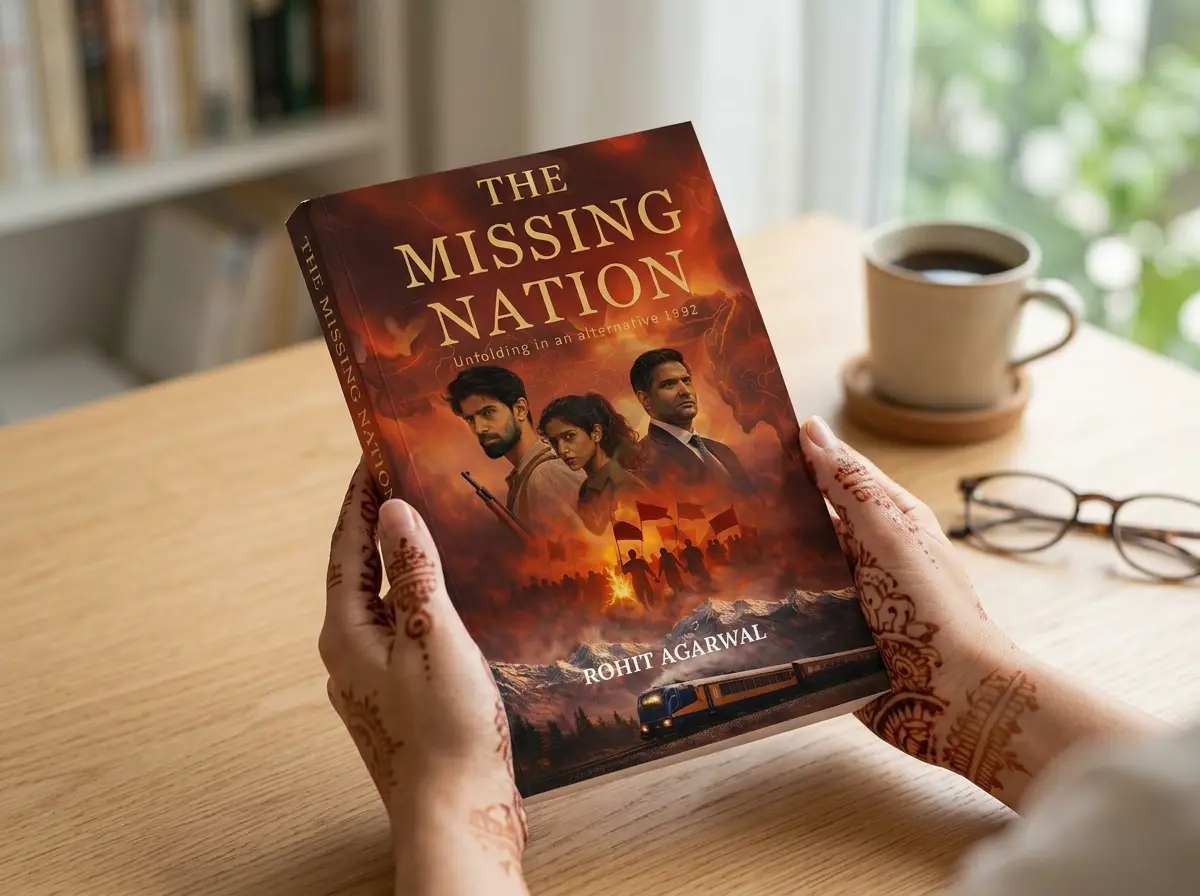
Rating: ⭐⭐⭐⭐ (4.2 out of 5)
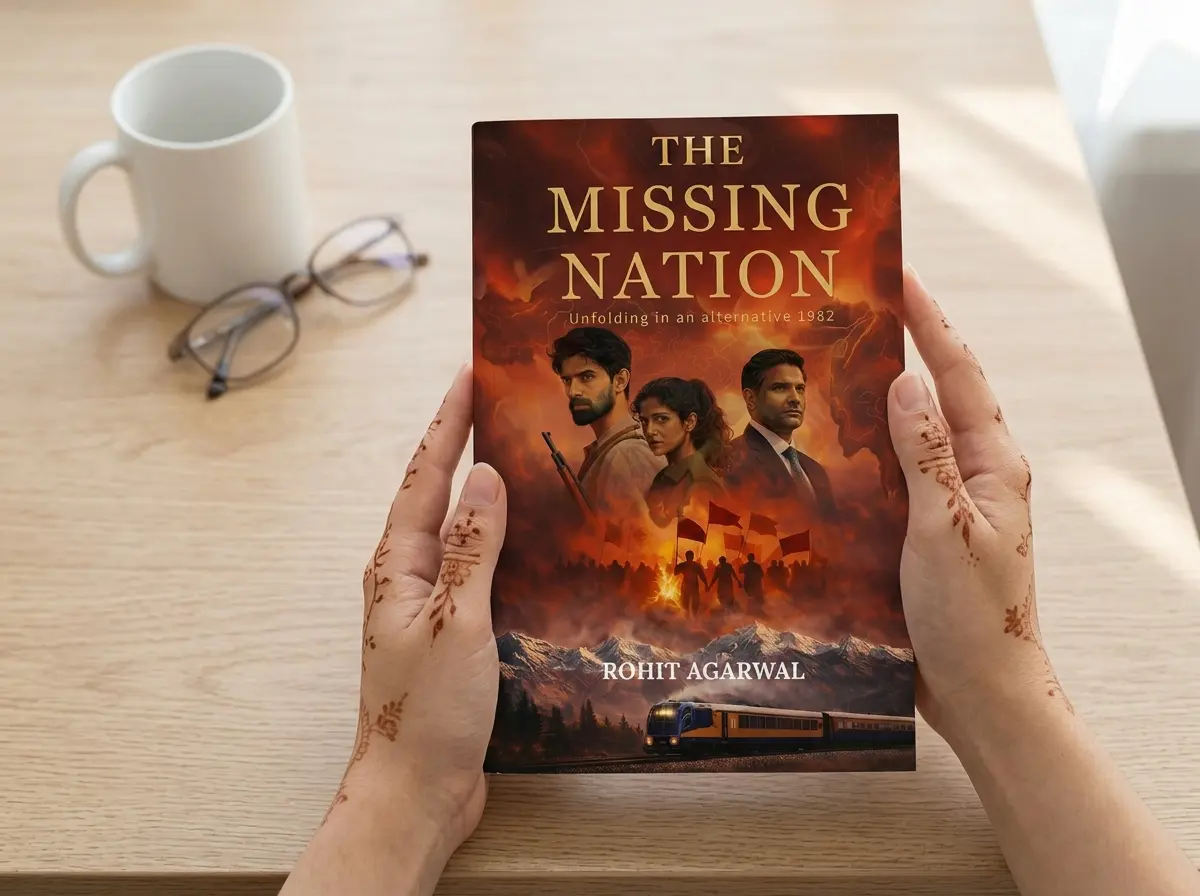
I’ve been sitting with this book for a few days now, trying to figure out how to talk about it without giving too much away. The Missing Nation by Rohit Agarwal is one of those novels that drops a simple hypothetical into your lap and then watches it explode into something far more layered than you expected. What if India was never partitioned in 1947? That’s the starting point. But the real question the book is interested in and the one that kept me reading is whether unity can survive inequality. In 2026, when we’re all watching fault lines open up in societies that once seemed settled, this question doesn’t feel distant at all. I genuinely wasn’t expecting to feel this unsettled by an alternate history novel, but here we are.
Here at Deified Publication, we read a lot of fiction that plays with the past, and most of it either leans too hard into the fantasy of it or gets so caught up in historical mechanics that the human story gets lost. Rohit Agarwal manages something trickier: he builds a convincing alternative India and then populates it with people who feel real, people who are confused and ambitious and morally compromised in ways that are entirely recognizable. That balance is genuinely hard to pull off, and I think it’s worth saying upfront that he largely succeeds.
What This Book Is About
The story unfolds in an alternate 1982. In this version of history, the subcontinent was never divided along religious lines in 1947. India remained whole. But by 1982, that wholeness has curdled. The western regions, places like Lahore, Jaipur, Delhi, have grown prosperous and powerful. The eastern regions, Bengal, Assam, and beyond, have been left behind economically and politically. The inequality is so deep that an armed Communist revolution has taken root in the east, fighting what it calls the exploitation of the Eastern Region by the capitalist west.
Into this world Rohit Agarwal drops two central figures whose lives become increasingly entangled. Mrityunjay is a shipping executive in Jaipur, a poet at heart, a man who attends lavish Mushairas and debates politics with friends over kebabs in Nahargarh. The book opens with him in his element, sitting at his desk, sipping stale chai, typing up a shipping report while his mind is clearly somewhere else entirely. He’s drawn to a revolutionary writers’ circle by something he can’t quite name, a conscience that won’t let him be comfortable. And then the state turns on him, and his comfortable life dissolves. On the other side is Prime Minister Sakarchand Gupta, operating out of Lahore, a man trying to hold a fracturing nation together through political maneuvering, intelligence operations, and whatever moral compromises he has to make along the way. Between them is Aditi, Mrityunjay’s friend, who becomes entangled with Sakar Chand in a relationship that mixes personal feeling with political calculation and genuine danger.
What Stood Out to Me
Honestly, the thing I kept returning to was how well Agarwal renders the gap between idealism and what revolutions actually do to people. There’s a scene where Mrityunjay and Ramanuj, one of the rebel leaders, are sitting cross-legged on forest ground beneath a mahua tree, and Ramanuj describes what’s happening to the cadres how some of them, like their friend Bhupa, have become addicted to opium in the camps, how they had to leave Bhupa behind in Tibet because he had lost most of his senses to the habit. Mrityunjay keeps his eyes down. He can’t get over the guilt of leaving a friend and partner in a foreign land. That moment hit me differently because it’s not a dramatic scene at all. No one is shouting. But the weight of what the revolution costs its own people is right there in the silence between the two men.
Then there’s the execution scene, which I found genuinely shocking. Srimand, the military leader of the Communist forces, has five suspected informers tied together in the middle of a camp square. He warns with cold menace that anyone who collaborates with the enemy will be killed most violently. And then the firing squad starts. One of the dead is Ramanuj Kaul. That name registers as a loss not just for Mrityunjay but for the reader too, because we’ve spent time with Ramanuj, we’ve seen him as a true believer who genuinely cares about the cause. The revolution eating its own is not a metaphor in this book. It’s a specific man shot in a specific square.
The other strand that I found myself thinking about a lot was Sakar Chand. Agarwal gives him complexity that politicians in fiction rarely get. There’s a chapter, Chapter 19, titled Maratha Light Infantry, where Sakar Chand has just managed to pass landmark legislation meant to address the inequalities in the Eastern Region. He’s reading through the newspaper coverage in the morning, relaxed, his forehead without furrows, looking almost simple rather than like a Prime Minister who just pulled off something extraordinary. And then the very next thing he does is authorize a military operation. The legislation and the bombs exist in the same man, in the same week. That’s not a contradiction Agarwal tries to resolve, and I think he’s right not to.
The book also has a lot of fun with the texture of its alternate world. Early on, Mrityunjay and his friends are heading to a Mushaira at a garden venue in Jaipur, all stone pavilions and star-like lights and blush-red padded chairs, where doodhiya biryani and mahi kebabs are served by caterers and Lucknowi cuisine fills the air. It’s opulent and specific and it tells you everything about who Mrityunjay is before the story turns hard. And then the contrast with the jungle camp near Jamshedpur, with its irregularly placed olive-colored canvas tents camouflaged with netting and leaves, the smell of phenyl on blood-spattered train berths, and cadres living in open jungle with bare necessities that contrast does a lot of the novel’s political argument without needing to say a single word about inequality directly.
I also want to mention the poem embedded near the end of the book, inspired by Rabindranath Tagore’s writings, which appears at the point where Mrityunjay is speaking at a press conference arranged by Sakar Chand. It’s the kind of verse that asks the nation to lift its voice not in dispute but in the service of labour and knowledge. In the context of everything that has happened to Mrityunjay by that point, reading those lines about a motherland sitting again on its throne, unshaken and clear of vanity, felt bittersweet in a way I wasn’t prepared for.
The Emotional Core of the Story
I think what Rohit Agarwal is really writing about is the specific grief of people who believe in something good and then watch it become something terrible. Mrityunjay never stops caring about the east’s suffering. But at some point, he has to reckon with the fact that the movement he joined is burning villages and shooting its own people for suspected disloyalty. There’s a conversation between Mrityunjay and Ramanuj where they’re both standing in the cold at the edge of camp, arms crossed, and Mukti gives Mrityunjay a meaningful look that says there is a lot of uncertainty about what leadership has in store for them. Nobody says the word betrayal. But the word hangs there. I’m not sure the book ever fully resolves the question of whether Mrityunjay made the right choice in the end. I think that’s intentional, and I think it’s the right call.
The Aditi thread adds a different register to the emotion. Her relationship with Sakar Chand starts in formality, she’s brought to his office, frisked at the gate, ushered into a waiting room that feels like a graveyard. But there’s a scene at that first meeting in Willingdon Crescent where Sakar Chand compliments her and Aditi tries very hard to be professional and ends up sitting on the edge of her chair trying to put sweetness in her voice like a nervous deer. It’s a small, slightly awkward moment and it made me smile, which I didn’t expect in the middle of all the war and politics. Agarwal is good at these small human details.
Who Should Read This Book
If you’re the kind of reader who likes alternate history that takes its premise seriously without becoming a history lecture, this is for you. If you’ve read books like Amitav Ghosh’s Partition-adjacent fiction or Vikram Seth’s A Suitable Boy and wondered what that subcontinent might have looked like on a different track, The Missing Nation offers a genuinely original answer. It’s also a good fit for readers interested in the internal contradictions of revolutionary politics, the kind of person who has spent time thinking about why movements that start with justice end up doing terrible things. The book is long and it takes its time, so if you prefer tighter, faster narratives this might require some patience in the middle sections. But I’d say the patience is worth it.
A Few Honest Notes
The book is ambitious to a degree that sometimes works against it. The cast is large and the geography is enormous, from Peshawar to Assam, and there are stretches in the middle where the political mechanics of the Prime Minister’s office, the committee votes, the wealth tax debates, require a bit more effort from the reader than the rebel camp storyline does. Some characters who feel significant early on recede without quite enough closure. And occasionally the prose is doing two things at once, trying to be both a political thriller and a more literary exploration of conscience and belonging, and the seams show a little. These are the kinds of things you notice as an editor, and I mention them not to undercut what Rohit Agarwal has built but because I think honest criticism is more useful than cheerleading.
That said, the ambition itself is worth something. Not many debut or early career novelists attempt a 275-plus page alternate history of the entire Indian subcontinent while also trying to write something emotionally true about friendship and idealism and the cost of conviction. The fact that it mostly lands is the more remarkable thing.
FAQs
Is The Missing Nation by Rohit Agarwal worth reading?
Yes, especially if you’re interested in alternate history with a South Asian lens, or in fiction that takes seriously the question of what justice and revolution cost. It’s a substantial, ambitious novel that has genuine emotional weight. Some sections require patience, but the overall story is one that I kept thinking about after I put it down.
What is The Missing Nation about in simple terms?
It’s set in an alternate 1982 India where Partition never happened, but the country is on the verge of a Communist-led civil war because the eastern regions have been economically neglected for decades. The story follows a poet-turned-shipping executive who gets drawn into the revolution, and a Prime Minister trying to stop the country from breaking apart. It’s a book about what happens when idealism meets reality.
Who should read The Missing Nation?
Readers who enjoy political fiction, alternate history, or South Asian literary fiction will find a lot to appreciate here. It also works well for anyone interested in the internal moral conflicts of revolutionary movements, or for readers who liked the sweep and ambition of novels like A Suitable Boy or The God of Small Things, even if the style is different.
Is The Missing Nation suitable for readers who don’t know much about Indian history?
The book includes a Pre-Partition map of India at the beginning, which helps orient you to the alternate geography. The author does a reasonable job of building the world through character and dialogue rather than exposition dumps. Some familiarity with the 1947 Partition context adds depth, but I don’t think it’s strictly necessary to enjoy the story. The human stakes are clear enough on their own.

With over 11 years of experience in the publishing industry, Priya Srivastava has become a trusted guide for hundreds of authors navigating the challenging path from manuscript to marketplace. As Editor-in-Chief of Deified Publications, she combines the precision of a publishing professional with the empathy of a mentor who truly understands the fears, hopes, and dreams of both first-time and seasoned writers.