
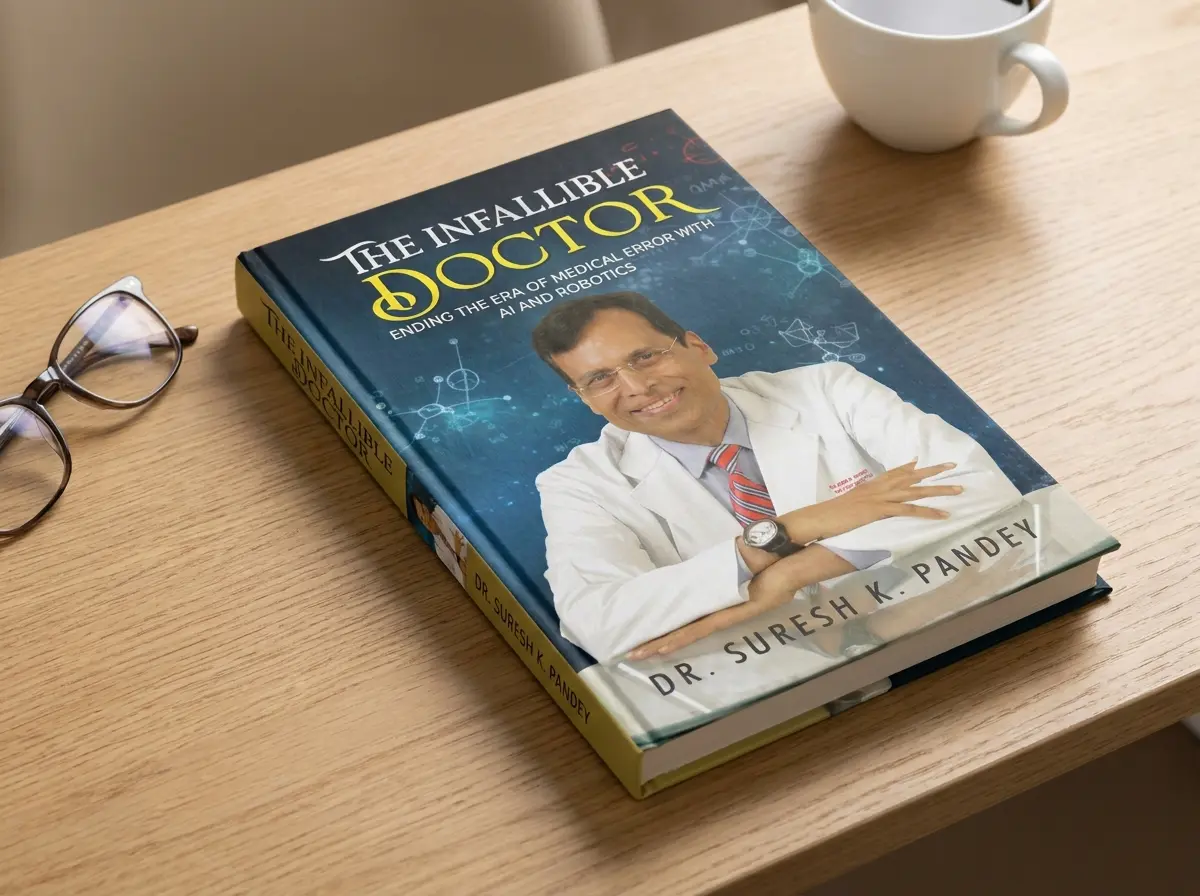
Rating:
⭐⭐⭐⭐ (4.3 out of 5)
I want to start with something that happened on page 27 of this book, because it’s the moment I knew Dr. Suresh Kumar Pandey was not writing an ordinary book about technology. He tells the story of Libby Zion, an eighteen-year-old college freshman admitted to New York Hospital on a rainy night in March 1984. She was burning with fever, jerking with strange spasmodic movements her parents couldn’t understand. The doctors who treated her were not incompetent. They were residents at one of the most prestigious teaching hospitals in the world. But the intern assigned to Libby had been awake for over eighteen hours. The supervising resident had been on duty even longer. They administered Demerol, a powerful opioid, without recalling that Libby was already on Nardil, an antidepressant. The two drugs collided in her bloodstream and triggered Serotonin Syndrome, a catastrophic overload of the nervous system. Her temperature spiked to 107 degrees. She went into cardiac arrest. Libby Zion died before sunrise.
I read that and I had to put the book down for a minute. Not because it shocked me in some dramatic way, but because it felt painfully, uncomfortably familiar. We have all, at some point, trusted a system we didn’t fully understand. We have all sat in hospital rooms believing that the person in the white coat had everything under control. Libby’s story is the crack in that belief, and Dr. Pandey uses it as the foundation for everything that follows.
What This Book Is Actually About
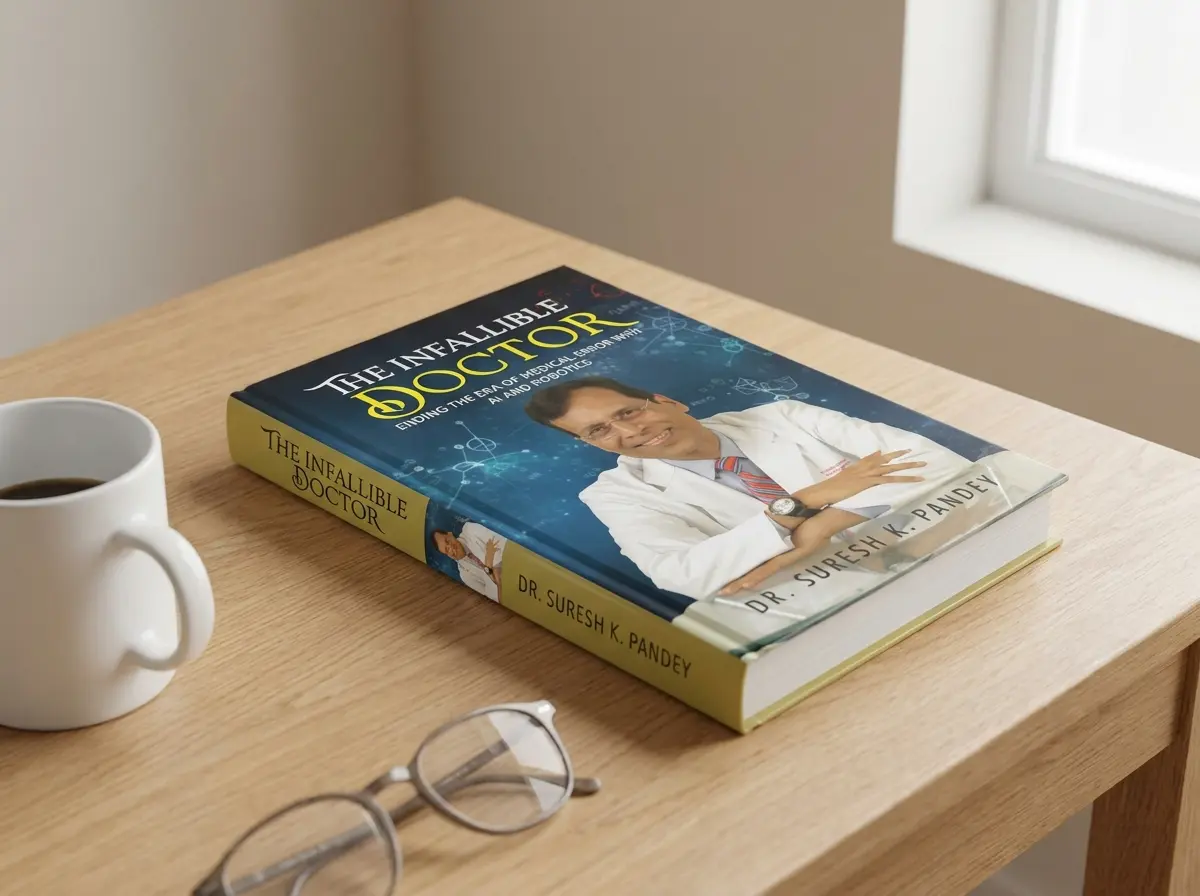
“The Infallible Doctor: Ending the Era of Medical Error with AI and Robotics” is Dr. Suresh Kumar Pandey’s argument that the medical profession’s greatest enemy is not a superbug or a funding crisis. It’s the biological limits of the human brain. The book opens with a startling fact: medical errors kill more than 250,000 people in the United States every year alone, making them one of the leading causes of death. That number alone is enough to make anyone uneasy. But Dr. Pandey doesn’t let the statistic stand on its own. He traces the problem back to something almost nobody talks about honestly, which is the culture that built modern medicine in the first place.
There’s an extraordinary section in Chapter 1 about Dr. William Stewart Halsted, the man who invented the modern medical residency at Johns Hopkins in the 1890s. Halsted demanded total immersion. He believed doctors should live in the hospital, work twenty-hour days as a baseline, and push past all human need for rest. For over a century, medical schools have treated this as gospel. What Dr. Pandey reveals is the secret buried in Halsted’s legacy: the man was a cocaine addict. His superhuman stamina wasn’t biology. It was chemistry. And the entire training system we built on his model was designed for a body running on a stimulant, then populated with sober people who were expected to perform the same way. The book puts it plainly: we have spent a hundred years trying to emulate Halsted’s grit without his chemical assistance, and the result has been a quiet epidemic of error disguised as professional culture.
The book is organized across eight parts covering everything from AI-assisted diagnosis and surgical robotics to wearable health monitors, telemedicine, drug discovery acceleration, and the deep philosophical shift in what a doctor’s role should actually be. It is a big, ambitious book with forty chapters and over 430 pages, and it moves confidently between clinical science, human stories, ethical questions, and visions of medicine in 2040.
What Stood Out to Me While Reading
The chapter I keep coming back to is Chapter 11, “The Eyes That Never Blink.” Dr. Pandey opens it with the famous 1999 experiment by psychologists Christopher Chabris and Daniel Simons at Harvard. You may know it: volunteers were asked to watch a video of two teams passing basketballs and count how many times the team in white shirts passed the ball. Halfway through, a person in a full gorilla suit walked into the center of the circle, thumped its chest, and walked off. The gorilla was visible for nine full seconds. It was not subtle. Fifty percent of the people watching never saw it. This phenomenon, called Inattentional Blindness, is fascinating in a psychology classroom and terrifying in a radiology suite.
Dr. Pandey then describes what researchers at Brigham and Women’s Hospital in Boston did in 2013. They repeated the gorilla experiment with twenty-four expert radiologists. They inserted a picture of a tiny gorilla into a stack of lung CT scans. The gorilla was forty-eight times larger than the average cancer nodule. Eye-tracking software showed that many radiologists looked directly at it. Their retinas received the photons. Their brains, locked into a pattern search for lung nodules, filtered it out entirely. Eighty-three percent of the radiologists missed it. The book notes that in the United States alone, roughly 30 percent of abnormalities in radiology scans are missed on the first viewing. That is millions of missed tumors, millions of moments where the disease was visible but not perceived.
I found this section particularly well-constructed because Dr. Pandey doesn’t use it to say radiologists are bad at their jobs. He uses it to make a precise, honest point: the human eye is attached to a brain that is easily tired, easily tricked, and prone to filtering out what it isn’t already looking for. No amount of training fully overrides that biology. AI, by contrast, does not suffer from inattentional blindness. It does not get bored at hour eleven of a twelve-hour shift. It does not filter out the unexpected because it doesn’t fit the pattern it was hunting.
The book’s structural choice throughout is this: lead with the human failure not as a condemnation of doctors, but as a precise diagnosis of the system. Dr. Pandey makes clear at every turn that he is one of these people. In the Afterword, titled “The End of the Superhero Doctor,” he writes about standing at an operating table at 3:00 AM, his back screaming and his eyes burning, feeling the cold fear that somewhere in the millions of pages of medical literature there was an answer he needed but could not recall in time. He writes about walking out of the theater and watching his hands shake, not from the surgery itself, but from the fear of how close he had come to the edge. There is something about that honesty that earns him the right to say what he says next.
The book’s vision of AI in medicine is not cold or impersonal. The concept of the “Centaur Physician” that Dr. Pandey introduces is genuinely interesting to think about. The centaur as a metaphor comes from chess, where centaur teams (human plus AI working together) consistently beat both pure AI and pure human players. The argument is that AI’s pattern recognition and data processing combined with human empathy, contextual judgment, and ethical navigation creates something better than either alone. Chapter 39, “The Symbiosis,” takes this further with a lovely structural observation about the geometry of the exam room. For two thousand years, the doctor’s chair was larger and positioned behind a desk; the patient’s was lower, often a crinkly exam table. That asymmetry encoded paternalism into the architecture of medicine. The book suggests the era of Symbiosis has a third presence in the room, the machine acting as Analyst and Guardian, clearing the fog of uncertainty so the human doctor and the human patient can finally see each other.
Chapter 40, “The Silent Guardian,” closes the book with a vision of Maya, a seventy-two-year-old woman in Chicago on a Tuesday morning in October 2040. She doesn’t know she was supposed to have a massive heart attack that day. The Infallible Doctor has been watching her all night. It detected a 94 percent probability of plaque rupture within six hours. Before she finishes her Earl Grey tea, her physician Dr. Sarah Jenkins appears on her kitchen screen from a clinic in Toronto to intervene. It’s written as near-future fiction but grounded in technologies already in development across the book’s preceding chapters. It works as a capstone because Dr. Pandey earns it. He spends thirty-nine chapters building the science before he asks you to imagine the future.
The Emotional Core of the Book
What I didn’t expect from a book about AI and robotics was how much it cares about the human cost of the current system. The section on decision fatigue and the “Drunk Doctor” analogy is disturbing in a productive way. Dr. Pandey references a landmark study published in Nature by researchers Dawson and Reid showing that after seventeen hours of sustained wakefulness, cognitive performance drops to a level equivalent to a blood alcohol concentration of 0.05 percent. He makes the comparison directly: we would never board a plane if the pilot announced over the intercom that he hadn’t slept in twenty-four hours but was going to try really hard to land the plane. We would never get into a taxi if the driver’s eyes were drooping. Yet every day, across every city, we allow surgeons to cut into bodies after sleepless nights. The book asks us to sit with that contradiction and feel genuinely uncomfortable about it. I did.
At the same time, the Afterword manages something most books in this space don’t. It acknowledges the fear. The fear of the resident asking, at 2:17 AM over bitter coffee, “If the machine can read the scan faster than me and remember more drugs than me and never get tired like me, what am I training for?” Dr. Pandey doesn’t wave that away. He takes it seriously. His answer is that the physician of the future is not a walking encyclopedia. The physician of the future is a strategist, an interpreter, a healer in the true sense. When AI handles data processing, pattern recognition, and documentation, the doctor is finally free to do the thing no algorithm will ever replicate: to comfort, to listen, to empathize, to be present. I found that framing genuinely moving rather than a marketing line, largely because of how much evidence the book had laid down before making that claim.
Who This Book Is For
If you work in medicine, read this book. Not because it will validate everything you believe, but because it will challenge you in ways that feel fair. Dr. Pandey is not writing from outside the system; he is writing from thirty years inside elite surgical practice across India, the United States, and Australia. If you are a patient (which is to say, if you are human), this book gives you a vocabulary and a framework for understanding what is changing in healthcare and why it matters to you personally. If you are a technologist or entrepreneur working anywhere near health, this is essential reading for understanding both the stakes and the human dimensions that purely technical literature tends to miss.
I would say this book might ask more of readers who have no background in either medicine or AI. Some of the clinical discussions, particularly around radiology, surgical robotics, and drug discovery timelines, assume a certain comfort with scientific concepts. But Dr. Pandey is a genuinely gifted explainer. He uses analogies well, the gorilla experiment, the drunk doctor, the chess centaur, the geometry of the exam room. I don’t think any intellectually curious reader would feel lost for long.
One honest note: the book covers an enormous amount of ground across forty chapters, and there are moments where the pace feels more encyclopedic than deeply investigative. Some chapters covering individual technologies read more like informed surveys than the deeply immersive storytelling of the opening and closing sections. That’s not a fatal flaw, more a consequence of ambition, but it’s worth mentioning for readers who prefer a narrower, deeper focus.
Final Thoughts
In 2026, when AI is entering almost every professional domain and the conversation about human relevance is everywhere, “The Infallible Doctor” feels particularly timely. But what separates it from the general wave of AI optimism literature is that Dr. Pandey has done something harder. He has built his case on grief, on the death of Libby Zion and the thousands of unnamed patients who followed, on the exhaustion of good doctors working inside a broken system. He is not selling a technology. He is diagnosing a crisis and proposing a treatment. The treatment involves AI and robotics, yes, but the soul of the prescription is about restoring something that the current system has been slowly grinding away: the capacity of medicine to be genuinely, reliably, humanly compassionate because the humans within it are finally supported rather than crushed.
I’ve reviewed enough non-fiction to know that books making large claims about the future often age poorly. But the clinical failures Dr. Pandey documents are not speculation. They are happening today. And the technologies he describes are not science fiction. Many are already in clinical trials or deployed in specific settings. The question he is really asking is whether we will build the bridge fast enough. After reading this book, that question feels more urgent than before I picked it up. For a book to do that, to change how you think about something you thought you already understood, that is what good non-fiction is supposed to accomplish.
Frequently Asked Questions
Is “The Infallible Doctor” worth reading if I’m not a doctor or scientist? Absolutely. Dr. Pandey writes primarily for a general audience, and while there are clinical details throughout, the book’s central arguments are built on human stories and historical context that any curious reader will find accessible. If you have ever been a patient, or have a family member who has, large portions of this book will feel very personal.
What is “The Infallible Doctor” about in simple terms? It’s about the fact that medical errors kill hundreds of thousands of people every year, largely because the human brain has biological limits that the healthcare system has never adequately acknowledged. Dr. Pandey argues that AI and robotics, used as partners with human doctors rather than replacements, can close that gap and make medicine far safer.
Should I read “The Infallible Doctor” if I’m already interested in AI? Yes, especially because it approaches AI from an angle that most technology books don’t: through the human and emotional cost of the problem AI is meant to solve. If you already follow AI developments, this book will give you clinical and historical context that makes the stakes of the technology much more concrete.
Who is Dr. Suresh Kumar Pandey and why does his perspective matter here? Dr. Pandey is an internationally recognised eye surgeon based at SuVi Eye Institute in Kota, Rajasthan, India, with over three decades of surgical experience across India, the United States, and Australia. He writes from inside the system he is critiquing, which gives his arguments a credibility and emotional honesty that outside observers rarely achieve.

With over 11 years of experience in the publishing industry, Priya Srivastava has become a trusted guide for hundreds of authors navigating the challenging path from manuscript to marketplace. As Editor-in-Chief of Deified Publications, she combines the precision of a publishing professional with the empathy of a mentor who truly understands the fears, hopes, and dreams of both first-time and seasoned writers.