
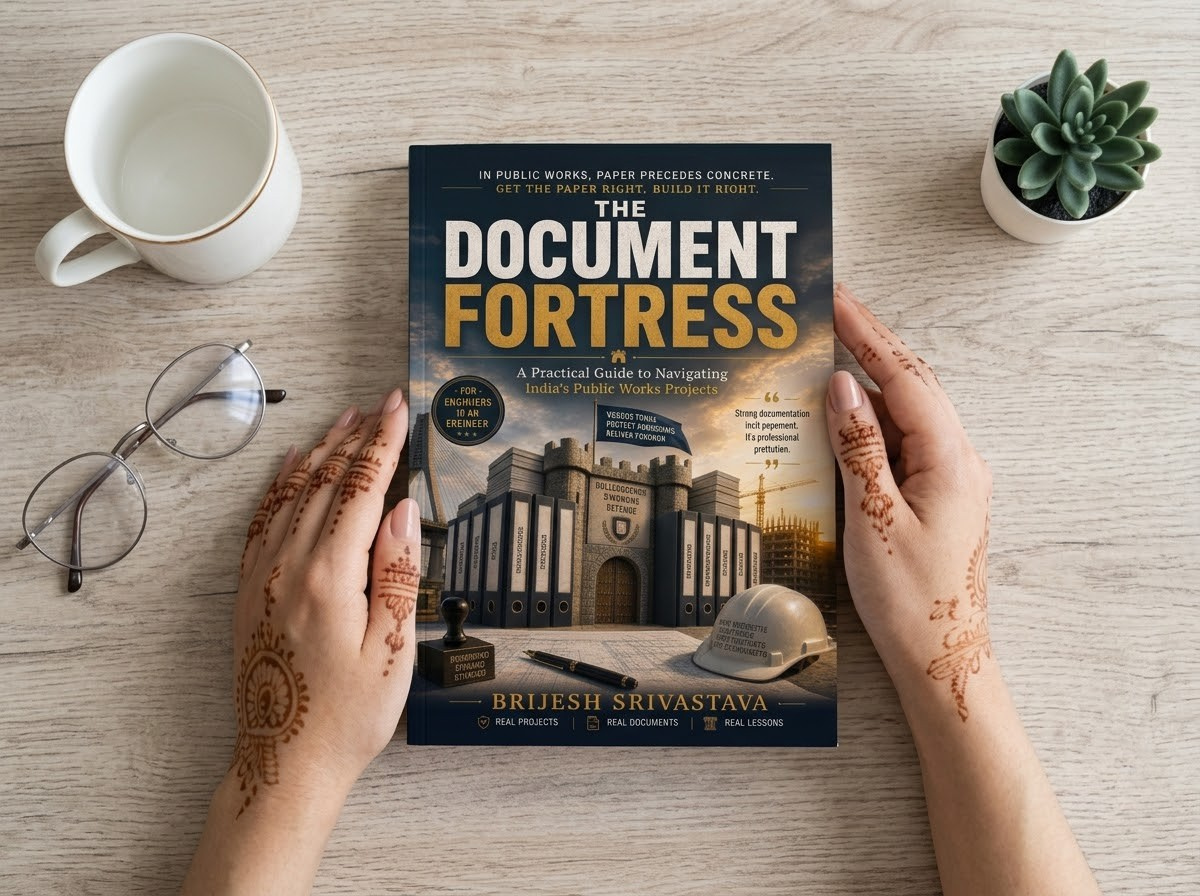
Rating: ⭐⭐⭐⭐1/2 (4.5 out of 5)
I have spent years reading books about technical triumphs and massive engineering feats, but I rarely stop to think about the paper trail that makes those structures possible. Honestly, when I first picked up this text, I expected a dry collection of departmental rules and administrative instructions. Instead, I found a deeply personal, surprisingly sharp look at how real work happens inside government departments and public sector undertakings. It made me look at every bridge, highway, and municipal building with entirely new eyes. As Editor-in-Chief at Deified Publication, I read across every genre imaginable, and it is always refreshing when an author takes a subject that sounds purely administrative and turns it into a masterclass in professional survival.
The core message of the text hits you early on, and it never lets up. The author argues that every public project is built twice, first on paper, and then on site. Most young engineers leave university eager to poured concrete, calculate loads, and manage site operations. Yet the reality of the Indian public works system is that projects fail on paper long before any physical structure shows a crack. When a document contains a missing clause, a bad unit of measurement, or an ambiguous specification, it creates a hidden defect. That defect travels downstream until it lands squarely on the desk of the executing engineer, who is then forced to pay for mistakes made months or years earlier by someone else.
What The Document Fortress Is Actually About
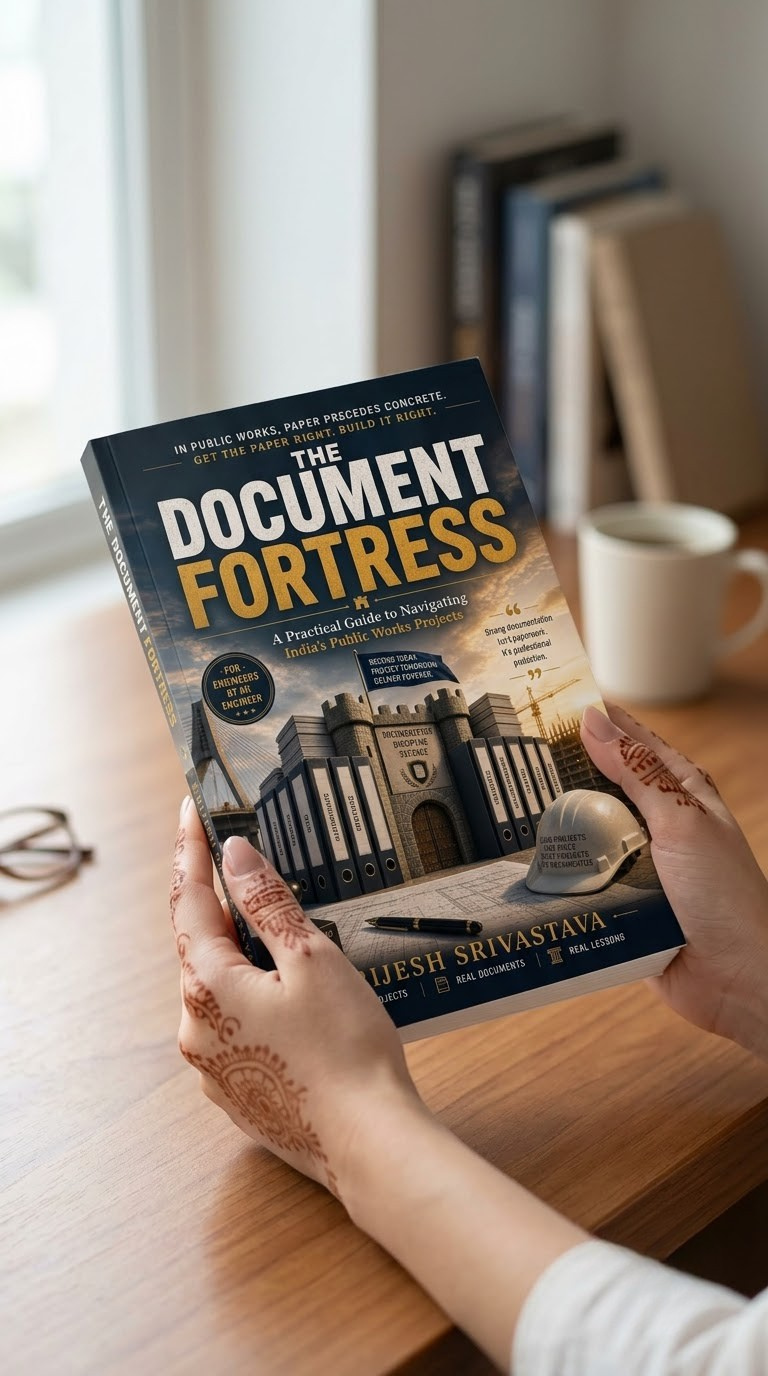
In this comprehensive guide, author Brijesh Srivastava breaks down the complex journey of contract administration across thirteen structured chapters. He shares experiences gathered over a thirty-six-year career in public infrastructure, particularly during his long tenure with RITES Ltd. He covers every phase of a project lifecycle, starting from the moment a tender is drafted to the final audit examination years after construction ends. Rather than offering abstract legal theories, he provides practical frameworks like the Document Toxicity Index, the Four-Pass System for reading tenders, and the Bill Dossier for submitting unrejectable claims. He shows how simple errors in a Bill of Quantities or a set of meeting minutes can destroy an otherwise solid engineering effort.
One story that stood out to me involves a World Bank aided project for polytechnic institutions across Uttar Pradesh. In a tender for window glazing, an item listed various glass thicknesses, including 4mm and 19mm. The department intended to delete the inapplicable sizes and retain 4mm, but by mistake, 19mm was left in the text. A sharp bidder noticed this oversight and inserted a decimal point between the digits, quoting a rate for 1.9mm glass, a size that does not even exist in standard window applications. Although the Tender Committee caught the trick during negotiations and got the bidder to agree in writing to supply 4mm glass at the lower rate, that critical negotiation note stayed in the New Delhi office. When the contract reached the executing team in Lucknow, it was silent about the negotiation. Months later, the contractor successfully claimed extra payment for 4mm glass because the local engineers had no record of the New Delhi meeting. It is a brilliant example of how vital context gets lost when paperwork fails to travel with the contract.
Noticing the Craft, Tone, and Practical Tools
The writing style is remarkably clear, direct, and disciplined. Brijesh Srivastava writes not like an academic lecturing from a distance, but like a seasoned mentor sharing hard-earned lessons over chai. His tone balances professional rigor with a deep empathy for junior engineers who are often thrown onto active construction sites without proper training in contract management. He organizes complex administrative procedures into logical, actionable steps. The inclusion of real-world templates in the appendix, such as the Defensive Site Diary and the Audit-Proof Measurement Sheet, transforms the book from a simple memoir into an everyday reference manual for site offices.
Another fascinating moment in the book centers on the mathematical precision required during field measurements. The author recounts working on combined footings for column pairs where the top and bottom rectangular faces had different dimensions and aspect ratios. Most site engineers used the average end area method to calculate concrete volume, which overestimates quantities for tapering solids and leads to systematic overpayment. Going back to first principles, the author derived and applied the exact prismoidal formula for a frustum to ensure the project paid only for the concrete actually placed. Later on, during a major railway line diversion near Shaktinagar that took twenty-one years and two foreclosures to complete, that same obsessive commitment to accurate recording allowed his site files to pass an intensive examination by the Central Technical Examiner without a single adverse finding. These concrete anecdotes give the text an authentic, grounded texture that keeps you reading.
The Emotional Core of Professional Integrity
Beyond the technical advice, there is a strong moral baseline running through every chapter. The author treats documentation not as a boring bureaucratic chore, but as an active shield for personal integrity and public funds. When an engineer signs an incomplete inspection report or approves a vague set of meeting minutes, they are taking on unlimited liability for things they cannot control. The book teaches engineers how to say no politely, firmly, and in writing. By framing documentation discipline as self-protection and public stewardship, it elevates routine paperwork into an act of professional pride.
I found myself thinking about how applicable these lessons are beyond civil engineering. Anyone who manages contracts, coordinates complex multi-agency projects, or deals with strict audit environments will recognize the human dynamics described here. The struggle against institutional inertia, the pressure from senior officers to sign off on incomplete work to meet artificial deadlines, and the temptation to accept vague verbal assurances are universal workplace challenges. Reading about how the author stood his ground on a boundary wall measurement by referencing CPWD specifications he bought with his own money reminded me that real professional authority comes from knowing your facts better than anyone else in the room.
Who Should Read This Book and Who Might Skip It
If you are a civil engineer, project manager, PMC consultant, or public sector officer working in India, this text is essential reading. It is particularly valuable for junior engineers who are just entering field postings and need to protect themselves from inherited liabilities. Executive engineers taking over running contracts will also find the 90-day turnaround plan immensely useful for establishing order on troubled sites. The practical insights on handling pre-bid queries, managing variation orders, and responding to audit observations offer a clear roadmap for avoiding career-damaging mistakes.
On the other hand, general readers looking for light non-fiction or dramatic stories of architectural design might find the detailed discussions of tender clauses, Schedules of Rates, and Indian Standard codes a bit dry. If you have no interest in contract law, project management, or the inner workings of government procurement, large portions of this manual will feel overly technical. My only mild criticism of the book is that it occasionally repeats its core warnings about documentation failures across multiple chapters. While this repetition helps reinforce key takeaways, a slightly tighter edit could have made the overall prose even more crisp.
Honest Closing Thoughts on This Essential Manual
Ultimately, this reader review leaves me convinced that Brijesh Srivastava has delivered an invaluable resource for the infrastructure sector. His advice is grounded in thirty-six years of real field experience, and his passion for protecting honest professionals shines through on every page. In an environment where systemic flaws often force engineers to choose between project delays and dangerous compromises, this guide offers a practical third path built on forensic reading, clear writing, and unassailable record-keeping. It is a book that belongs on every site office desk across the country as we look ahead toward infrastructure development in 2026 and beyond.
FAQs
What is THE DOCUMENT FORTRESS about?
THE DOCUMENT FORTRESS is a practical guide written by Brijesh Srivastava that focuses on contract management, risk mitigation, and documentation discipline within India’s public works infrastructure. Drawing from thirty-six years of industry experience, the book explains how projects fail on paper through ambiguous tender clauses, incomplete Bills of Quantities, and toxic meeting minutes. It offers structured frameworks, audit defense strategies, and real-world templates to help engineers, project managers, and consultants protect public funds and safeguard their professional careers.
Is THE DOCUMENT FORTRESS worth reading for young engineers?
Yes, it is exceptionally useful for young engineers, assistant engineers, and site supervisors who are starting their careers in public infrastructure. Engineering curricula rarely teach the legal, financial, and administrative realities of contract management. This book fills that critical knowledge gap by teaching young professionals how to read tenders forensically, maintain audit-proof site diaries, resist social pressure to sign incomplete inspection forms, and build a defensible paper trail from day one of a posting.
Does this book cover specific Indian standards and guidelines?
Yes, the book contains detailed references to key Indian codes, manuals, and regulatory frameworks. It discusses the application of IS 1200 for measurement methods, IS 456 for concrete practices, CPWD Specifications, General Financial Rules (GFR 2017), the Manual for Procurement of Works (DOE 2022), and RITES Guidelines on Procurement of Works, Goods and Services. It also explains how examinations by the Central Technical Examiner (CTE) under the Central Vigilance Commission (CVC) operate in practice.
Is this book useful for contractors and consultants?
Definitely. While the book is written primarily from the perspective of an executing engineer and Project Management Consultant (PMC), contractors can benefit enormously from understanding how departments evaluate risk, process bills, and handle variations. By applying the book’s pre-bid forensic reading methods and documentation standards, contractors can avoid costly scope misunderstandings, reduce bill rejection cycles, and build better working relationships with project authorities based on absolute clarity.

With over 11 years of experience in the publishing industry, Priya Srivastava has become a trusted guide for hundreds of authors navigating the challenging path from manuscript to marketplace. As Editor-in-Chief of Deified Publications, she combines the precision of a publishing professional with the empathy of a mentor who truly understands the fears, hopes, and dreams of both first-time and seasoned writers.