
Rating:
⭐⭐⭐⭐ (4.3 out of 5)
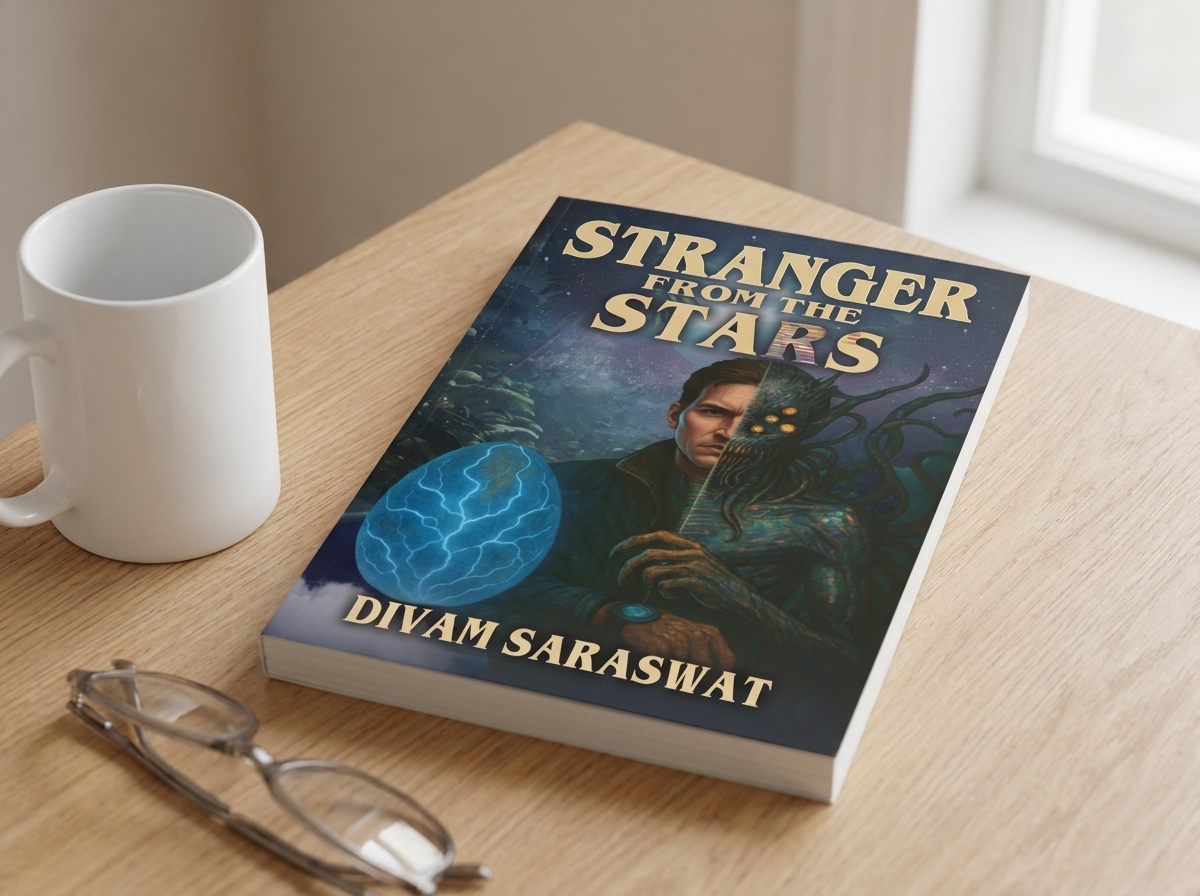
I have read a lot of science fiction over the years. Some books focus so much on worldbuilding that they forget people. Some become so serious about aliens, war, technology, and politics that the story starts feeling cold. Then there are books like Stranger From The Stars by Divam Saraswat that surprise you because underneath all the chaos, weird creatures, and absurd humor, there is genuine warmth.
And honestly, I was not expecting that.
At first glance, this looks like a funny alien adventure. You see strange names like XocXoc, Ximucurry, Kael, Brizul, and Glissnar. You see chapter titles like They Probably Licked It, Drone Alone: Lost In The Mall, and The Idiot In The Jump Lane. Naturally, you assume the book is leaning heavily into comedy.
It does. Very much.
But somewhere between the jokes about humans, cosmic misunderstandings, and alien bureaucracy, the story slowly becomes about connection. About fear. About misunderstanding cultures. About friendship between completely different beings. And weirdly enough, about muffins too.
I think that balance is what worked for me most.
What the Book Is About
Stranger From The Stars follows XocXoc, an alien impact analyst from the planet Ximucurry. Early in the story, a mysterious Earth object crashes near a populated area on his planet. The Ximucurry leadership fears humans may be preparing for war. Instead of immediately retaliating, they send XocXoc on a covert mission to Earth to understand humanity first.
Now this setup could have easily turned into a standard “alien studies humans” comedy. But Divam Saraswat gives the premise enough personality that it feels fresh.
The opening chapters immediately establish the tone. The prologue made me smile because it treats humans the way humans usually treat aliens. There is this wonderfully funny line where Earth is described as not exactly the galaxy’s top vacation spot because of wars, pollution, reality TV, and online comment sections. That kind of humor appears throughout the novel. It feels playful instead of forced.
XocXoc himself is honestly adorable in the strangest way possible.
He is described as tall, vaguely humanoid, with glossy tentacles, needle teeth, sensory tendrils, and shimmering skin. On paper, he sounds horrifying. Yet his personality makes him instantly lovable. He complains about work, gets distracted, panics under pressure, argues with coworkers, and reacts to human behavior with complete confusion.
There is a scene early on aboard the Glissnar where two giant alien creatures start fighting while the ship spirals into chaos. Everyone is flying through the air, things are exploding, spores are everywhere, and meanwhile XocXoc is screaming, “STOP HITTING ITS BRAINS!”
I laughed harder than I expected to.
The humor in this novel works because it comes from character reactions rather than random jokes thrown into the dialogue every two lines.
As the story progresses, the stakes become much larger. What begins as observation slowly turns into conflict involving alien shards, interplanetary politics, misunderstandings between worlds, and eventually war itself. But even when the scale expands, the story keeps returning to its emotional center, which is XocXoc’s growing attachment to Earth and especially to the people he meets there.
That emotional grounding matters.
What Stood Out to Me
The first thing that stood out was the imagination.
Divam Saraswat clearly enjoys inventing strange concepts. Even small details feel playful. Alien weekdays have names like Quorxdak and Drimdak. Fuel is called Nytr. Creatures casually chew on dangerous plants while giant biomechanical ships pulse like living organisms. The terminology could have become exhausting, but the writing keeps it approachable because the tone remains light.
I also liked that the chapters are short and active. The pacing moves quickly. Something is always happening. One moment there is an alien council debate, then suddenly there is a dog involved in a crisis, then someone hacks Earth technology, then an ancient shard starts behaving like an emotionally attached cosmic roommate.
And somehow it works.
In my years reviewing books, I have noticed that younger writers often struggle with tonal consistency. They either become too serious or too chaotic. Divam Saraswat comes surprisingly close to balancing both. Yes, some sections feel a little overstuffed with ideas, but I would honestly rather read an ambitious story overflowing with imagination than something emotionally flat.
Another thing I genuinely appreciated was the way the book treats humanity from an outsider’s perspective.
There is a softness in the observations. Humans are destructive, irrational, emotional, dramatic, and messy. But they are also caring. Protective. Funny. Capable of empathy.
XocXoc arrives expecting danger. What he finds instead are relationships.
The family dynamics especially helped the story feel grounded. Mira became one of my favorite characters very quickly. Children in science fiction sometimes exist only to sound “cute,” but Mira actually affects the emotional direction of the story. By the ending, her connection with XocXoc becomes one of the strongest emotional threads in the novel.
There is this lovely moment near the end where she asks if they can send her drawing to XocXoc because she misses him. It is simple. Nothing dramatic. But I think scenes like that are why the ending lands emotionally.
I also enjoyed the shard character far more than I expected.
The shard communicating in blunt statements like:
“I remain.”
“I chose you.”
“You may continue eating noodles.”
should not work this well. But it does because the book fully commits to the absurdity. The shard slowly becomes funny, protective, and oddly comforting at the same time.
And honestly, the muffin joke at the very end made me grin.
The Emotional Core
Underneath the sci fi comedy, this book is really about misunderstanding and fear.
The entire conflict begins because one civilization assumes the worst about another without truly understanding them. That feels especially relevant in 2026 where people across the world react first and listen later. The novel never becomes preachy about it, which I appreciated.
Instead, it lets relationships carry the message.
XocXoc changes because he spends time with humans. Adrian changes because he spends time with XocXoc. Even Kael, who initially feels cold and authoritative, develops more complexity later.
The emotional scenes are surprisingly sincere too. There is a reunion scene in Peace on Both Worlds where XocXoc learns his name has been cleared and completely breaks down emotionally. I think that moment works because the book earns it. By then, readers have watched him stumble through fear, guilt, responsibility, and attachment across hundreds of pages.
The goodbye scenes near the portal also hit harder than I expected.
Not because they are written in a melodramatic way. Actually the opposite. The dialogue remains simple. Human. A child asking someone to come back soon. A friend promising to annoy another friend over comms. Someone joking about phasing through a car even during an emotional farewell.
That balance between humor and sincerity gives the story its identity.
I will say this honestly though. Some readers may find the pacing a bit too fast in places. Certain emotional developments happen quickly because the novel has so many plot points moving at once. I personally did not mind because the energy of the story carried me forward, but readers who prefer very detailed emotional introspection may want more breathing room in certain sections.
Still, the heart of the book feels genuine. And that matters more to me than technical perfection.
Who This Book Is For
I think Stranger From The Stars will work best for readers who enjoy imaginative sci fi that does not take itself too seriously.
If you like stories where aliens behave strangely but emotionally, where families accidentally become part of intergalactic chaos, where humor exists alongside real emotional stakes, this book will probably connect with you.
It also feels very accessible for younger readers or readers who are new to science fiction. The language is easy to follow, the chapters move quickly, and the humor keeps things lively.
At the same time, older readers may appreciate the underlying message about empathy and misunderstanding between cultures.
If someone is looking for very hard science fiction focused heavily on scientific realism, this may not be their style. The book leans much more toward character driven adventure and comedy than technical realism.
But honestly, that is part of its charm.
Final Thoughts
I finished Stranger From The Stars feeling unexpectedly fond of its strange little universe.
The book is messy in places. Wildly imaginative. Occasionally chaotic. But it also has personality, and personality is becoming rare in modern fiction. I would much rather read a story that swings big emotionally and creatively than one that feels manufactured for trends.
Divam Saraswat writes with visible enthusiasm. You can feel how much he enjoys these characters and this world. That energy transfers to the reader.
And somewhere along the way, I stopped seeing XocXoc as a bizarre alien creature and started seeing him as someone trying to understand a confusing world while hoping the world understands him back.
Maybe that is why the story works.
Because beneath all the cosmic chaos, the glowing shards, portal diplomacy, conspiracy theories, barking dogs, and stolen butter, this is really a story about friendship.
And honestly, I think a lot of readers need stories like that right now.

With over 11 years of experience in the publishing industry, Priya Srivastava has become a trusted guide for hundreds of authors navigating the challenging path from manuscript to marketplace. As Editor-in-Chief of Deified Publications, she combines the precision of a publishing professional with the empathy of a mentor who truly understands the fears, hopes, and dreams of both first-time and seasoned writers.