
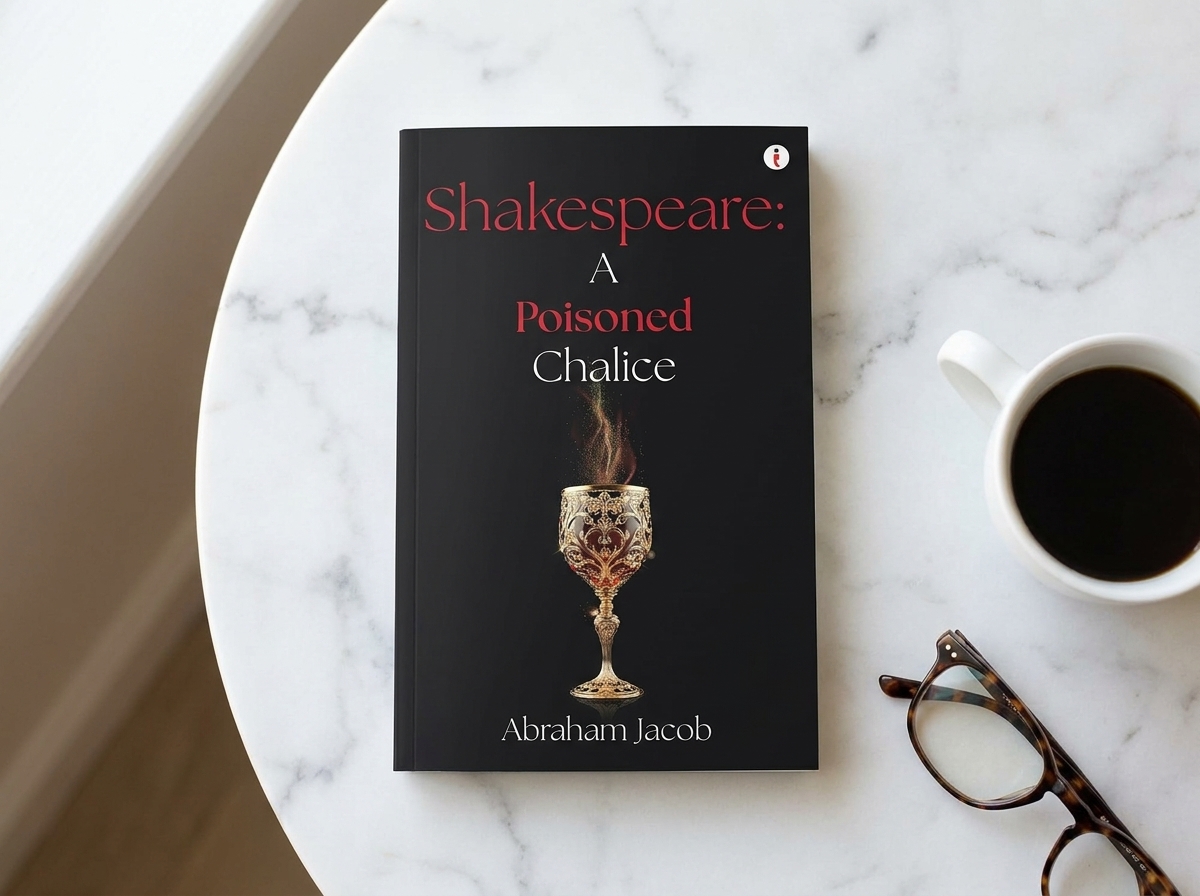
Rating:
⭐⭐⭐⭐ (4.4 out of 5)
There are some books that discuss literature like an academic exercise. Dates, references, theories, quotations, all neatly arranged like files in a cabinet. And then there are books that approach literature like a living thing. Messy. Human. Dangerous even. Abraham Jacob’s Shakespeare: A Poisoned Chalice belongs to the second category.
I have read Shakespeare criticism for years. Some books admire Shakespeare from a distance. Some try too hard to sound intellectual. Some reduce the plays into political slogans or psychological diagrams. But while reading A Poisoned Chalice, I felt something different happening. Abraham Jacob writes like a man who has lived enough life to recognize human weakness when he sees it in literature. That matters.
Maybe that comes from his unusual life journey. A civil servant. A military background. A railway administrator. And yet beneath all that, clearly, someone deeply attached to literature and moral philosophy. You can sense that experience in the writing. He is not interested in showing off scholarship for the sake of it. He wants to understand why Shakespeare still unsettles us centuries later.
And honestly, in 2026, this book feels strangely timely.
Because the central idea running through the book is frighteningly modern. Human beings poison their own world through ambition, cowardice, vanity, jealousy, greed, self deception, and then act shocked when chaos arrives. Macbeth drinks from the poisoned chalice he helped create. Lear destroys love with pride. Antony and Cleopatra chase desire until ruin becomes unavoidable. Again and again, Shakespeare’s characters destroy the moral structure holding their lives together.
Abraham Jacob sees these plays not as museum pieces but as warnings.
What the Book Is About
At its core, Shakespeare: A Poisoned Chalice is a literary examination of Shakespeare’s historical plays, tragedies, and problem plays. But calling it only literary criticism would actually undersell it.
The book constantly moves between literature, philosophy, politics, morality, religion, psychology, and civilization itself. One chapter may discuss King Lear, and suddenly the conversation shifts toward nihilism, social collapse, or the erosion of moral order. Another chapter begins with Henry VI or Richard II and becomes a reflection on power, nationalism, feudalism, and the rise of ordinary people against corrupt structures.
I found that genuinely refreshing.
There is a chapter called “The Landscape Of The Histories” where Jacob argues that Shakespeare’s historical plays are not merely about kings. They are about the collapse of feudal systems, the emergence of common people, and the dangerous instability that appears when societies lose moral direction. He writes about England changing socially, politically, and intellectually, and how Shakespeare captured that transition through drama.
What I appreciated is that he never treats Shakespeare as some untouchable saint. He openly questions Shakespeare’s political limitations in places. In the chapter “The Political Shakespeare,” Jacob points out that Shakespeare often struggled to imagine democracy outside aristocratic systems. That kind of honesty makes the book more trustworthy.
Then there are the tragedy chapters, and honestly, this is where the book becomes emotionally heavier.
The sections on Macbeth, Hamlet, King Lear, Othello, Antony and Cleopatra, and Troilus and Cressida are deeply philosophical. Jacob repeatedly returns to one difficult question. What happens when moral certainty collapses? What happens when human beings lose faith in goodness, justice, loyalty, or even themselves?
You can see this clearly in the Macbeth chapter titled “A World Without God.” Jacob interprets Macbeth not merely as an ambitious murderer but as someone entering a world where morality itself begins to decay. That framing changes the emotional weight of the play completely.
The Hamlet discussion surprised me too. Instead of treating Hamlet as just an indecisive intellectual, Jacob connects the character to questions about free will, responsibility, theology, and existential fear. Some parts reminded me of long conversations I had during college days when literature students would argue whether Hamlet’s real enemy was corruption outside him or confusion inside him.
The book also spends time on race in Othello, anti semitism in Merchant of Venice, and the complicated relationship between love and destruction in Antony and Cleopatra. The chapter “On Love” especially caught my attention because Jacob refuses to romanticize love blindly. He repeatedly shows how love in Shakespeare can become obsession, manipulation, dependence, illusion, or self destruction.
That honesty gives the book emotional credibility.
What Stood Out to Me
The first thing that stood out was the sheer seriousness with which Abraham Jacob reads Shakespeare.
A lot of modern criticism feels afraid of moral language. People hesitate to discuss good and evil directly because it sounds old fashioned. Jacob does not avoid those words. He openly talks about corruption, cowardice, vanity, moral collapse, betrayal, spiritual emptiness. Sometimes I disagreed with his conclusions, but I respected the conviction behind them.
His writing on feudalism and political change was particularly strong.
There is a section discussing how Shakespeare’s historical plays show the decline of feudal nobility and the rise of educated commoners. Jacob connects this to the Renaissance, access to learning, and shifts in political power. I was honestly impressed by how naturally he moves between literary analysis and historical interpretation without sounding dry.
I also liked the way he handles Shakespeare’s tragedies as interconnected moral worlds instead of isolated plays.
For example, he connects King Lear, Macbeth, and Hamlet through themes of moral disintegration and existential terror. He argues that Shakespeare gradually moves toward darker and darker visions of humanity. By the time we reach King Lear, hope itself feels fragile.
And then there is Antony and Cleopatra.
Jacob clearly has deep admiration for that play. His interpretation of Cleopatra fascinated me because he sees her not simply as seductive or manipulative but as someone chasing immortality through passion and intensity. The phrase “immortal longings” becomes almost philosophical in his reading.
I kept thinking about that section afterward.
Another thing worth mentioning is the emotional honesty in the prose itself. The writing does not feel sanitized. Sometimes Jacob sounds angry at moral weakness. Sometimes disappointed in humanity. Sometimes almost heartbroken by what Shakespeare reveals about civilization.
That emotional investment gives the book character.
Now, to be fair, the book is not always easy reading. Some chapters are dense. Jacob references philosophers, theologians, historians, and political thinkers quite often. Readers expecting a beginner friendly “Shakespeare explained simply” kind of book may struggle in places.
Also, the book occasionally circles around similar philosophical ideas repeatedly. I noticed recurring discussions about moral vacuum, corruption, decay, collapse of faith, and civilizational breakdown. Personally, I did not mind it because those ideas form the backbone of the author’s argument, but some readers may wish for tighter editing in certain sections.
Still, I would rather read a passionate, intellectually alive book with rough edges than a perfectly polished one with no soul.
The Emotional Core
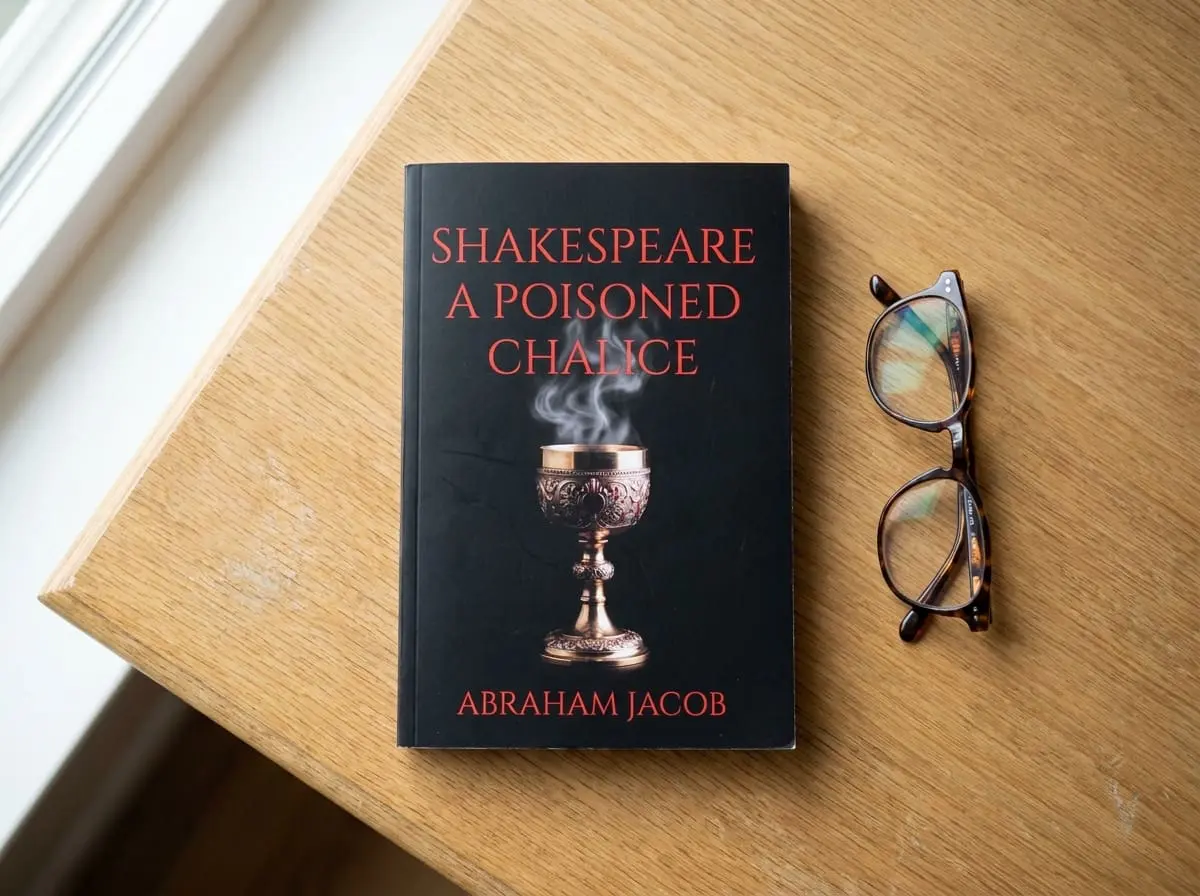
What affected me most while reading Shakespeare: A Poisoned Chalice was its sadness.
Not melodramatic sadness. Something older and heavier.
Jacob sees Shakespeare as a writer deeply aware of human fragility. Kingdoms fail. Morality weakens. Love becomes corrupted. Power destroys judgment. Even intelligence cannot save people from themselves.
And yet the book is not entirely hopeless.
There are moments where Jacob speaks about courage, dignity, sacrifice, love, and moral resistance with genuine admiration. Characters like Cordelia, Kent, and certain ordinary figures in the historical plays become reminders that goodness still matters even inside broken worlds.
That balance matters.
Without it, the book would become unbearably cynical.
I also think readers above thirty five may connect with this book differently than younger readers. Some ideas here require lived experience to fully land emotionally. Failure. Regret. Compromise. Watching institutions decay. Watching intelligent people destroy themselves through ego. Shakespeare understood those things. Abraham Jacob clearly does too.
Who This Book Is For
If you are looking for a light introduction to Shakespeare, this may not be your first choice.
But if you already enjoy literature, philosophy, history, or political thought, I think this book offers something genuinely valuable.
It is especially suited for readers who enjoy asking uncomfortable questions about civilization, morality, leadership, religion, and human weakness. Readers who liked authors such as Harold Bloom, A.C. Bradley, George Orwell’s essays, or even Will Durant’s historical reflections may find parts of this book deeply engaging.
I would also recommend it to university students studying literature because the book constantly pushes beyond surface level interpretation. Even when I disagreed with certain arguments, I respected how seriously Jacob treated the material.
And honestly, older readers may appreciate it even more. There is maturity behind these pages. The voice of someone who has spent decades observing institutions, politics, ambition, and people.
You can feel that life experience throughout the book.
Final Thoughts
I think Shakespeare: A Poisoned Chalice succeeds because Abraham Jacob never treats Shakespeare as academic decoration. For him, these plays are alive. Dangerous. Morally urgent.
This is not the kind of book you speed through for entertainment. It asks readers to think carefully about power, corruption, love, faith, and the ways societies slowly damage themselves. Some chapters demand patience. Some arguments become intense. But there is sincerity throughout the work, and sincerity matters more to me than polished cleverness.
As someone who has spent years reviewing books at Deified Publication, I can say this honestly: many literary criticism books explain Shakespeare, but very few make you feel why Shakespeare still matters emotionally and politically in modern life.
Abraham Jacob comes remarkably close.
FAQ
Is Shakespeare: A Poisoned Chalice worth reading?
Yes, especially if you already enjoy Shakespeare, literary criticism, philosophy, or historical analysis. It is intellectually ambitious and emotionally serious.
Who should read Shakespeare: A Poisoned Chalice?
Readers interested in Shakespeare’s tragedies and historical plays will get the most from it. Literature students, philosophy readers, and people who enjoy reflective nonfiction may appreciate it deeply.
Is this book beginner friendly?
Not entirely. Some chapters are dense and philosophical. Readers completely new to Shakespeare may find certain sections challenging.
What makes Abraham Jacob’s book different?
The book treats Shakespeare’s plays as reflections of moral and civilizational crisis rather than simply literary texts. Abraham Jacob connects literature with politics, religion, history, and psychology in a very personal way.

With over 11 years of experience in the publishing industry, Priya Srivastava has become a trusted guide for hundreds of authors navigating the challenging path from manuscript to marketplace. As Editor-in-Chief of Deified Publications, she combines the precision of a publishing professional with the empathy of a mentor who truly understands the fears, hopes, and dreams of both first-time and seasoned writers.