
Rating
⭐⭐⭐⭐ (4.3 out of 5)
Over the years, I have reviewed poetry collections about love, grief, spirituality, politics, memory, and identity. Very few poets attempt to build an entire philosophical framework through poetry. Even fewer spend hundreds of pages defending that framework from every possible angle.
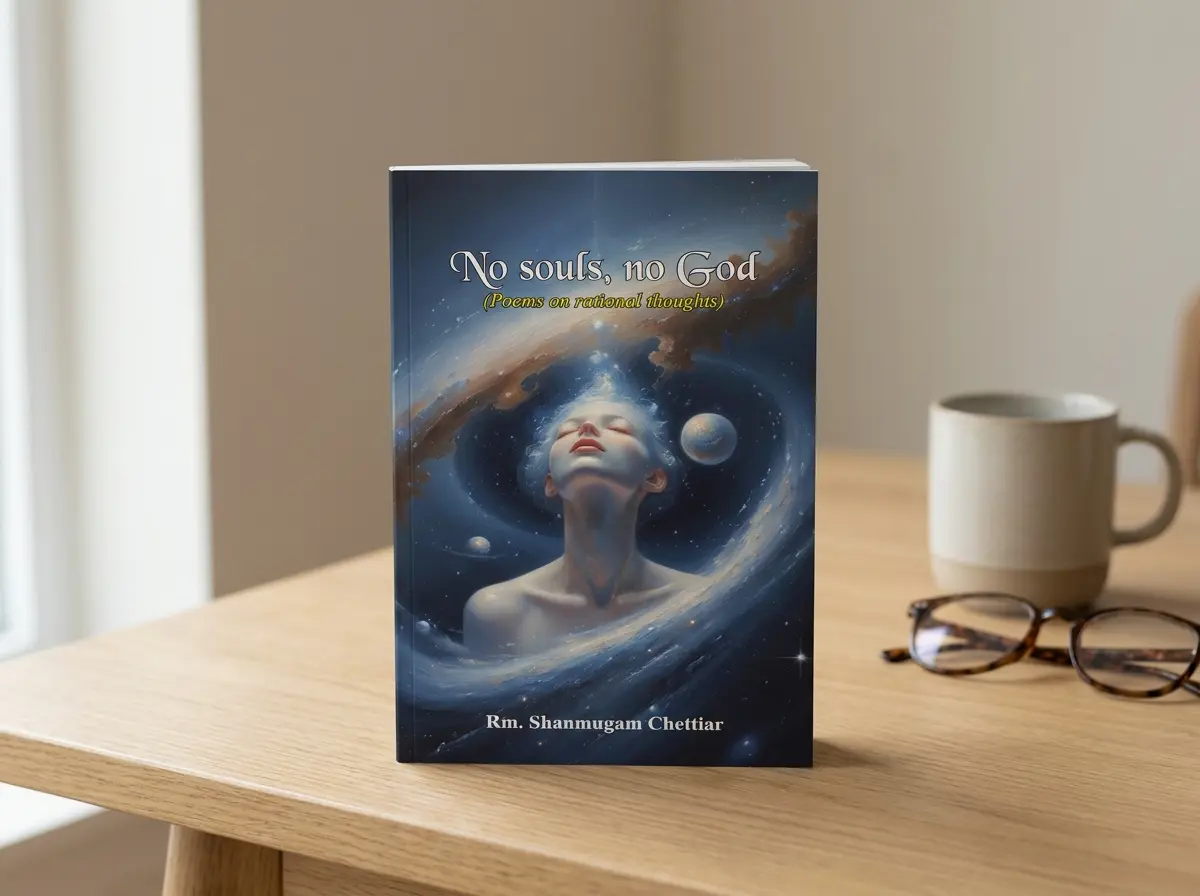
That is exactly what Rm. Shanmugam Chettiar tries to do in No Souls, No God: Poems on Rational Thoughts.
This is not a conventional poetry collection. Readers expecting lyrical imagery, romantic metaphors, or emotional confessions may be surprised. The author has openly stated in his preface that he intentionally avoids decorative language and focuses on ideas instead. The result is a book that often reads like philosophy expressed through verse rather than poetry expressed through philosophy.
The collection contains 267 poems organized around soul, God, religion, rebirth, karma, consciousness, life, death, and human belief systems. More importantly, these poems are not isolated observations. Together they form a sustained argument against the traditional concepts of individual souls, divine intervention, heaven, hell, and rebirth.
Whether one agrees with the author or not, the intellectual ambition of this book deserves attention.
Understanding the Title Poem: “No Souls, No God”
The title poem is perhaps the most important poem in the entire collection because it functions as the author’s manifesto.
The poem begins with evolution:
“Life evolved from a single cell,
The unicellular being…”
From the opening lines, Mr. Chettiar establishes that his explanation of life will be rooted in biology rather than theology. He argues that every living organism originates from preexisting life and asks a direct question:
“Where is individual soul to life?”
This single question drives almost every poem that follows.
The poet then expands the discussion from biology to cosmology. He speaks of galaxies, black holes, space, and time in constant motion before concluding with another provocative question:
“Where is God who listens to you?”
What impressed me here is not the conclusion but the structure of the argument. The poet does not begin by denying God. He begins with observable continuity in life and then asks whether traditional religious explanations remain necessary.
Readers may disagree with his conclusion, but the poem succeeds in establishing the intellectual foundation of the book.
The Central Argument of “The Concept of the Soul”
If I had to choose one poem that best represents the collection, it would probably be “The Concept of the Soul.”
This poem is where Mr. Chettiar develops his most original idea.
He uses the image of a candle and flame. Traditionally, many religions describe the soul as something separate from the body that enters at birth and leaves at death. Mr. Chettiar rejects this idea entirely.
He asks:
“Does the death mean the exit of the soul?
The soul to exit, when had it entered?”
This is one of the strongest moments in the book because it forces readers to confront a logical question that religious traditions often treat as self evident.
The poet then traces life backward through embryo, zygote, sperm, and ovum. His argument is simple. If life already exists at every stage, when exactly does an external soul enter?
From there he introduces the metaphor that appears repeatedly throughout the collection. Life is not a series of disconnected entities. Life is a continuous chain.
The most memorable section compares existence to a tree:
“Death is no more than the death of a shoot.
The death of the shoot is not the death of the tree.”
This image captures the author’s entire philosophy.
Individual organisms die, but life itself continues.
According to Mr. Chettiar, what religions call individual souls are actually temporary expressions of one continuous life process.
Why “No Individual Soul” Matters
Another significant poem is “No Individual Soul.”
This poem moves from metaphysical questions to biological inheritance.
The poet asks whether soul or body determines personality, social status, or genetic characteristics. He then argues that life exists continuously through biological processes and therefore does not require separate souls entering and leaving bodies.
The poem ends with an image that appears throughout the collection:
“Death is no more than
A death of a twig of the tree.”
This tree metaphor becomes the author’s preferred explanation for continuity in life. It is effective because it transforms an abstract philosophical argument into something readers can visualize.
Whether one accepts the argument is another matter. But as a literary device, it works.
The Book’s Treatment of God
Many readers may assume from the title that the book is primarily an attack on religion.
That is not entirely accurate.
The larger portion of the collection is actually concerned with the soul.
God appears frequently, but often as a consequence of the poet’s investigation into consciousness, life, and existence.
One recurring pattern is the poet’s insistence that natural processes are sufficient explanations.
He repeatedly points to evolution, energy transformation, biological reproduction, and physical laws.
In the title poem, galaxies and black holes become evidence that the universe operates independently of human expectations.
Elsewhere, he argues that prayer does not alter the operation of natural forces and that religious doctrines frequently emerge from human fear of death.
What makes these poems interesting is that they are not written in anger. They are written as challenges.
The poet repeatedly asks questions rather than delivering declarations.
This gives readers room to engage with the ideas rather than simply receiving conclusions.
Rebirth, Karma, and the River Analogy
One of my favorite sections of the manuscript concerns rebirth and karma.
In “No Rebirth; No Karma,” Mr. Chettiar uses a river analogy:
“You don’t step into the same water two times
When you step in a river at a place.”
He follows this with a similar image involving a flame.
The river remains the river.
The flame remains the flame.
Yet the water and fuel constantly change.
Using this framework, he argues that every birth is new rather than a continuation of an individual consciousness from a previous life.
This is one of the clearest examples of how the poet combines philosophy with imagery.
The poem succeeds because it uses familiar experiences to discuss difficult metaphysical questions.
Strengths of the Collection
The greatest strength of No Souls, No God is consistency.
Many philosophical poetry collections jump between unrelated ideas. This one does not.
Nearly every poem contributes to a larger intellectual framework.
The candle and flame analogy appears repeatedly.
The tree metaphor appears repeatedly.
The relationship between matter, energy, life, and consciousness appears repeatedly.
Some readers may see this repetition as excessive, but I think it serves a purpose. The author is constructing an argument layer by layer.
Another strength is accessibility.
Mr. Chettiar avoids academic jargon.
Even when discussing consciousness, evolution, or metaphysics, he prefers everyday examples such as rivers, lamps, seeds, branches, heat, and electricity.
This makes difficult ideas easier to follow.
Weaknesses and Limitations
The book is not without weaknesses.
The first is repetition. At 278 pages, several ideas are revisited many times. Readers who understand the central thesis early may feel that later poems sometimes restate arguments rather than extending them.
The second limitation is poetic texture. Readers who enjoy rich imagery, emotional storytelling, or musical language may find the collection too direct.
Many poems function more like philosophical propositions than traditional poems.
The third limitation is that the author occasionally presents scientific concepts with a level of certainty that some readers may challenge.
The discussion becomes strongest when the poems ask questions and weakest when complex scientific or philosophical debates are reduced to definitive conclusions.
Relation to Rationalist Poetry Traditions
This collection belongs to a long tradition of rationalist and humanist writing. There are echoes of materialist philosophy, Enlightenment skepticism, and modern scientific humanism.
Within the Indian context, readers may also notice connections with rationalist movements that challenged ritualism, caste hierarchies, supernatural beliefs, and unquestioned religious authority.
However, Mr. Chettiar’s distinctive contribution is his attempt to replace rather than merely reject.
Many atheistic works focus entirely on criticism. This book tries to provide an alternative explanation for soul, consciousness, and continuity.
That makes it more ambitious than simple disbelief.
Who Should Read This Book?
This book is ideal for readers interested in philosophy, atheism, rationalism, consciousness studies, and the relationship between science and spirituality.
It is also valuable for readers who enjoy debating ideas.
However, readers looking for emotional poetry, narrative poetry, devotional poetry, or literary experimentation may not connect with it in the same way.
The book demands intellectual engagement more than emotional immersion.
Final Verdict
After reading No Souls, No God, I came away feeling that the collection is less about denying God and more about redefining life.
The strongest sections are those dealing with the soul, continuity of life, rebirth, and consciousness. The title poem and “The Concept of the Soul” deserve particular attention because they contain the foundation of the author’s philosophy.
I do not think every argument succeeds completely. Some readers will challenge the scientific assumptions. Others will reject the conclusions outright.
Yet the book achieves something increasingly rare. It asks fundamental questions and refuses easy answers.
For that reason alone, it deserves serious consideration.
If you’d like a complimentary digital copy of this book, feel free to contact the author directly at [email protected] or via WhatsApp at +919080455850.
FAQs
Is No Souls, No God worth reading?
If you enjoy philosophy, rational inquiry, and books that challenge conventional beliefs, it is certainly worth exploring.
What is No Souls, No God about?
The collection examines concepts such as soul, God, religion, karma, rebirth, consciousness, and human existence from a rational and scientific perspective.
Who should read No Souls, No God?
Readers interested in secular philosophy, atheism, humanism, and scientific approaches to spirituality will likely appreciate the book.
Is this a religious book?
No. The collection explicitly questions and critiques many traditional religious concepts while presenting alternative interpretations based on rational thought.

With over 11 years of experience in the publishing industry, Priya Srivastava has become a trusted guide for hundreds of authors navigating the challenging path from manuscript to marketplace. As Editor-in-Chief of Deified Publications, she combines the precision of a publishing professional with the empathy of a mentor who truly understands the fears, hopes, and dreams of both first-time and seasoned writers.