
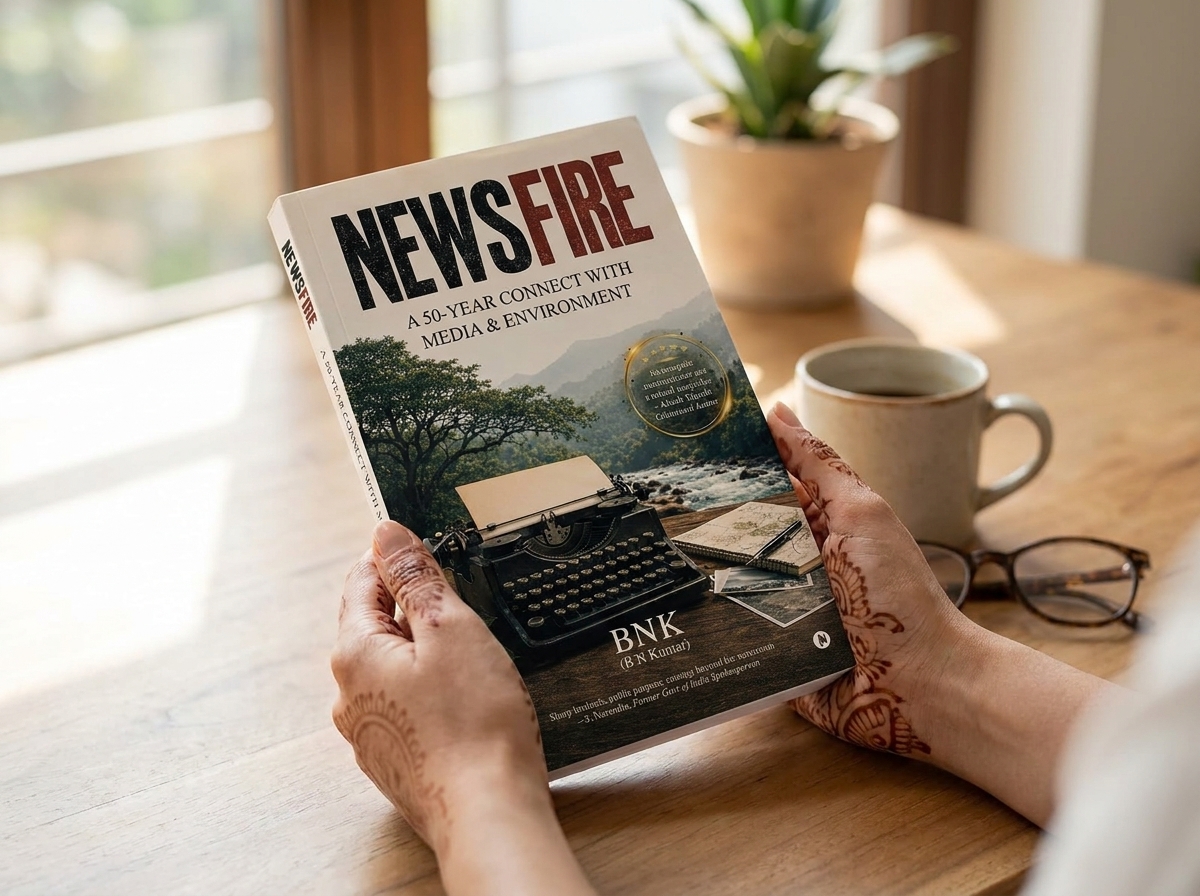
Rating: ⭐⭐⭐⭐ (4.3 out of 5)
I finished Newsfire on a weekend when my own phone would not stop buzzing with breaking news alerts, and there was something almost funny about reading a book on the history of Indian journalism while three different apps kept interrupting me with headlines. B N Kumar’s memoir made me think about how much noise we live with now, and how different it must have been for a young reporter chasing a story with nothing but a landline and a scooter. In my years reviewing books at Deified Publication, I have read a fair number of journalist memoirs, and most of them either turn into a list of famous people the writer once met, or they get so caught up in politics that you forget there was a person living through all of it. Newsfire manages to avoid both traps, and I think that is its biggest achievement.
What the Book Is About
Newsfire is B N Kumar’s account of five decades inside Indian journalism, starting from an army childhood that moved him across cantonments in Jammu and Kashmir, Punjab, Bihar, Assam and Andhra Pradesh, and eventually landing him in the pressure cooker newsrooms of Hyderabad and Mumbai. The book is structured as a series of short chapters, almost like dispatches, each one built around a specific memory, a specific city, or a specific professional turning point. It moves from his rural Andhra roots and his father’s army postings, through his early struggles as a cub reporter surviving on bun maska and chai, into the newsroom during the Emergency, and then into his later years running PR campaigns for major corporate clients and eventually turning his energy toward environmental activism in Navi Mumbai. The subtitle calls it a fifty year connect with media and nature, and by the end you understand exactly why that framing was chosen, because the book genuinely does hold both halves of his career together without either one feeling like an afterthought.
What Stood Out to Me
The thing I kept noticing, and I have read enough memoirs to know when a writer is reaching for effect versus when they are just remembering something true, is how specific Kumar’s details are. There is a moment early in the book where his father, a disciplined army man, is offered a small hand-crafted pan by a blacksmith as a gesture of gratitude after training him, and his father simply will not accept it, even though it is a modest gift. His mother, on the other hand, accepts it graciously. That single small scene tells you more about the household Kumar grew up in than three pages of description would have. I found myself thinking about how these tiny moral distinctions, the father’s refusal and the mother’s warmth, seem to run underneath the rest of the book, showing up later in Kumar’s own instincts as a journalist who chased hard truths but never lost his humour.
There is also a genuinely funny thread running through the family chapters, particularly the story of his mother learning Hindi in a Punjabi cantonment and answering every single question with the word Pathankot, whether someone asked her where she was going or what dish she was cooking. It made me laugh out loud, and I do not say that about many memoirs. Kumar has a gift for placing these lighter domestic memories right next to much heavier material, like the chapter on the 1962 war reaching his quiet Andhra village through nothing more than a change in the tone of adult conversations, and somehow the contrast works instead of feeling jarring.

The chapters on the Emergency are where I think the book earns its place as more than personal nostalgia. Kumar writes about entering journalism right as Indira Gandhi declared the Emergency at midnight on June 25, 1975, and having to learn the rules of the profession at the exact moment those rules were being suspended by the state. He does not turn this into a lecture on democracy, he simply describes what it felt like to be a young reporter watching senior journalists get arrested and newspapers get censored, and that restraint makes the section hit harder than if he had tried to editorialise. Later, the chapters on the 1982 Mumbai textile strike and the resulting police unrest, where striking constables torched police posts and the city genuinely lost control for a few days, read almost like a thriller, except you know it actually happened and that Kumar was one of the reporters trying to file copy from a landline while everything around him fell apart.
One of the sections that stayed with me the most is his account of the aftermath of the 1986 Pan Am hijacking in Karachi and the story of Neerja Bhanot, the air hostess who saved passengers and lost her own life. Kumar was part of the PR team handling the crisis communication for Pan Am, and he describes a quiet moment at the Taj where the airline’s regional director hesitated before deciding to personally visit Neerja’s grieving family, then went anyway because it was the right thing to do. It is a small human beat inside a massive tragedy, and Kumar includes it without turning it into something sentimental, which I appreciated.
The corporate PR chapters, particularly the one on rewriting the OBM company anthem into a punchy Hindi jingle, or the account of handling the VST Industries investor story and the tobacco field visits with journalists from Mumbai and Delhi, show a different side of Kumar, the strategist rather than the reporter. I will admit these sections move a little slower than the newsroom chapters, mostly because corporate PR case studies are inherently less dramatic than covering riots or hijackings, but they matter because they show how Kumar’s career actually evolved rather than pretending journalism was his only chapter.
The Emotional Core
What really got me, though, was the closing section on Climate Action Now, the advocacy platform Kumar built later in life around wetland and mangrove protection in Navi Mumbai. There is a passage where he writes about the revival effort at Powai Lake and how years of pressure finally proved that systems can respond, right before admitting in the next breath that isolated victories are no longer enough because the losses keep accelerating faster than the wins. That honesty, admitting the fight is not being won even by someone who has spent decades in it, felt more real to me than any triumphant conservation success story would have. He references the 3-30-300 principle for urban greenery almost like a personal mission statement, and by the time you reach the final pages addressed directly to infrastructure planners and drivers, asking them to think of their own children, you can tell this is not a rehearsed activist voice, it is a tired but stubborn one.
Who This Book Is For
I think Newsfire will genuinely appeal to a few different kinds of readers. If you are interested in Indian media history, especially the Emergency years or the transformation of newsrooms from Hyderabad to Mumbai, this book gives you a ground level view that textbooks simply cannot. If you grew up in an army family or moved constantly as a child, the early chapters about cantonment life and constant transfers will feel very familiar. And if you care about environmental issues in the Mumbai region specifically, the later chapters function almost as a standalone record of activism that deserves attention on its own. I will say this honestly, if you are looking for a tightly plotted single narrative arc, this is not that book, since it is structured more like a collection of connected memories than a conventional three act story, and readers who prefer a single continuous thread might find the shifts between journalism, PR work and environmental campaigning a bit abrupt in places.
Final Thoughts
Newsfire is not a flashy book, and I do not think it is trying to be. It reads like a man sitting down and honestly recounting fifty years of a life spent chasing stories, first as a reporter, then as a PR professional, and eventually as an environmental advocate, without smoothing over the parts where the fight was not won. I teared up a little at the section on Neerja Bhanot, I laughed at the Pathankot joke, and I closed the book thinking mostly about how rare it is for someone to stay this engaged with public life across five full decades. Is it worth reading? Yes, particularly if you have any interest in Indian journalism, the Emergency, or the quieter environmental battles happening in our cities right now, in 2026, when wetland destruction and urban flooding are more relevant than ever.

With over 11 years of experience in the publishing industry, Priya Srivastava has become a trusted guide for hundreds of authors navigating the challenging path from manuscript to marketplace. As Editor-in-Chief of Deified Publications, she combines the precision of a publishing professional with the empathy of a mentor who truly understands the fears, hopes, and dreams of both first-time and seasoned writers.