
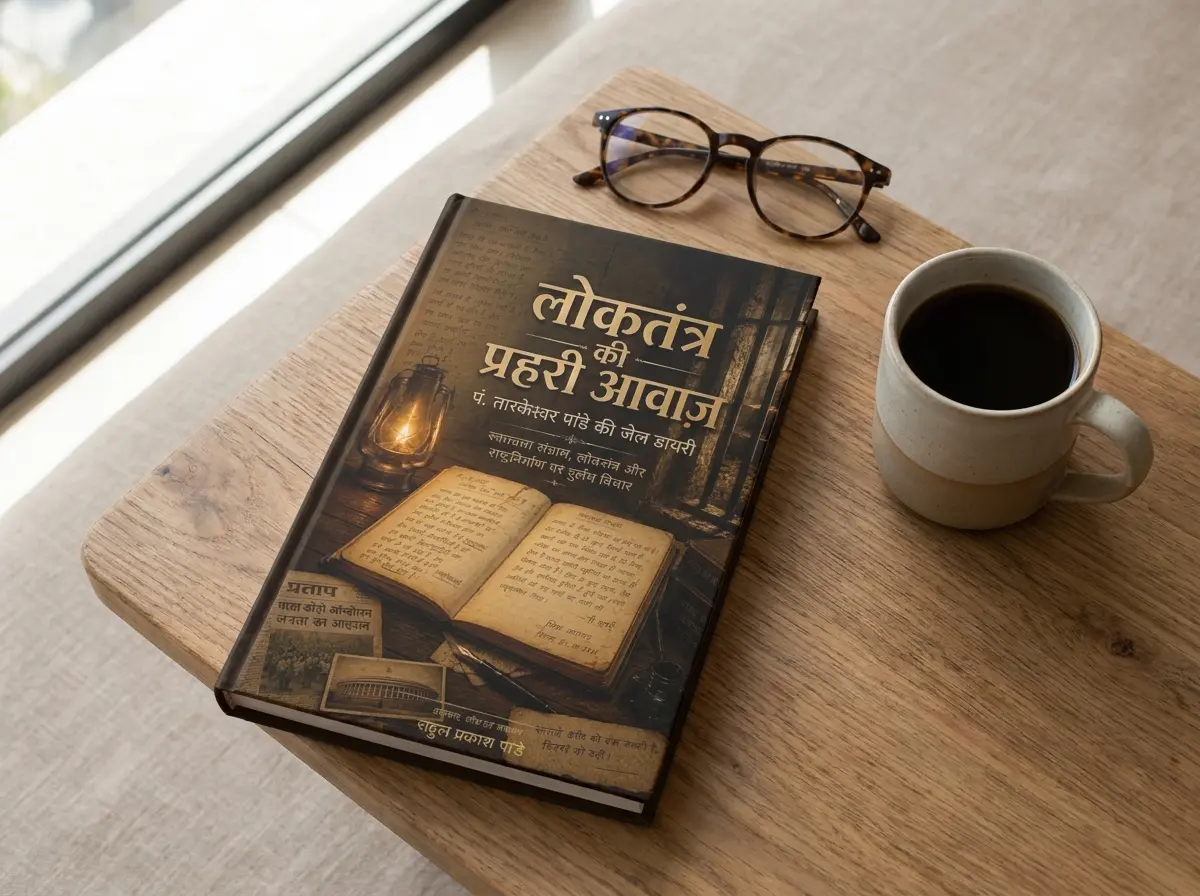
Rating: ⭐⭐⭐⭐ (4.2 out of 5)
I picked up Loktantra Ki Prahari Awaaz on a slow afternoon, expecting another biography of a freedom fighter I would barely remember by the time I reached the last chapter. That is not what happened. Somewhere around the third chapter, I found myself thinking about my own grandfather, about the stories that get told at dinner tables and the ones that get lost because nobody wrote them down in time. Rahul Prakash Pandey has done something a lot of families talk about doing and almost never actually do. He took his grandfather’s jail diary, some parliamentary records, and eighty years of family memory, and turned it into a book that reads less like a tribute and more like an argument someone is still having with history.
What the Book Is About
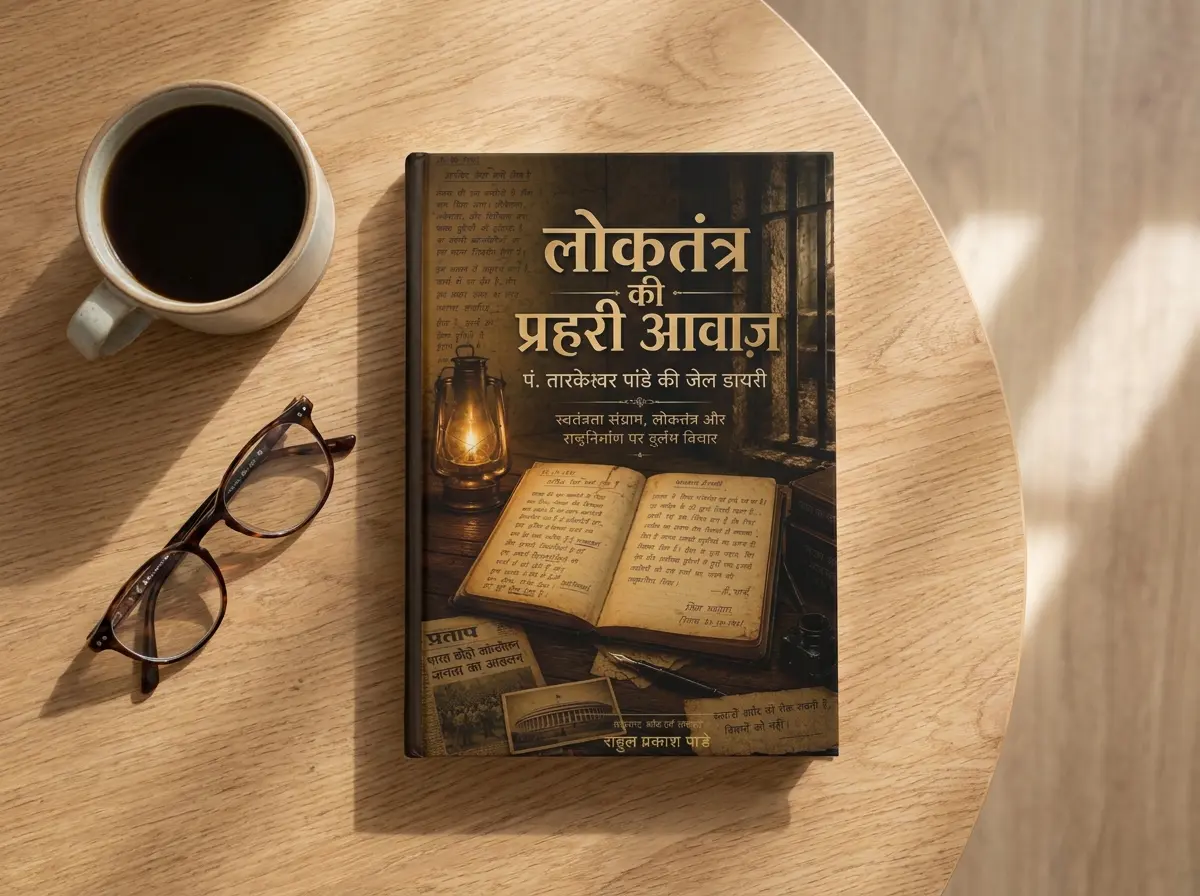
Loktantra Ki Prahari Awaaz follows the life of Pt. Tarkeshwar Pandey, a freedom fighter from the Ballia district of Uttar Pradesh who later became a member of the Rajya Sabha from 1952 to 1971 and the Lok Sabha from 1972 to 1977. Structurally, the book moves through seven chapters, starting inside Fatehgarh Central Prison in 1941, where Pandey sat in a cell writing in a diary that his family would preserve for the better part of a century. From there it goes backward into his childhood in a poor rural household, then forward through his years at Kashi Vidyapeeth, his part in the Quit India Movement, his long parliamentary career, his fight for a functional and inclusive idea of Hindi, and finally a chapter where the author steps out from behind the biography and writes in his own voice as a grandson trying to understand a man he never really knew as a person, only as a name. It is not a chronological march so much as a set of questions asked from different angles.
What Stood Out to Me
What got me early was the actual reproduction of the jail diary page from 21 October 1941, the handwriting slightly cramped, an official prison stamp pressed into the corner of the page. It is one thing to read about a freedom fighter’s imprisonment and another to see the paper he actually wrote on, complete with the Fatehgarh Central Prison seal. In that same chapter, Pandey sits with a fairly unusual set of questions for a man in a cell. He is not asking when he will be released. He is asking why human beings crave fame the way they do, what made men like Gandhi, Buddha, Napoleon and Marx into who they became, and what eventually undid some of them. The book frames these as lokeshna, janeshna and vitteshna, the pull of fame, love and wealth, and honestly I have not seen a freedom fighter’s memoir organize itself around a framework this philosophical before.
The parliamentary chapters are where I think Rahul Prakash Pandey does his best work as a writer rather than just a family archivist. There is a moment where Pandey, speaking in the Rajya Sabha, reminds the house that the very ministers criticizing a salary cut bill were the ones who had proposed cutting their own salaries and travel perks in the first place. It is a small procedural point, but the author frames it well, noting that this was not really about money, it was about a man who held himself to the same standard he expected from the people governing the country. Later there is a sharper moment, where Pandey turns to fellow parliamentarians who kept citing Soviet Russia as a model and asks them, quite directly, what the actual difference in living conditions is between Stalin and an ordinary Soviet worker. You can tell from the way it is written that this was not a man interested in scoring points for the sake of it.
The sixth chapter, on language, is probably the most layered part of the book, and also the part I suspect will generate the most conversation among readers. Pandey argued for Hindi as a national language but insisted it should be a language ordinary people could speak and understand, not a sanskritized version designed to sound impressive. In the same breath, he defended Urdu against those who called it a foreign script, and he pushed back hard on his own government’s failure to fund Telugu, Tamil, Kannada, Marathi, Odia and Gujarati at the same level. There is a particularly sharp exchange recorded here where he asks the house what kind of Indian unity excludes citizens of Kashmir and Nagaland from land ownership rights that everyone else takes for granted. Reading it in 2026, with language politics still very much alive in Indian public life, that argument does not feel like something from a sealed off past. It feels current.
The Emotional Core
The book’s real heart, though, is the final chapter, where Rahul Prakash Pandey drops the biographer’s distance and writes as himself. He admits that he began this project expecting to write a fairly standard tale of sacrifice and heroism, and instead found a man full of contradictions, someone who called himself orthodox in some respects and progressive in others, someone who defended tradition and also argued for widow remarriage and gender equality in the same era. He makes a choice I found genuinely moving, deciding not to sanitize or modernize his grandfather’s views to make them more comfortable for a 2026 reader. He says plainly that some of Pandey’s opinions on caste and gender feel uncomfortable by today’s standards, and that softening them would have done a disservice both to the reader and to history. That kind of honesty from a family member writing about their own blood is rare, and it is what convinced me this was not a hagiography dressed up as a biography.
Who This Book Is For
I will be honest, this is not a book for someone looking for a fast, plot driven read. If you want a tightly paced narrative with dramatic set pieces, this might feel slower in places, especially through the middle chapters that lean heavily on parliamentary record. But if you have any interest in India’s freedom movement told through a lesser known regional figure, or if you are curious about how Parliament actually debated language, land reform and civil liberties in the decades right after independence, this book rewards patience. It will also appeal to readers interested in family history and archival work, since a good part of what makes this book work is watching a grandson piece together a person from a diary, some old speeches, and secondhand memory.
Final Thoughts
I do have one small reservation. The middle chapters, particularly the ones drawn heavily from Rajya Sabha and Lok Sabha records, occasionally read more like documentation than storytelling, and a reader who is not already interested in Indian parliamentary history might find their attention drifting there. It is a minor issue in a book that otherwise handles a difficult balancing act, staying loyal to the primary source material while still shaping it into something readable. Loktantra Ki Prahari Awaaz is, in my years reviewing books at Deified Publication, one of the more unusual freedom fighter biographies I have come across, mostly because it refuses to flatten its subject into a simple hero. Pt. Tarkeshwar Pandey comes across as someone who spent his whole life asking questions, in a cell, in Parliament, and evidently at home too, and Rahul Prakash Pandey has written a book that respects that habit rather than tidying it up.
A Few Quick Questions Readers Ask
Is Loktantra Ki Prahari Awaaz worth reading if you are not from Uttar Pradesh or do not know who Pt. Tarkeshwar Pandey was?
Yes, honestly. The book works well on its own as a study of a freedom fighter turned parliamentarian, and you do not need prior familiarity with the region or the man to follow it.
Who should read this book?
Readers interested in India’s freedom struggle, parliamentary history, regional politics, or family memoir writing will get the most out of it.
Is this a heavy, academic read?
Parts of it, especially the parliamentary chapters, lean on primary source material, so it asks a bit more patience than a typical narrative biography. But the family sections and the final chapter are warmer and easier to sit with.
Does the book only cover his political career?
No. It also covers his childhood, his time at Kashi Vidyapeeth, and closes with a personal reflection from his grandson, so it moves between public record and private memory throughout.

With over 11 years of experience in the publishing industry, Priya Srivastava has become a trusted guide for hundreds of authors navigating the challenging path from manuscript to marketplace. As Editor-in-Chief of Deified Publications, she combines the precision of a publishing professional with the empathy of a mentor who truly understands the fears, hopes, and dreams of both first-time and seasoned writers.