
Rating: ⭐⭐⭐⭐ (4.3 out of 5)
I spend my evenings sitting by the window with a warm mug of ginger tea, watching the rain fall and thinking about romance. As the Editor-in-Chief at Deified Publication, I read dozens of manuscripts every month, yet it is rare to find a collection that captures the entire spectrum of human affection across centuries. When writing this Legendary Love Book Review, I wanted to see how ancient mythology and modern historical realities could co-exist under a single cover. The book at hand offers an unusual pairing, mixing the legendary figures of ancient India and Greece with the very real lives of twentieth-century icons. It made me wonder if our love is really any different from classical rulers.
Unpacking a Vast Poetic Ledger
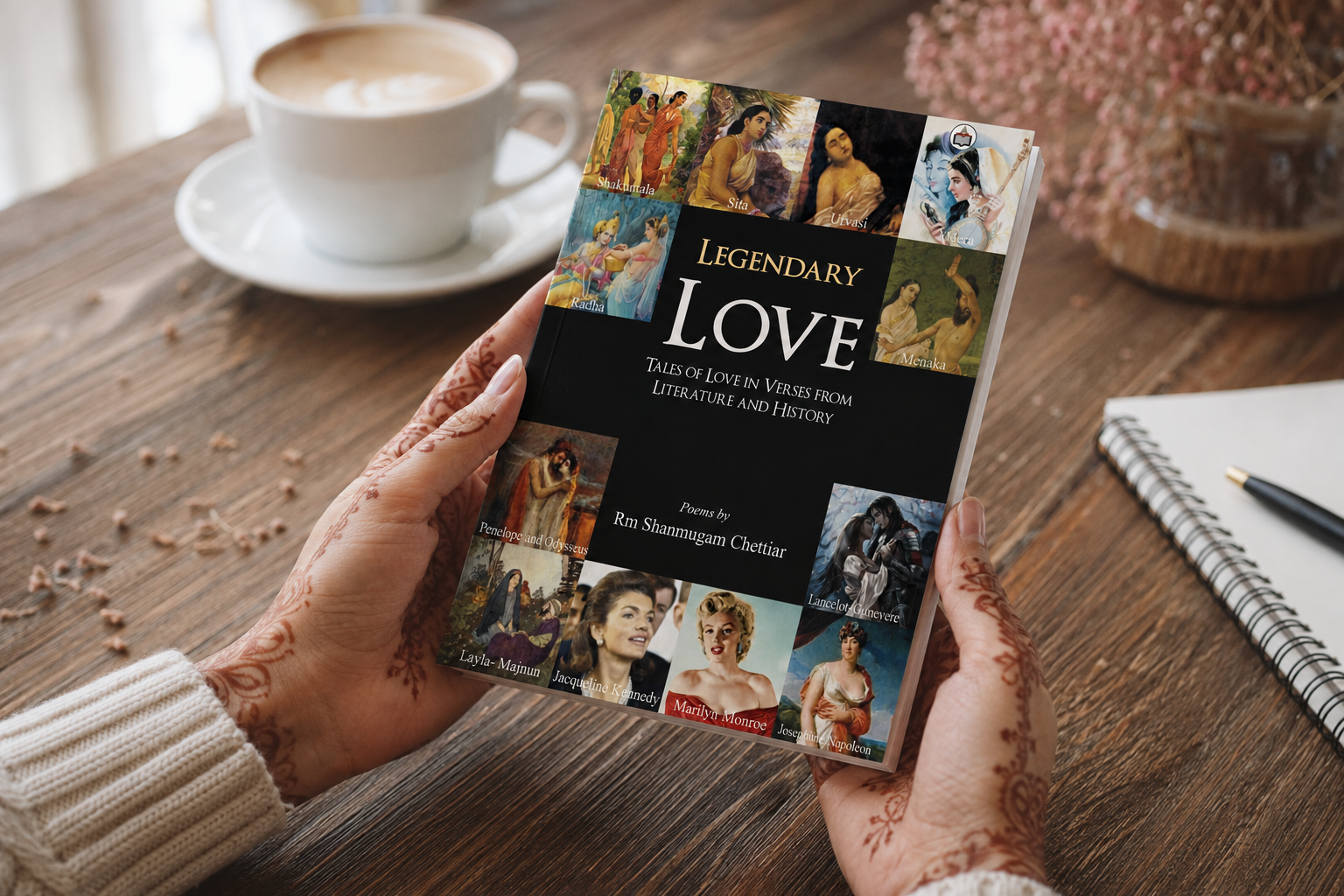
For anyone looking for a comprehensive book summary, this work is an extensive poetic ledger of forty-eight different love episodes. When asking what is it about, the answer lies in the vast range of the book Legendary Love, spanning ancient Sanskrit lore, Greek tragedy, and modern marriages. We see the tragic fate of Oedipus, the long fidelity of Penelope, and the scandalous romances of modern figures like Marilyn Monroe. The author, Rm Shanmugam Chettiar, writes in a direct, unadorned free verse style that strips away the academic language of these classics. He replaces it with a simple, conversational poetic chronicle focusing on the physical and emotional reactions of his characters. It is an ambitious project that shows how our drive for connection remains identical across eras.
If you are wondering should you read this collection, the book Legendary Love offers a unique structural approach by dividing its contents into distinct historical and mythological eras. The first section focuses on tales of love from mythologies, drawing heavily on Greek classics and ancient Indian epics. We transition into early history, storybooks, and then into modern times, where the author writes about figures like Edwina Mountbatten and the singer M.S. Subbulakshmi. This rapid transition can feel a bit jarring at first, but it serves a clear purpose by showing how legendary status is constructed over time. Rm Shanmugam Chettiar does not try to hide the flaws of his subjects, but instead presents their passions as both their greatest strength and their undoing.
Rooted Beds and Whispering Swans
What stood out to me most during my reading was the way the author uses specific, highly physical details to ground his poetic retellings. For example, in the poem about Penelope and Odysseus, there is a concrete scene where Penelope tests her returning husband by asking her maid to move their royal bed. Odysseus becomes furious because he knows the bed is physically impossible to move, since he built their bedroom round an old olive tree trunk that is firmly rooted to the earth. This small detail from the Odyssey, expressed here in simple verse, illustrates how shared secrets form the true foundation of long-term partnership.
In the retelling of Damayanti’s Love, we see King Nala falling in love with a woman he has never met, simply by listening to a wild swan describe her physical structure. The swan describes her slender waist as a shaft too frail to bear the load of her beauty, which immediately sparks a deep passion in the king’s breast. As I moved deeper into the section on modern history, I found that the poems about real people offered a fascinating contrast to the mythological tales. These historical moments show that real-life romance often requires far more courage and practical defiance than any mythical fables.
Courageous Elopements and Preserved Letters
In the poem about Edwina Mountbatten and Jawaharlal Nehru, the author mentions the volumes of private letters Nehru wrote to her, which were surprisingly preserved by her husband, Lord Mountbatten. This reveals a highly complex, mature dynamic that existed between three remarkable individuals during a turbulent political era. Then we have the story of Elizabeth Barrett and Robert Browning, where the invalid poetess initially declines his proposal because she fears her illness will ruin his life. She eventually recovers and elopes with him, fleeing the wrath of her tyrant father to live a happy life in Italy.
To offer an honest reader review, I must admit that the book will not suit every reader’s palate. While the simple free verse style makes the stories highly accessible, some of the transitions feel rather abrupt, and the language occasionally slips into awkward phrasing. Furthermore, the latter half of the book features a section of highly explicit erotic poetry and reflections on the Kamasutra. While this section aligns with the author’s belief that sensual desire is sacred, it might surprise some readers who are expecting a more traditional, purely romantic collection. The poetic rhythm can also feel a bit repetitive, since many poems follow a similar structure of introducing a couple and summarizing their eventual fate.
For Lovers of Folklore and Bold Verses
If you are deciding is it worth it to buy this volume, you should consider your own reading preferences. This book is ideal for lovers of world folklore who enjoy seeing famous narratives condensed into quick summaries, similar to the classical retellings by Robert Graves. It is also a great fit for readers who are interested in the intersection of physical desire and spiritual devotion, a theme that the author returns to repeatedly. On the other hand, if you prefer highly polished, modern lyrical poetry with complex metaphorical structures, you might want to skip this one. Similarly, those who dislike explicit discussions of sensuality may find some of the later chapters a bit too bold.
My final thoughts on the book Legendary Love are that it represents a deeply personal, ambitious effort by a poet who has spent decades observing human nature. It is the kind of book that sits on your shelf for a long time, and you find yourself pulling it down on a rainy afternoon in 2026 to reread a specific chapter. There is an honest, unvarnished quality to the writing that I found quite refreshing, even when the poetic meter faltered. It reminds us that whether we are reading about ancient Greek heroes or modern politicians, the basic language of desire remains unchanged. I am glad I took the time to read these verses, as they left me with a lot to think about.
FAQs
Is the poetry in Legendary Love easy to understand?
Yes, the poetry in this collection is written in an extremely accessible, straightforward style. Rm Shanmugam Chettiar deliberately avoids overly complex metaphors and academic jargon, choosing instead to focus on clear, narrative free verse. Each poem reads like a condensed story, making it very easy for readers who may not have a background in classical literature to follow the plot. While some literary purists might find the language a bit too simple, it succeeds in making these ancient and modern tales highly readable for a general audience. This approach allows the emotional and physical realities of the characters to shine through without getting lost in complicated poetic structures.
Does the book contain mature or explicit content?
Yes, the collection contains highly sensual and explicit themes, particularly in the latter half. The author devotes several chapters to the Kamasutra and includes his own erotic poems, which depict physical desire with great detail. He approaches these topics from a perspective that physical love and spiritual devotion are closely linked, rather than treating them as purely vulgar. However, this explicit focus means that the book is not suitable for younger readers or those who prefer conservative romance. If you are sensitive to bold descriptions of physical intimacy, you might want to bypass these specific chapters. For other readers, it offers a historically grounded study of how different cultures have integrated sexuality into their spiritual and creative works.
What sources did the author use to write these poems?
The author drew from an incredibly wide variety of historical, mythological, and literary sources to construct this volume. For the mythological sections, he relied on classical Greek works like Homer’s epics and ancient Sanskrit texts, including Kalidasa’s plays and the Mahabharata. The historical poems are based on well-documented biographies, letters, and memoirs of famous figures from different eras, such as Napoleon Bonaparte and Cleopatra. He also utilized digital reference tools and English translations of original Tamil and Sanskrit literatures to ensure accuracy. This extensive research is reflected in the detailed footnotes and historical context provided at the end of many poems in the collection.

With over 11 years of experience in the publishing industry, Priya Srivastava has become a trusted guide for hundreds of authors navigating the challenging path from manuscript to marketplace. As Editor-in-Chief of Deified Publications, she combines the precision of a publishing professional with the empathy of a mentor who truly understands the fears, hopes, and dreams of both first-time and seasoned writers.