
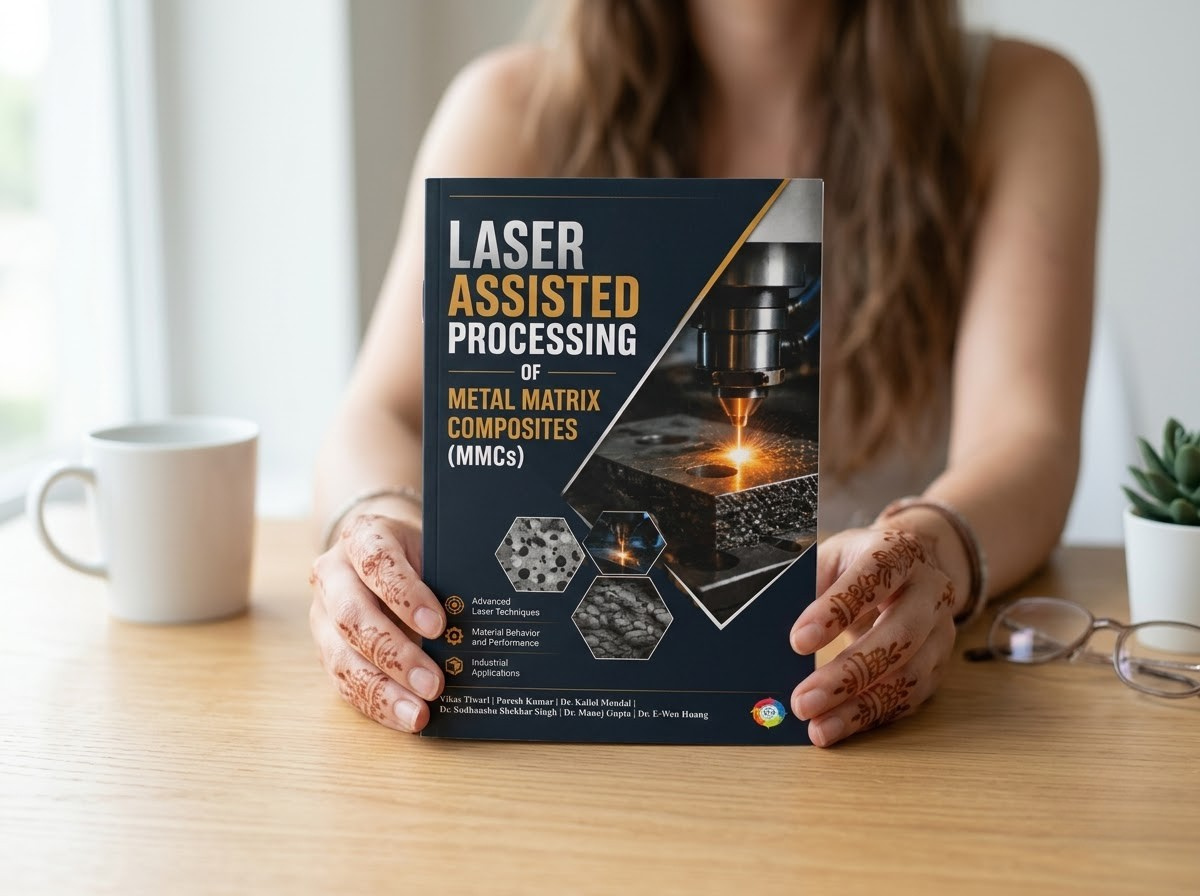
Rating: ⭐⭐⭐⭐ (4.2 out of 5)
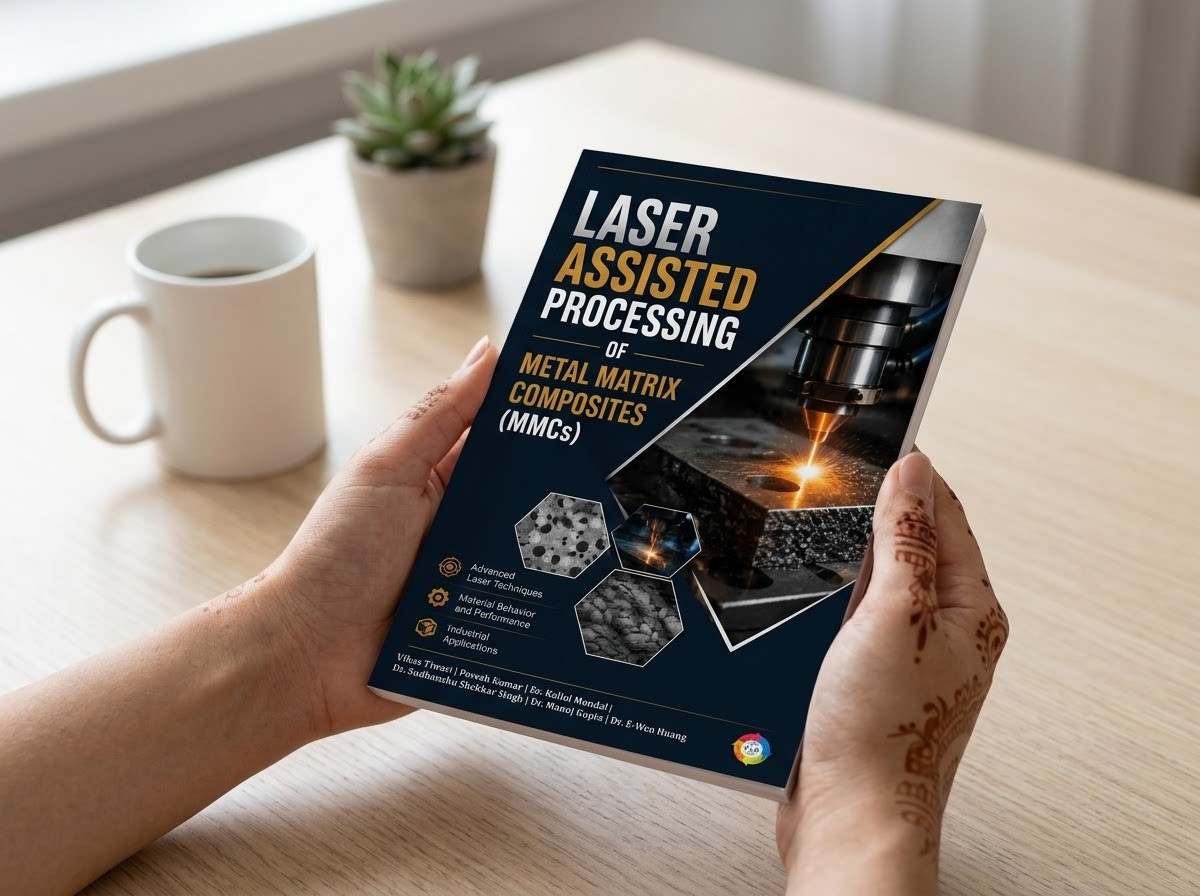
Most of what lands on my desk at Deified Publication is fiction or memoir, so when Laser Assisted Processing of Metal Matrix Composites (MMCs) showed up, I knew this review was going to work a little differently. This isn’t a book you read curled up with tea on a Sunday. It’s a monograph, written by six researchers spread across three institutions, on how lasers are used to build advanced composite materials layer by layer. But here’s what kept me reading past the introduction. Even outside my usual lane, I found myself genuinely caught up in how tightly this book ties a physical process, a laser melting metal and ceramic together, to a real engineering payoff: parts that survive conditions most materials simply cannot. In my years reviewing technical and academic titles, I’ve noticed that what separates the useful ones from the forgettable ones is whether the authors actually walk you through their reasoning instead of just dropping results on the page. This one does that, with more discipline than I expected going in.
What the Book Is About
Laser Assisted Processing of Metal Matrix Composites (MMCs) is authored by Vikas Tiwari and Poresh Kumar of the Indian Institute of Technology Kanpur, along with Dr. Kallol Mondal and Dr. Sudhanshu Shekhar Singh, also of IIT Kanpur, plus Dr. Manoj Gupta at the National University of Singapore and Dr. E-Wen Huang at National Yang Ming Chiao Tung University in Taiwan. The project behind the book was funded under India’s SPARC scheme, a research collaboration program, and you can feel that cross-border, multi-lab energy running through the whole thing. The subject at the center of it all is metal matrix composites, materials that pair a metal matrix with a harder reinforcing phase, usually a ceramic like titanium carbide or silicon carbide, to get combined properties that neither material could deliver on its own.
The first two chapters lay out why this pairing matters and how laser techniques, including laser cladding, laser powder bed fusion, and directed energy deposition, have become some of the most flexible ways to build these composites with real control over the internal microstructure. From there, the book moves in a sensible order. It covers the different metal matrices and reinforcement types in Chapter 3, the characterization tools researchers use to actually see what’s happening inside these materials in Chapter 4, the mechanical and high temperature performance in Chapter 5, and finally the industrial applications, scaling challenges, and where the field is headed in Chapter 6. It reads like it was built to be used as a reference, not just read once and shelved.
Where the Book Really Shines
What convinced me this book has real substance, rather than just breadth, is how often it backs up its claims with actual numbers instead of vague statements about performance. There’s a table early in Chapter 5 pulled from a study by Tayeh and colleagues on aluminum-titanium diboride composites, where hardness and elastic modulus climb steadily as the reinforcement’s particle size shrinks and its volume fraction increases. It’s a small table, three columns of numbers, but it does more to explain why interfacial bonding matters than several paragraphs of description could on their own.
Later in the same chapter, there’s a table on nickel-based coatings reinforced with silicon carbide, built on top of an Inconel 718 substrate, the kind of super alloy used in aircraft engines. The substrate alone measures around 234 on the Vickers hardness scale. Add twenty percent silicon carbide and that number jumps to roughly 740, more than triple, while the material also loses less mass during a hundred hours of high temperature oxidation testing. I’ll admit that’s the point where the book stopped feeling abstract to me. Somewhere in that comparison is the actual reason engineers reach for these composites instead of the plain alloy underneath them.
Chapter 6 is where the book earns its keep for anyone who wants to know this isn’t just laboratory curiosity. It walks through cobalt-based Stellite coatings used on valve seats and sealing surfaces in petrochemical and nuclear plants, and iron-based composites reinforced with tungsten carbide that end up on rail systems, mining tools, and scraper conveyors. These aren’t hypothetical use cases. They’re existing industrial components operating under conditions that would chew through an ordinary alloy in a fraction of the time. I also appreciated the short history laid out in Chapter 1, tracing reinforcement strategies from continuous fibers in 1960s aerospace work through particulate systems built for cost and scale, and on to today’s nano-scale and hybrid reinforcements. Watching a whole field mature across a few paragraphs, with the timeline mapped out plainly, gave me a much clearer sense of where the current research actually sits.
The Payoff for Readers Who Stick With It
I won’t pretend this book delivers the kind of emotional experience a novel does, and honestly, it shouldn’t try to. But there’s a specific kind of satisfaction here that I think matters just as much for the right reader. It’s the satisfaction of watching a number do exactly what the theory predicted it would, or better yet, watching it do something you didn’t expect and then reading the authors explain why. The section correlating processing parameters with microstructure and final performance, capped off by a flowchart mapping how thermodynamic inputs during laser processing eventually decide whether a part succeeds or fails, is the kind of thing a working engineer will come back to more than once. That’s not a small compliment for a monograph like this. Reference books either get reread or they get forgotten, and I don’t think this one is heading toward the second pile.
Who This Book Is For
This is written for graduate students, researchers, and practicing engineers already working in additive manufacturing, surface engineering, or advanced composite materials, and it assumes you’re comfortable with terms like nanoindentation, EBSD, and volumetric energy density without a glossary holding your hand. If that’s your world, this book earns its price by consolidating a wide spread of research into one organized reference, with the tables and figures doing a lot of the heavy lifting. If you’re a casual reader curious about materials science with no technical background, I’d steer you elsewhere first. This isn’t a popular science book, and it doesn’t pretend to be one.
Final Thoughts
My honest critique, and the reason I’m not giving this the top of the scale, is that the book leans heavily on synthesizing other researchers’ published studies chapter after chapter. Given that all six authors have their own substantial research records in this exact space, I found myself wanting a bit more room for their own original findings and direct commentary, rather than curated summaries of the wider literature. It’s a reasonable choice for a monograph meant to consolidate a field, but it does mean the authors’ own voice sometimes gets a little buried under the weight of citations. That said, the organization is sound, the data is real and well chosen, and the applications chapter alone makes it worth having on the shelf if this is your field. It’s a book that does exactly what it sets out to do.
Frequently Asked Questions
What is Laser Assisted Processing of Metal Matrix Composites about?
It’s a technical monograph covering how laser-based techniques, including laser cladding, laser powder bed fusion, and directed energy deposition, are used to build metal matrix composites with controlled microstructures and enhanced mechanical, thermal, and wear-resistant properties.
Who should read this book?
Graduate students, researchers, and practicing engineers working in additive manufacturing, surface engineering, or advanced composite materials. It assumes prior familiarity with materials science terminology and characterization techniques.
Is Laser Assisted Processing of Metal Matrix Composites worth reading?
Yes, if you’re in the field. The book summary of this monograph pulls together processing fundamentals, materials selection, characterization methods, and industrial applications into one organized reference, backed by real experimental data rather than generalized claims.
Does the book cover real industrial applications or just laboratory research?
Both. Chapter 6 specifically addresses industrial applications, including coatings used in petrochemical, nuclear, aerospace, and mining equipment, alongside the scalability and sustainability challenges of moving these composites from the lab to the factory floor.

With over 11 years of experience in the publishing industry, Priya Srivastava has become a trusted guide for hundreds of authors navigating the challenging path from manuscript to marketplace. As Editor-in-Chief of Deified Publications, she combines the precision of a publishing professional with the empathy of a mentor who truly understands the fears, hopes, and dreams of both first-time and seasoned writers.