
Rating:
⭐⭐⭐⭐½ (4.4 out of 5)
As someone who has spent more than fifteen years reading and reviewing books at Deified Publication, I’ve learned that children’s books are actually some of the hardest books to get right. Adults often underestimate them. They think adding bright colors, smiling characters, and a few moral lessons is enough. But children notice sincerity immediately. They know when a story feels alive and when it feels manufactured.
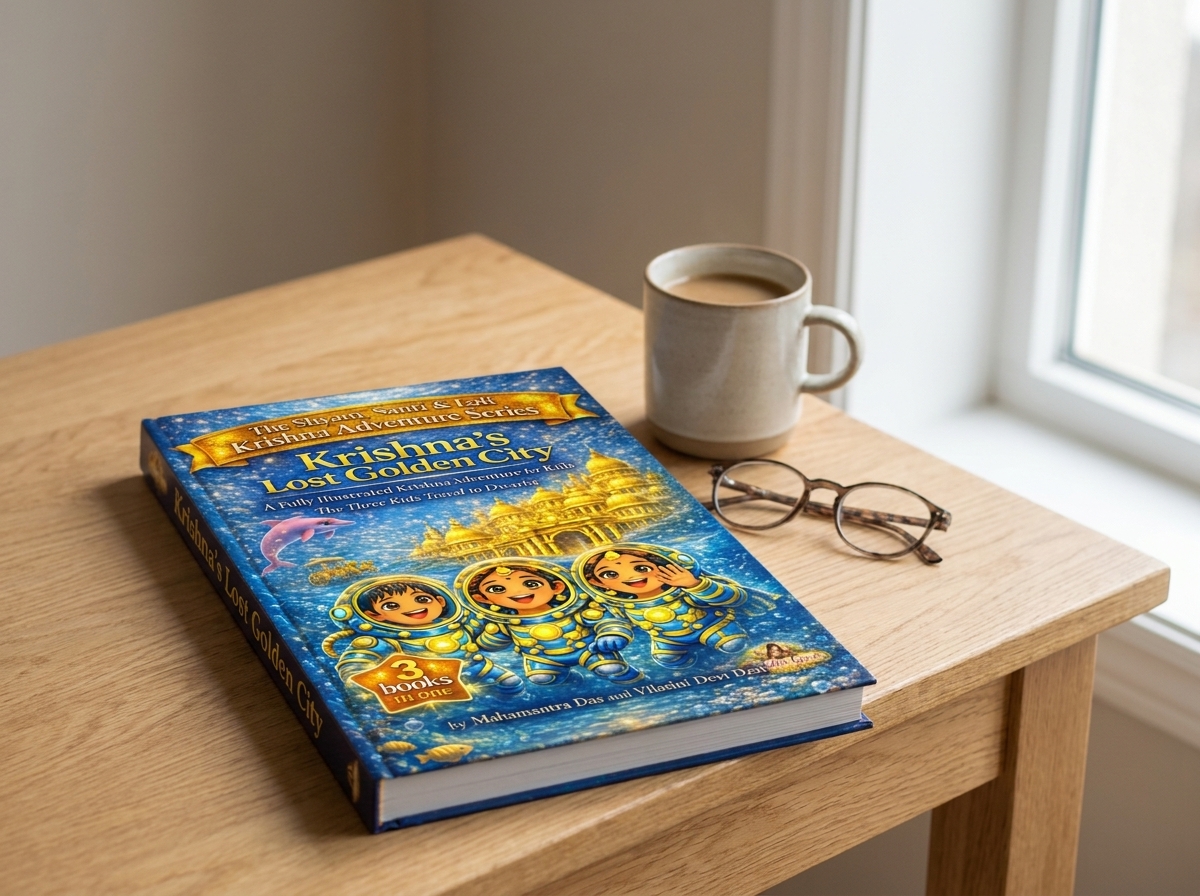
That’s probably why Krishna’s Lost Golden City by Mahamantra Das and Vilasini Devi Dasi caught my attention the moment I saw the cover and read the concept behind it.
There’s something deeply earnest about this book. It doesn’t feel cynical. It doesn’t look like it was created only to “teach values” in a rigid way. Instead, it seems genuinely interested in making children curious about Krishna’s world through imagination, color, adventure, and visual storytelling. And honestly, I think that matters a lot in 2026, when so much children’s content is loud, hyperactive, and designed mainly to hold attention for ten seconds at a time.
This book appears to move in another direction entirely.
What the Book Is About
Krishna’s Lost Golden City: Fully Illustrated Krishna Adventure for Kids is presented as a collection of three stories in one volume. From the blurb and visual presentation, the stories seem centered around sacred locations tied to Krishna’s life and mythology, including Barsana, Vrindavan, and Dwarka.
The central trio, Shyam, Santi, and Lali, appear to guide young readers through these adventures. What I liked immediately is that the children themselves are front and center on the cover. That may sound like a small thing, but for younger readers, relatability matters. Kids often enter magical worlds more easily when they see characters close to their own age experiencing wonder alongside them.
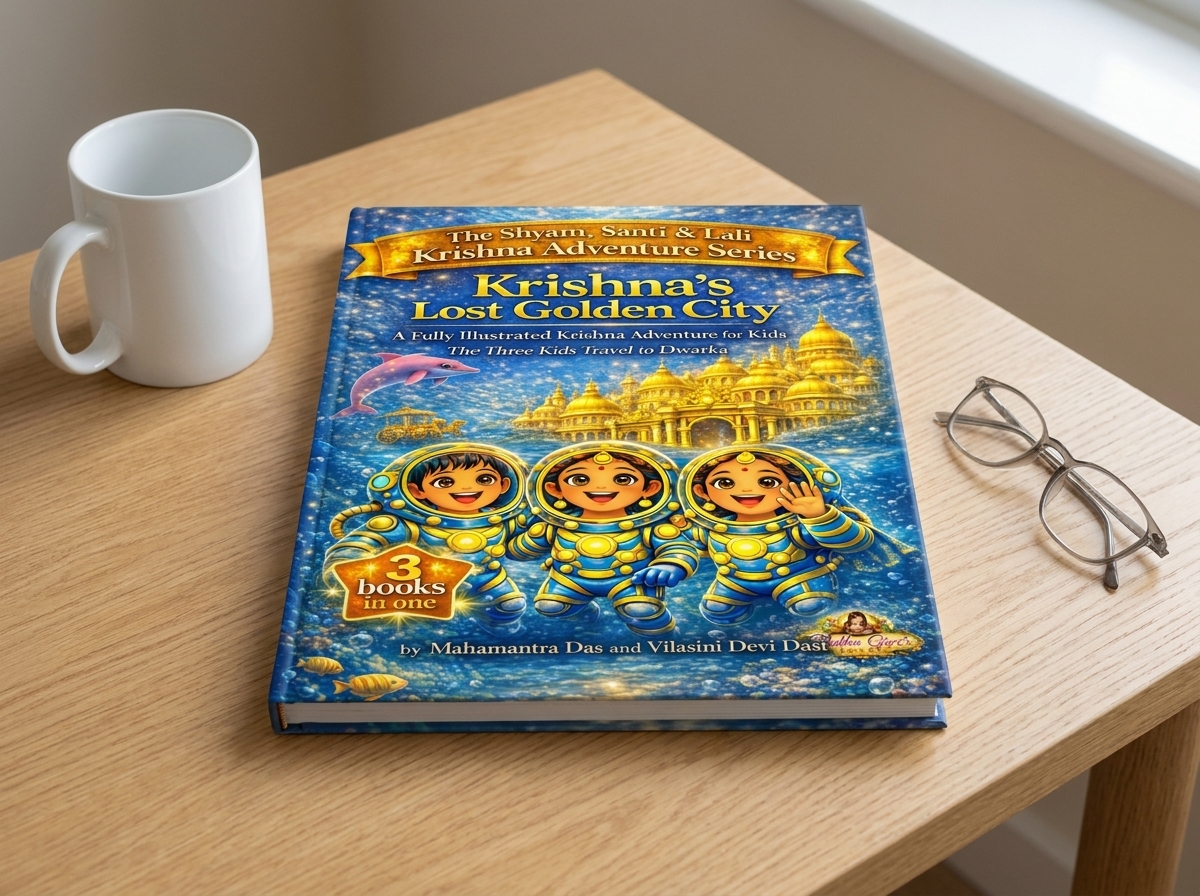
The book’s strongest visual idea is clearly Dwarka, Krishna’s legendary golden city beneath the sea. The underwater imagery on the cover is honestly beautiful in a very old fashioned fantasy way. Dolphins swim near glowing palaces. The children wear diving suits like tiny explorers. The entire scene feels inspired by mythological wonder instead of modern irony.
I actually smiled looking at it because it reminded me of the kind of illustrated books many of us grew up with before everything became minimalist and emotionally detached.
The “3 books in one” concept also feels practical for parents. Children often become attached to recurring characters, so having multiple adventures in a single volume gives them more time inside that world.
And I think that’s really the heart of this book. It wants children to spend time in Krishna’s universe naturally, through fascination and storytelling, instead of feeling like they’re attending a lesson.
What Stood Out to Me
The first thing that stood out was the visual commitment.
A lot of children’s spiritual books rely heavily on text and treat illustrations almost like decoration. Here, the illustrations seem central to the reading experience itself. Every image shown on the cover feels packed with movement, light, architecture, animals, expressions, and texture. Peacocks frame the borders. Forests glow with impossible colors. Temples rise from oceans. There’s an unapologetic richness to the artwork.
Some people may find it visually overwhelming. I can already imagine certain readers preferring simpler layouts. But personally, I think children often love abundance in fantasy art. They enjoy discovering little details repeatedly.
I remember being a child and staring at illustrated pages far longer than the actual reading time. You search corners of the artwork. You invent side stories in your head. This book looks designed for exactly that kind of engagement.
Another thing I appreciated was the tone implied by the blurb. It uses words like “magic,” “devotion,” and “wonder” without sounding preachy. That balance is difficult. Spiritual children’s books sometimes become too instructional, almost like textbooks with decorative covers. Here, the focus appears to remain on experience first.
The mention of Barsana and Vrindavan also gives the book cultural grounding. These places are not presented as abstract fantasy settings disconnected from Indian tradition. They carry emotional and devotional significance for many families. I think parents who want their children to develop familiarity with Krishna stories in a softer, imaginative format may genuinely appreciate this approach.
And then there’s Dwarka.
Honestly, the idea of an underwater golden city is already enough to capture a child’s imagination. Even adults are fascinated by the mythology surrounding Dwarka. There’s mystery built into it naturally. Lost cities have always fascinated readers across generations. Atlantis, El Dorado, hidden kingdoms beneath oceans. This book seems to channel that same excitement into Krishna mythology for children.
I also liked that the children on the cover look joyful rather than frightened or overly dramatic. Modern children’s media often mistakes intensity for engagement. Not every story needs destruction, trauma, or nonstop conflict. Sometimes children simply want beauty, curiosity, friendship, and adventure.
That energy comes through strongly here.
The Emotional Core
I think the emotional strength of Krishna’s Lost Golden City lies in the feeling of innocence it tries to preserve.
And maybe that sounds strange to say in 2026, but innocence has become rare in entertainment. Even children’s stories now often carry sarcasm, overstimulation, or emotional cynicism aimed more at adults than kids.
This book seems to reject that entirely.
There’s warmth in the way Krishna’s world is presented. The glowing temples, colorful forests, dancing peacocks, and smiling children create an atmosphere that feels comforting rather than chaotic.
As an editor, I notice when creators genuinely respect childhood imagination instead of trying to “market” childhood back to itself. Mahamantra Das and Vilasini Devi Dasi appear to understand that children don’t need constant noise. Sometimes they simply need stories that make the world feel magical again.
I also think many Indian parents and grandparents may feel emotional introducing this book to younger children because these stories are culturally familiar while still packaged in a visually modern way.
That bridge matters.
I’ve seen many families struggle with this exact issue. They want children connected to mythology and heritage, but the old formats don’t always compete with flashy digital entertainment anymore. Books like this attempt to solve that problem through illustration driven storytelling.
And honestly, I respect that effort.
At the same time, I do think the visual richness may overshadow narrative depth for some older readers. Children above a certain age who prefer faster plots or stronger conflict might want more emotional complexity. Based on the presentation, this seems best suited for younger children who enjoy immersive worlds and visual fantasy rather than highly layered storytelling.
But that’s not really a flaw. It’s simply understanding what kind of book this is trying to be.
Who This Book Is For
I think this book will work especially well for children between roughly ages five and ten, particularly those who already enjoy mythology, fantasy worlds, or highly illustrated stories.
Parents looking for screen free reading options may genuinely appreciate this one because the artwork itself seems capable of holding a child’s attention for long stretches.
It also feels ideal for family reading sessions. I can easily imagine a parent reading this aloud while children ask questions about Krishna, Dwarka, temples, peacocks, or underwater cities. Some books naturally create conversation. This looks like one of them.
If your child enjoys visually rich animated films, devotional stories, fantasy kingdoms, or colorful adventure books, there’s a good chance they’ll connect with this.
At the same time, readers searching for a more historically detailed or academically grounded mythology retelling may need to approach it differently. This appears to prioritize imagination and emotional atmosphere over realism or scholarly interpretation.
And honestly, I think that’s perfectly fine for its intended audience.
Not every children’s mythology book needs to function like a research document. Sometimes storytelling itself is enough.
Final Thoughts
I finished looking through the material for Krishna’s Lost Golden City feeling surprisingly hopeful.
That may sound dramatic for a children’s book review, but I mean it sincerely.
There’s care visible here. The creators seem genuinely invested in giving children an experience filled with color, devotion, imagination, and joy. The book doesn’t appear embarrassed by beauty or spirituality. It embraces both openly.
In many ways, it reminds me of older children’s classics that believed fantasy worlds could still feel sincere without needing irony every few minutes.
I also think the combination of Krishna mythology and adventure storytelling is smart because it makes cultural storytelling accessible instead of intimidating. Children are far more likely to connect emotionally when stories invite them into discovery rather than instruction.
Would every reader connect with the artistic style? Maybe not. Some parents may prefer more minimalist illustration or simpler layouts. Others might want deeper plot development depending on the child’s age.
But overall, I think Krishna’s Lost Golden City succeeds at what it’s trying to do. It offers children a vivid doorway into Krishna’s world through friendship, fantasy, and visual wonder.
And honestly, I’d much rather see children spending time with books like this than endlessly scrolling through forgettable content online.
FAQ
Is Krishna’s Lost Golden City worth reading?
Yes, especially for younger readers who enjoy mythology, colorful illustrations, and fantasy adventures. The visual storytelling seems to be one of the book’s strongest features.
Who should read Krishna’s Lost Golden City?
This book appears best suited for children between five and ten years old, particularly families interested in Krishna stories, Indian mythology, and illustrated adventure books.
What is Krishna’s Lost Golden City about?
The story follows three children through magical adventures connected to Krishna’s world, including Barsana, Vrindavan, and the legendary underwater city of Dwarka.
Is this book educational or mainly entertainment?
It seems to balance both. The book introduces children to Krishna related mythology and sacred places while keeping the tone imaginative and visually engaging.

With over 11 years of experience in the publishing industry, Priya Srivastava has become a trusted guide for hundreds of authors navigating the challenging path from manuscript to marketplace. As Editor-in-Chief of Deified Publications, she combines the precision of a publishing professional with the empathy of a mentor who truly understands the fears, hopes, and dreams of both first-time and seasoned writers.