
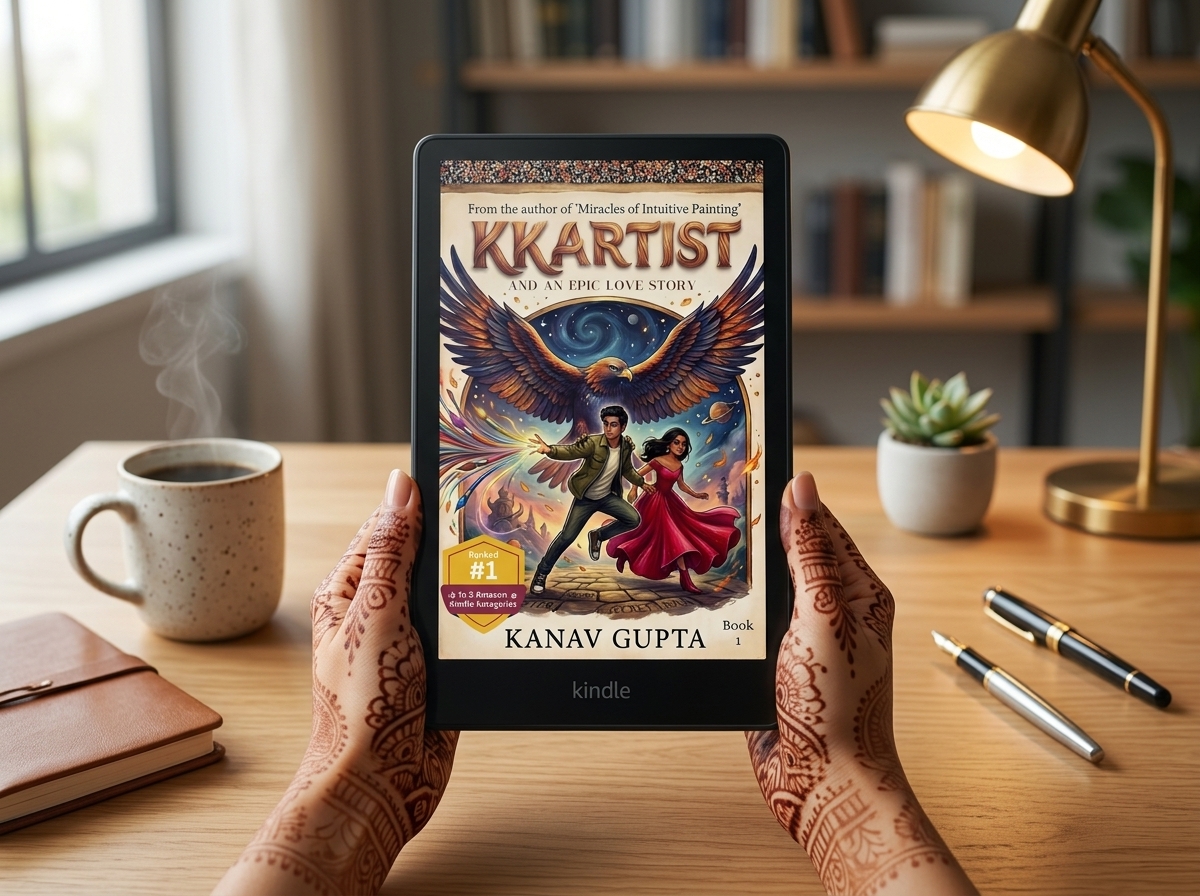
Rating:
⭐⭐⭐⭐ (4.2 out of 5)
I picked up KKARTIST expecting another campus love story dressed up with an artsy backdrop, and by the time I closed it, I realized I had read something a lot stranger and a lot more layered than that. In my years reviewing books for Deified Publication, I have gone through a fair number of college romances and just as many fantasy debuts, but very few authors try to weld the two together the way Kanav Gupta does here. KKARTIST: And an Epic Love Story opens with a grandmother telling a story to a circle of kids around a bonfire under a sky full of stars and moons, and that framing choice alone told me this was not going to be a straightforward romance. It sets the tone for a book that keeps stepping sideways into myth just when you think you know where it is headed, and honestly, I did not expect to be talking about ancient tribes and holy fire by the end of it.
At the center of that grandmother’s story is Kanav Bansal, a boy who grew up hearing from every uncle and aunty that he was destined to be a great artist. He walks into the prestigious Ringling School of Music and Fine Arts in Mumbai on a borrowed superbike, dripping with the kind of confidence that comes from never once being told no. Within a chapter or two, that confidence cracks. Surrounded by classmates with real, effortless talent, Kanav starts to understand that he is nowhere near the prodigy his family built him up to be, and that gap between what he was promised and what he actually is becomes the engine of the whole book. It is a familiar kind of ache, dressed up in an unfamiliar setting.
Into that mess of self doubt walks Pari, a girl from another department who becomes his soft landing. I liked how Gupta does not rush this part. Their early scenes together, especially the ice breaking activities where Kanav mistakes another girl for Pari and nearly makes a fool of himself in front of her, have an easy, funny rhythm to them, the kind you would expect from any good campus romance. Their birthday date near the end of that arc, with the little Ganesh idol Pari gifts him and the kiss that follows, reads like the emotional high point of the book’s first half, right before everything tips over into something much darker and stranger.
What stood out to me most, though, is how much mythology Gupta stitches into what looks, on the surface, like a simple coming of age story. There is a whole subplot running underneath the campus scenes involving a being called Narad, an old grudge against people called Kkartists, and a tribe called the Kkarr who test and mark gifted artists across worlds. Honestly, I was not expecting a book about art school heartbreak to also be doing worldbuilding about holy fire and something called ichcha mrityu, the power to choose one’s own death. It is an ambitious mix, and I think readers who like their fantasy fed to them slowly, in pieces, rather than handed over in one clean explanation, will get the most out of it.
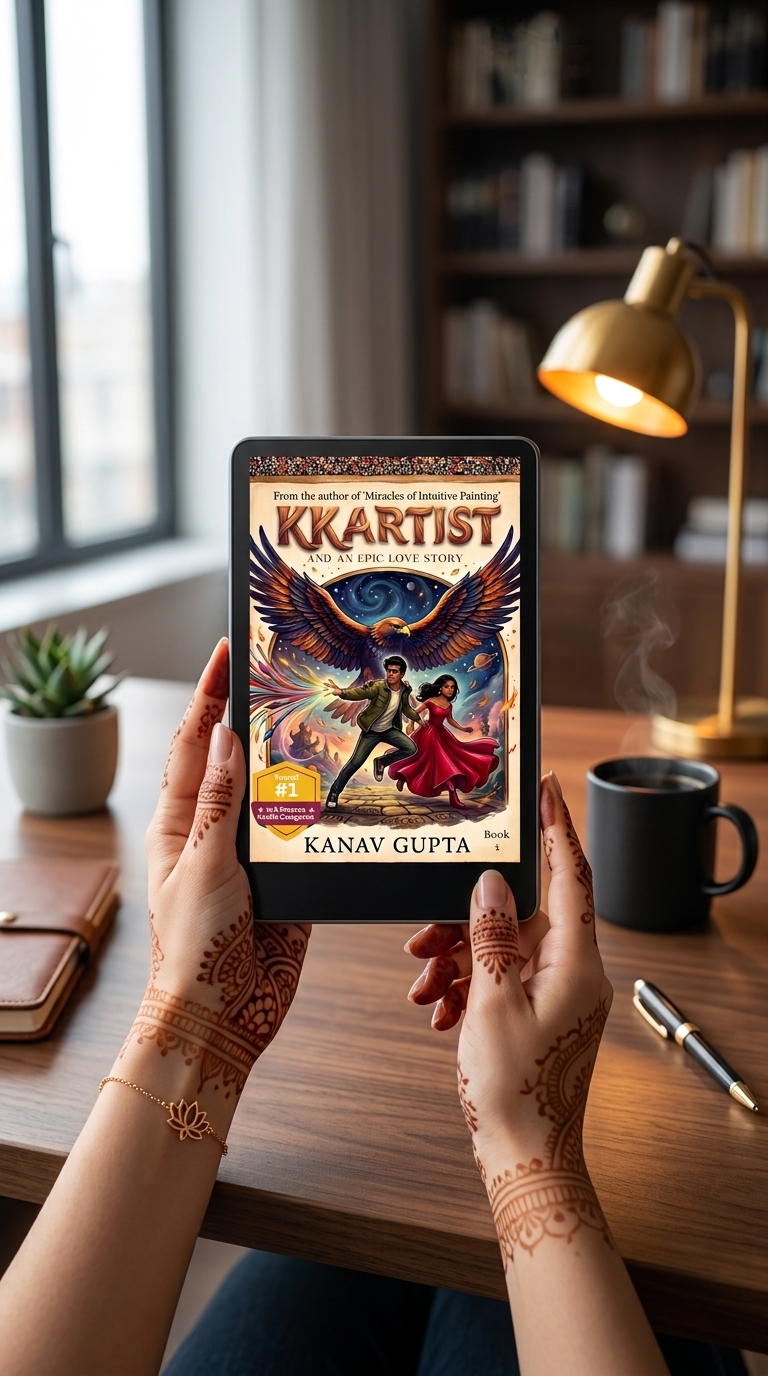
There is a moment I kept coming back to, where Kanav’s friend Vishnu gets hold of his diary and starts reading it out loud to the whole friend group, teasing him about being in love. It is a small, almost throwaway scene, but it is the kind of detail that made Kanav feel like an actual teenager to me rather than a plot device, embarrassed and unable to stop his friends from finding out what he already knows about himself. Little moments like this are doing a lot of work to keep the book grounded before it goes fully strange.
The scene that really got me is the one where things stop being metaphorical altogether. Right after that first kiss with Pari, Kanav notices something growing out of his fingertips where his nails should be, and it turns out to be bristles, actual paintbrush bristles, while the scribbles around him start rearranging themselves into shapes on their own. I have read a fair number of magical realism books that use art as a symbol for hidden power, but I cannot think of one that commits to the idea this literally, and this early. It recontextualizes everything that came before it, including his family’s insistence that he was born for this.
Then there is the phone call with his mother, Shivani, where Kanav is half asleep and dreaming about his childhood, and she keeps circling around something that happened to him when he was seven, something about a surgery and lost memories he cannot place. That conversation is where the family pressure from the opening chapters stops feeling like ordinary parental ambition and starts feeling like something being deliberately hidden from him, which lines up with the blurb’s promise of a dangerous secret buried in his family’s brushstrokes. It is one of the more unsettling scenes in the book precisely because it is so ordinary on its surface, just a mother and son on the phone.
Emotionally, this book works best when it stays close to Kanav’s imposter syndrome. Anyone who has walked into a room and immediately felt smaller than everyone around them will recognize that specific ache, the one where you are not sure if you are angry at the people who lied to you about your talent or angry at yourself for believing them. Gupta captures that well in the early chapters, and it gives real weight to the romance with Pari, because her attention genuinely reads like relief rather than just a plot requirement dropped in for convenience. I will admit some of the mythological passages, particularly Narad’s long interior monologues about karma and old grudges, slowed me down and pulled me a little too far from Kanav’s actual feelings. I found myself wanting to get back to the campus and the characters rather than stay with the cosmic backstory, at least on a first read.
KKARTIST is going to work best for readers who enjoy Indian mythology reimagined alongside a modern setting, and who do not mind a slow reveal of the rules of a fantasy world. If you love a college romance with banter, hostel politics, and rich kid versus middle class tension, the first third alone delivers that in full. If you are looking for a tight, single genre read with no detours, this might test your patience in the middle stretch, where the mythology and the romance are still learning how to share the page. By the final chapters, when Pari and Vishnu are revealed to be part of the Kkarr tribe themselves and Kanav is pulled through a portal toward his real training, I was fully invested in where the story goes next.
Overall, I think Kanav Gupta, who also wrote Miracles of Intuitive Painting, is clearly interested in art as something closer to magic than metaphor, and KKARTIST commits to that idea more literally than most books in this space. It is not a perfectly balanced book. The mythology chapters could use tighter editing, and casual readers might feel the pace dip whenever Narad takes over the narration. But the core story, of a boy discovering that his own family may have engineered his entire sense of failure, is genuinely gripping, and I am curious enough about the Kkarr tribe reveal that I would pick up a sequel the day it gets announced. In 2026, with so many books either playing it safe as pure romance or going all in on fantasy, I appreciated one that tried to do both at once, even if it does not land perfectly every time.
FAQs
Is KKARTIST worth reading?
If you like campus romance blended with Indian mythology and are willing to be patient with the worldbuilding, yes, I would say it is worth your time.
Who should read KKARTIST?
Readers who enjoyed slow burn art school romances and want a supernatural twist layered on top, along with anyone drawn to modern stories that borrow from Hindu mythology.
Is KKARTIST part of a series?
Yes, the book ends with a direct setup for a sequel involving the Kkarr tribe, so this reads as the first entry in a longer story.
What genre is KKARTIST?
It sits between contemporary romance, coming of age fiction, and mythological fantasy, without settling fully into any single one of them.
With over 11 years of experience in the publishing industry, Priya Srivastava has become a trusted guide for hundreds of authors navigating the challenging path from manuscript to marketplace. As Editor-in-Chief of Deified Publications, she combines the precision of a publishing professional with the empathy of a mentor who truly understands the fears, hopes, and dreams of both first-time and seasoned writers.