
Rating:
⭐⭐⭐⭐ (4.4 out of 5)
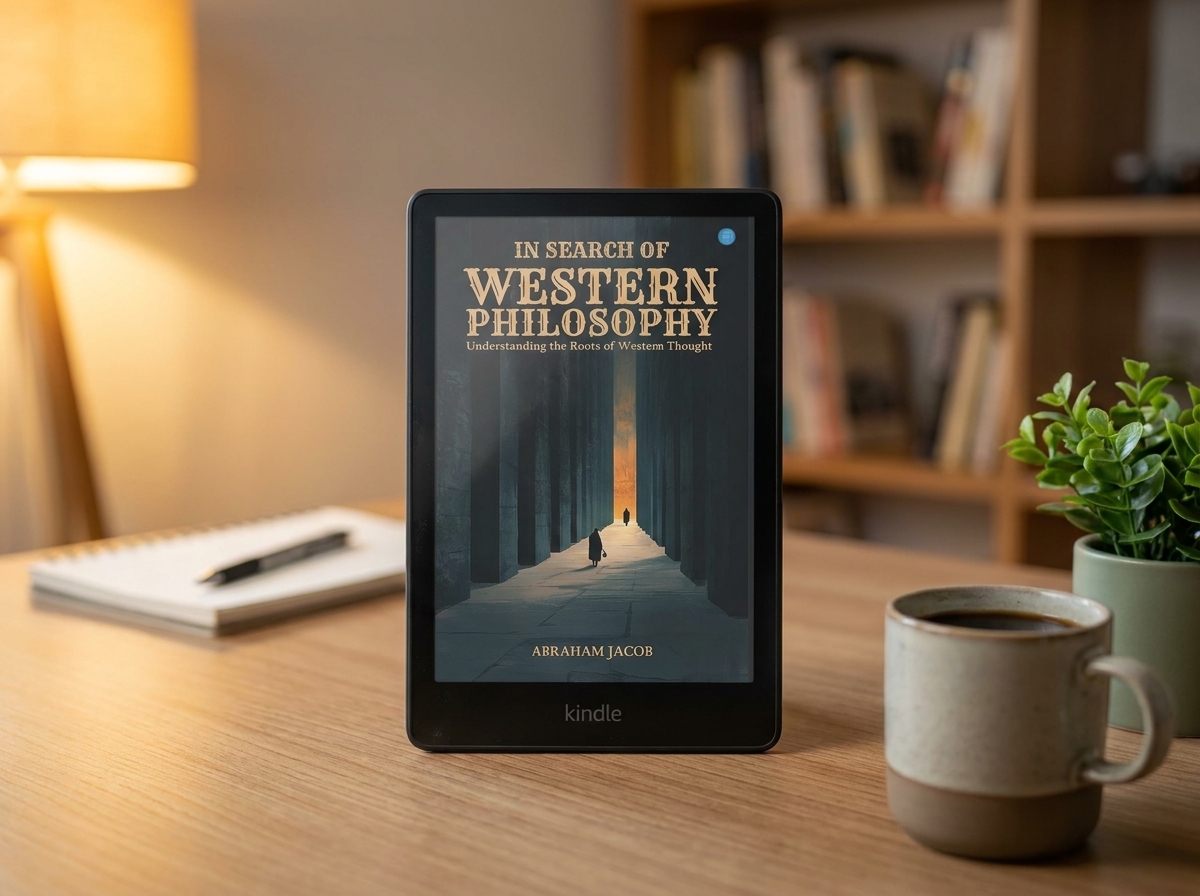
There are some books you read for information, and then there are books you read because you are trying to understand why human beings think the way they do. In Search of Western Philosophy by Abraham Jacob belongs to the second category.
I have been reviewing books for many years now, and honestly, philosophy books can sometimes feel exhausting. Either they become too academic and cold, or they simplify everything so much that the thinkers lose their complexity. This book surprised me because it sits somewhere in between. It respects the reader’s intelligence without turning every page into a lecture hall.
What I appreciated most was that Abraham Jacob writes philosophy like it is part of human life, not some distant museum object. While reading the sections on Heraclitus, Plato, Aristotle, Hegel, Schopenhauer, and even Michael Foucault, I kept feeling that the author genuinely cares about how ideas shape civilizations, emotions, morality, politics, religion, and even personal suffering.
And maybe that is why this book works.
It is not merely explaining philosophers. It is trying to show why they mattered.
What the Book Is About
In Search of Western Philosophy is essentially a historical and intellectual survey of Western philosophical thought beginning with the Ancient Greeks and moving gradually toward modern philosophy and existentialism.
The structure of the book is quite broad. From the table of contents alone, you can see that Abraham Jacob is attempting something ambitious. He moves from Plato and Aristotle to Descartes, Spinoza, Hume, Kant, Hegel, Nietzsche, Kierkegaard, Russell, Wittgenstein, Sartre, Camus, Foucault, and many others. There are also sections devoted to empiricism, German philosophy, American pragmatism, skepticism, stoicism, and existentialism.
What makes the book interesting is that the author does not present philosophy as isolated thinkers speaking into empty space. He presents it as an ongoing argument across centuries.
For example, while discussing Plato, the book talks about Heraclitus and Pythagoras as intellectual influences. When the narrative reaches Aristotle, you can clearly sense how Aristotle is responding to Plato’s idealism with a more grounded and observational approach. Later, when the book reaches Hume, Kant appears almost like someone trying to rescue rational thought from collapse. Then Hegel arrives and expands philosophy into history, consciousness, and social evolution.
That progression gives the book momentum.
I also noticed that Abraham Jacob frequently connects philosophical ideas to political events, religion, wars, revolutions, and scientific discoveries. The French Revolution appears during the Hegel section. The decline of Greek civilization influences skepticism and stoicism. Modern science and uncertainty principles become part of the concluding philosophical discussion.
This approach makes the material easier to absorb because ideas are tied to real historical conditions rather than floating abstractly.
What Stood Out to Me
One thing that immediately stood out was the author’s tone. He is clearly opinionated.
Now sometimes that can become a problem in philosophy books because authors begin preaching instead of explaining. Here, though, I think the strong voice actually helps. Abraham Jacob writes with conviction. Whether you agree with all his interpretations or not, you never feel like the book was assembled mechanically.
The chapters on the Ancient Greeks were especially engaging for me. The discussion around Heraclitus and constant change was handled beautifully. There is a section explaining the famous river analogy and how everything exists in flux. But instead of presenting it like a textbook definition, the author connects it to human life, aging, perception, conflict, and even modern scientific thinking.
I underlined several passages in that section.
The parts about Pythagoras were also unexpectedly fascinating. Most people only associate him with mathematics, but the book presents him as a mystic, philosopher, and almost cult like intellectual figure whose influence stretched far beyond geometry. I liked that the author was willing to discuss the strange and spiritual dimensions of early philosophy instead of sanding them away.
Then comes Plato.
Honestly, the Plato chapter felt like the emotional center of the early sections. Abraham Jacob clearly admires Plato deeply. You can sense it in the writing. He describes Plato not simply as a philosopher but as someone who shaped the very boundaries of Western thought itself. Some readers may feel the admiration becomes a little excessive at times, but I think it reflects genuine engagement rather than empty praise.
The Aristotle chapters were probably my personal favorite. There is something refreshing about how the book presents Aristotle as practical, systematic, and intensely curious about the real world. The discussion on logic, metaphysics, categories, and the classification of knowledge was surprisingly readable considering how dense these topics usually become.
I also appreciated that the book spends time discussing stoicism and skepticism instead of rushing past them. The section on Seneca particularly caught my attention because the author treats stoicism not as motivational social media wisdom but as a response to instability, violence, political collapse, and mortality. In 2026, that feels incredibly relevant.
The Hegel chapter is another major highlight. Now, I will admit something honestly. Hegel is difficult. Even readers who genuinely love philosophy sometimes struggle with him. But Abraham Jacob manages to communicate the emotional ambition behind Hegel’s thought. The book explains how Hegel saw history itself as part of consciousness unfolding. You may not fully agree with the interpretation, but at least you understand why Hegel mattered.
And then there is Schopenhauer.
I think many readers will connect deeply with those pages because the writing suddenly becomes darker and more intimate. The sections about suffering, isolation, desire, and the tragic nature of existence are written with unusual emotional clarity. It does not feel academic anymore. It feels personal.
The Foucault chapter was interesting too because it shifts the mood entirely. By that stage, philosophy becomes fragmented, suspicious of certainty, suspicious of language itself. The author presents Foucault almost as someone dismantling old intellectual structures brick by brick.
Not everyone will agree with all the interpretations here. Some academic readers may argue that certain thinkers are simplified or approached too personally. But I think general readers will actually appreciate that accessibility.
The Emotional Core
What surprised me most about In Search of Western Philosophy is that beneath all the theories and historical references, the book is really about human confusion.
That sounds strange to say, but I mean it sincerely.
Again and again, the book returns to the same human questions. What is truth? Can we trust our senses? Is morality real or invented? Does God exist? Are we free? Is life meaningful? Why do civilizations rise and collapse? Why does suffering exist?
And maybe the reason philosophy continues across centuries is because no answer ever fully satisfies us.
The conclusion section especially carries this feeling strongly. Abraham Jacob moves through Descartes, Hume, Kant, Popper, Wittgenstein, Heidegger, existentialism, and modern scientific uncertainty almost like someone tracing the slow breakdown of certainty itself.
There is a sadness in those final pages.
Not melodrama. Something more intellectual and existential.
The book seems to suggest that human beings desperately want stable truth, but every philosophical system eventually cracks under pressure. And yet people continue searching.
I think many readers will recognize themselves in that struggle, even if they have never studied philosophy formally.
Who This Book Is For
This book is best suited for readers who genuinely enjoy ideas and intellectual history.
If you want a highly technical academic text filled with citations and specialized terminology, this may not fully satisfy you. The book is much more narrative and interpretive in style.
But if you are someone who has ever wondered where modern ideas came from, why philosophers still matter, or how Western thought evolved from Ancient Greece to existentialism, then I think you will find a lot to appreciate here.
It is also a good entry point for readers who feel intimidated by philosophy books. Abraham Jacob writes with enough clarity that newcomers can follow the major arguments without getting completely lost.
That said, I do think the pacing becomes uneven in some sections. Certain philosophers receive enormous attention while others move past very quickly. A few transitions also feel abrupt. And occasionally the author’s personal judgments become stronger than the actual philosophical analysis.
Still, I would rather read a philosophy book written with passion than one written like an instruction manual.
Final Thoughts
As someone who has spent years reviewing books at Deified Publication, I can honestly say that In Search of Western Philosophy feels like a book written out of genuine intellectual obsession.
It is ambitious. Sometimes messy. Sometimes intensely insightful.
But never lifeless.
What I admired most was its willingness to treat philosophy as something deeply human instead of merely academic. Abraham Jacob is not just cataloging thinkers chronologically. He is trying to understand how centuries of human thought shaped our present world.
And honestly, in a time where attention spans are collapsing and complex ideas are reduced into twenty second clips online, there is something admirable about a book that still believes human beings are capable of wrestling with difficult questions.
I think readers who love history, philosophy, politics, psychology, and intellectual debates will get the most out of this book.
Some sections may require patience. Some interpretations may spark disagreement. But perhaps that is fitting for a philosophy book.
After all, philosophy was never meant to make everyone comfortable.
FAQ
Is In Search of Western Philosophy worth reading?
Yes, especially if you enjoy intellectual history and philosophical ideas presented in a more human and narrative style rather than strict academic language.
Who should read In Search of Western Philosophy by Abraham Jacob?
Readers interested in Plato, Aristotle, Hegel, Nietzsche, existentialism, skepticism, and the evolution of Western thought will probably enjoy it the most.
Is this book beginner friendly?
Mostly yes. Some chapters become dense, particularly the Hegel and modern philosophy sections, but overall the writing remains accessible for general readers.
What genre is In Search of Western Philosophy?
It falls under philosophy, intellectual history, and nonfiction cultural analysis.

With over 11 years of experience in the publishing industry, Priya Srivastava has become a trusted guide for hundreds of authors navigating the challenging path from manuscript to marketplace. As Editor-in-Chief of Deified Publications, she combines the precision of a publishing professional with the empathy of a mentor who truly understands the fears, hopes, and dreams of both first-time and seasoned writers.