
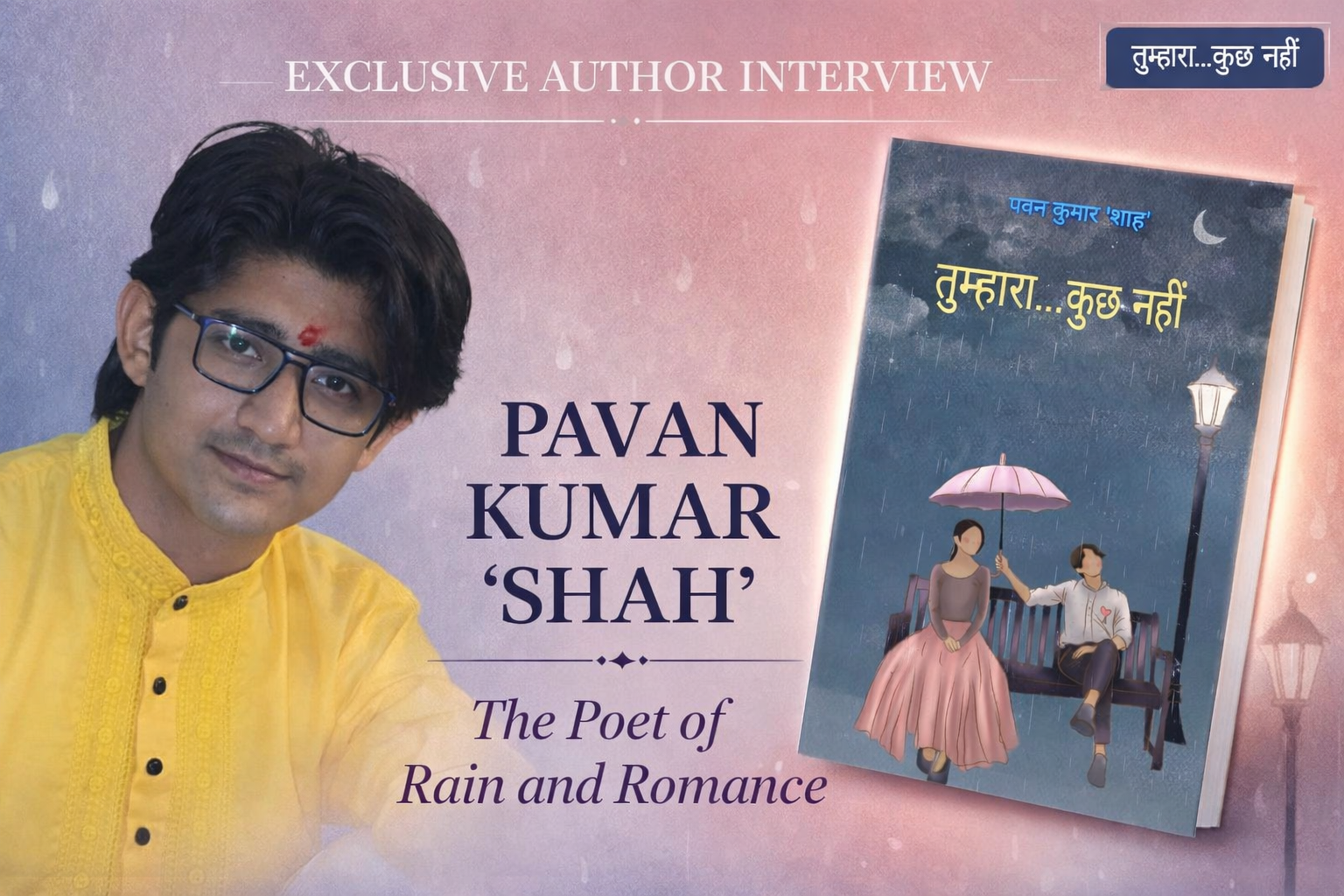
A tender dialogue with the poet who captures love’s innocence and the ache of separation
Interview by Priya Srivastava, Editor-in-Chief, Deified Publications
There’s a particular kind of poetry that doesn’t just tell you about love. It makes you remember every rain-soaked moment you ever lived, every umbrella you ever shared, every goodbye that left your heart heavier than words could hold. Pawan Kumar Shah writes that kind of poetry.
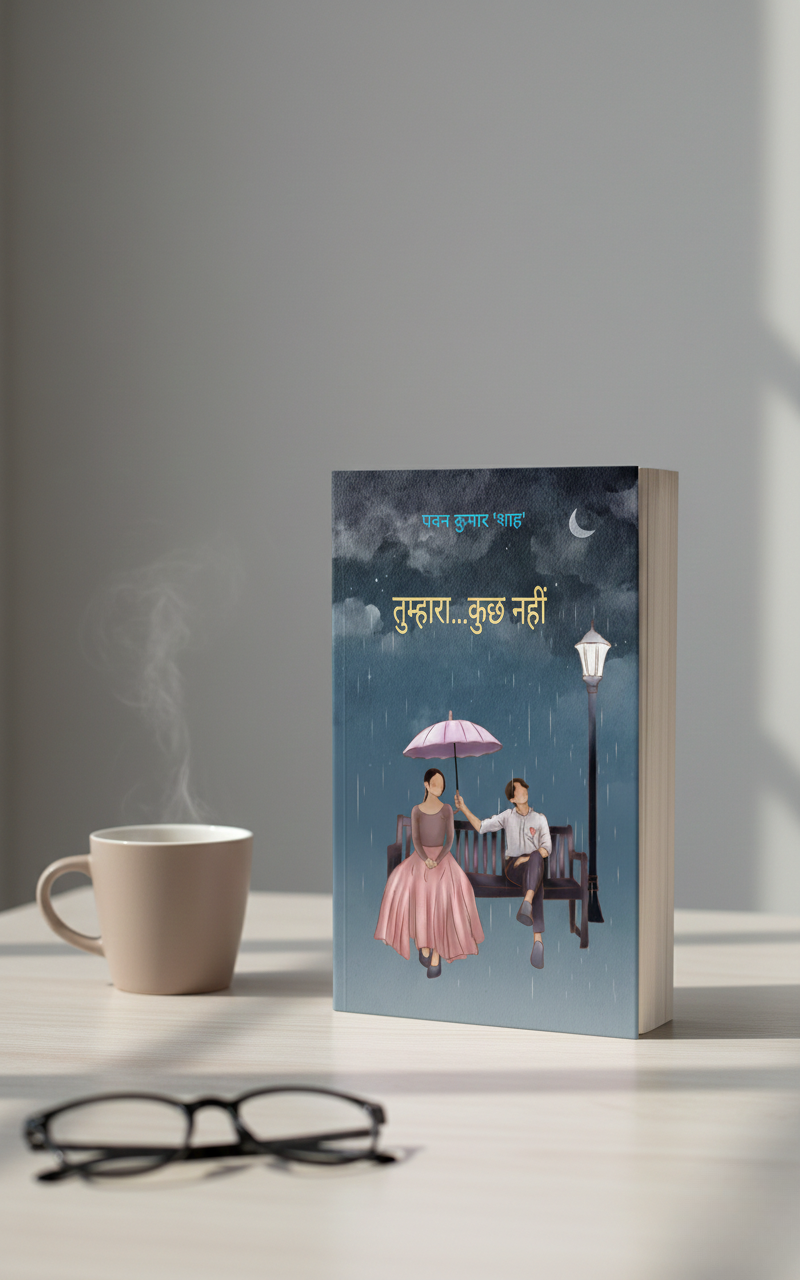
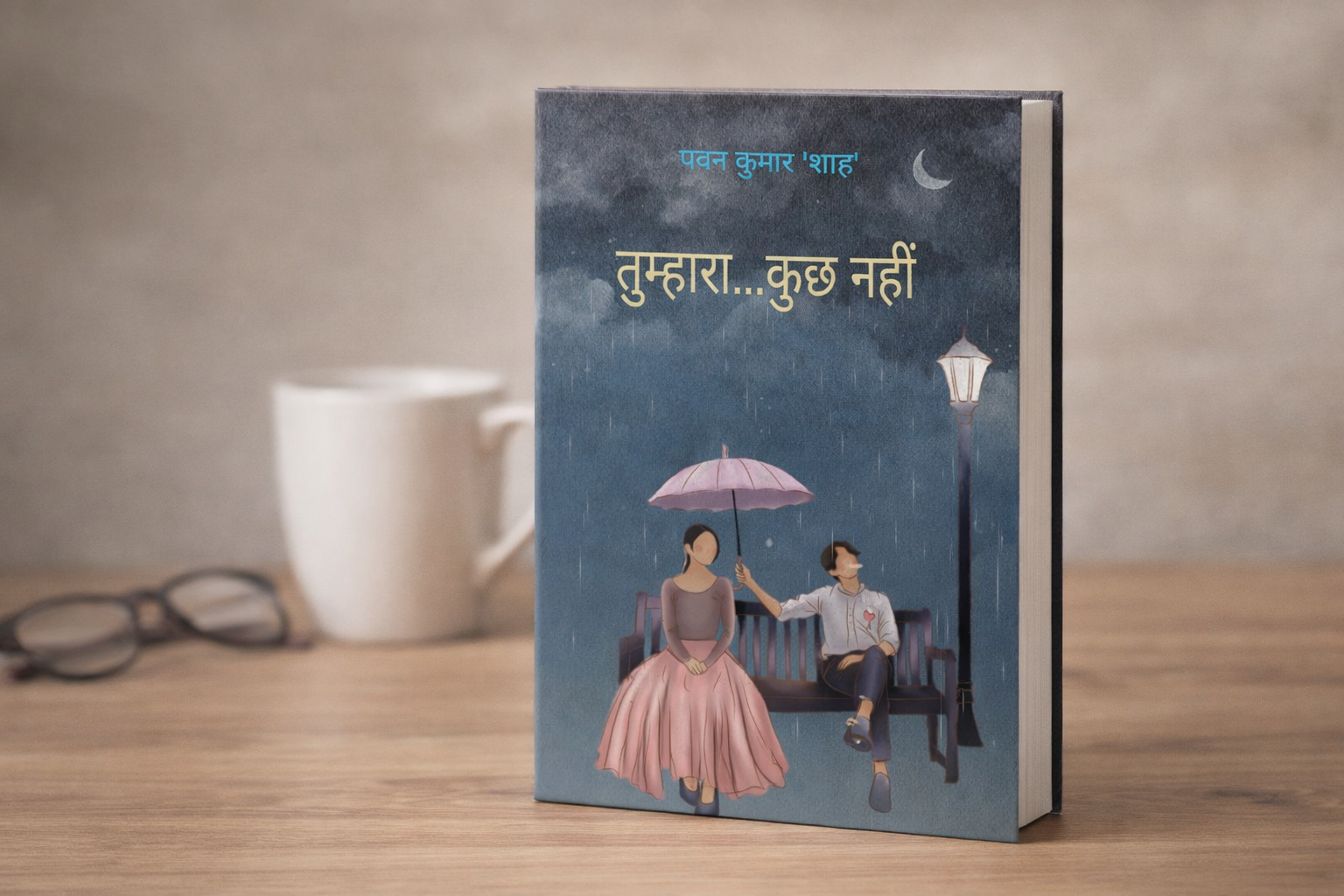
When I first saw the cover of Tumhara…Kuch Nahi, a couple sitting on a bench under a pink umbrella as rain falls around them, I thought I understood the book. When I read the poems inside, I realized I’d only glimpsed the surface. This isn’t just romantic poetry. It’s the chronicle of every heart that’s loved, lost, longed, and learned to carry the weight of “yours…nothing.”
Meeting Pawan felt like meeting someone who’s collected rain in his palms and somehow turned it into words.
The Title That Holds Everything
Priya Srivastava: Pawan, your book is titled Tumhara…Kuch Nahi. That ellipsis between “yours” and “nothing” holds so much silence, so much unsaid emotion. What does this title mean to you?
Pawan Kumar Shah: That ellipsis is everything, Priya. It’s the pause between what we want to say and what we actually say. It’s the space between loving someone and losing them. It’s that moment when you realize you’re not theirs anymore, or maybe you never were.
“Tumhara…Kuch Nahi” can be read in so many ways. “Yours…Nothing,” meaning I have nothing that’s yours. Or “Of yours…Nothing remains.” Or even “You’re…Nothing to me now.” Each reading is a different kind of heartbreak.
I chose this title because it captures what most of my poems explore. That painful territory between connection and disconnection. Between belonging and being left behind.
PS: The cover shows a couple under an umbrella in the rain. It’s romantic but also melancholic. Tell me about that choice.
PK: Rain is the perfect metaphor for love, isn’t it? It’s beautiful and necessary, but it can also drench you, leave you cold, make you seek shelter.
The couple on the cover, they’re together but faceless. You can’t see their expressions. Are they in love? Are they saying goodbye? Are they strangers sharing an umbrella? The ambiguity is intentional.
And the umbrella, that’s protection. It’s the small kindnesses we offer each other. But notice, the rain is still falling. Even when someone holds an umbrella for you, the storm doesn’t stop. You’re just a little less alone in it.
That’s what this book is. It’s about finding moments of shelter in each other, even when the storm of life continues.
Love’s Innocence and Separation’s Ache
PS: A reviewer said your poetry touches both the innocence of love and the ache of separation. Those seem like opposite emotions. How do you hold both?
PK: Because that’s what real love is. It starts innocent, pure, full of hope. You believe it will last forever. You believe nothing can touch it.
But then life happens. Distance happens. Change happens. Misunderstanding happens. And suddenly, that innocent love becomes a source of the deepest pain.
My poems try to capture that entire arc. The excitement of first meeting. The joy of connection. The comfort of being understood. And then, slowly, the realization that it’s slipping away. The confusion. The hurt. The final goodbye. And the long, lonely aftermath.
Separation isn’t just a moment. It’s a process. It’s waking up every day and remembering someone who’s no longer there. It’s hearing a song and feeling your heart break all over again. That ache doesn’t go away quickly.
PS: Your poetry is described as having “simple yet effective language.” In a world where poets often reach for complexity, why choose simplicity?
PK: Because heartbreak is simple. Love is simple. The feelings are universal and direct.
When your heart is breaking, you don’t think in metaphors. You think, “I miss you.” “I loved you.” “Why did you leave?” Simple sentences. Raw emotions.
I wanted my poetry to feel like a conversation you might have with yourself at 2 AM. Not a performance. Not showing off vocabulary. Just honest, direct expression of what the heart feels.
The effectiveness comes from truth, not from complicated language. If I can make you feel what I felt when I wrote the poem, then it’s worked. That’s all that matters.
The Poems That Connect
PS: I saw one of your poems titled “Nazar” (Gaze). It talks about how God gave him eyes to look at her, a black mole on her forehead, but an evil eye that disrupts that gaze. Tell me about this poem.
PK: That poem is about how desire and obstacle are often inseparable. You’re given the ability to see beauty, the object of beauty itself, but also the forces that keep you from fully possessing or experiencing that beauty.
In Indian culture, the evil eye is this concept that even good things can be endangered by excessive attention or envy. So the poem plays with that idea. Even the act of looking, of admiring, can invite harm.
But it’s also about perspective. Sometimes we are our own evil eye. Our insecurities, our fears, our past wounds, they disrupt our ability to simply enjoy what’s in front of us.
PS: The reviewer mentioned that your poems make readers connect with their own experiences and continue to resonate even after reading. What creates that lasting impact?
PK: Universality. I write about my experiences, my love, my loss. But I try to express them in a way where you can insert your story into the poem.
When I write about missing someone, I don’t fill it with specific details that are only mine. I focus on the emotion itself. That way, when you read it, you’re not reading about me. You’re reading about yourself.
That’s when poetry becomes powerful. When it stops being about the poet and starts being about the reader. When it becomes a mirror, not a window.
And I think the poems resonate because they’re honest. People can sense when you’re pretending or performing. But when you write from a real place of hurt or joy, that authenticity carries through.
The Poet Behind the Words
PS: Tell me about Pawan Kumar Shah before he became a published poet. Who were you before this book?
PK: I was, and still am, just someone who feels deeply. Someone who notices the small gestures, the quiet moments, the things most people walk past without seeing.
I’ve always been drawn to poetry. Growing up, I read a lot of Hindi poets, the ones who wrote about love and loss in language that felt like everyday conversation. That influenced how I write.
But for a long time, I wrote just for myself. In notebooks, on my phone, wherever I could capture the feeling before it escaped. Publishing felt like a big step, like undressing in front of strangers. These poems are so personal.
PS: What made you decide to finally publish?
PK: A friend read some of my poems and said, “You know, other people are feeling this too. They just don’t have the words for it. Your poems could be their words.”
That shifted something for me. I realized holding onto these poems was selfish in a way. If they could help someone feel less alone, if they could give language to someone’s unnamed pain or unnamed love, then I had a responsibility to share them.
So I stopped thinking of publishing as exposure and started thinking of it as offering. I’m offering these words to anyone who needs them.
PS: Your pen name is ‘Shah.’ Is there a story there?
PK: It’s actually part of my full name, Pawan Kumar Shah. But using ‘Shah’ as my poetic identity felt right. It’s short, memorable, but also there’s something regal about it, something that suggests a certain gravity.
Plus, in poetry, you’re creating a persona, even when you’re being honest. The Shah who writes these poems is a version of me, the version that’s willing to be vulnerable, to admit pain, to speak what others only whisper.
The Craft of Emotional Poetry
PS: Walk me through your writing process. How does a feeling become a poem?
PK: It usually starts with an image or a moment. I’ll see something, a couple in the rain, a woman’s laugh, a street lamp at night, and it will trigger a flood of feeling.
I sit with that feeling. I don’t rush to write. I let it build until I can’t hold it anymore. Then I write, usually in one sitting, letting the words pour out without judgment.
That first draft is always messy, too emotional, too raw. Then I come back later, sometimes days later, and I shape it. I look for the lines that carry the most weight and I cut everything else. Poetry is as much about what you leave out as what you include.
PS: Do you write to heal or to remember?
PK: Both. Writing helps me process pain, make sense of loss. It’s cathartic. But it’s also a way of preserving moments I don’t want to forget.
Even painful memories are precious in their own way. They’re proof that you felt something, that you lived fully. So I write to honor those experiences, even the ones that hurt.
PS: Is there a poem in this collection that cost you the most to write?
PK: There’s one about the last conversation before a goodbye. Writing that one felt like living the goodbye all over again. Every line brought back specific words, specific silences, the exact ache in my chest.
I had to write it in pieces because I couldn’t handle the full weight of it at once. But I’m glad I wrote it. That poem feels like closure, like I finally said everything I couldn’t say in the actual moment.
The Landscape of Love and Loss
PS: Your poems explore various situations and emotions of life. What themes run through the collection?
PK: The primary thread is romantic love, in all its phases. The excitement of new love, the comfort of companionship, the fear of losing someone, the pain of separation, the bitterness of betrayal, the longing that remains after.
But there are also poems about self-reflection. About looking at yourself after heartbreak and asking, who am I without this person? What do I carry forward? What do I leave behind?
And there are poems about acceptance. About learning to live with loss. About finding beauty in rain even when you’re getting drenched. About understanding that some things are “tumhara…kuch nahi,” yours…nothing, and that’s okay. You survive anyway.
PS: The rain imagery appears throughout. Why rain?
PK: Rain is transformative. It changes the entire atmosphere. The smell of the air, the color of the sky, the way light falls. When it rains, the world becomes different.
That’s what love does too. It transforms everything. Suddenly every song is about them. Every place reminds you of them. The world is filtered through the lens of this feeling.
And rain also represents sadness, tears, things washing away. So it holds both the beauty and the melancholy that I’m trying to capture.
Plus, there’s something inherently romantic about rain in Indian culture. Bollywood has taught us that rain is when hearts confess, when lovers reunite, when emotions overflow. My poems play with that imagery while also subverting it. Sometimes rain is just cold and you’re alone.
Writing in the Digital Age
PS: You’re a young poet writing in an age dominated by social media and instant content. How does that influence your work?
PK: It’s both a blessing and a challenge. Social media gives poets immediate access to readers. You can share a two-line verse and within hours, hundreds of people have read it, responded to it.
But there’s also pressure to be constantly producing, constantly relevant. And there’s a tendency toward oversimplification. Social media poetry can sometimes sacrifice depth for virality.
I try to balance both worlds. I share excerpts online to build connection with readers. But the full poems, the complete emotional journeys, those live in the book where they have space to breathe.
PS: Do you think there’s a hunger for Hindi romantic poetry among today’s youth?
PK: Absolutely. More than ever, actually. Young people are dealing with complex emotional situations, modern relationships, new kinds of loneliness. They need language for these experiences.
Hindi poetry, especially the accessible kind, gives them that language. It’s in their mother tongue, so it hits deeper. It’s simple, so they can share it, quote it, make it their own.
And I think there’s a longing for sincerity. Everything online is curated, filtered, performative. Poetry offers raw truth. That’s refreshing.
Connection Through Heartbreak
PS: Your book description mentions that poems touch readers’ experiences and continue echoing in their hearts. Have you received responses from readers that surprised you?
PK: I’ve had readers message me saying they read a poem to the person they’re struggling to leave. Others have said they finally found words for feelings they’ve carried for years.
One reader told me they cried reading the book because it felt like I’d written their story. That’s both humbling and heavy, you know? To realize your personal pain is actually collective pain.
What surprises me is how specific experiences create universal connection. I write about my heartbreak, my specific relationship, but readers find themselves in it. That’s the magic of honest expression.
PS: What do you hope readers take away from Tumhara…Kuch Nahi?
PK: I hope they feel seen. I hope they realize that whatever they’re feeling, the joy, the pain, the confusion, it’s valid and it’s shared.
I hope they find comfort in knowing that heartbreak is survivable. I survived mine enough to write about it. They’ll survive theirs too.
And maybe, I hope they learn to find beauty even in the painful moments. Rain might make you wet and cold, but it’s still beautiful if you let yourself see it that way.
The Quick Round
PS: Favorite Hindi poet?
PK: Harivansh Rai Bachchan. The way he captured longing and philosophical depth in simple language always inspired me.
PS: When do you write best?
PK: Late at night or during rain. Both times when the world is quieter and emotions feel louder.
PS: One word to describe your poetry?
PK: Relatable. I want everyone to see themselves in it.
PS: Favorite line from your own book?
PK: That’s hard! But there’s one that goes, “वो नज़र उठी और उसने लड़के के एक थप्पड़ जैसी बेइज्ज़त हो गई।” It captures how a single look can destroy you. That line wrote itself and I knew immediately it was true.
PS: What gives you hope after heartbreak?
PK: The fact that I can write about it. If I can transform pain into poetry, then pain isn’t wasted. It becomes something that might help someone else. That gives me hope.
Looking Ahead
PS: Is this your first and only collection, or are there more poems waiting?
PK: There are always more poems waiting. Life keeps happening, which means feelings keep happening.
I’m already thinking about themes for a second collection. Maybe something more focused on self-discovery after loss. Or about different kinds of love, not just romantic. Familial love, friendship, love for places and moments.
But I’m not rushing. I want each collection to be honest and necessary, not just a product.
PS: What advice would you give to young people experiencing their first heartbreak?
PK: Feel it fully. Don’t rush past it. Don’t let people tell you it’s just puppy love or you’ll get over it. Your pain is real and it matters.
Write about it. Talk about it. Create something from it. Heartbreak is terrible, but it’s also one of the most creatively fertile experiences you’ll have.
And know that it won’t feel this intense forever. The rain always stops eventually. But what you learn in the rain, that stays with you.
Final Reflections
PS: Before we close, what would you say to someone holding your book right now, about to read it?
PK: I’d say, this book holds my heart, but there’s room for yours too. As you read, you might remember your own rainy nights, your own shared umbrellas, your own goodbyes.
That’s intentional. These poems are yours as much as they’re mine.
And if you’re currently heartbroken, if you’re sitting with the pain of “tumhara…kuch nahi,” of having nothing that’s theirs anymore, I want you to know: you’re not alone. I’ve been there. Others have been there. We survived. You will too.
The rain keeps falling, but we keep finding umbrellas. We keep finding benches to rest on. We keep finding moments of beauty even in the storm.
That’s what it means to be human. To love, to lose, to hurt, to heal, and to love again despite everything.
PS: That’s beautiful, Pawan. Thank you for your honesty, your vulnerability, and for giving voice to the ache and beauty of love in all its forms.
PK: Thank you, Priya. For understanding what I’m trying to say, even in the silences between the words. For giving space to poetry that doesn’t shout but whispers. That means everything.
Tumhara…Kuch Nahi by Pawan Kumar Shah is a vivid portrayal of life and love in various circumstances. Written in simple yet effective language, these poems touch both the innocence of love and the ache of separation, connecting readers with their own experiences and echoing in their hearts long after reading.
This interview has been edited for clarity while maintaining the authentic voice of the conversation.

With over 11 years of experience in the publishing industry, Priya Srivastava has become a trusted guide for hundreds of authors navigating the challenging path from manuscript to marketplace. As Editor-in-Chief of Deified Publications, she combines the precision of a publishing professional with the empathy of a mentor who truly understands the fears, hopes, and dreams of both first-time and seasoned writers.