
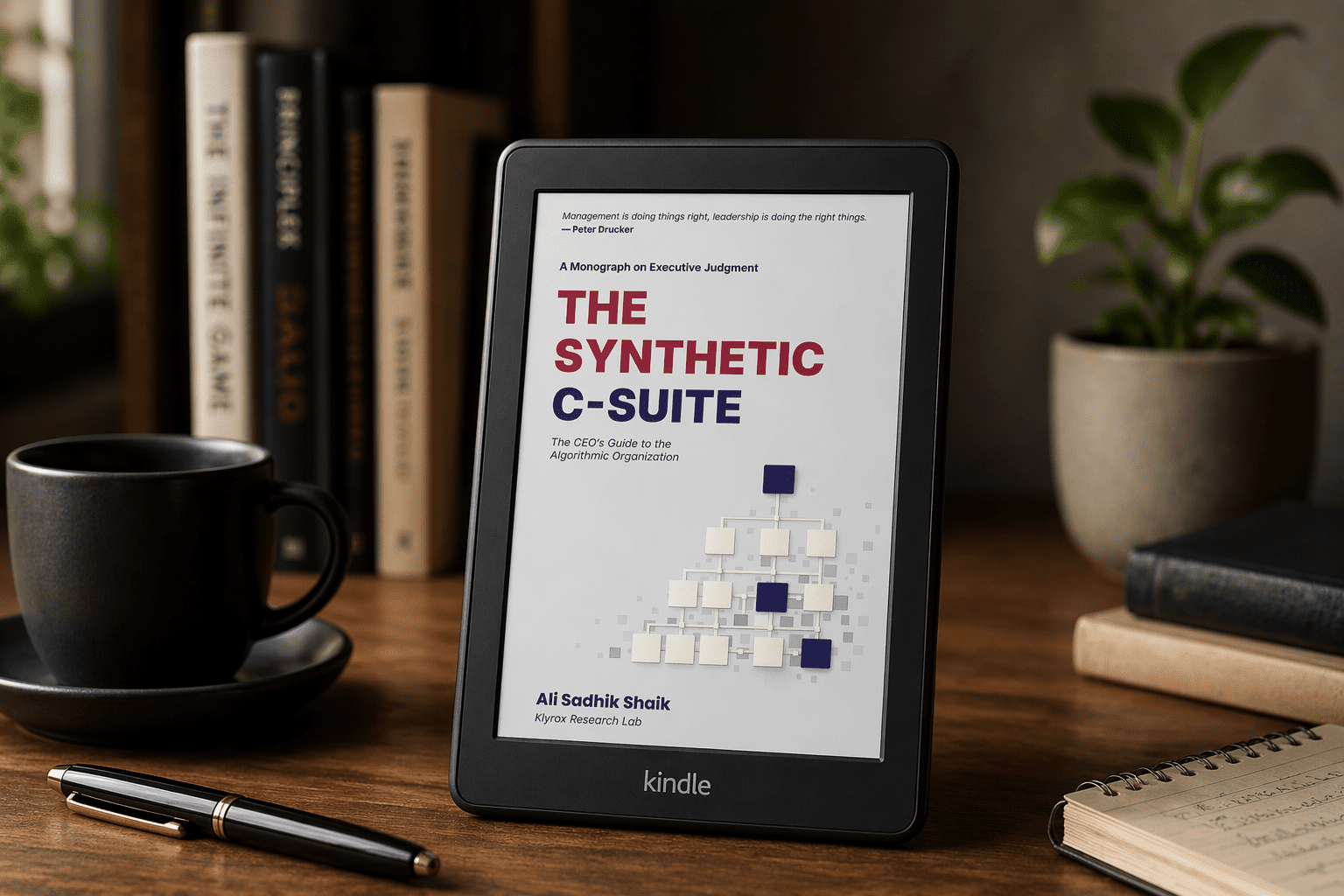
Rating:
⭐⭐⭐⭐1/2 (4.5 out of 5)
I closed The Synthetic C-Suite and just sat there for a while. Not because it was confusing or overwhelming. But because something about it felt… a little uncomfortable. The kind of discomfort that comes when a book doesn’t just give you ideas, it quietly questions how you’ve been thinking all along.
In my years as an editor at Deified Publication, I’ve read many books about leadership, productivity, even AI. Most of them promise clarity. This one does something slightly different. It gives clarity, yes, but also takes away a certain comfort. And maybe that’s exactly why it stayed with me longer than I expected.
What the Book Is About – And what it’s really trying to say
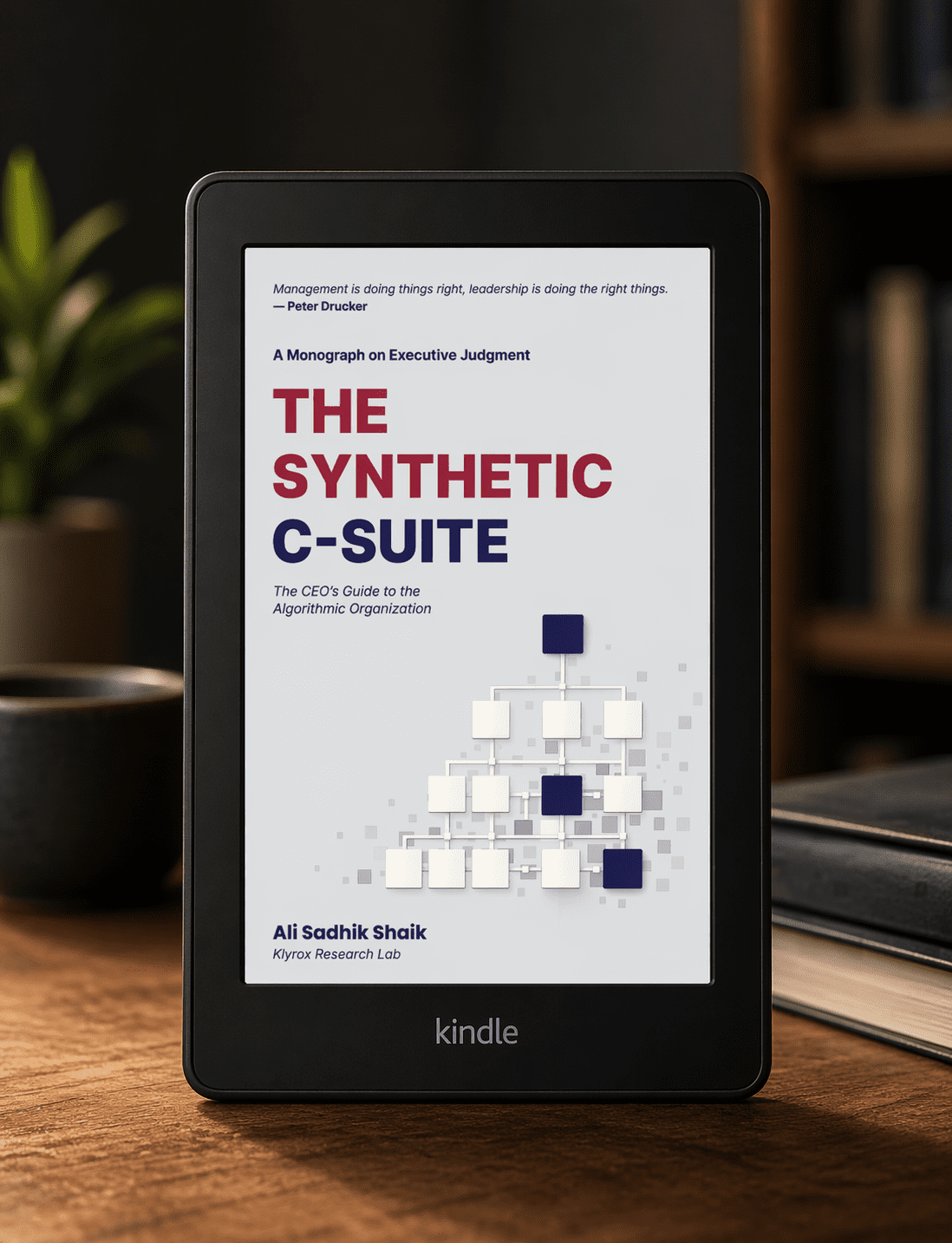
At the surface level, The Synthetic C-Suite: The CEO’s Guide to the Algorithmic Organization by Ali Sadhik Shaik is about how leadership must evolve in an AI-driven world. The book talks about how traditional management structures were built when information was scarce. Back then, leaders were valuable because they could gather, process, and act on information better than others.
Now, that advantage is disappearing.
Algorithms can process faster. Systems can optimize better. Decisions can be simulated before they are even made. So the book asks a simple but unsettling question:
If machines can “do” better than us, then what exactly is the role of a human leader?
From there, the author introduces ideas like the “Centaur Model,” where humans and AI work together, not as competitors but as extensions of each other. The human becomes the one who decides direction, intent, judgment. The machine handles execution.
But honestly, the book doesn’t feel like a typical business guide. It reads more like a shift in worldview.
There are moments where it feels almost philosophical. Like when it talks about how intelligence and speed are no longer your advantage. Humanity is.
What Stood Out to Me – The parts I kept thinking about
There’s this section about the “Human Moat” that I found really striking. The author uses the story of Sully landing the plane on the Hudson. The simulation said he could have gone back to the airport. The math supported that. But Sully added something the machine didn’t account for. Human hesitation. Shock. Time to process reality.
That moment really stayed with me.
Because it made me think about how often we trust clean data over messy reality.
Another part that lingered was the idea that companies still need human CEOs not because humans are better at decisions, but because someone has to be accountable. The line about needing “someone to go to jail” sounds harsh, but it reflects something real. You cannot punish an algorithm. You cannot hold a system morally responsible.
And that creates a strange gap between efficiency and responsibility.
Then there’s the section on irrationality. The author talks about how humans don’t always make logical choices. We buy expensive things because they feel meaningful. We stay loyal to things that don’t make sense. And instead of seeing this as a flaw, the book suggests that this might actually be an advantage.
I liked that idea more than I expected.
It reminded me of how some of the best decisions in life are not optimized. They’re felt.
The Emotional Core – What this book made me feel
I think what surprised me most is that this book, despite being about AI and corporate structure, feels deeply human.
There’s this quiet thread running through it that keeps coming back to one thing:
What does it mean to remain human in a system that is becoming increasingly non-human?
Some parts made me feel a little uneasy. Especially the idea that companies might optimize themselves into a point where they destroy the very ecosystem they depend on. The analogy of the Dust Bowl, where rational decisions led to collective disaster, felt very relevant. In 2026, when automation and AI are accelerating so quickly, that idea doesn’t feel theoretical anymore.
It feels close.
At the same time, there are moments of hope. The idea of the “Steward” leader, someone who uses AI but still protects the broader system, felt grounded. Not idealistic, just necessary.
And then there’s the ending thought about greatness not being efficient. About how machines will always choose the safe path, but humans sometimes choose the risky one. The one that doesn’t make sense on paper.
I paused there.
Because I’ve seen that in real life too. The decisions that change everything rarely look logical at the start.
Who This Book Is For – And who might not enjoy it
If you are someone working in business, startups, leadership, or even banking, this book will probably feel very relevant. Not in a technical way, but in a “this is where things are going” kind of way.
It’s also for people who are trying to understand AI beyond the hype. Not just what it can do, but what it changes.
That said, this might not be for everyone.
If you’re looking for a very structured, step-by-step guide with clear frameworks and immediate action points, you might feel this book is a bit abstract at times. It leans more into ideas than checklists.
Also, if someone is completely new to these topics, a few sections might feel dense. Not confusing exactly, but you might have to slow down and sit with it.
But for readers who like thinking about where the world is heading, and what their role might be in it, I think this book offers something meaningful.
Final Thoughts – What stayed with me after everything
I think what I appreciated most about The Synthetic C-Suite is that it doesn’t try to impress you with complexity. It tries to shift how you see things.
In my experience reviewing books for over fifteen years, the ones that stay are not always the ones with the most information. They’re the ones that change a sentence in your head. A way of thinking.
This book did that for me in small ways.
Like the idea that the future CEO is not the smartest person in the room, but the one who understands responsibility the deepest.
Or that the real advantage in an AI world might not be intelligence, but judgment.
And maybe most importantly, that efficiency is not the same as wisdom.
There were moments where I wished the book slowed down a bit more, especially when introducing some concepts. A few sections move quickly from one idea to another. But that didn’t take away from the overall experience. If anything, it made me want to revisit certain parts.
If you’re wondering whether The Synthetic C-Suite book review points to something worth your time, I’d say this:
It’s not a book you rush through. It’s one you read, pause, and think about later. Sometimes hours later.
And those are usually the ones that matter.
FAQ
Is The Synthetic C-Suite worth reading?
I think it is, especially if you are curious about how AI will change leadership and decision-making. It’s not light reading, but it offers ideas that stay with you.
Who should read The Synthetic C-Suite?
Leaders, founders, professionals, and anyone trying to understand the future of work and organizations. Even thoughtful general readers might find it interesting.
Is The Synthetic C-Suite difficult to read?
Not exactly difficult, but it does require attention. Some ideas need a bit of reflection to fully sink in.
What is The Synthetic C-Suite about in simple terms?
It’s about how leadership must evolve in a world where machines can think and act faster than humans, and why human judgment still matters.

With over 11 years of experience in the publishing industry, Priya Srivastava has become a trusted guide for hundreds of authors navigating the challenging path from manuscript to marketplace. As Editor-in-Chief of Deified Publications, she combines the precision of a publishing professional with the empathy of a mentor who truly understands the fears, hopes, and dreams of both first-time and seasoned writers.