
Rating:
⭐⭐⭐⭐ (4.3 out of 5)
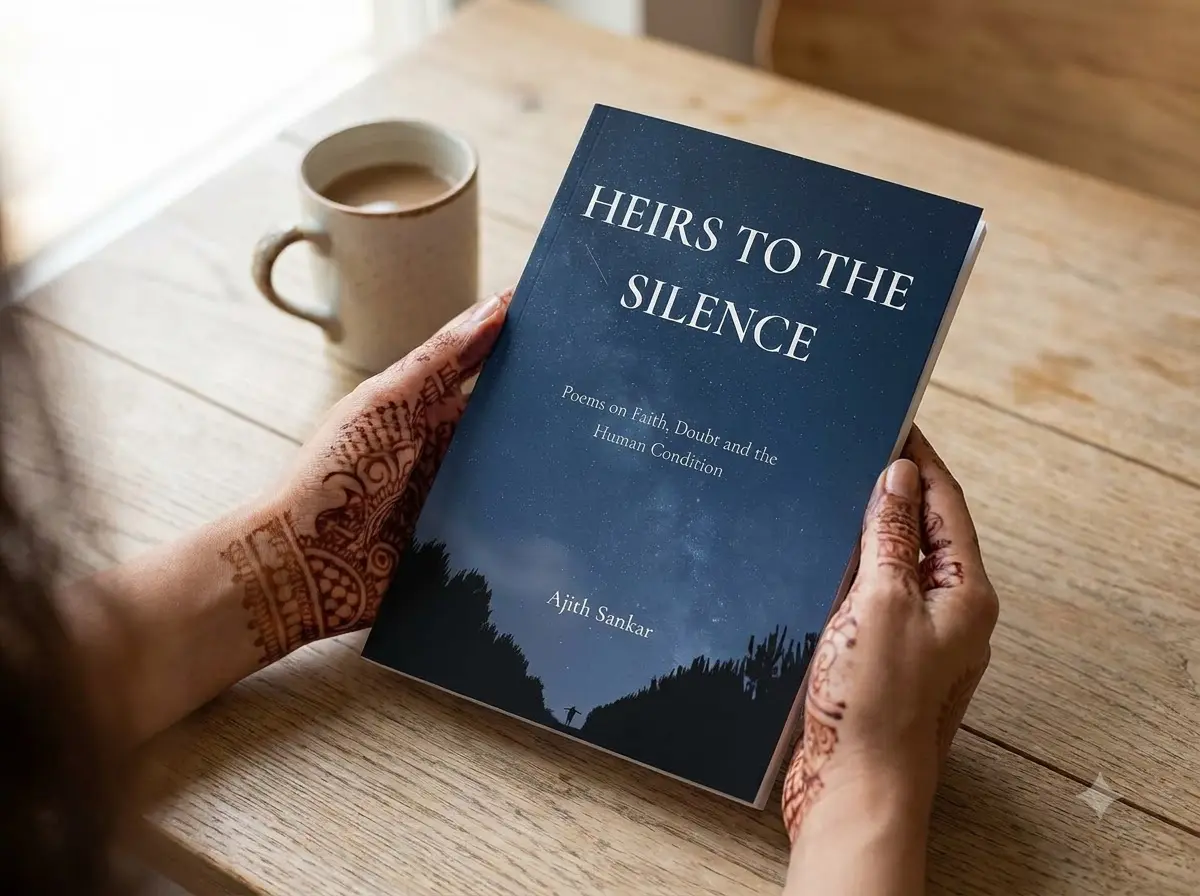
I’ll be honest, I didn’t expect a book of poems about faith and doubt to make me think about my own grandmother’s prayer room, but that’s exactly what happened somewhere around the fourth or fifth poem in Ajith Sankar’s Heirs to the Silence. She used to light a lamp every evening without fail, and I remember asking her once what she thought happened if nobody lit it. She just laughed and said the lamp wasn’t for anyone up there, it was for her own hands to remember what steadiness felt like. I hadn’t thought about that conversation in years, and then I read a line in this collection about a small, cupped flame arguing with the wind, and there it was again, sitting right in front of me. That’s the kind of book this is. It doesn’t announce itself loudly. It just finds the door you forgot you’d left open.
What the Book Is About
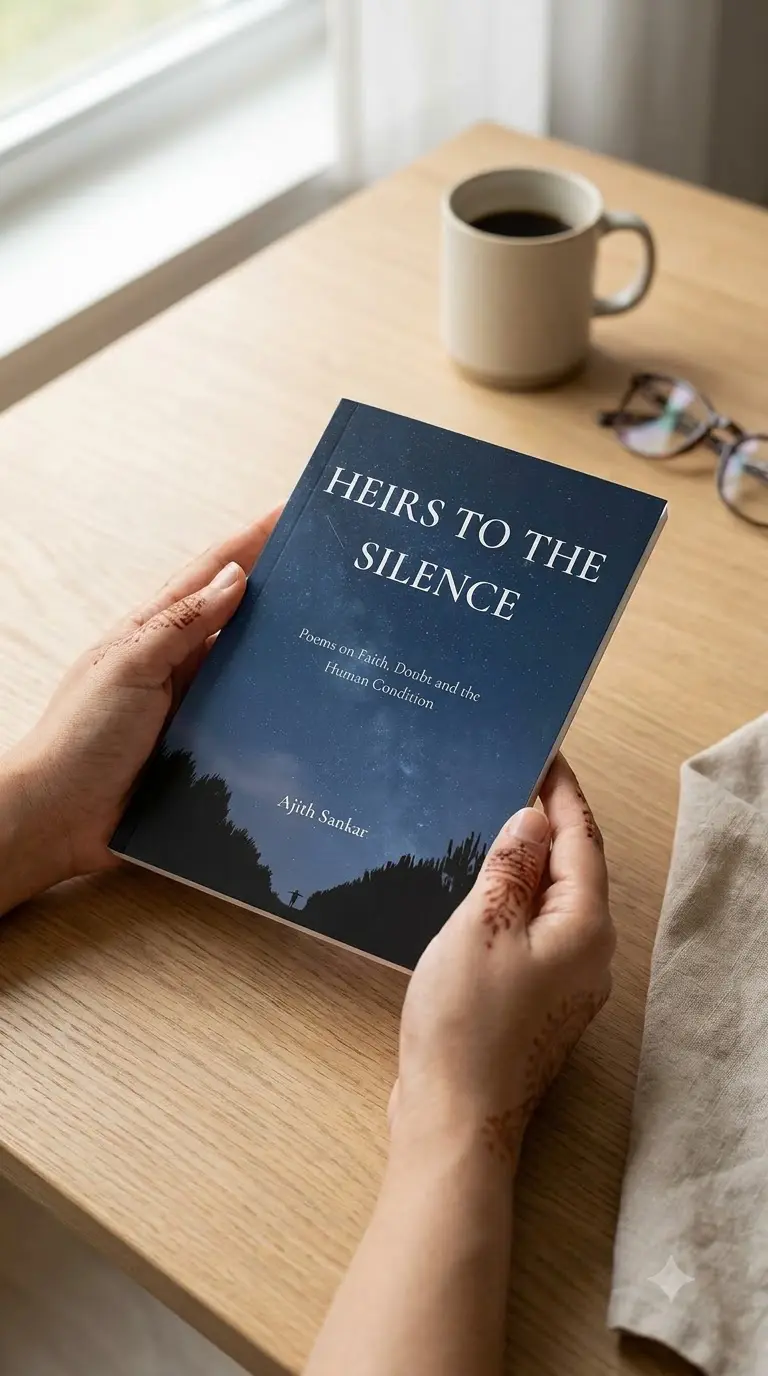
Heirs to the Silence is a collection of twenty one philosophical poems by Ajith Sankar that circle around the oldest questions we inherit as human beings, questions about god, suffering, morality, caste, nationalism, and what it means to live decently in a universe that doesn’t promise us anything back. The book doesn’t pretend to answer these questions with certainty, and that’s actually its biggest strength. Sankar writes like someone who has sat with doubt long enough to stop being afraid of it. The poems move in a loose arc, starting with inherited beliefs and the systems built around them, moving through the discomfort of realizing the sky isn’t going to correct our mistakes for us, and landing somewhere unexpectedly warm, a kind of ethics built on responsibility and compassion rather than fear of punishment or hope of reward.
What struck me early on is that this isn’t really an atheist manifesto, even though a lot of readers might expect that going in given the subject matter. It’s closer to someone standing at the edge of belief and asking honest questions instead of walking away in anger. The opening poem, “Where?”, sets this tone right away. It asks where god is when children learn to grieve on dirty footpaths beneath strip lit hospital eaves, and instead of ending in despair, it lands on the image of the poet holding onto a small flame and arguing with the wind rather than waiting for a miracle to arrive. I’ve read enough philosophical and spiritual poetry over the years to know how easily this kind of writing collapses into either bitterness or empty comfort. Sankar somehow avoids both.
What Stood Out to Me
There’s a poem called “The Earthly Mandate” that I keep coming back to. It describes someone who, instead of looking up at the sky to beg for answers, watches two neighbours pass each other by and asks why the wound of the world isn’t really in the stars at all, but in the words we let go careless and the duties we let slip. That single shift, from blaming heaven to noticing our own carelessness, is where the whole book earns its title for me. The silence isn’t punishment. It’s an invitation to take responsibility.
Sankar also has a real gift for taking abstract ideas and making them physical. In “Chosen Few!”, he writes about hands that shaped temple stone after stone being barred from the very gods they carved, and asks plainly whether the dirt people fear is really in the flesh or in the thought that built the throne in the first place. It’s a sharp, uncomfortable image, and I think that’s intentional. In “Not Another Banner”, which reads almost like commentary on the world we’re actually living in right now in 2026, he writes that the poor don’t need banners or creeds or blame, they need a roof that doesn’t leak in the rain. That line landed harder than most political essays I’ve read this year, and it did it in one sentence.
The craft here deserves a mention too. Most of the poems use a loose rhyming quatrain structure, which gives the collection a steady, almost hymn like rhythm, which feels deliberate given the subject matter is often directly questioning hymns and scripture. It’s a nice tension, using the form of devotion to question the content of devotion. I noticed this most in “The Scepter and the Lie”, where the rhythm of the poem mimics old religious verse even as the words themselves are dismantling the idea of divinely sanctioned power.
The Emotional Core
I won’t pretend every poem hit me the same way. Some of the pieces early in the collection, especially the ones dealing with caste and organized religion, are more argumentative than emotional, and readers looking for a purely meditative experience might find a few of them read more like philosophy lecture notes than poetry. But then a poem like “The Practice” shows up, and it completely resets the tone. It ends with the image of standing, not perfect, not serene, but steady where you have been, and honestly I felt that one in my chest. It’s not asking you to have faith or lose faith. It’s asking you to just keep showing up to your own life with some honesty.
The final poem, “After the Silence”, is where the book’s real heart is. It closes with the image of two people standing on bone answering to bone, no god descending, and still the light increasing, and the last line says we stand together now, and stand alone. I read that twice before moving on. It’s not a hopeful ending in the traditional sense, there’s no resolution or revelation, but it’s a kind of hope that doesn’t need permission from anywhere else. I think that’s rare in this genre, where a lot of philosophical poetry either ends in nihilism or forces a tidy spiritual bow at the end. Sankar does neither.
Who This Book Is For
This collection is for readers who like to sit with hard questions rather than have them resolved for them. If you’ve ever found yourself somewhere between belief and disbelief, not fully at home in either camp, this book will feel like it was written with you in mind. Readers who enjoy poets like Rumi read against the grain, or philosophical writers like Yuval Noah Harari but in verse form, will find familiar territory here. I’d also say this is a strong pick for anyone interested in how religion intersects with caste, power, and nationalism in the Indian context specifically, since several poems engage with that directly and with real precision.
This probably isn’t for readers who want gentle, comforting devotional poetry, or for readers who prefer their poems short and imagistic rather than argumentative. Some sections lean more toward essay in verse than lyric poem, and that’s a deliberate choice, but it won’t be everyone’s taste.
A Few Common Questions
Is Heirs to the Silence worth reading if you’re a person of faith? I’d say yes, honestly. Sankar isn’t attacking belief so much as he’s questioning the systems built around it, and a lot of the poems land just as hard if you already believe in god as they do if you don’t. Is this book depressing? Not really, despite the subject matter. It’s clear eyed rather than gloomy, and it ends somewhere closer to acceptance than despair. What’s the book actually about in one line? It’s a series of poems asking whether we can build a meaningful, ethical life without needing certainty or reward, and mostly concluding that we can.
Final Thoughts
In my years reviewing poetry for Deified Publication, I don’t come across many collections that manage to be intellectually serious without losing their pulse. Heirs to the Silence does that balancing act well, even if a handful of the earlier poems feel more like arguments than poems. Ajith Sankar has written something that respects the reader enough not to hand them easy comfort, and that’s worth something in a genre that often reaches for exactly that. I’d recommend this one with real enthusiasm, and a small note that it asks for patience in a few places.

With over 11 years of experience in the publishing industry, Priya Srivastava has become a trusted guide for hundreds of authors navigating the challenging path from manuscript to marketplace. As Editor-in-Chief of Deified Publications, she combines the precision of a publishing professional with the empathy of a mentor who truly understands the fears, hopes, and dreams of both first-time and seasoned writers.