
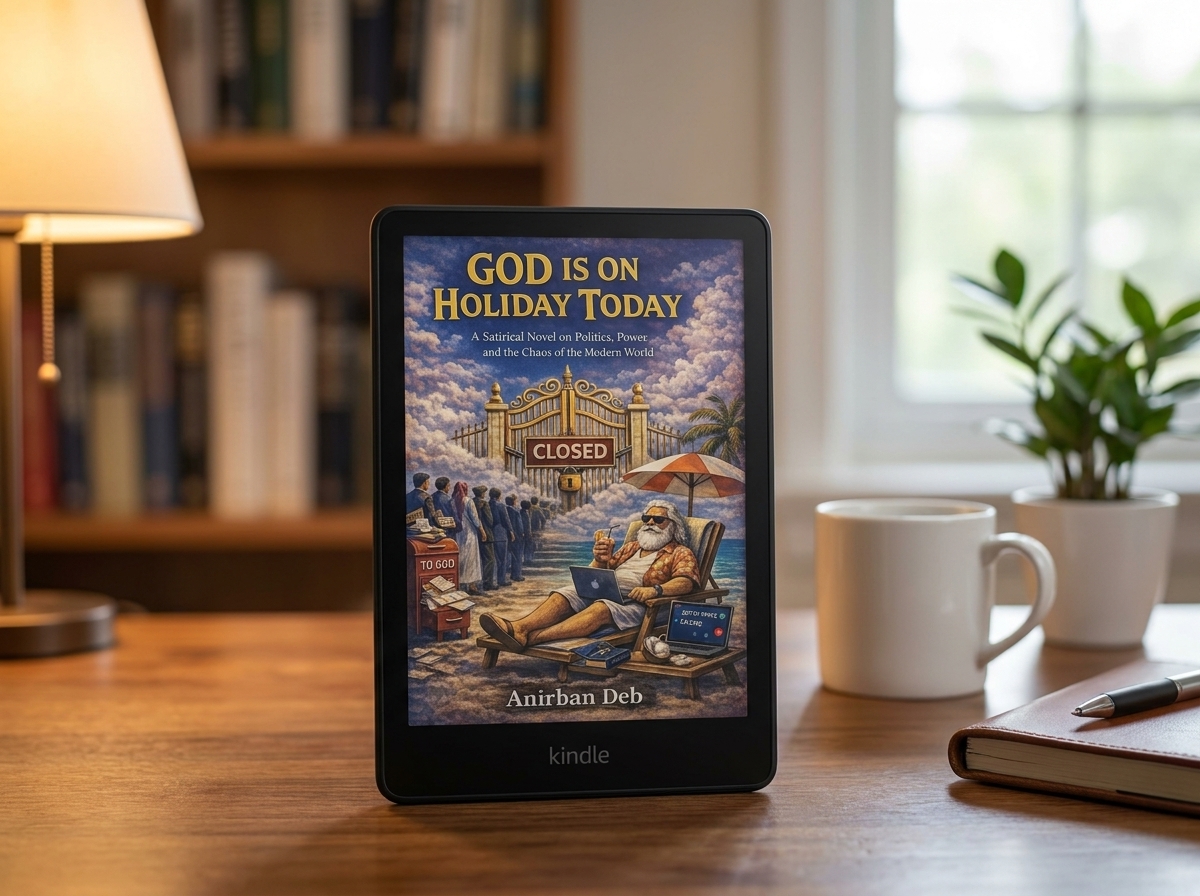
Rating:
⭐⭐⭐⭐ (4.3 out of 5)
I have read a lot of political satire over the years. Some books try too hard to sound intelligent. Some become lectures disguised as fiction. And some are so busy mocking the world that they forget to say anything meaningful about being human.
God Is On Holiday Today by Anirban Deb surprised me because it does something much harder. It looks at politics, war, bureaucracy, leadership, religion, democracy, media panic, public outrage, and human helplessness without sounding preachy. Honestly, the book reads like somebody took the chaos of modern life, opened twenty browser tabs at once, and somehow turned that noise into a deeply personal story.
What affected me most was this: beneath all the satire and humor, this is actually a very emotional novel about responsibility.
Not responsibility in the motivational speaker sense. Real responsibility. The uncomfortable kind. The kind where you suddenly realize fixing the world is much harder than tweeting about it over coffee.
And in 2026, with everything happening globally every single day, this book feels strangely relevant.
What the Book Is About
The premise itself is brilliant in its simplicity.
Jay Kumar is an MBA graduate, corporate problem solver, confident modern professional who genuinely believes the world is just a badly managed system. Honestly, I know people exactly like him. Maybe all of us have been that person at some point. Sitting in offices or scrolling through news feeds thinking, “Why are leaders so incompetent? I could probably handle this better.”
Then God gives him the chance.
Not metaphorically. Literally.
For a few days, God steps away and leaves Jay in charge.
That setup could have easily become a gimmick. But Anirban Deb understands something important about satire. The funniest ideas become powerful only when they are emotionally believable.
Jay enters what is essentially heaven run like an overworked multinational office. There are departments for wars, weather, heartbreak, births, deaths, prayer processing, geopolitical instability, elections, food supply chains, diplomacy, and public emotion. There are Teams calls with God from Goa. There are analysts handling impossible situations with exhausted professionalism. There are clipboards, dashboards, backlogs, and escalation systems.
One of my favorite moments early in the novel is when Jay expects heaven to look grand and divine, but instead finds departments and bureaucracy. Weather has employees arguing with cyclones. Love and heartbreak departments are overflowing. Wars and conflicts feel understaffed and emotionally drained. That scene genuinely made me smile because it captures modern institutional exhaustion perfectly.
And slowly Jay realizes something terrifying.
The world is not failing because nobody is managing it.
It is failing because millions of people are managing competing versions of reality at the same time.
That idea runs through the entire novel.
What Stood Out to Me
The first thing that stood out was the structure.
Anirban Deb writes in very short scenes, but unlike many modern minimalist novels, these scenes actually build momentum. Every chapter adds another layer to Jay’s understanding of power. The chapters involving global politics were especially strong because they never reduce conflicts into simplistic morality plays.
The Russia and Ukraine conversation was one of the strongest sections in the book for me. Instead of treating war like a headline, the novel frames it as accumulated history, identity, borders, memory, and competing stories people tell themselves. There is a line where God tells Jay that wars are not solved through outcomes alone because the real problem exists inside causes. I think that section says more about modern geopolitics than many nonfiction books I have read recently.
The Venezuela and Bangladesh sections were equally interesting because they avoid neat ideological conclusions. The book keeps asking uncomfortable questions. What happens when instability creates incentives for powerful people? What happens when revolutions remove systems faster than they build replacements? What happens when democracy becomes driven more by emotion than understanding?
These are difficult themes to write about without sounding arrogant, but the novel handles them with surprising balance.
I also appreciated that the humor never becomes cartoonish. The comedy comes from recognition. Anyone who has worked inside corporate systems, government structures, consulting environments, or large institutions will recognize the language immediately. The meetings. The escalation culture. The endless prioritization. The belief that every disaster can be solved through a better framework.
There is a scene where Jay asks for guidelines, escalation protocols, and management structure after being left in charge of the world. God basically tells him most systems continue functioning without intervention anyway. I laughed at that part, but there is also something deeply unsettling about it.
Another thing I genuinely liked was Gabriel. He appears throughout the story almost like the ultimate administrator. Calm, efficient, emotionally unreadable. The kind of person who has probably seen every crisis imaginable and still remembers to organize paperwork correctly. Small character details like that made the world feel believable.

The Emotional Core
This is where I think the book becomes stronger than a typical satire.
Underneath the politics and humor, God Is On Holiday Today is really about human limitation.
Jay enters the role believing intelligence and effort are enough. And honestly, modern culture rewards that belief. We are constantly told that every problem has a solution if smart enough people analyze it correctly.
But the novel slowly dismantles that assumption.
Not cynically.
Not hopelessly.
Just honestly.
There is a deeply affecting thread running through the story where Jay realizes that many global crises continue not because people are evil, but because human systems are emotional, historical, fragmented, fearful, and interconnected beyond easy repair.
The conversations about democracy were especially memorable for me. At one point Jay asks whether democracy itself is breaking. God’s answer is fascinating because He frames politics not as policy management but emotional management. Fear, identity, anger, belonging. Reading those chapters in today’s environment felt honestly uncomfortable because the observations feel close to reality.
And then there is the ending.
I will avoid spoilers, but the final chapters shift the novel from satire into something almost philosophical. Jay realizes the power was never really “out there.” The world continues because people collectively shape it every day through choices, systems, beliefs, institutions, incentives, and stories.
There is a line near the end where Jay says the staff does nothing. God agrees completely. That moment completely reframes the novel. Suddenly the entire story becomes about perception, responsibility, and awareness.
I genuinely think many readers will finish this book and sit silently for a while afterward. Not because the ending is shocking, but because it changes how you interpret everything that came before.
The Writing Style
Anirban Deb writes with restraint. That is harder than it sounds.
A lot of modern satire becomes noisy. This book avoids that trap. The language remains clean, conversational, and readable even when discussing heavy subjects like war, nationalism, migration, elections, institutional collapse, or public anger.
At times I wished certain emotional moments lasted longer. Some chapters move so quickly that I wanted more depth before shifting to the next global issue. Readers who enjoy highly detailed literary fiction may occasionally feel the pacing moves too briskly.
But honestly, I also think that rhythm reflects the world the book is describing. Modern life itself barely gives us time to process one crisis before another notification appears.
And the humor lands surprisingly often.
The “God working remotely from Goa” idea should not work this well. Yet somehow it does.
Who This Book Is For
I think this book will connect strongly with readers who enjoy intelligent contemporary fiction mixed with social commentary.
If you like novels that blend philosophy with humor, there is a good chance this will work for you.
Readers who enjoyed books like Animal Farm, The Hitchhiker’s Guide to the Galaxy, Good Omens, or even certain parts of Harari style social analysis may find something interesting here. Though to be clear, Anirban Deb has his own voice. The corporate satire especially feels very rooted in modern Indian urban culture and global workplace exhaustion.
This is also a very good book for readers in their twenties and thirties who constantly consume political news and feel emotionally overloaded by the state of the world. Jay represents a generation raised on optimization, productivity, systems thinking, and constant information exposure. Watching him slowly realize the limits of control feels very human.
At the same time, this might not work for readers who want highly action driven storytelling or conventional emotional drama. The book is conversation heavy and idea driven. The emotional impact comes through reflection rather than plot twists.
Personally, I appreciated that.
Final Thoughts
In my years reviewing books at Deified Publication, I have learned that some novels entertain you for a weekend while others quietly rearrange the way you think about everyday life.
I think God Is On Holiday Today belongs in the second category.
Not because it claims to have answers. Actually, the book becomes stronger precisely because it refuses simplistic answers.
Anirban Deb understands something many political commentators forget. Human beings are complicated. Systems are complicated. History is complicated. And sometimes the most dangerous people are the ones completely convinced they alone can fix everything.
Jay begins the novel believing management is the answer.
He ends it understanding awareness matters more.
That evolution felt earned to me.
And honestly, I think many readers will see parts of themselves inside Jay. The frustration. The confidence. The helplessness. The desire to repair things. The exhaustion from watching the world spiral every day online.
This novel captures all of that with humor, intelligence, and surprising emotional honesty.
Some books entertain you.
Some books expose you a little.
This one does both.
FAQ
Is God Is On Holiday Today worth reading?
Yes, especially if you enjoy political satire mixed with philosophy and modern social commentary. The book balances humor with serious reflections about power, leadership, democracy, and responsibility.
Who should read God Is On Holiday Today by Anirban Deb?
Readers who enjoy contemporary satire, politically aware fiction, and idea driven novels will probably connect strongly with it. It is especially relevant for younger professionals who constantly feel overwhelmed by global news and institutional chaos.
Is this book funny or serious?
Honestly, both. Some scenes are genuinely hilarious, especially the corporate style heaven bureaucracy and Teams calls with God. But beneath the humor, the book asks serious questions about power, systems, war, and human behavior.
What genre is God Is On Holiday Today?
It sits somewhere between satirical fiction, political fiction, philosophical fiction, and contemporary social commentary.

With over 11 years of experience in the publishing industry, Priya Srivastava has become a trusted guide for hundreds of authors navigating the challenging path from manuscript to marketplace. As Editor-in-Chief of Deified Publications, she combines the precision of a publishing professional with the empathy of a mentor who truly understands the fears, hopes, and dreams of both first-time and seasoned writers.