

Rating: ⭐⭐⭐⭐ (4.2 out of 5)
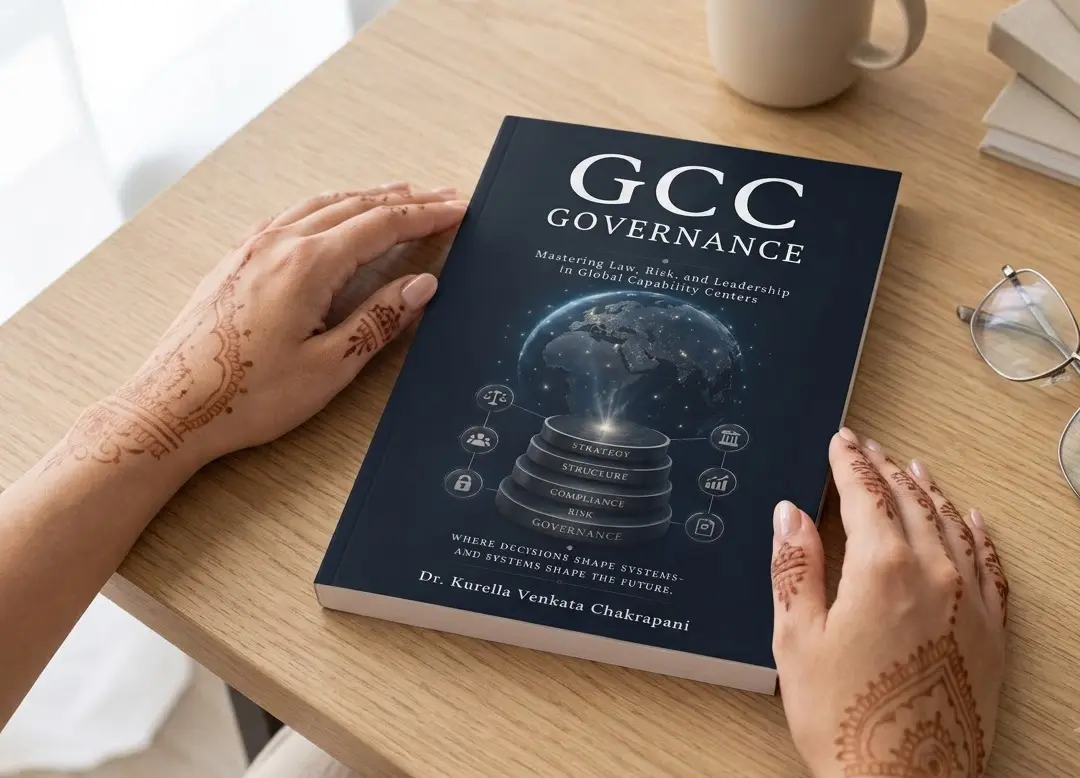
When I first picked up GCC GOVERNANCE by Dr Kurella Venkata Chakrapani, I expected a dry manual full of corporate jargon and statutory citations. I have spent over fifteen years reading books across every imaginable genre, and many business policy books feel like legal text bound in glossy covers. This book surprised me right from the opening pages. I found myself thinking about real corporate teams I have observed over the years, places where operations ran smoothly on the surface while structural misalignments gathered beneath the floorboards. The author opens with a stark observation that most center failures do not happen because executives are careless, but because the business expands faster than its legal framework. It made me reflect on how easily functional leaders work in isolated corners, with finance solving pricing and HR handling hiring, without anyone asking if the whole system still fits together. That opening reflection set a grounded, realistic tone that kept my attention throughout all sixteen chapters.
What GCC GOVERNANCE Is Really About
At its core, this book examines how Global Capability Centers evolve from cost saving offshore support units into strategic engines that drive global enterprise value. Dr Kurella Venkata Chakrapani draws from nearly two decades of experience in finance, law, and corporate leadership to show that managing a center is fundamentally a systems problem. The narrative moves across sixteen structured chapters, dividing the center lifecycle into distinct phases from initial strategy and entity setup to daily operations, tax alignment, data privacy, and long-term sustainability. The book emphasizes that legal identity, foreign exchange rules, workforce structures, and technology contracts are not separate administrative duties. Instead, they form an interconnected Legal Operating System. A foreword by Sri D. Sridhar Babu, the Minister for IT and Legislative Affairs in Telangana, reinforces this exact point by highlighting how state ecosystems and corporate governance must work together to build reliable institutions.
To explain how structural risk accumulates over time, the author introduces a clear framework that he calls the Failure Equation, where regulatory exposure equals fragmentation multiplied by scale multiplied by time lag. He illustrates this concept through a case study of two multinational life sciences centers operating in Hyderabad. Both entities began with identical mandates and scaled rapidly, but one team treated every operational shift as a governance milestone while the other made isolated decisions in functional silos. By year six, when regulatory reviews arrived, the first center answered questions with clear documentation while the second faced painful reconstruction work. That story plain-spokenly demonstrates why legal alignment matters far more than short term speed or initial cost savings.
Craft, Structure, and the Art of Plain English
What impressed me most about the author’s writing style is his ability to translate dense statutory provisions into clear executive choices. As Editor-in-Chief at Deified Publication, I read many technical guides where authors hide behind legal terminology, but Dr Chakrapani avoids that trap completely. He breaks down complex laws like the Companies Act of 2013, foreign direct investment rules, and the Digital Personal Data Protection Act of 2023 into practical questions that any senior executive can understand. Every chapter ends with action steps, red flags, and review checklists that turn complex legal concepts into immediate operational controls.
A great example of this practical design appears in chapter thirteen, where the author outlines his LENS method for leaders without legal background. LENS stands for Legal requirement, Event or threshold, Next-step consequences, and System effects. By teaching non-lawyer executives to ask what activates a law and where else the decision travels across the company, the book demystifies regulatory interpretation. I also appreciated how up to date the material is, referencing upcoming shifts like the 2026 Budget updates to Safe Harbour margins, where IT services margins are consolidated at fifteen and a half percent, alongside MAT credit rule changes. That attention to current regulatory details shows a deep respect for the reader’s time.
The Human Element and Operational Reality
Beyond corporate structures and tax filings, the book pays close attention to the human core of enterprise operations. Chapter seven and chapter eight deal directly with workforce governance, workplace dignity, and ethical culture. The author argues that employment contracts, wage design, and social security compliance are actually trust mechanisms rather than backend administrative tasks. He tackles challenging operational issues like extended-hour night shifts for women, remote work across multiple Indian states, and the strict six-hour incident reporting requirement under CERT-In directions for cyber security events. He reminds readers that when a crisis happens, regulators do not evaluate good intentions, they evaluate physical evidence and documented records.
The discussion on third-party vendor risks and ethics was particularly eye-opening for me. The author shares a scenario where a center used a digital dashboard to track employee login times and idle hours, expecting it to boost efficiency. Instead, the lack of clear communication and proportional boundaries created widespread employee distrust. In another scenario, an unvetted vendor handling electronic asset disposal created unseen compliance vulnerabilities for a global brand. These real-world examples highlight that governance is not an abstract slogan on an office wall, but a lived daily habit that protects both employees and the organization.
Who Should Read This Book and Who Might Want to Pass
In this reader review, I wanted to focus on who gets the most value from these pages. I think GCC GOVERNANCE is an essential resource for center heads, chief financial officers, legal counsel, HR directors, and transformation consultants who build or manage global capability setups. If you wonder what is it about at the ground level, it gives a practical decision framework for cross-border operations, intercompany contracts, or regulatory compliance in India. If you wonder whether you should read this text for your daily operations, the checklists alone are worth keeping on your desk for strategy sessions and risk reviews.
On the other hand, if you are looking for a simple book summary or a light overview of global business trends, this text might feel overly detailed. So, is it worth it for someone outside leadership? Probably not. It contains dense discussions on tax regulations, transfer pricing, clause mechanics, and statutory registers. Readers without an active interest in corporate management or regulatory structure may find the granular legal frameworks heavy going. My only minor critique is that the book contains a massive amount of information across its three hundred plus pages, which can occasionally feel overwhelming if read in one sitting.
Closing Reflections on GCC GOVERNANCE
In the end, GCC GOVERNANCE succeeds because it treats compliance not as a defensive burden, but as the foundation of sustainable institutional growth. Dr Kurella Venkata Chakrapani has written a thorough, practical guide that bridges the gap between boardroom decision-making and ground-level execution. It challenges corporate leaders to stop treating law as a separate backend function and start treating it as an essential component of business design. I finished the book with a renewed appreciation for the discipline required to keep complex global systems coherent, aligned, and trusted over time.
FAQs
What is the main premise of GCC GOVERNANCE?
The book argues that Global Capability Centers cannot sustain long-term growth through cost savings or operational efficiency alone. True resilience requires an integrated Legal Operating System that connects corporate structure, tax positions, workforce design, data privacy, and contracts into a coherent enterprise framework before operational complexity creates hidden risks.
Who is Dr Kurella Venkata Chakrapani?
Dr Kurella Venkata Chakrapani is a senior finance, tax, and corporate governance leader with nearly two decades of experience building and transforming global capability centers. He holds advanced degrees in law and business, serves as a board member for leading global enterprises, and is an accredited Independent Director in India.
Does this book cover recent legal and regulatory changes in India?
Yes, the text incorporates current legal frameworks including the Digital Personal Data Protection Act of 2023 and its 2025 implementation rules, the four consolidated Labour Codes, CERT-In cyber security directives, and tax updates such as the Budget 2026 changes to Safe Harbour margins and Minimum Alternate Tax rules.
Is this book useful for non-lawyers?
Yes, the author explicitly wrote this guide for business executives, finance heads, HR leaders, and operational directors. It provides practical frameworks like the LENS method and clear checklists that allow non-legal professionals to understand regulatory triggers and ask the right questions without needing formal legal training.

With over 11 years of experience in the publishing industry, Priya Srivastava has become a trusted guide for hundreds of authors navigating the challenging path from manuscript to marketplace. As Editor-in-Chief of Deified Publications, she combines the precision of a publishing professional with the empathy of a mentor who truly understands the fears, hopes, and dreams of both first-time and seasoned writers.