
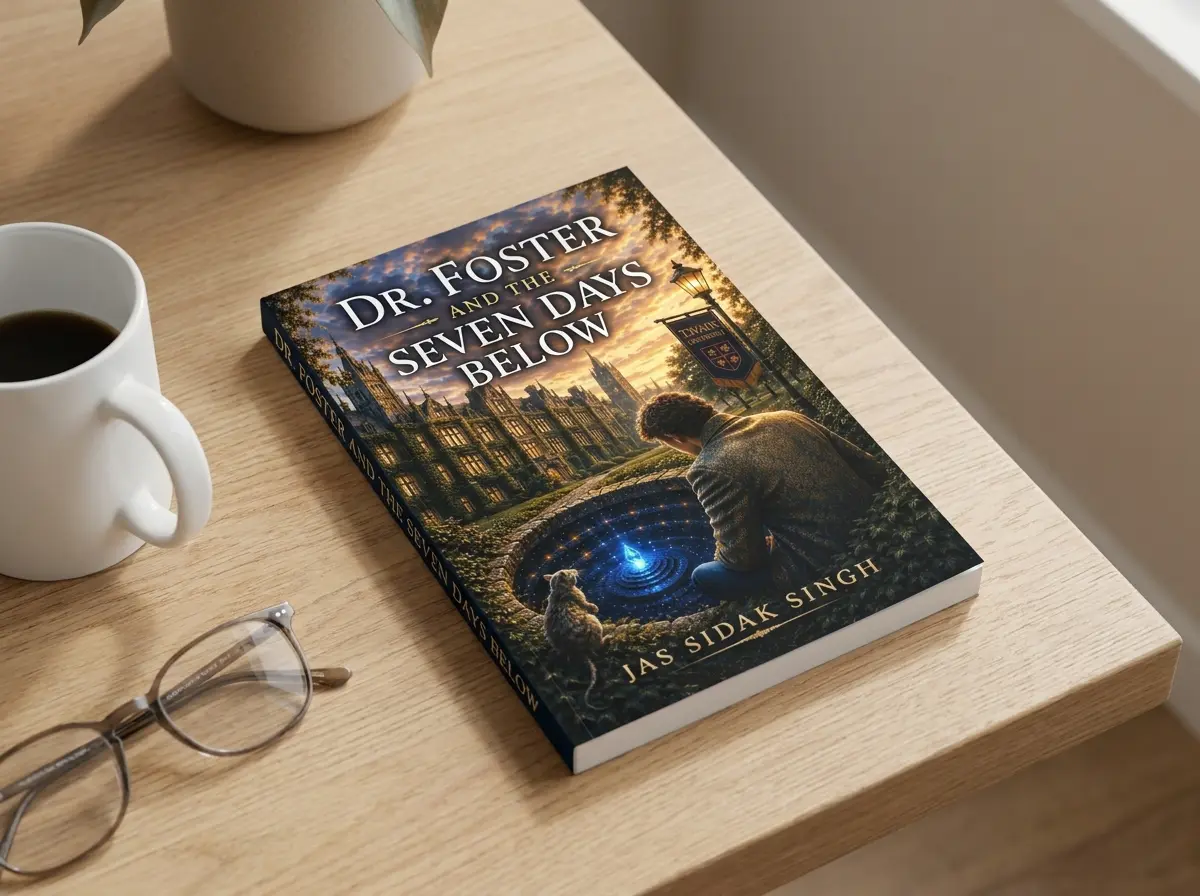
Rating: ⭐⭐⭐⭐ (4.3 out of 5)
I’ve been editing and reading books at Deified Publication for over fifteen years now, and I’ll be honest with you: I picked up Dr. Foster and the Seven Days Below by Jas Sidak Singh expecting a charming little fantasy, maybe something mildly whimsical, good for an afternoon. What I wasn’t expecting was to sit with it for days afterward, turning over a single line that Ash says to Edward somewhere in the middle of the book. He tells Edward, “You spend all your time looking through the bars. You never look here.” And there it is. That’s the whole book in one breath. I’ve known people like Edward. I think, if I’m being fair, I’ve been a little like Edward. That line hit somewhere specific.
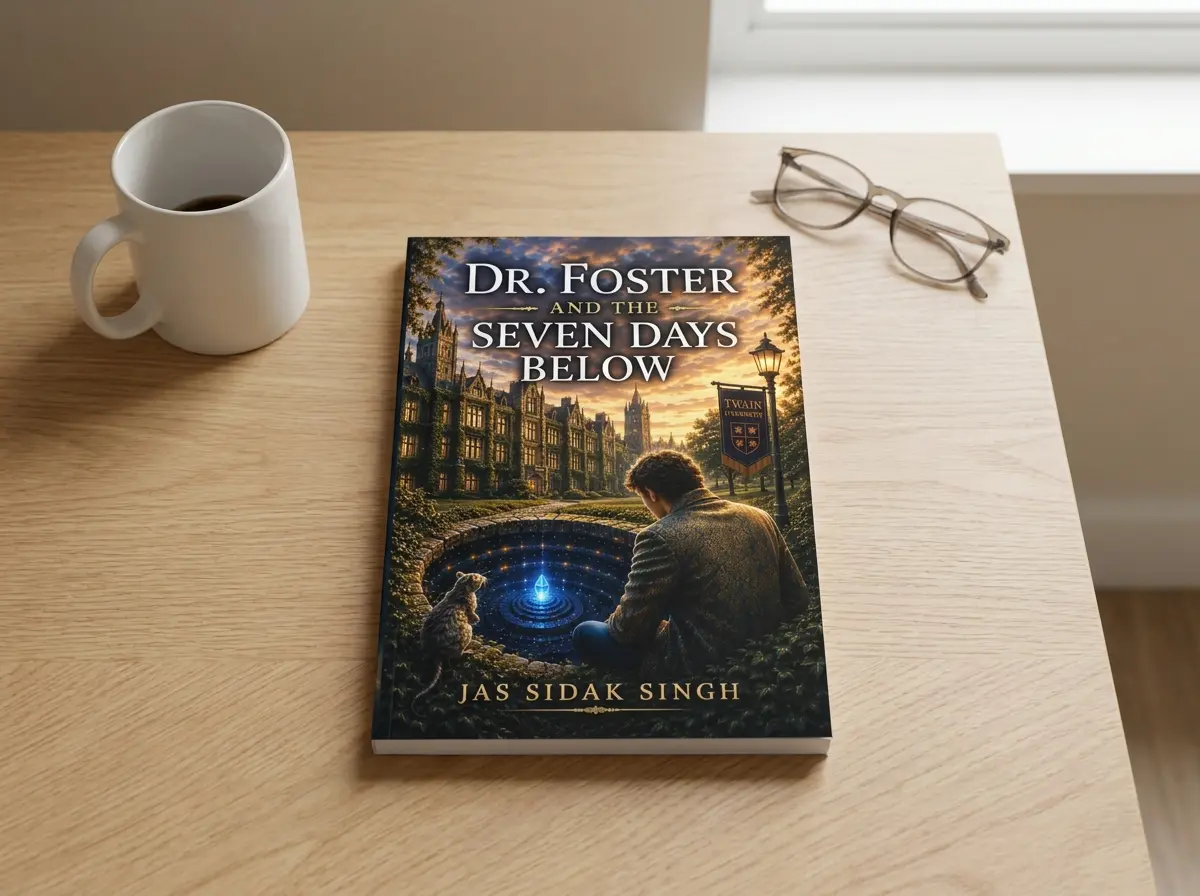
The premise of Dr. Foster and the Seven Days Below sounds like it could tip into absurdity very easily: a brilliant neuroscientist named Dr. Edward Foster, at the height of his career, receives a standing ovation at Twain University’s Grand Auditorium and goes home to his lab the same night because awards, it turns out, are less interesting to him than the results still running on his screen. Then his experiment with a perceptual compound goes wrong in a way that nobody planned for, and Edward wakes up small, frightened, and in the body of a rat. That’s the setup. But Jas Sidak Singh isn’t really writing a body-swap story. The transformation is a mechanism, a way of forcing Edward to stop looking through the bars of his own ambition and actually look at the world around him.
What the Book Is Actually About
The story follows Edward as he discovers a colony of rats living beneath Twain University, in tunnels and hidden chambers that the university above has never thought to notice. The colony has its own rhythms, its own language of small gestures and shared history, and its own characters who are drawn with real care. Ash is the one who got to me most: an old rat of extraordinary stillness who sits beneath a hanging chain and watches things with the patience of someone who has made peace with many endings. Pip is his counterpart in every way, a young collector who has never met a bottle cap he didn’t want to keep and who, without quite meaning to, becomes the warm heart of the story’s middle section. There’s also Mira, Bristle, Nix, and a community that slowly becomes real to Edward in the way that Ash notices it has become real: not when Edward learns their names collectively, but when he knows each one individually without having to think about it.
The mystery element is genuinely interesting. There are ancient symbols carved into chambers beneath the colony. Fresh tracks where no tracks should be. And the legend of the Keepers, a lineage of patient guardians who have maintained something in the dark for generations, waiting for someone who might finally understand what it’s for. This part of the story is handled with a light touch that I appreciated. Jas Sidak Singh doesn’t oversell the mystery. It accumulates the way awareness does in the book, not as a sudden revelation but as presence, a change in the quality of the dark. The eventual encounter with the Last Keeper is one of the most quietly remarkable scenes I’ve read in this kind of story. The Keeper tells Edward that they’ve been watching since the storm, waiting to see who comes down when the lights wake. Edward has been reading the tracks for months without understanding they were an answer. That moment of recognition, arriving whole and requiring no assembly, is the kind of writing that makes you put a book down for a moment just to let it settle.
What Stood Out to Me
Jas Sidak Singh writes with a prose style that is patient and precise in a way I found genuinely impressive. The early chapters establishing Edward’s life above ground are done with real economy. We see him at his award ceremony, present for all of it and somewhere else for most of it. We see Dean Harrison notice this, notice the specific quality of Edward’s attention that is already back in Laboratory Seven even while he stands at the podium. There’s a flashback to Edward’s childhood with his mother Margaret that I kept returning to in my mind, a Saturday morning with a secondhand telescope and a conversation about wondering. Margaret tells young Edward that some people chase answers, but he chases questions, and that questions don’t run out. It’s a small scene but it does enormous structural work: it tells you everything about who Edward is before the experiment, and it makes the later transformation feel less like a punishment and more like a correction.
The Ash and Edward dynamic is the book’s beating core, and it’s handled with care. Three days pass before Ash speaks to Edward directly, and Singh lets those three days matter. When Ash finally crosses the enclosure and sits near Edward, the conversation that follows is one of the better pieces of dialogue in the book. Ash makes the distinction between “special” and “unusual” in a way that lands without being preachy. He tells Edward that Edward looks at things nobody else notices, and that moving differently and thinking differently is not the same thing as not belonging. Edward resists this, of course. He’s planning to go home. “Every day,” he says. “That sounds exhausting,” Ash replies. And it does. Suddenly, it really does.
I also want to mention the book’s physical presentation, because I think it’s worth noting. The black and white illustrations throughout the text are atmospheric and well-chosen. There’s one image of two rats silhouetted against a beam of light in the chamber that I found genuinely beautiful. The chapter titles are lovely too: “The Collector of Impossible Things,” “The Stories Ash Never Told,” “One Last Squeak.” Even the table of contents has a kind of warmth to it.
The Emotional Core
I wasn’t expecting to tear up at the chapter called “The Last Night.” I should probably have expected it, looking back, but I didn’t. The chapter opens with Edward sitting with the colony after they’ve settled to sleep, watching the familiar shapes of Pip and Mira and Ash in the dark, having already made his decision but not announcing it. Pip has moved his collection slightly closer to Edward over the past three days, as though proximity could delay what both of them know is coming. Mira is pretending to be asleep, offering Edward the gift of not turning his leaving into a performance. And Ash is awake, as he always is when things of consequence move through the colony, carrying the patient warmth of someone who has made peace with many endings and found that peace does not make them easier, only more possible. “They sat together in the quiet for the last time,” Singh writes, and the sentence does exactly what it needs to do without reaching for anything extra.
The epilogue, set six months later, wraps things up in a way that I found genuinely satisfying rather than tidy. Edward is back in his office at Twain University. He says good morning to a photograph of Margaret. His awards have been moved to the third shelf to make room for photographs. And there’s a small grey shape in the garden below the faculty windows, darting between flower stems, pausing for a moment to look up at the window before disappearing. Edward says “Pip” softly and doesn’t need to know for certain whether it’s true. He picks up the paperclip from his desk. The kind that nobody keeps because there’s no reason to keep them. He holds it. That’s the ending. I think it’s perfect.
Who This Book Is For
This is the kind of book that will mean something very different depending on where you are in your life when you read it. If you’re someone who has ever been so deep in work or ambition that you’ve missed the people around you, this book is going to find that place. If you’ve ever moved somewhere new and felt like an outsider looking through glass at a life that seems to be happening for everyone else, Edward’s experience below the chain is going to feel uncomfortably familiar in the best way. I think readers who love books like The Remains of the Day or even Richard Adams’s Watership Down will find things to appreciate here, though Dr. Foster and the Seven Days Below is warmer and less austere than either of those. It’s also, I think, a book for anyone who has lost someone and is still figuring out what it means to carry that loss without being flattened by it. Margaret is present throughout this story even after she’s gone, in the way that people who taught us to wonder stay present. In 2026, when so many of us are asking questions about belonging and what we’re actually building our lives toward, this message feels particularly well-timed.
I’d say it reads better for adults than it might for younger readers, despite its surface warmth. The emotional registers are adult ones, and Singh trusts his readers to sit with ambiguity and resist easy resolution. That’s not a criticism. It’s actually what I liked most about it. My one minor note is that the mystery of the Keepers, while handled beautifully in the final encounter, is a little underdeveloped in its middle chapters. There were moments where I wanted more texture around the ancient symbols and the hidden chamber before we reached the reveal. But this is a small thing against a book that gets so much right.
Final Thoughts
Jas Sidak Singh has written something that I genuinely didn’t expect to love as much as I did. Dr. Foster and the Seven Days Below is patient and precise and full of the kind of small moments that accumulate into something that matters. It asks what home really is, not as a rhetorical question but as an actual inquiry, and it answers that question through character and relationship rather than plot mechanics. The book’s dedication reads: “Because before I wrote a story about finding a home, I was fortunate enough to have one.” I read that after I finished and had to sit with it for a while. That’s the kind of book this is.
FAQs
Is Dr. Foster and the Seven Days Below worth reading?
Yes, I think it genuinely is, particularly if you’re someone who responds to character-driven fiction with emotional depth. This isn’t a fast-paced story but it’s a meaningful one, and the writing is careful and precise in ways that reward attention. If you’re looking for a book that might make you think differently about your own relationships and what you call home, this is a strong choice.
Who should read Dr. Foster and the Seven Days Below by Jas Sidak Singh?
This book is well-suited to adult readers who enjoy quiet, emotionally intelligent fiction with a speculative premise. Fans of character studies, books about belonging and identity, and stories where the emotional payoff builds slowly over time will find a lot here. It’s also a good fit for readers who appreciate beautiful prose and don’t need constant action to stay engaged.
What is Dr. Foster and the Seven Days Below about, in simple terms?
A highly successful scientist named Edward Foster accidentally transforms himself into a rat through a failed experiment and finds himself living among a colony of rats beneath Twain University. Over seven months underground, he forms real friendships, uncovers an ancient mystery, and slowly learns what it means to actually belong somewhere rather than simply succeeding somewhere. It’s a book about perspective, belonging, and what we choose to keep.
Is Dr. Foster and the Seven Days Below suitable for children?
The premise and warmth of the book might appeal to curious young readers, but the emotional register and thematic complexity are genuinely adult. The questions the book asks about ambition, loss, identity, and belonging land differently for someone who has actually lived some of those experiences. I’d suggest it primarily for adult readers, though a thoughtful teenager might find a great deal in it too.

With over 11 years of experience in the publishing industry, Priya Srivastava has become a trusted guide for hundreds of authors navigating the challenging path from manuscript to marketplace. As Editor-in-Chief of Deified Publications, she combines the precision of a publishing professional with the empathy of a mentor who truly understands the fears, hopes, and dreams of both first-time and seasoned writers.