
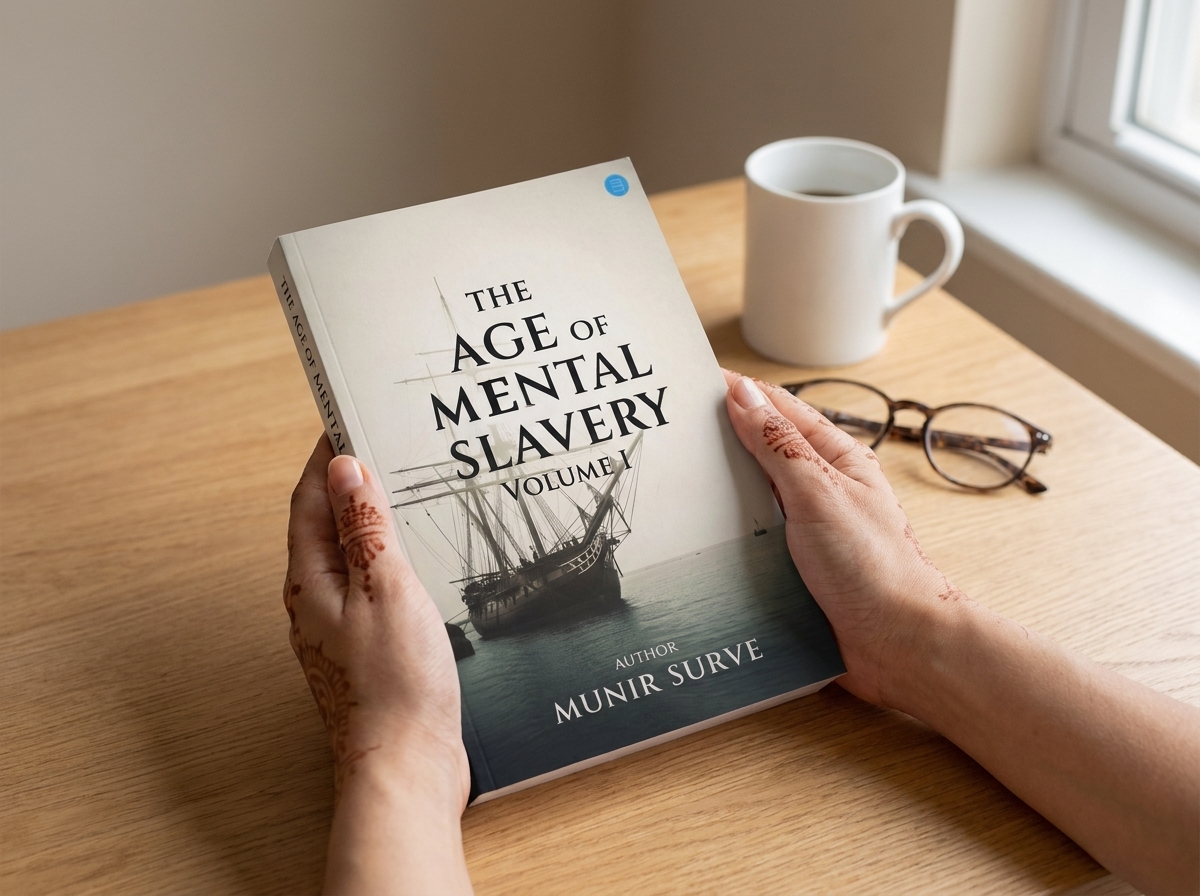
Rating:
⭐⭐⭐⭐ (4.2 out of 5)
I finished reading Age of Mental Slavery last week and I’m still turning a few pages over in my head, which honestly doesn’t happen with every non-fiction book that crosses my desk at Deified Publication. In my years reviewing books, I’ve read a fair number of titles that promise to wake you up, shake you out of complacency, hand you some grand revelation about how the world really works. Most of them fall flat somewhere in the middle. Munir Surve’s book doesn’t entirely avoid that trap either, but it earns its ambition in a way that surprised me, and I think that’s worth talking about honestly.
What the Book Is About
Age of Mental Slavery, the first volume in what’s planned as a three part series, is Surve’s attempt to trace how control over human beings has shifted from the physical to the psychological. The core argument, laid out clearly in the introduction, is that the old tools of domination, chains, whips, prisons, armies, have become socially indefensible in the modern world, so power adapted. It moved inward. Surve writes about a kind of slavery that requires no guards because the guard has been replaced by guilt, no whip because the whip has been replaced by shame, and no master’s voice because that voice now lives inside our own heads, shaped by school, religion, television, and tradition. The book moves through nine chapters, starting with the foundational idea of unseen chains and moving through duty and obedience, religious and spiritual conditioning, cultural captivity, propaganda, and finally the mechanics of manufactured consent, closing with an epilogue that sets up where the next two volumes are headed.
What Stood Out to Me
What struck me first was how Surve refuses to let this stay abstract. In the opening chapter, he makes this argument that a physically enslaved person dreams of freedom, but a mentally enslaved person defends their own cage, and he backs it up with concrete, almost uncomfortable examples, the employee who never questions authority, the wife who believes suffering silently is a virtue, the student who never doubts what he’s taught. I’ve read enough socio-political non-fiction to know that this genre lives or dies on whether the author can make the theory land in daily life, and this is where Surve does his best work.
The chapter on duty, Between Duty and Bondage, is probably the section I kept coming back to. Surve builds an entire table contrasting true duty and false duty, one born from awareness and conscience, the other imposed through fear and social pressure, and then walks through examples that span traditions, Krishna’s teaching to Arjuna in the Bhagavad Gita about acting without attachment to outcome, the Qur’anic emphasis on niyyah and reflection rather than blind submission, and historical figures like Socrates, Prophet Ibrahim, Martin Luther King Jr, and Malala Yousafzai who chose the harder path of purpose over the easier path of compliance. It’s not a new observation that duty can be twisted into control, but I liked how Surve lays it out almost like a diagnostic tool, something a reader could actually use to examine their own choices rather than just nodding along.
There’s a moment in the chapter on religion, Divine Echoes, that I found genuinely moving, where Surve writes about the Qur’an describing the Divine as closer to a person than their own jugular vein, and pairs it with Jesus saying the kingdom of God is within, and the Upanishadic phrase Tat Tvam Asi, thou art that. He’s not trying to flatten these traditions into one thing, he’s making the case that across very different faiths, the deepest teaching points inward rather than toward blind obedience, and that institutions have often done the opposite, replacing reflection with ritual and inquiry with edict. I wasn’t expecting a book with this title to handle religious material with that much care, and it changed how I read the rest of the book.
The chapter on cultural captivity, The Many Faces of Captivity, is where Surve gets specific in a way I appreciated, pulling in Antonio Gramsci’s idea of cultural hegemony, the old Chinese proverb about the nail that sticks out getting hammered down, and a long list of people who were, in their own time, treated as troublemakers before history recast them as heroes, Galileo, Rosa Parks, Malala again. He also spends real time on arranged marriage, workplace dress codes, and diaspora communities that hold onto rigid versions of home culture more tightly than the people who stayed behind, which he describes as cultural baggage that gets heavier rather than lighter when carried across borders. That line stuck with me because I’ve seen a version of it in my own circle, people who left home decades ago and somehow became more conservative about tradition than the relatives who never left.
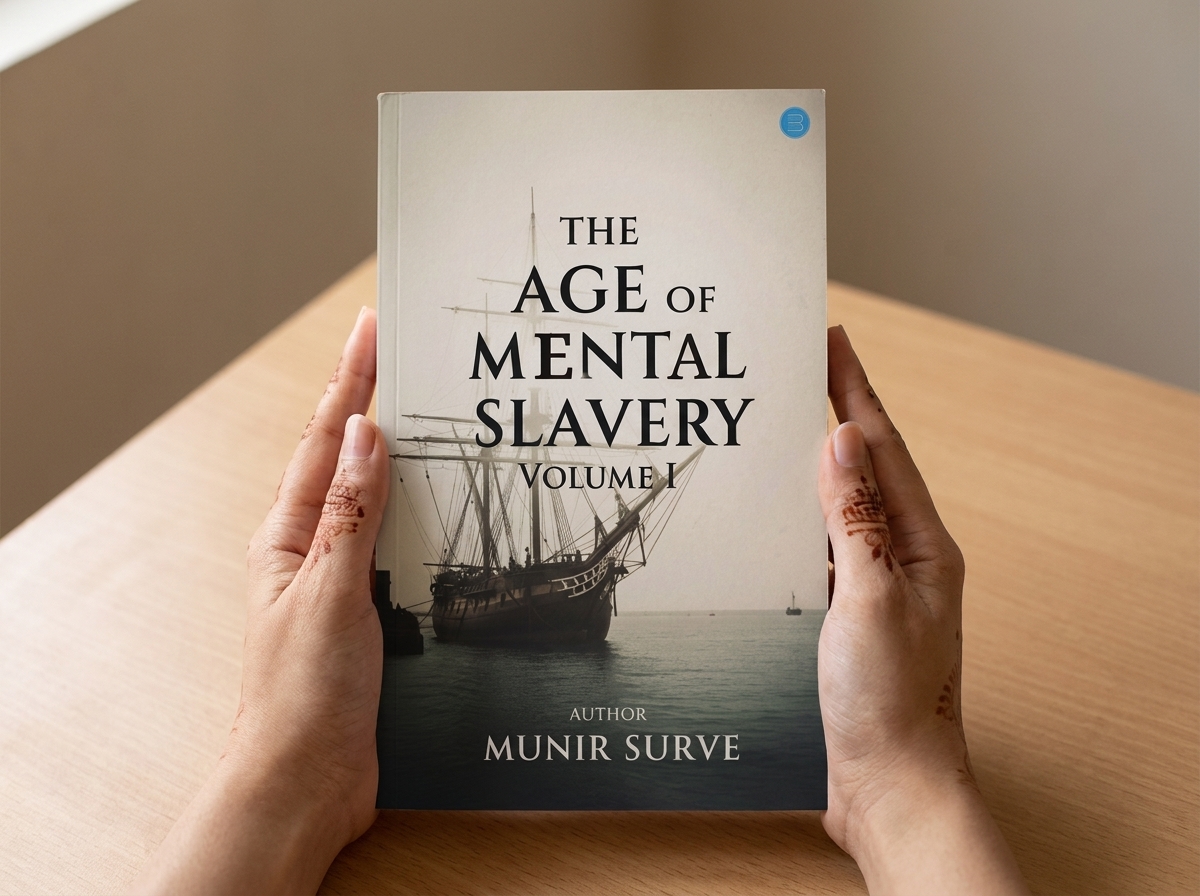
The Emotional Core
This isn’t a book that’s trying to make you cry, and honestly it shouldn’t, given the subject matter. But there’s a slow burn discomfort that builds as you move through the chapters, especially by the time you reach the section on manufactured consent, where Surve leans on Edward Herman and Noam Chomsky’s work to argue that the illusion of choice, Pepsi or Coke, red or blue, is itself a form of control, because the real question was never which option you pick but who decided what options exist in the first place. I found myself putting the book down a few times just to sit with that, not because it’s shocking exactly, but because it’s the kind of point that keeps applying itself to different corners of your own life the longer you think about it.
The epilogue is where the book softens a little, and I think intentionally so. Surve writes that the volume was never meant to hand out answers, only questions, and that discomfort readers might be feeling by the end isn’t a failure of the book but a sign that something in them has started to stir. He’s upfront that this is not a book offering escape routes, and that the next two volumes will shift toward healing, self awareness, and how freedom gets practiced in daily life rather than just diagnosed. I respect that structural honesty. A lot of books in this genre promise transformation in one sitting. This one tells you plainly that awareness comes first and everything else comes later.
Where It Doesn’t Quite Land
I want to be honest here because that’s the whole point of a review like this. The book leans heavily on bullet point lists and side by side comparisons, true duty versus false duty, authoritarian regimes versus modern democracies, and while some of these are genuinely useful, there are stretches where the writing shifts from flowing argument into more of an outline format, which can interrupt the momentum just as an idea is building. I also think readers who aren’t already familiar with thinkers like Gramsci, or texts like the Bhagavad Gita and the Qur’an, might need a bit more context stitched in around some of the references, since Surve moves through them quickly, assuming a reader who’s already comfortable with comparative religion and political theory. Neither of these is a dealbreaker, but they’re worth knowing going in.
Who This Book Is For
If you’re someone who enjoys books that sit at the intersection of psychology, politics, and spirituality, and you don’t mind a text that asks more of you than it gives back in easy comfort, this is worth your time. Readers who liked Manufacturing Consent itself, or who’ve spent time with writers examining propaganda, media, and internalised control, will find familiar territory here handled with a broader, more interfaith lens. I’d be a little more cautious recommending it to someone looking for a light read or a purely motivational self help book, because that’s not what this is. It’s closer to a mirror than a manual, at least in this first volume.
Final Thoughts
Age of Mental Slavery is an ambitious opening to what’s clearly meant to be a longer project, and Munir Surve does something I don’t see often enough in this space, he treats religious tradition, political theory, and personal psychology as parts of the same conversation instead of separate arguments. It’s dense in places, a little list heavy for my taste, but the specific examples, the Bhagavad Gita passages, the Qur’anic verses on reflection, the walk through Rosa Parks and Malala and the nail that sticks out, give it real weight. In 2026, with algorithms shaping so much of what we see and believe before we’re even aware of it, a book asking whose voice is really in your head feels timely rather than abstract. I closed the last page with more questions than I started with, and after finishing this one, I think that was exactly the point.
FAQs
Is Age of Mental Slavery worth reading?
Yes, particularly if you’re drawn to books that blend socio-political analysis with religious and psychological insight. It asks you to examine your own conditioning rather than just observe someone else’s.
Who should read this book?
Readers interested in propaganda, media influence, comparative religion, or the psychology of obedience will get the most out of it. It’s less suited to readers wanting a quick, purely uplifting read.
What is Age of Mental Slavery about?
It’s a non-fiction exploration of how control in modern society has shifted from physical force to psychological conditioning, examining media, religion, education, and culture as tools that shape belief without people realising it.
Does this novel work as a standalone read, or do I need to wait for future volumes?
Volume One is complete on its own terms, closing with reflection rather than resolution, though Surve has already outlined that Volumes Two and Three will build on this foundation.

With over 11 years of experience in the publishing industry, Priya Srivastava has become a trusted guide for hundreds of authors navigating the challenging path from manuscript to marketplace. As Editor-in-Chief of Deified Publications, she combines the precision of a publishing professional with the empathy of a mentor who truly understands the fears, hopes, and dreams of both first-time and seasoned writers.