
Rating:
⭐⭐⭐⭐ (4.2 out of 5)
I’ve been reviewing books for over fifteen years now, and if there’s one thing I’ve learned, it’s that the books which stay with you aren’t always the ones with the flashiest plots or the most clever twists. Sometimes they’re the ones that feel like someone sat you down and said, “Let me tell you about the things nobody sees.”
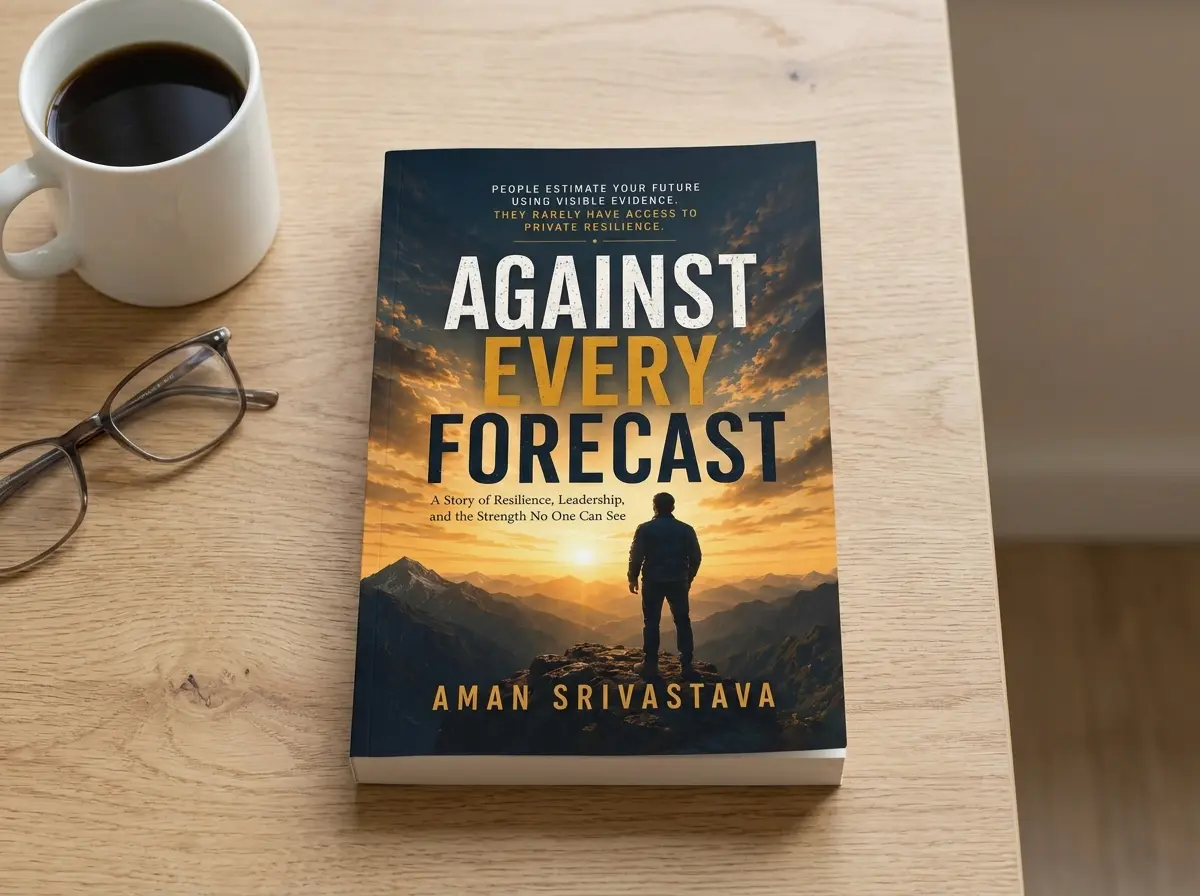
That’s exactly what Aman Srivastava’s Against Every Forecast does. It’s being marketed as a story about resilience and leadership, and sure, those words are on the cover. But reading through it, I realized pretty quickly that this book is about something messier and more honest than those neat categories suggest.
The book opens with something that immediately got my attention. There’s a scene where the narrator, a fifteen-year-old boy, is lying in a hospital bed with severe jaundice during his board examination year. For anyone who grew up in an Indian middle-class family, that sentence alone carries so much weight. Board exams aren’t just tests. They’re social verdicts, as the book puts it. Relatives start offering unsolicited career advice. Neighbors suddenly have opinions about your future. Every conversation circles back to marks.
But here’s what I appreciated about this opening. The author doesn’t dramatize it. The narrator is genuinely weak. Not motivationally weak. Physically weak. The kind where even sitting up feels like a negotiation. And when the doctor says it’s “difficult” for him to attempt the remaining three papers, the people around him aren’t being cruel. They’re being reasonable. Practical. They’re looking at visible evidence and making logical predictions.
That’s the first time the book introduces what becomes its central tension. People estimate your future using what they can see. They have no access to your private resilience. That line appears on the cover too, and honestly, it’s the kind of sentence that makes you stop and think about your own life. How many times have people made assumptions about you based on incomplete information? How many times have you done the same to others?
From there, the book moves through different phases of the narrator’s life. College, where he learns that people don’t always judge intelligence or character first. Sometimes they judge appearance. Skin tone. The strange lottery of physical features that nobody earns and everybody comments on. There’s this moment where he’s standing with a group, someone makes a comment about his appearance, and everyone laughs. Including him. Because when everyone is laughing, refusing to laugh feels socially dangerous. And that’s how emotional damage often begins, not through obvious cruelty but through repetition disguised as humor.

I’ve seen this happen in real life so many times. In schools. In workplaces. In friend circles. The casual comment that gets repeated until it becomes a narrative. And narratives are dangerous because eventually you start hearing them even when nobody is speaking. The book captures this shift beautifully. The narrator starts noticing mirrors differently. Not because mirrors change, but because he does. He begins searching for flaws through borrowed perception.
What I found really interesting was how the narrator eventually responds to this. He doesn’t confront anyone dramatically. He doesn’t have some big emotional outburst. Instead, he becomes analytical. He realizes that the people making these comments are enjoying his reaction. His discomfort is entertainment. His silence is confirmation. So he stops participating. He laughs first, louder than everyone else. He improves the jokes himself. He removes the emotional reward. And slowly, interest declines.
There’s something so quietly powerful about that. The book doesn’t pretend the pain disappears. Words leave residue. Humiliation leaves memory. But power changes direction. And that matters.
The middle sections of the book deal with professional life, and this is where things got really personal for me. There’s a chapter called “The Room Nobody Entered” that I kept thinking about for days after I finished. The narrator is twenty-six, old enough to understand responsibility, young enough for ambition to still feel urgent. He gets an opportunity. A different company. A better role. A larger future. But there’s a practical detail. Travel cost. Nineteen thousand rupees. One way.
For some people, that’s inconvenience. For others, planning. For him, at that moment, it’s emotional mathematics. Not impossible. That would have been easier. Just painful enough to keep hope alive. And that’s worse, because impossible gives closure. Difficulty gives emotional conflict.
There’s a scene where he goes into a forgotten room in his house, a space nobody really uses, closes the door, and cries. Not dramatically. Not because he lacks courage. Not because he doubts his capability. But because timing can feel profoundly unfair. The mismatch between ambition and immediate means.
This is the kind of honesty that makes the book work. It doesn’t romanticize struggle or pretend that determination alone solves everything. Sometimes you need support. Sometimes you need someone to open the door. And in this case, his father and uncle do exactly that. No dramatic speeches. No emotional interrogation. Just simple, immediate support. “Go. We will make it happen.”
I think about that scene a lot. How ordinary spaces become emotionally sacred. A room no one entered became the birthplace of one of the most important transitions in his life. Life hides turning points inside unimpressive architecture.
The professional chapters that follow deal with something I don’t see discussed enough in books about leadership. The narrator gets a job with a five times salary jump, and he’s thrilled. But then comes reality. A larger organization. Sharper expectations. Different cultural language. He’s not unsure about his capability. He’s unsure about belonging. And that’s a sharper question. “Am I capable?” feels solvable. “Do I belong here?” feels emotional.
He learns to observe first, listen longer, speak when contribution matters rather than when silence feels uncomfortable. He learns that technical competence opens doors, but behavior determines how long you remain inside. These lessons are rarely taught explicitly, yet they shape careers profoundly.
There’s also a chapter on loyalty that I found particularly honest. The book doesn’t describe one grand betrayal. That would make the story cleaner than life actually is. Instead, it talks about repeated disappointment. Different people. Different moments. Same emotional conclusion. Betrayal that looks like absence. Convenience. Selective memory. Unequal emotional investment revealed too late.
I’ve been there. Most adults have. You think a relationship means one thing, and reality reveals it means something else. The book’s take on this isn’t bitter, but it’s cautious. It talks about emotional budgeting. Trust is expensive. After enough emotional losses, even generous people become financially disciplined.
The later chapters deal with success and its complications. The narrator achieves professional recognition, but he finds there are very few people he genuinely wants to celebrate with. Celebration requires emotional safety, and that kind of environment had become rare. Many victories become private experiences. Achievement. Smile. Acknowledgement. Move on. No emotional noise.
I think this is something successful people don’t talk about enough. The loneliness that comes with achievement. The emotional incompleteness. Professional life looks full from the outside, but the emotional equation is more selective. And when emotional trust has narrowed over time, processing becomes internal. Silence can be dignified. Silence can also become overloaded.
The book also deals with emotional exhaustion in a way that felt really true to life. Not dramatic burnout. Not obvious breakdown. Just a quiet accumulation of weight. Responsibility. Expectations. Decision fatigue. Emotional caution. Private disappointments. One by one, until you realize you’re carrying far more than you consciously acknowledged. And the confusing part is that visible life looks good. Progress is happening. Growth is visible. So your own exhaustion feels almost unjustified.
There’s a moment where the narrator asks himself what exactly he’s chasing now. Earlier in life, the answer would have been immediate. Growth. Opportunity. Recognition. Proof. Progress. But maturity complicates motivation. Once some battles are won, proving others wrong loses emotional excitement. Then what remains?
I appreciated that the book doesn’t pretend to have a neat answer to that question. It just sits with it. Honest.
By the final chapters, the narrator has reached a different kind of leadership role. Broader ownership. Strategic influence. And something has shifted. He no longer associates importance with visible busyness. Presence becomes quieter. More deliberate. More measured. The rooms have stopped apologizing for being bigger, and he has stopped apologizing for belonging inside them.
If I have one small critique, it’s that the book’s structure is very episodic. Each chapter deals with a different phase or theme, and while that makes it easy to read in chunks, it also means some threads don’t get as much development as I wanted. The chapter on emotional exhaustion, for example, felt like it could have gone deeper. But maybe that’s also the point. Some things don’t resolve neatly. They just become part of who you are.
The writing style is straightforward and accessible. No literary pyrotechnics. Just clear, honest prose that lets the emotional content speak for itself. The author has a background in leadership and organizational transformation, and that experience shows in how he thinks about people, behavior, and culture. But the book never feels like a business manual. It feels like someone telling you their story.
Who is this book for? I think it’s for anyone who has ever been underestimated. Anyone who has been measured using visible limitations while carrying invisible strength. Anyone who has kept moving despite forecasts that suggested otherwise. It’s for people navigating professional ambitions, yes, but also for anyone who has ever faced doubt, external or internal. Because ultimately, every meaningful journey encounters doubt and resistance and forecasts that suggest otherwise. The most remarkable ones are those that continue anyway.
At Deified Publication, we see a lot of books about success and leadership. Most of them are formulaic. This one isn’t. It’s messy and honest and occasionally uncomfortable. It doesn’t give you a five-step plan or a guaranteed path to achievement. It just tells you a story and lets you draw your own conclusions.
And maybe that’s enough. Maybe that’s what we actually need. Not more instructions. Just permission to keep going despite everything.

With over 11 years of experience in the publishing industry, Priya Srivastava has become a trusted guide for hundreds of authors navigating the challenging path from manuscript to marketplace. As Editor-in-Chief of Deified Publications, she combines the precision of a publishing professional with the empathy of a mentor who truly understands the fears, hopes, and dreams of both first-time and seasoned writers.