
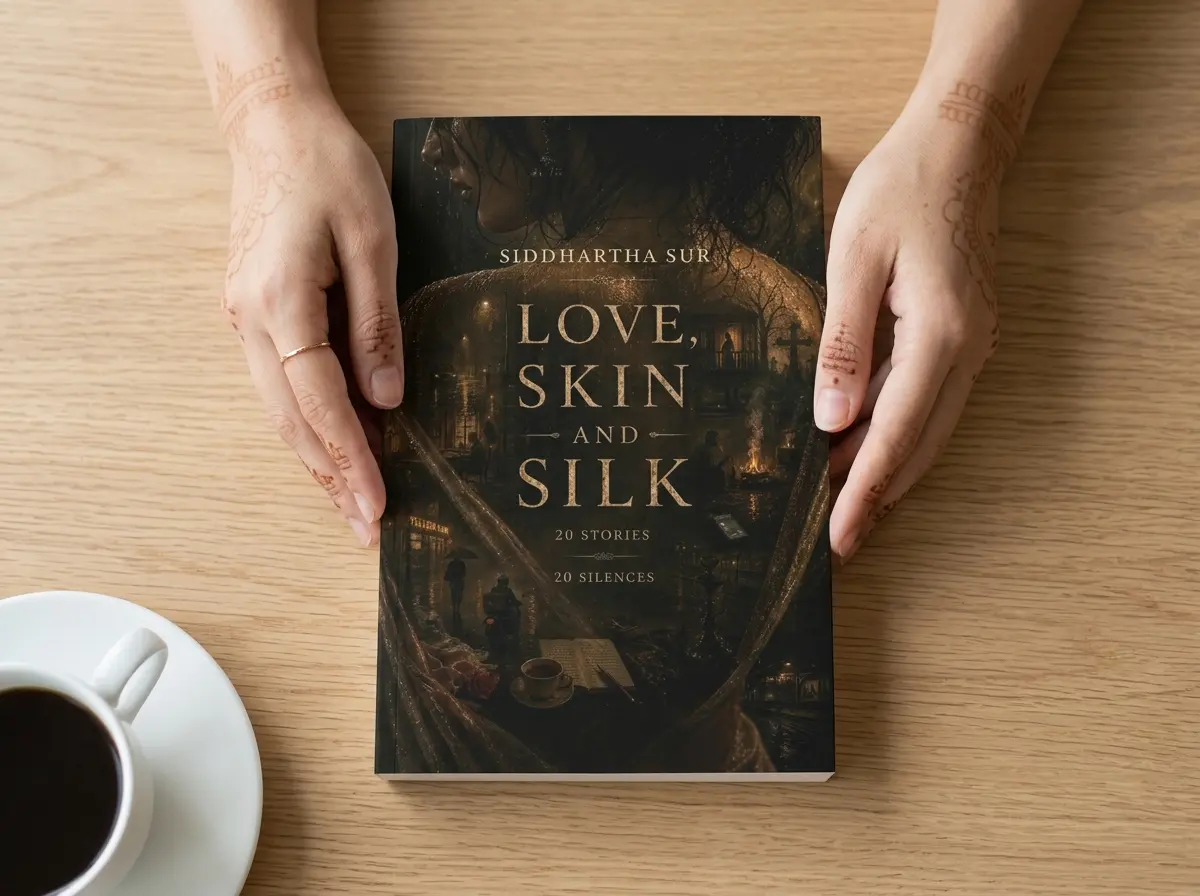
Rating: ⭐⭐⭐⭐½ (4.5 out of 5)
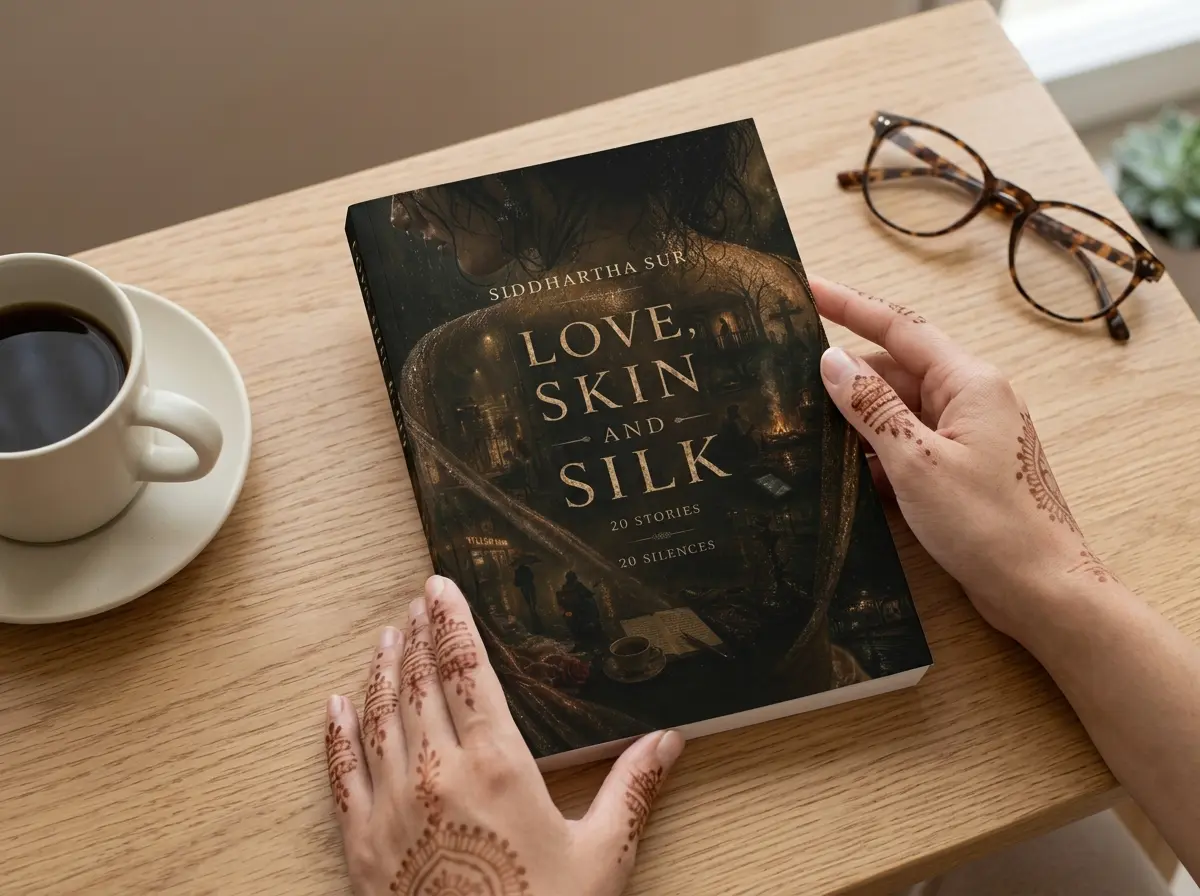
I’ve been reviewing books for over fifteen years, and I’ve developed a certain kind of immunity to being caught off guard. You read enough fiction, and you start to see the stitching. You notice the craft choices, the structural logic, the places where an author is working hard to make something feel effortless. What I wasn’t prepared for, when I sat down with Love Skin and Silk by Siddhartha Sur, was the particular way it gets under your skin without announcing itself. It doesn’t arrive with a dramatic opening gambit or a narrative hook designed to grab you by the collar. It comes in like monsoon air through a window you forgot to close and by the time you’ve noticed, it’s already inside you.
This is a book that operates across time, across bodies, across civilisations. And somehow, it holds together. That’s the thing that impressed me most, honestly. Not any single chapter in isolation, but the audacity and execution of the architecture.
What the Book Is About
Love Skin and Silk by Siddhartha Sur is not one kind of book. That’s both its strength and the thing that might initially confuse a reader expecting a single narrative line. It is, in structure, a collection of interconnected chapters, each a story unto itself, but the thread running through all of them is desire. Not desire in its glamorous, cinematic sense, but desire in its oldest, most aching form: the desire to be known by another person, to be touched without harm, to be remembered after you are gone.
The book opens, startlingly, before history. Chapter 1, “The Child of the Tides,” tells the story of Mira and Arak, a Homo sapien woman and a Neanderthal man who meet on an island between two worlds, in a time before flags, before scripture, before colour was turned into power. Their love grows in a cave beside a small fire, their bodies learning each other across the oldest divide there is: the fear of the other. Siddhartha Sur writes this with a kind of anthropological tenderness, and the image of Arak placing a fig on a flat stone and then stepping back while Mira watches and decides whether to trust him is one of the quietest, most moving gestures of courtship I’ve read in a long time. It doesn’t shout love. It just performs it.
From there, the book moves across centuries. There is a story set in the Vijayanagar Empire, in the court of Rama Raya, where a narrator describes the Krishna Temple as the most gorgeous structure in the city and watches a young friendship with Jishnu deepen into love that social position will eventually sever. There is Sreelekha, who in Chapter 6 walks barefoot through a Behala lane after midnight on the eve of her wedding to spend a final night with Shantanu, in a room that smells of damp walls and clean sheets, the ceiling fan turning slowly as if even time was tired. There is Madhabi, who in Chapter 19 gets on a train and moves through three ghostly compartments: in one, she sees her father, younger and lighter than she has ever known him, laughing with children; in another, she sees her dead mother, young and alive, whispering to the child version of herself. And then there is Arun, twenty-two years old, the boy she loved for three winters without ever saying so, who touches her face carefully in the third compartment as if afraid she might disappear, and kisses her. Not passionately. Not dramatically. And the train moves on.
I’m spending time on these individual moments because that’s what Sur’s writing rewards. The accumulation of specific, sensory, true-feeling scenes. The table of contents alone tells you how wide this book’s ambitions are: chapters titled “Devdas Never Came Here,” “The Everyday Murders,” “Swiped Desires,” “Santanu and Sabari,” “The Grammar of Desire.” Twenty chapters, each inhabiting a different world, a different body, a different register of wanting.
What Stood Out to Me
The writing in Love Skin and Silk has a quality I can only describe as controlled compression. Sur writes in short sentences, often very short, stacked close together, and the cumulative effect is something between prose and breath. It’s not quite poetry, and it’s not quite conventional fiction, but it works. The chapter “What Lingers After” opens with a sentence some smells never really leave us, they stay behind with us like quiet ghosts and builds an entire meditation around the way a dead woman’s scent returns to the narrator when her death is announced among old friends smoking in a room that smells of tea, tobacco, and something faintly human. There’s a moment where Suman, one of the men in the room, says almost to himself that it wasn’t her face or her voice that remained with him, only the smell of her nearness, the way a smell stays even after someone leaves the room. I read that paragraph twice. I read it a third time. I’ve known that feeling, and I don’t think I’d ever seen it described that precisely.
The Sreelekha and Shantanu chapter is where Sur does something I think is genuinely difficult to pull off: he writes a physical farewell between two people who will never belong to each other, and he makes it feel neither tragic nor transgressive but simply human. They undress, the book tells us, with clothes folded with respect, not for reuse but for closure. They move together without haste. And when she leaves before dawn, tying her hair the way her mother liked, turning once at the door with no drama and no tears, Shantanu says “Be happy,” and she gives him what the book calls a careful smile. A trained smile. That distinction, between a real smile and a trained one, is the kind of thing a good writer notices. Sur notices it.
What also struck me was the Madhabi chapter, “Compartments.” The structure of moving through three train compartments, each one a different impossible vision a father who should be broken but is laughing; a mother who should be dead but is alive and humming; a boy who should be a memory but is stepping closer is a formally inventive way to render grief, longing, and the versions of life we almost lived. And Sur has the discipline to let the compartment dissolve before Madhabi can step closer, which is the right choice. The right ending is always the one that trusts the reader to feel what isn’t said.
I want to be honest about one limitation, though, because it would be unfair not to. The short-sentence prose style that Sur employs is extremely effective in its best moments, but it occasionally risks becoming a mannerism. In some chapters, the compression can feel like restraint for its own sake rather than precision in service of emotion. A few chapters in the middle of the book, particularly in stories that are more contemporary and urban in setting, don’t quite match the atmospheric intensity of the prehistoric or historical chapters. The range is part of what makes Love Skin and Silk interesting, but it also means the book is slightly uneven across its twenty chapters.
The Emotional Core
The question underneath all of these stories is one that I find genuinely important and genuinely underexplored in Indian literary fiction: what do we do with the love that doesn’t fit? The love that comes too early, or too late, or in the wrong body, or across the wrong tribe, or on the wrong side of a marriage that hasn’t happened yet? Siddhartha Sur doesn’t answer this question with resolution. He answers it with witness. He shows you Sreelekha who carries Shantanu in a silent inner room, untouched by marriage and motherhood, as proof that once, before becoming everything else, she was herself. He shows you Mira and Arak’s daughter Luma, carried down the slope across the wet sand toward a divided shore, perhaps to grow up and have children of her own, perhaps to carry both worlds in her blood across centuries. He asks, at the end of that chapter: “Is this not the story of the world even now?”
I wasn’t expecting to feel that moved by a book that opened in prehistory. But I think that’s because Sur is doing something quietly ambitious throughout: he is arguing that love is the oldest human continuity. That it precedes civilisation, survives empire, travels in the blood, and lingers in smells and train compartments and the way a woman ties her hair on the morning after. In 2026, when so much of what we read about love is filtered through the language of self-optimisation and relationship metrics, there is something almost radical about a book that just says: people have always wanted each other across impossible distances, and the wanting itself is not nothing.
Who This Book Is For
I want to be straightforward here because not every book is for every reader, and Sur’s style is particular enough that it warrants honesty. If you prefer your fiction driven by plot, by external conflict, by clearly drawn narrative arcs that build and resolve, Love Skin and Silk may frustrate you. This is a book for people who read for feeling rather than event. For people who underline sentences and put the book down to sit with them. For people who have loved someone they couldn’t keep and who have never found quite the right words for what that cost them. For readers of literary fiction in the tradition of writers like Mahasweta Devi or the quieter registers of Amit Chaudhuri, though Sur’s range across time periods is his own distinct project.
It’s also a book that rewards re-reading, I think. The chapters gain meaning from each other. A chapter you read early will feel different once you’ve read what comes after. That’s a sign of considered architecture, and it’s something I’ve come to respect over many years of reading and editing at Deified Publication.
Final Thoughts
Love Skin and Silk is the kind of book I’m glad exists. Not because it’s perfect, but because it’s genuinely trying to do something. Sur is asking what love looks like when you strip away the ceremonies and the social permissions and the correct endings, and what he finds is something ancient and stubbornly alive. The image of Arak placing a fig on a stone and stepping back, waiting to see if Mira will trust him, is three thousand years old and also completely contemporary. That’s the achievement.
Read it slowly. Read it more than once if you can.

With over 11 years of experience in the publishing industry, Priya Srivastava has become a trusted guide for hundreds of authors navigating the challenging path from manuscript to marketplace. As Editor-in-Chief of Deified Publications, she combines the precision of a publishing professional with the empathy of a mentor who truly understands the fears, hopes, and dreams of both first-time and seasoned writers.