
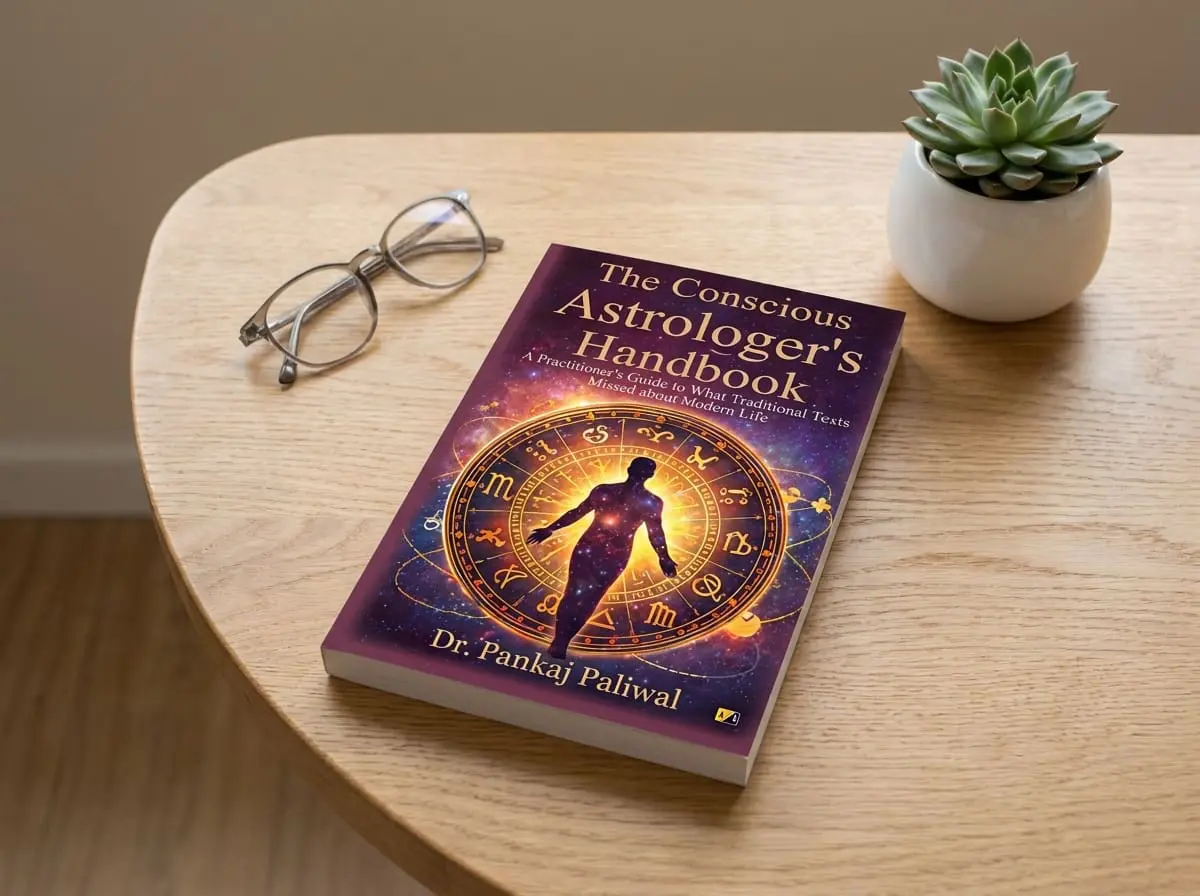
Rating:
⭐⭐⭐⭐ (4.3 out of 5)
There are some books that try to teach you a subject. Then there are books that try to challenge the way that subject is being practiced.
The Conscious Astrologer’s Handbook by Dr. Pankaj Paliwal belongs firmly in the second category.
As someone who has spent years reviewing books across genres, I’ve noticed that books about astrology usually fall into one of two camps. They are either introductory guides that explain planets, houses, and signs, or they promise shortcuts to success, wealth, relationships, and happiness. This book does something different. It asks a surprisingly uncomfortable question:
What if astrology itself needs to evolve?
Honestly, that question caught my attention immediately.
The subtitle, A Practitioner’s Guide to What Traditional Texts Missed About Modern Life, gives readers a clear indication of what they are stepping into. Dr. Pankaj Paliwal is not rejecting traditional Jyotish. In fact, he shows considerable respect for classical texts throughout the book. What he is questioning is whether astrologers can continue applying centuries old interpretations without considering how dramatically human life has changed.
That idea forms the foundation of almost everything discussed in this work.
What the Book Is About
At its core, The Conscious Astrologer’s Handbook is an attempt to bridge ancient Vedic astrology and modern society.
The book begins by establishing the philosophical foundations of Jyotish and explaining why astrology has been respected for thousands of years. The author presents astrology as a system built upon observation, mathematics, patterns, and cosmic relationships rather than simple fortune telling. He repeatedly emphasizes that birth charts reveal possibilities and tendencies rather than fixed outcomes. Free will still matters. Human choices still matter.
From there, the book moves into what I think is its most interesting territory.
Dr. Paliwal argues that many traditional interpretations were created in societies that looked nothing like ours. Ancient astrologers lived in worlds without artificial intelligence, social media, digital entrepreneurship, fertility treatments, remote work, modern medicine, mental health awareness, or global career mobility. Applying old rules without context, he argues, often produces inaccurate predictions and damages astrology’s credibility.
The book covers marriage, careers, wealth, education, health, social media, psychology, planetary strengths, yogas, research methodology, and the future of astrology itself. Rather than presenting astrology as a rigid system, the author encourages practitioners to become researchers who continuously test, observe, and refine their understanding.
What Stood Out to Me
The biggest strength of this book is that it refuses to hide behind tradition.
That may sound like a criticism, but I mean it as praise.
One of the recurring themes throughout the manuscript is intellectual honesty. Dr. Paliwal repeatedly points out situations where astrologers make overly simplistic claims based on planetary combinations without properly evaluating planetary strength, dasha periods, transits, divisional charts, or modern realities. He challenges the habit of declaring success, wealth, or failure based on surface level chart reading.
I appreciated this because it feels rare.
Many books in spiritual or metaphysical spaces spend their energy defending their systems. This book spends much of its energy examining weaknesses in current practice.
Another thing that stood out was the discussion about changing social structures.
The author examines how marriage has transformed from a family arrangement into a partnership based on compatibility, personal growth, and individual choice. He discusses delayed marriages, second marriages, live in relationships, changing gender roles, and the need for astrologers to rethink traditional assumptions. Whether readers agree with every conclusion or not, the discussion feels timely.
The same approach appears in chapters about careers and education. The author points out that ancient texts never had to account for software developers, social media managers, AI professionals, cybersecurity experts, or digital entrepreneurs. Rather than discarding traditional planetary meanings, he argues for adapting them to contemporary professions.
That balance between preservation and adaptation is probably the book’s most consistent theme.
The Emotional Core
At first glance, this might seem like a technical handbook. In many ways, it is.
There are discussions about planetary strength, dasha systems, yoga formations, conjunctions, research methods, and chart analysis. Readers looking for technical material will find plenty of it. Yet beneath the technical content, I found a more human message.
The author seems deeply concerned about why people seek astrology in the first place.
Many modern clients are not asking about rituals or spiritual liberation. They are asking why they feel anxious. Why relationships keep failing. Why success feels empty. Why they feel lost despite doing everything society told them to do. The book acknowledges these concerns and treats them seriously. I found myself returning to that idea several times.
In 2026, we live in a world overflowing with information. People have access to endless advice, endless content, endless opinions. Yet confusion seems to be growing rather than shrinking.
This book argues that astrology, when practiced responsibly, should not become a machine for certainty. It should become a framework for self awareness. That distinction matters.
The chapters on karma, free will, and conscious decision making were particularly interesting because they avoid extreme fatalism. The author repeatedly reminds readers that planetary influences create tendencies, not guarantees. Individuals still participate in shaping their lives through awareness and action.
I suspect many readers will connect with that perspective, even if they are not practicing astrologers.
Where the Book May Not Work for Everyone
No honest review should pretend a book is perfect. For me, the biggest challenge was repetition. Several core ideas appear throughout multiple chapters. The need for research, the importance of modernizing astrology, the dangers of superficial predictions, and the importance of adapting traditional interpretations are revisited frequently.
Some readers will appreciate the reinforcement. Others may feel that certain arguments could have been presented more concisely.
The writing style is also highly instructional. Readers looking for storytelling, personal anecdotes, or lighter reading may find parts of the book dense. This is very much a practitioner’s handbook rather than a casual introduction.
I also think the book occasionally assumes a degree of acceptance regarding astrology that skeptical readers may not share. While the author attempts to discuss astrology in scientific and research oriented language, readers approaching the subject from a strictly scientific perspective may remain unconvinced.
That said, the author’s willingness to encourage testing, observation, and evidence gathering does add credibility to the discussion.
Who This Book Is For
I think this book will resonate most with three groups of readers.
- First, practicing astrologers who feel traditional interpretations sometimes fail to explain modern life.
- Second, serious students of Jyotish who want to move beyond memorizing combinations and understand the reasoning behind chart analysis.
- Third, readers interested in the intersection of spirituality, psychology, personal growth, and decision making.
This might not be the ideal starting point for someone who knows absolutely nothing about astrology. Beginners can certainly learn from it, but many discussions assume some familiarity with concepts such as houses, dashas, yogas, and planetary influences.
Readers seeking quick predictions or easy answers may also find themselves challenged. The author repeatedly argues against shortcuts and emphasizes depth, research, and thoughtful analysis.
Final Thoughts
When I finished The Conscious Astrologer’s Handbook, I found myself thinking less about astrology and more about adaptation.
Every field faces the same challenge.
- How do we preserve valuable traditions without becoming trapped by them?
- How do we honor old knowledge while remaining open to new realities?
That is the conversation Dr. Pankaj Paliwal is trying to start. Whether readers agree with every argument is almost secondary. The real value of the book lies in its willingness to ask difficult questions about astrology’s future and its insistence that practitioners become students, researchers, and observers rather than mere interpreters of inherited rules.
As Editor-in-Chief at Deified Publication, I’ve read many books that explain astrology. Fewer books attempt to challenge astrologers themselves. This one does. And for that reason alone, I think it deserves attention from serious students of Jyotish.
Frequently Asked Questions
Is The Conscious Astrologer’s Handbook worth reading?
If you’re interested in modern Jyotish, astrological research, and how ancient principles can be applied to contemporary life, I believe it offers valuable perspectives.
What is The Conscious Astrologer’s Handbook about?
The book examines how traditional Vedic astrology can be updated to address modern careers, relationships, technology, psychology, education, and social changes.
Who should read The Conscious Astrologer’s Handbook?
Astrology students, practicing astrologers, spiritual seekers, and readers interested in self development will likely gain the most from it.
Does the book challenge traditional astrology?
Yes. The author respects traditional Jyotish while arguing that practitioners should rethink outdated interpretations and embrace research driven approaches.

With over 11 years of experience in the publishing industry, Priya Srivastava has become a trusted guide for hundreds of authors navigating the challenging path from manuscript to marketplace. As Editor-in-Chief of Deified Publications, she combines the precision of a publishing professional with the empathy of a mentor who truly understands the fears, hopes, and dreams of both first-time and seasoned writers.