
Rating
⭐⭐⭐⭐½ (4.5 out of 5)
After more than fifteen years of reading and reviewing books at Deified Publication, I’ve realised that spiritual books usually fall into one of two categories. Some are deeply scholarly, filled with scriptural references that demand careful study. Others simplify everything so much that the original depth almost disappears. Finding a book that sits comfortably between those two extremes isn’t easy.
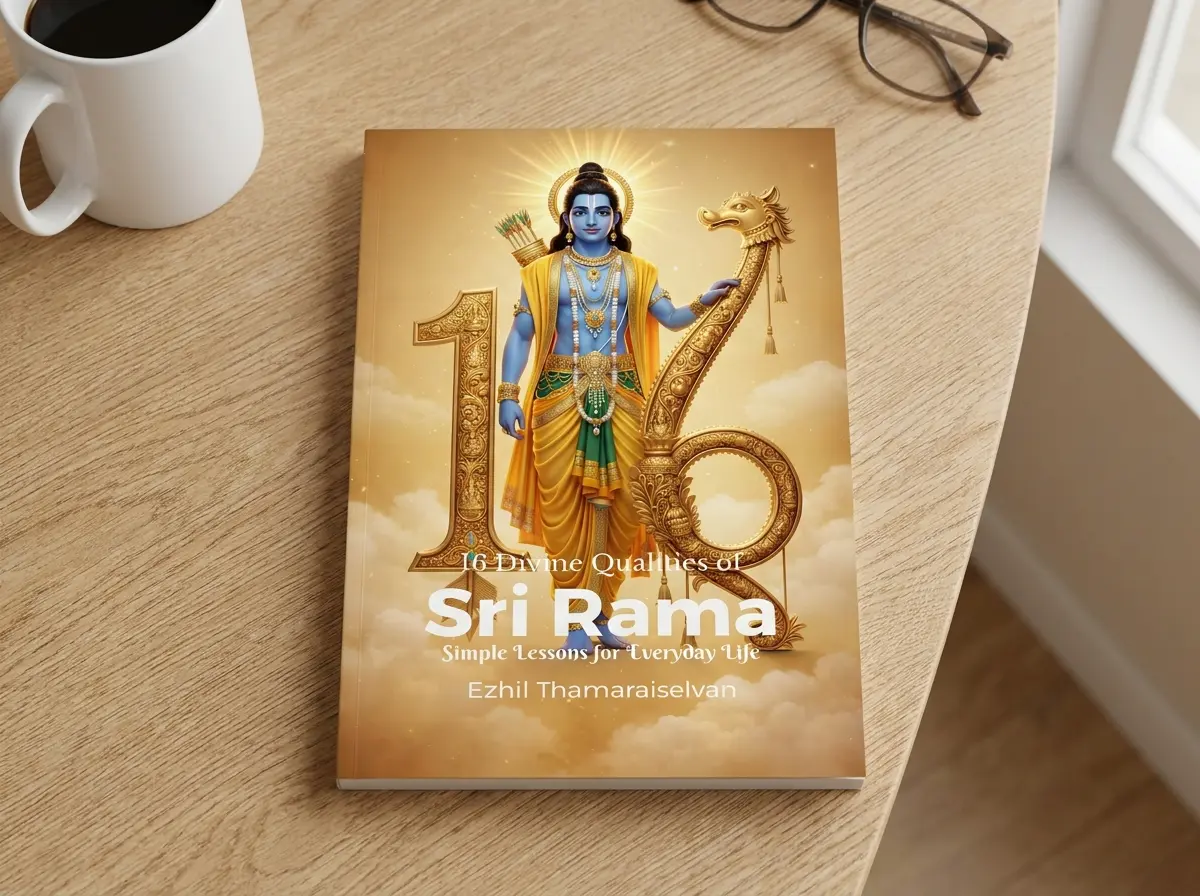
That is what immediately caught my attention while reading 16 Divine Qualities of Sri Rama: Simple Lessons for Everyday Life by Ezhil Thamaraiselvan.
I didn’t feel like I was reading another retelling of the Ramayana. Instead, it felt like sitting with someone who genuinely loves Sri Rama and wants to explain why His character still matters in everyday life. The focus isn’t on recounting every event from the epic. The focus is on understanding why Rama acted the way He did, what those actions reveal about His nature, and how those same principles can help us become better people.
I appreciated that approach because many readers already know the broad story of the Ramayana. What they often seek is something deeper than chronology. They want meaning. They want practical guidance that connects ancient wisdom with modern challenges without sounding preachy. This book attempts exactly that.
It doesn’t claim that reading about Sri Rama will instantly transform your life. Instead, it repeatedly encourages readers to reflect, question themselves, and gradually cultivate virtues through daily choices. That made the reading experience feel personal rather than instructional.
What the Book Is About
As the title suggests, 16 Divine Qualities of Sri Rama revolves around sixteen virtues traditionally associated with Lord Rama. The introduction begins with a memorable conversation between Sage Valmiki and Sage Narada. Valmiki asks sixteen questions about the ideal human being, and Narada, overwhelmed with devotion, finds himself answering every question with a single name: Lord Rama.
I actually smiled while reading this opening. The author doesn’t present Narada’s response merely as a story from scripture. Instead, he explains why someone immersed in devotion naturally sees every noble quality reflected in the person they revere. It’s a thoughtful beginning because it establishes the entire purpose of the book before moving into the individual chapters.
Each chapter focuses on one specific quality, including Gunavaan, Veeryavaan, Dharmajna, Kritajna, Vidwaan, Samarthah, Anasuyakah, Dhyutimaan, and several others. Rather than simply defining these Sanskrit terms, Ezhil Thamaraiselvan illustrates them using familiar incidents from the Ramayana. Every virtue is then connected to situations readers encounter in ordinary life, whether at home, in the workplace, among friends, or within society.
That practical structure is one of the book’s greatest strengths.
Instead of reading like a theological commentary, the chapters resemble conversations that invite readers to think about their own behaviour. The author continually asks questions that encourage self reflection. Are we treating everyone equally? Do we allow jealousy to influence our relationships? Are we learning with humility or merely collecting information? Those questions make the book feel relevant without forcing modern interpretations onto ancient stories.
What Stood Out to Me
The chapter on Gunavaan, which explains the virtue of treating everyone equally, was one of the strongest sections in the book.
The author discusses Rama’s relationship with Guha, Sugriva, and Vibhishana to show that true nobility isn’t measured by birth, wealth, or social standing. One example that particularly caught my attention was Rama embracing Vibhishana despite opposition from others. Instead of reacting with suspicion simply because Vibhishana came from Ravana’s family, Rama judged him by his character. The author then gently shifts that lesson toward present day life by asking readers whether we unconsciously judge people based on profession, education, religion, or economic background. I thought that transition worked very well because it never felt forced.
Another chapter I found especially meaningful was Veeryavaan, which looks beyond physical strength. Naturally, the familiar episode of Rama breaking Shiva’s mighty bow appears here, but the discussion doesn’t stop there. The author also examines Rama’s encounter with Parashurama and later his decision to support Sugriva instead of Vali. That second example interested me even more.
Many readers have debated Rama’s decision regarding Vali for centuries. Instead of avoiding that difficult subject, the author addresses it directly, explaining the ethical reasoning behind Rama’s actions and placing them within the broader framework of Dharma. Whether every reader agrees completely or not, I appreciated that the discussion acknowledged complexity instead of presenting simplistic answers.
The chapter on Dharmajna also deserves mention because it reminds readers that Dharma isn’t merely about following rules. Through Rama’s acceptance of exile, respect for his father’s promise, compassion toward Jatayu, and consistent commitment to righteousness, the author presents Dharma as a living principle expressed through choices rather than slogans.
As someone who has reviewed many spiritual books, I often notice authors repeating moral conclusions without showing how those conclusions arise from the narrative itself. Here, the examples generally support the lessons quite naturally.
One section that remained in my thoughts long after I finished reading concerns Kritajna, the virtue of gratitude.
The author recalls Rama performing the final rites of Jatayu after the noble bird sacrificed his life trying to rescue Sita. That scene has always been emotionally powerful within the Ramayana, but here it becomes a lesson about acknowledging even the smallest acts of kindness. The discussion then moves toward Rama forgiving Kakasura after justice had been served. I liked this contrast because gratitude and forgiveness are presented not as weakness but as expressions of moral strength.
Another chapter I genuinely enjoyed focuses on Vidwaan, or true wisdom.
The author argues that wisdom is not measured by how much information a person possesses. Instead, it is reflected in lifelong curiosity and humility. Rama’s respectful relationship with Sage Vishwamitra becomes the foundation for this lesson. Even though Rama was no ordinary prince, He listened, learned, asked permission before acting, and accepted guidance without arrogance. I think that message is especially valuable today, when knowledge is often confused with confidence.
The author even connects this quality to modern education by encouraging readers to remain students throughout life. That felt refreshing because it transforms an ancient virtue into practical advice rather than distant philosophy.
Another pleasant surprise was the chapter on Samarthah, the quality of competence.
Instead of defining competence only as efficiency or intelligence, Ezhil Thamaraiselvan describes Rama’s ability to understand different people’s emotional needs. There is a thoughtful discussion explaining how Rama spoke differently to Dasharatha, Bharata, Kaushalya, and Sita because each person required different reassurance. Leadership, the author suggests, is not about saying the same thing to everyone. It is about understanding whom you are speaking to. I found that observation insightful because it applies equally to parents, teachers, managers, and community leaders.
Perhaps the most contemporary chapter in the book is Anasuyakah, which addresses jealousy.
Rather than treating jealousy as an abstract spiritual problem, the author discusses everyday comparisons, including social media, family relationships, professional success, and material possessions. He explains how harmless comparison gradually becomes resentment if left unchecked. I appreciated this chapter because it acknowledges modern realities without losing its spiritual foundation.
Finally, I enjoyed the closing reflections on the power of Rama Nama. Instead of presenting chanting as a mechanical ritual, the author describes it as a practice that gradually transforms one’s thoughts, emotions, and inner life. The emphasis remains on sincerity rather than performance, which feels entirely consistent with the tone of the rest of the book.

The Emotional Core
Although 16 Divine Qualities of Sri Rama is a non fiction spiritual book, I think its greatest strength lies in the fact that it never feels like a lecture. Instead of asking readers to admire Sri Rama from a distance, it gently encourages them to ask a far more personal question: What would this quality look like in my own life? That shift makes all the difference.
While reading, I often found myself reflecting on situations outside the book. There were moments that reminded me of workplace disagreements, conversations within families, and even the way we sometimes react online. It made me realise how quickly we judge people, compare ourselves with others, or become impatient without even noticing.
The chapter on jealousy was especially effective in this regard. The author explains that envy rarely begins with hatred. It often starts with comparison, whether it is someone’s success, possessions, recognition, or social media presence. That observation felt surprisingly relevant because it reflects something almost everyone experiences today. Rather than simply telling readers not to be jealous, the book explains how jealousy quietly grows and eventually affects relationships if left unchecked.
I also appreciated the discussion surrounding righteous anger. Modern conversations often suggest that all anger is harmful, but the author makes an important distinction. Through episodes such as Rama’s response to the Ocean God and the story of Kakasura, he explains that anger arising from ego destroys, while anger born from protecting righteousness serves a completely different purpose. I thought this was one of the most balanced sections in the book because it avoids oversimplification.
Another moment that genuinely touched me was the author’s reflection on Jatayu. Most readers remember the episode itself, but here the emphasis falls on Rama personally performing the final rites for the noble bird. The author uses that incident to illustrate gratitude that extends beyond social status or personal benefit. I found myself thinking about how easily we overlook acts of kindness simply because they come from unexpected people.
The recurring message throughout the book is that greatness is rarely built through extraordinary moments alone. It grows through everyday habits, honesty, humility, compassion, discipline, gratitude, and the willingness to continue learning. That perspective gives the book a warmth that many spiritual guides struggle to achieve.
Who This Book Is For
One aspect I particularly appreciated is that 16 Divine Qualities of Sri Rama does not assume prior scholarly knowledge of Hindu scriptures.
If you have grown up hearing stories from the Ramayana, you’ll recognise many familiar episodes and probably enjoy seeing them interpreted through the lens of individual virtues rather than chronological storytelling.
At the same time, readers who know very little about the epic can also follow the discussion comfortably because each chapter provides enough context before drawing its lesson. I believe this book will appeal to several different audiences.
Parents looking for meaningful values to discuss with children may find it useful because the explanations are straightforward without becoming childish.
Teachers and mentors could also benefit from many of the practical examples, particularly the chapters on leadership, gratitude, humility, competence, and lifelong learning.
Young professionals may find the chapters on jealousy, leadership, equality, and self discipline surprisingly relevant. Those lessons translate naturally into modern workplaces without feeling artificially adapted.
Readers searching for an academic study of Sanskrit terminology or a detailed theological commentary should know that this is not the author’s objective. The emphasis remains on practical reflection rather than scholarly debate. Personally, I think that choice makes the book far more approachable for general readers.
Final Thoughts
By the time I reached the final pages of 16 Divine Qualities of Sri Rama, I realised that the book had accomplished something many spiritual books attempt but few fully achieve. It made familiar stories feel fresh again.
Most readers already know that Sri Rama represents Dharma. What Ezhil Thamaraiselvan does particularly well is explain why individual actions reveal particular virtues and how those same principles continue to matter in ordinary life. Whether discussing Rama welcoming Vibhishana, respecting Sage Vishwamitra, honouring Jatayu, comforting Bharata, forgiving Kakasura, or speaking differently to each member of his family according to their needs, the lessons consistently return to one central idea. Character is revealed through conduct.
I also admired the author’s writing style. The language is clear, sincere, and welcoming. Sanskrit terms are introduced with care instead of becoming barriers for readers unfamiliar with them. More importantly, every chapter ends with reflections that invite personal introspection rather than demanding agreement.
If I had one small suggestion, it would be to include even more practical contemporary examples in a few chapters. The sections connecting ancient wisdom with modern life were among the strongest parts of the book, and expanding those further would make future editions even more engaging for younger readers.
As Editor in Chief at Deified Publication, I have reviewed books across fiction, spirituality, history, and self development. Many spiritual books succeed in explaining scripture. Fewer succeed in making readers genuinely examine themselves. 16 Divine Qualities of Sri Rama belongs to the second category. It encourages reflection without becoming preachy and offers timeless values in language that remains accessible.
I closed the book feeling less interested in memorising sixteen Sanskrit names and more interested in practising even one of them a little better. For me, that is the strongest compliment I can give a book like this.
FAQs
Is 16 Divine Qualities of Sri Rama worth reading?
Yes. If you’re looking for a practical spiritual book rather than a complete retelling of the Ramayana, this is a rewarding read. It explains Sri Rama’s virtues in simple language while connecting them to situations we encounter in everyday life.
What is 16 Divine Qualities of Sri Rama about?
The book explores sixteen divine qualities traditionally associated with Sri Rama, including compassion, gratitude, wisdom, courage, humility, self discipline, and freedom from jealousy. Each chapter combines incidents from the Ramayana with practical reflections that help readers apply these virtues in their own lives.
Who should read 16 Divine Qualities of Sri Rama?
This book is suitable for readers interested in Hindu philosophy, spiritual growth, self improvement, and the teachings of the Ramayana. It is also a good choice for parents, teachers, students, and anyone searching for practical life lessons rooted in Indian spiritual tradition.
Who is the author of 16 Divine Qualities of Sri Rama?
Ezhil Thamaraiselvan presents timeless teachings through an accessible and reader friendly approach. Instead of focusing only on scriptural narration, the author explains how Sri Rama’s virtues remain relevant in modern life.
Do I need to know the Ramayana before reading this book?
Not at all. Familiarity with the Ramayana certainly adds context, but the author explains each incident clearly enough that newcomers can understand the lessons without difficulty. The focus remains on values, character, and practical application rather than assuming extensive prior knowledge.

With over 11 years of experience in the publishing industry, Priya Srivastava has become a trusted guide for hundreds of authors navigating the challenging path from manuscript to marketplace. As Editor-in-Chief of Deified Publications, she combines the precision of a publishing professional with the empathy of a mentor who truly understands the fears, hopes, and dreams of both first-time and seasoned writers.