
Rating:
⭐⭐⭐⭐ (4.3 out of 5)
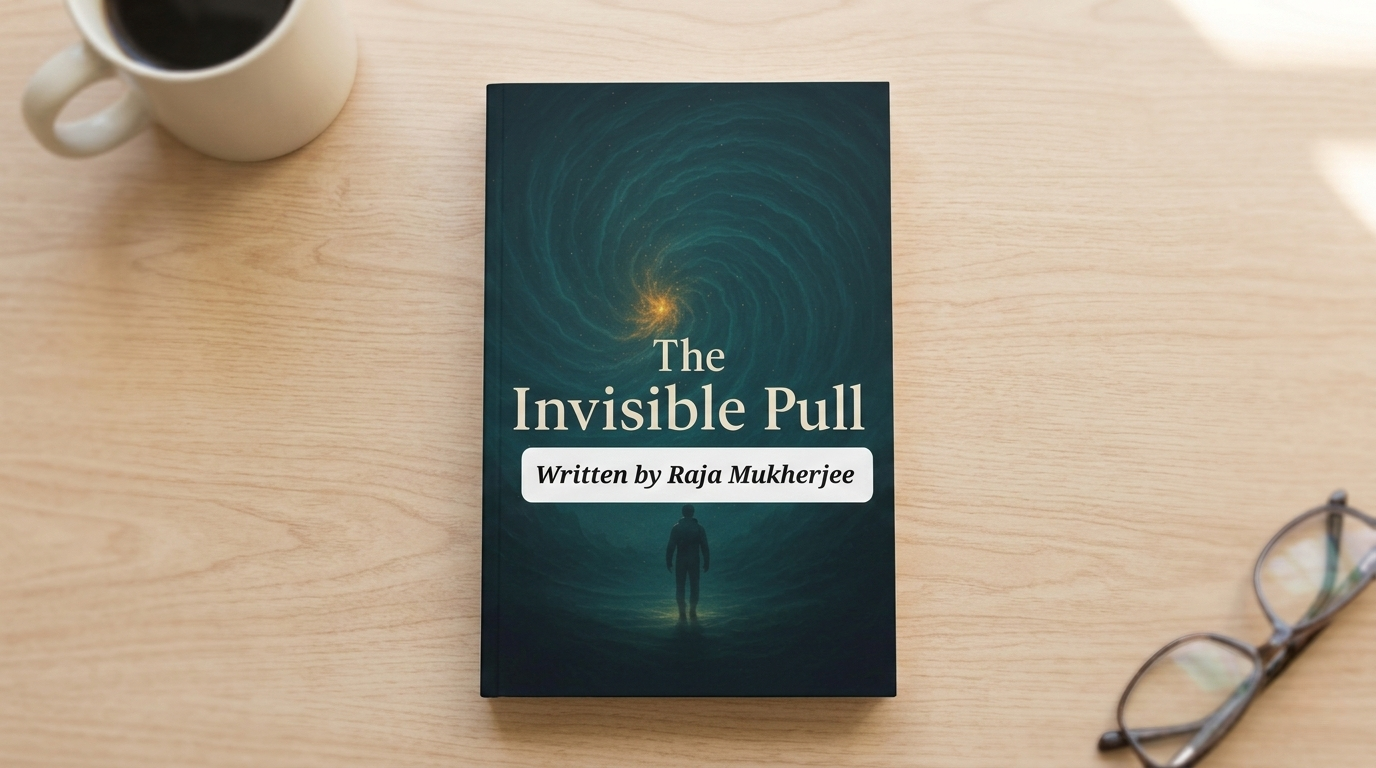
Sometimes a book cover tells you more than the blurb. When I first saw The Invisible Pull, that spiral of teal space collapsing inward toward a golden core, and a lone human figure standing beneath it, I paused. It did not look like a typical hard science fiction novel. It looked like a question.
And I have learned over the years that the best speculative fiction does not begin with answers. It begins with a question that refuses to leave you alone.
Opening Thoughts
In my fifteen years of reading across genres, I have noticed something. Science fiction often falls into two camps. One dazzles with technology and jargon. The other uses science as a mirror to examine something deeply human.
The Invisible Pull by Raja Mukherjee clearly belongs to the second camp.
The premise is intriguing. A space station called Graviton 1. A Gravity Inducer Module built on something called the Singularity Field Mass Manipulation Theory. Artificial gravity created by manipulating space time itself. Already, that sounds ambitious. But what interested me more was not the device. It was the suggestion in the blurb that the real force at work might respond not to machines, but to human consciousness.
That idea stayed with me.
What The Invisible Pull Is About
At its surface, this novel follows the crew of a deep space research station testing an experimental gravity system. The Gravity Inducer Module is meant to create controlled artificial gravity by bending the very fabric of space time. It is a bold scientific leap.
Two scientists begin to notice anomalies. Their experiments do not behave as expected. Measurements blur. Data conflicts with experience. Visions begin to creep into their waking hours. The distinction between mechanical effect and internal perception begins to thin.
Soon the story shifts from pure engineering to philosophical speculation. Is gravity merely a force acting on mass? Or is it something more relational, something responsive?
As the narrative unfolds, the crew realizes that the Gravity Inducer might not be responding purely to equations. It may be reacting to emotional states, to awareness, to intention.
And then comes the central question that drives the novel: Are we discovering the universe, or is the universe discovering us?
I have read many science fiction novels that attempt to merge quantum theory with spirituality. Some succeed. Many collapse under their own ambition. Raja Mukherjee attempts something delicate here. He does not reduce science to mysticism. Instead, he allows uncertainty to breathe.
What Stood Out To Me
First, the metaphor of gravity itself.
Gravity is an invisible pull. You cannot see it. You only experience its effects. That becomes a powerful parallel for emotion, memory, longing. We are constantly pulled by things we cannot measure.
I kept thinking about how relationships often feel gravitational. You do not choose them consciously sometimes. You are drawn. You orbit. You resist. You fall.
The novel seems to suggest that the cosmos may operate on similar principles.
Second, the emotional undercurrent.
For a book that begins with a technical experiment aboard a space station, the blurb makes it clear that this is not merely about scientific discovery. It is about human consciousness. About sacrifice. About truth hiding deeper illusion.
In my experience as an editor, when authors blend philosophy with science, pacing becomes critical. If the philosophical reflection overwhelms the narrative movement, readers can feel stalled. If the science dominates, the emotional thread weakens. From the description, it seems Mukherjee tries to keep that balance.
I especially appreciated the idea that every discovery demands a sacrifice. That line feels honest. Scientific breakthroughs are rarely sterile. They cost time, relationships, certainty. Sometimes sanity.
Third, the existential tone.
The question of whether we are discovering the universe or being discovered by it is not new. But placed inside a high stakes experiment in deep space, it gains urgency. When you are isolated in the void, stripped of Earthly noise, the mind has space to wander into uncomfortable territory.
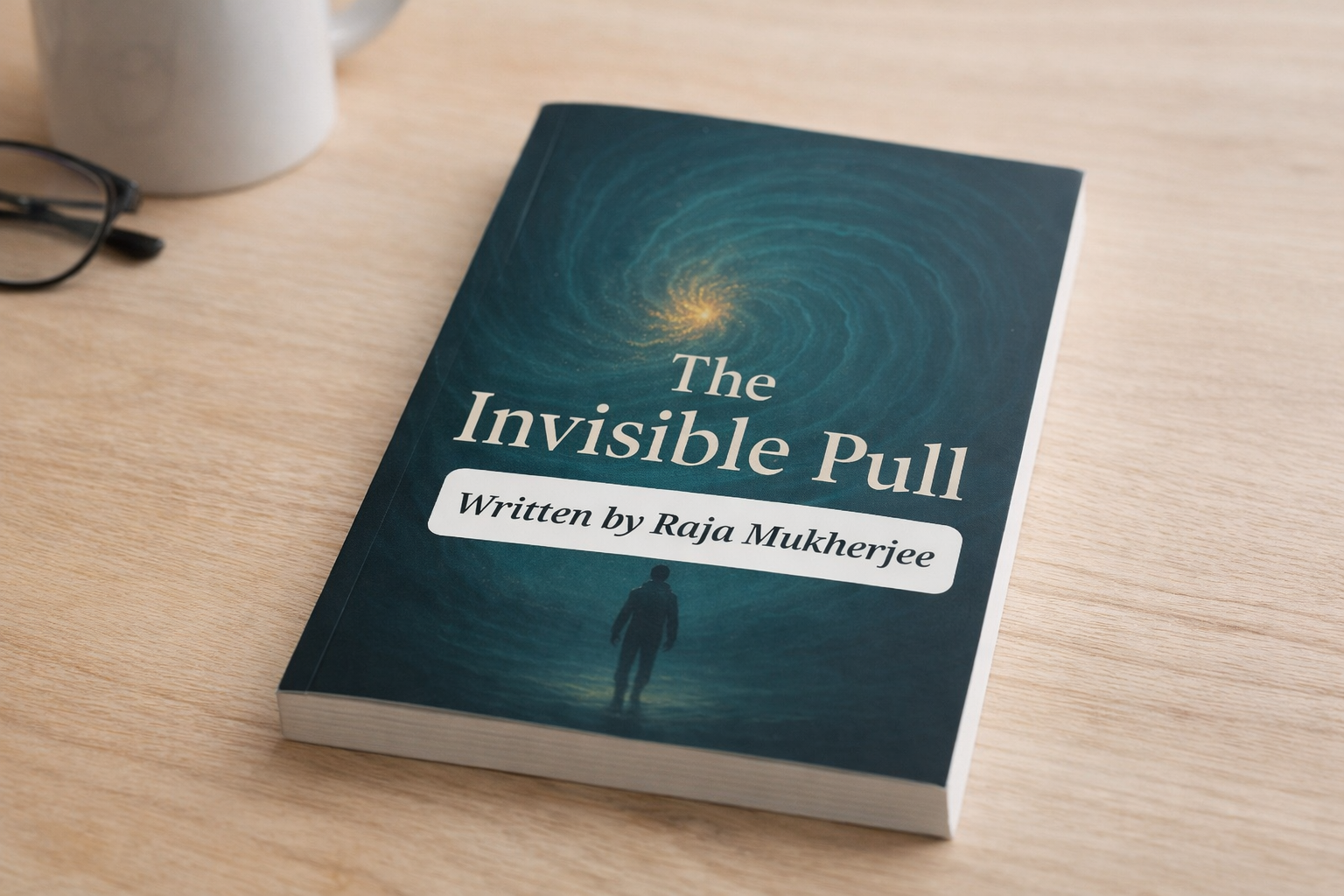
The cover reinforces this. A single figure facing a swirling cosmic force. Alone, yet not alone.
The Emotional Core
Here is where I felt the novel might resonate most.
Science fiction often imagines advanced futures. But beneath that imagination lies a simple fear. What if we are not in control?
Artificial gravity represents mastery over physical law. Human consciousness influencing gravity represents surrender to something larger.
There is something humbling in that idea.
In 2026, when we talk about artificial intelligence, space tourism, and quantum computing almost casually, a story like The Invisible Pull feels timely. We are constantly pushing boundaries. But are we prepared for the emotional consequences of those breakthroughs?
This novel seems to ask that gently.
I also sense a subtle spiritual layer. Not religious in a traditional sense. More like a philosophical awe. A recognition that the universe might not be a cold mechanism. It might be relational.
Some readers may find that idea exhilarating. Others may prefer harder, more technical science fiction.
A Small Critique
Because the concept is so expansive, there is always a risk of abstraction. When a story grapples with consciousness shaping gravity, the danger lies in losing grounding. Readers still need human stakes. Clear character arcs. Tangible consequences.
If the narrative leans too heavily into philosophical dialogue without anchoring it in personal conflict, it may feel distant.
That said, ambition is something I admire. And Mukherjee’s premise is undeniably ambitious.
Who This Book Is For
If you enjoy science fiction that mixes physics with philosophy, this book may be for you.
If you liked novels that question reality and consciousness, or stories where scientific experimentation opens unexpected metaphysical doors, you will likely connect with this.
If you prefer fast paced action driven space operas filled with battles and chase sequences, this might not be your first choice.
This feels more contemplative. More reflective.
Final Thoughts
As Editor in Chief at Deified Publication, I often tell aspiring writers that genre is only a vehicle. What matters is the emotional truth beneath it.
The Invisible Pull uses science fiction as its vehicle. But its true subject seems to be connection. The invisible threads binding human consciousness to cosmic law.
I found myself thinking less about the Gravity Inducer Module and more about the metaphor. What unseen forces shape our decisions? What pulls us toward certain truths?
Maybe that is the mark of a thoughtful novel. It leaves you with questions rather than conclusions.
FAQs
Is The Invisible Pull worth reading?
If you enjoy science fiction blended with philosophical reflection, yes. It offers more than technical speculation.
What is The Invisible Pull about?
It follows scientists testing artificial gravity on a space station, only to discover that consciousness may influence the very fabric of space time.
Who should read The Invisible Pull?
Readers who appreciate speculative fiction that explores emotion, reality, and cosmic connection.
Is it heavy on science?
The premise is rooted in theoretical physics, but the emotional and philosophical layers are equally important.

With over 11 years of experience in the publishing industry, Priya Srivastava has become a trusted guide for hundreds of authors navigating the challenging path from manuscript to marketplace. As Editor-in-Chief of Deified Publications, she combines the precision of a publishing professional with the empathy of a mentor who truly understands the fears, hopes, and dreams of both first-time and seasoned writers.