
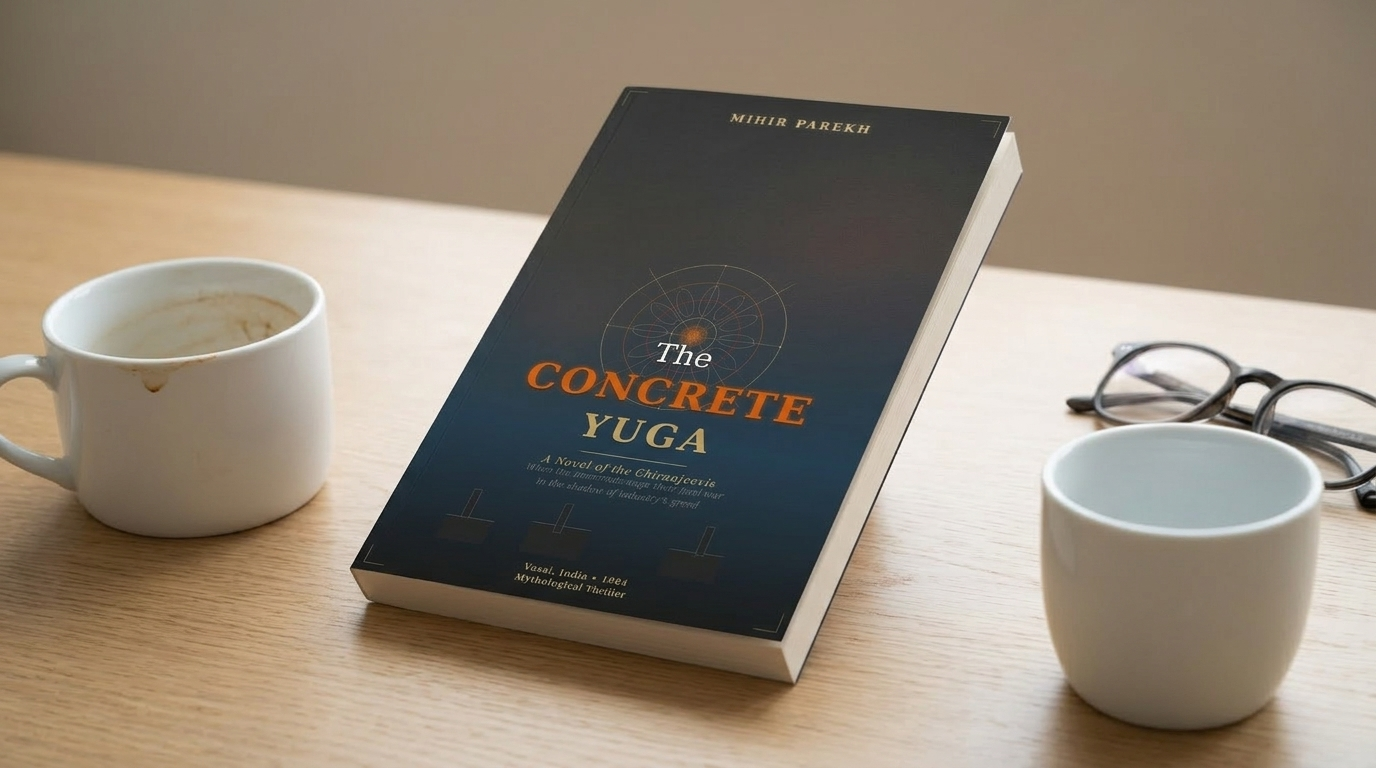
Rating:
⭐⭐⭐⭐ (4.4 out of 5)
When Myth Walks Into a Railway Station
Some books introduce themselves politely.
Others arrive with a strange energy, like something old stepping quietly into the modern world.
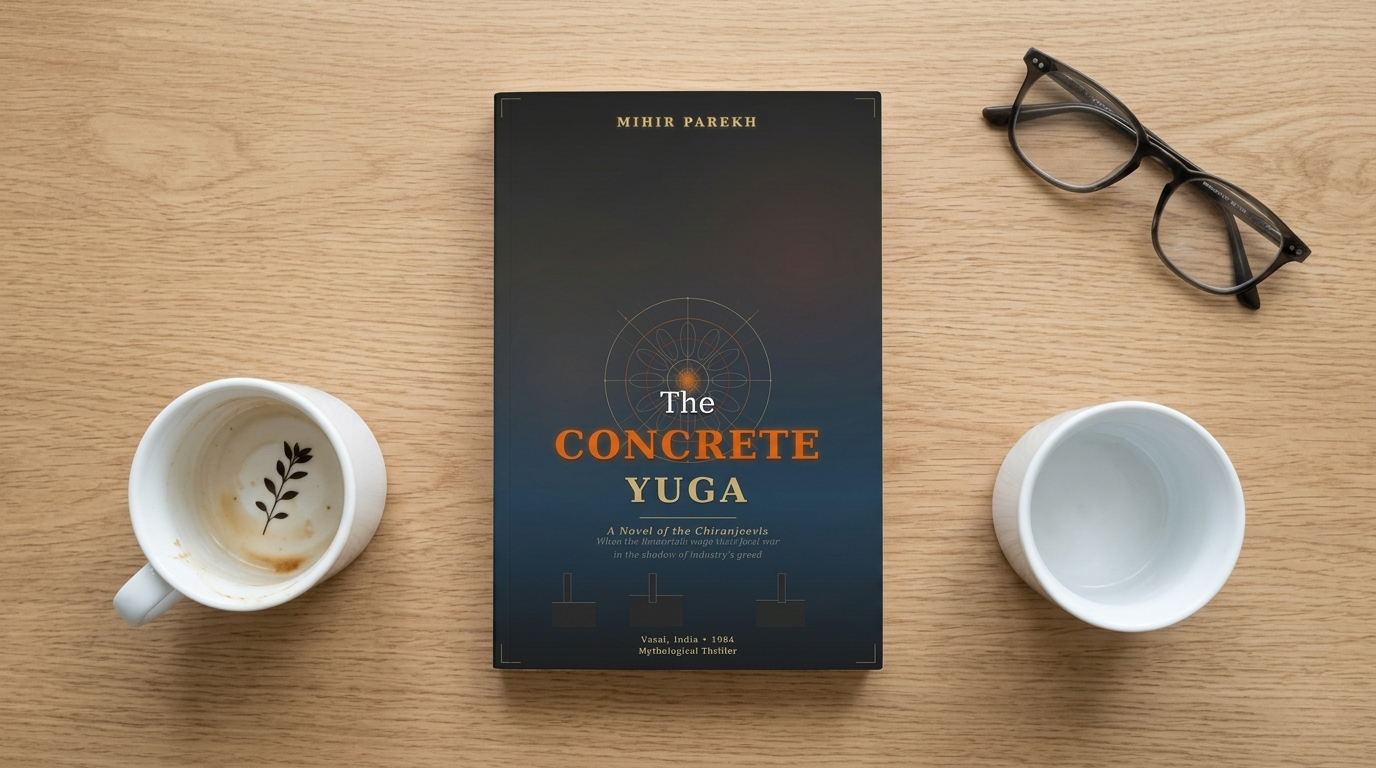
That is how I felt reading the opening pages of The Concrete Yuga by Mihir Prashant Parekh.
The very first scene unfolds at Vasai Road railway station in 1984. People rush past in bell bottoms and briefcases, commuters living ordinary lives. But sitting against a wall is a ragged beggar, ignored by everyone. And yet the narration hints that this man has seen centuries pass. His eyes carry an “ancient agony” as he senses a darker shift in human nature around him.
That moment stayed with me longer than I expected.
Because suddenly the story stops feeling like simple fiction. It begins to feel like mythology observing the modern world.
In my fifteen years of reading manuscripts and novels at Deified Publication, I have seen many writers try to mix Indian mythology with contemporary storytelling. Some succeed beautifully. Others struggle because mythology can easily turn into spectacle instead of meaning.
What Mihir Parekh seems to attempt here is something more interesting.
He asks a quiet but unsettling question.
What if the ancient immortals from our mythology were still here, watching us build factories and cities over sacred land?
What The Book Is About
The Concrete Yuga: A Novel of the Chiranjeevis is set in Vasai, India in the 1980s. On the surface it looks like a story about industrial expansion and human ambition.
But underneath that, something much larger is unfolding.
The novel imagines a hidden war taking shape between forces tied to dharma and adharma. Not the obvious good versus evil you might expect from fantasy. Instead it unfolds slowly through ordinary people and seemingly mundane events.
One central thread revolves around Mayadhar, a man determined to transform the land through industry. When drought devastates farmland, he begins dreaming of factories and smokestacks replacing crops. In his mind, this is progress. A way to conquer nature and escape poverty.
But the novel suggests something darker beneath that ambition.
The land itself remembers.
Characters across the story begin sensing that something sacred is being disturbed. Ancient forces awaken. The mythology of the Chiranjeevis, the immortal beings of Hindu tradition, quietly enters the narrative.
We see figures like Ashwathama appearing in disguise, watching events unfold from the margins of society. We see mysterious spiritual energies connected to artifacts like the Mani discovered deep underwater.
At the same time, very human stories run alongside this mythological layer.
There is Charmi, the daughter of the industrialist. A young woman caught between privilege and a growing awareness that her father’s empire may be poisoning the land.
There is Prabhav, a thoughtful college student who shares quiet moments with her while questioning what “progress” really means.
There are workers, priests, journalists, and even soldiers whose lives slowly intersect as tensions grow.
Piece by piece the novel builds toward what it calls a final war between immortals, fought not on mythical battlefields but inside a rapidly industrializing India.
What Stood Out To Me
One thing that struck me immediately about The Concrete Yuga is its atmosphere.
The book doesn’t rush.
Instead it creates a world where every place feels charged with meaning.
For example, Vasai’s salt pans appear again and again throughout the story. At first they feel like ordinary geography. But gradually they begin to feel symbolic, almost sacred landscapes being reshaped by factories and chemicals.
There is a moment where a character notices how smokestacks rise against the sky while the smell of sulfur replaces the scent of sea salt. That contrast is simple but powerful.
As a reader I kept thinking about how quickly modern development can erase the memory of land.
Another thing I appreciated was the ambition of the narrative structure.
This is not a small story.
Mihir Parekh moves between multiple perspectives. A beggar who may be immortal. A submarine officer encountering ancient power beneath the ocean. A journalist exposing corruption. Workers rising against industry.
At times the book almost feels cinematic.
The chapters shift locations and tones frequently, which can feel slightly disorienting at first. But after a while you realize the author is intentionally building a mosaic. Each storyline contributes to a larger mythological pattern.
I also liked how Indian mythology is treated with respect here.
The book’s disclaimer makes it clear that this is imaginative fiction, not religious interpretation. Yet the reverence for the original traditions is very visible.
That balance is not easy to maintain.
The Emotional Core
Beyond mythology and political tension, the emotional heart of The Concrete Yuga is actually quite personal.
It lies in the conflict between generations.
Mayadhar believes he is building the future. He sees factories, pipelines, and industrial power as salvation from poverty.
But his daughter Charmi begins seeing the consequences. Polluted wells. Empty fishing nets. The quiet loss of the landscape she grew up with.
There is a dinner scene between them that honestly felt uncomfortable in a very real way. The father dismisses environmental concerns as foolishness while celebrating the expansion of his empire.
If you have ever sat at a dinner table where two generations see the world completely differently, you know that tension.
Another emotional layer appears in the subtle relationship between Charmi and Prabhav. Their interactions are small, almost delicate. Sharing water on a dusty roadside. Talking on a college terrace.
Nothing dramatic.
Yet those scenes carry a strange warmth that contrasts with the industrial darkness surrounding them.
And then, of course, there is the larger mythological weight hovering above everyone.
Immortals watching. Waiting. Preparing for something inevitable.
That idea gave me chills more than once.
Who This Book Is For
I think The Concrete Yuga will resonate with several types of readers.
If you enjoy mythological fiction in the tradition of writers like Amish Tripathi or Ashwin Sanghi, this novel might catch your attention. But it feels a little darker and more philosophical.
Readers interested in environmental themes may also appreciate the book. In 2026 especially, the conflict between development and ecological preservation feels painfully relevant.
However I should mention something honestly.
This is not a fast or simple story.
The book carries multiple characters and mythological layers. Some readers may find the pacing slower than typical thrillers.
But for readers who enjoy thoughtful world building and layered storytelling, that complexity is part of the reward.
Final Thoughts
When I finished reflecting on The Concrete Yuga, I kept returning to the title itself.
Concrete.
Yuga.
One word representing modern construction. The other representing vast cosmic ages from Hindu philosophy.
Putting those two together feels strangely accurate.
Because the book suggests that even in an age of factories, highways, and chemical plants, the ancient rhythms of dharma and adharma are still unfolding.
We may believe we are living in purely modern times.
But perhaps we are simply living in another chapter of a much older story.
Mihir Prashant Parekh clearly has big ideas. Sometimes the novel reaches for so many threads that it feels slightly overwhelming. A few sections might have benefited from tighter pacing.
But the ambition here is admirable.
And honestly, I like seeing writers attempt something this bold.
Because sometimes the most interesting books are the ones willing to ask uncomfortable questions about progress, history, and the cost of ambition.
The Concrete Yuga leaves you with that lingering thought.
What if the land remembers everything we do to it?
And what if someone ancient is still watching?
FAQ
Is The Concrete Yuga worth reading?
If you enjoy mythological fiction mixed with modern social themes, this novel offers an unusual blend of mythology, environmental conflict, and thriller elements.
What is The Concrete Yuga about?
The book imagines a hidden conflict involving the Chiranjeevis, the immortal figures from Hindu mythology, unfolding in 1980s Vasai during rapid industrial expansion.
Who should read The Concrete Yuga?
Readers interested in Indian mythology, environmental themes, and philosophical thrillers may find the story particularly engaging.
Is The Concrete Yuga beginner friendly?
Mostly yes, though the story includes several characters and mythological references that reward patient reading.

With over 11 years of experience in the publishing industry, Priya Srivastava has become a trusted guide for hundreds of authors navigating the challenging path from manuscript to marketplace. As Editor-in-Chief of Deified Publications, she combines the precision of a publishing professional with the empathy of a mentor who truly understands the fears, hopes, and dreams of both first-time and seasoned writers.