
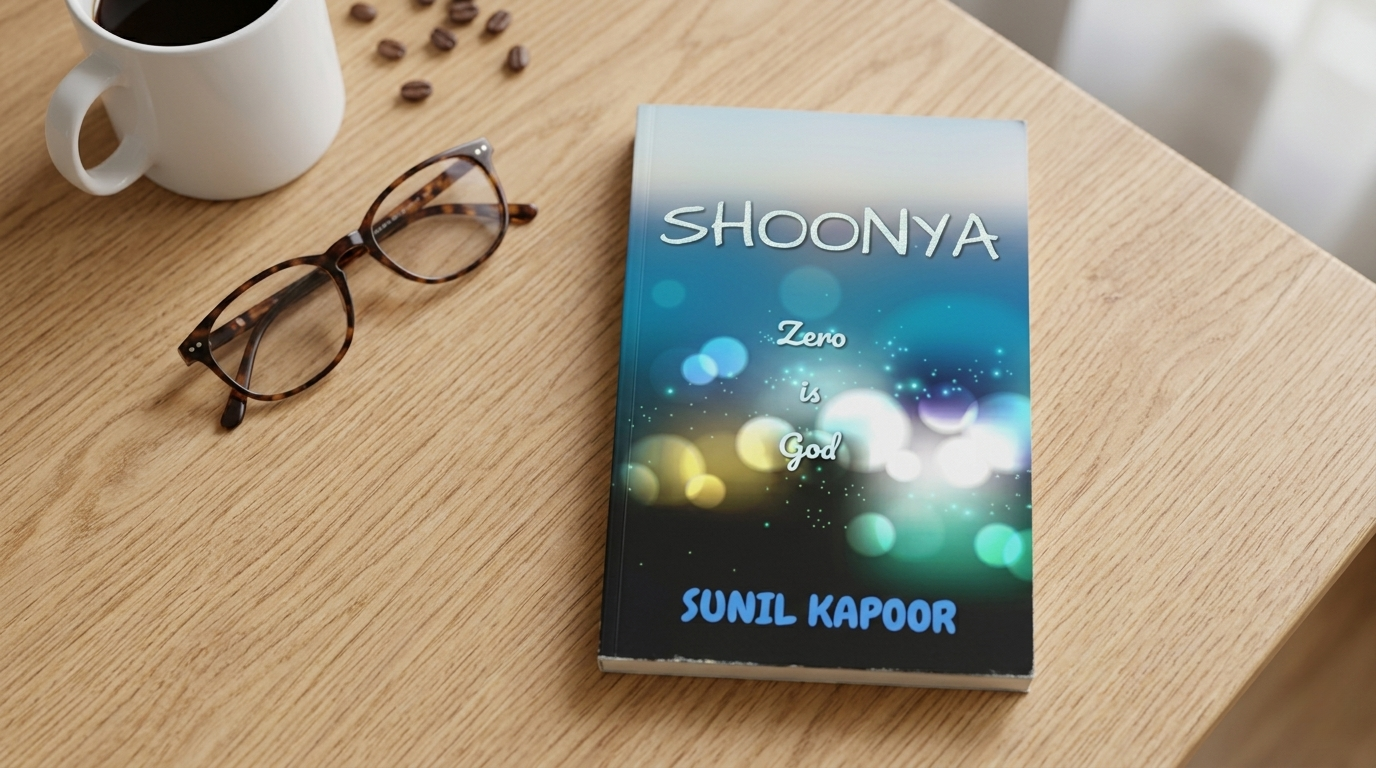
Rating:
⭐⭐⭐⭐ (4.3 out of 5)
A novel that made me pause between science and soul
I read across genres every week, and every now and then a book arrives that doesn’t behave like a conventional novel at all. Shoonya: Zero is God by Sunil Kapoor gave me exactly that feeling. I did not move through this book in the usual way of plot first, character second. Instead, I found myself stopping at ideas, underlining passages in my mind, and returning to scenes that felt almost like philosophical conversations disguised as fiction.
Honestly, this is one of those books where the premise alone can sound abstract, maybe even intimidating. A man named Peter Koom comes to India, but not as a tourist. His movement through the country feels more like destiny, or perhaps a spiritual summons. Yet what surprised me is that Sunil Kapoor doesn’t let the novel float away into vague mysticism. He grounds it in software, solar energy, economics, Kumbh Mela, family memory, migration, illness, ambition, and the body itself as a living circuit.
In 2026, when conversations around AI, renewable energy, burnout, and spiritual emptiness are everywhere, this message feels strangely timely.
What the book is about
At the center of Shoonya is Peter Koom, an outsider who arrives in India carrying both technological intelligence and an inner restlessness. Through him, Sunil Kapoor stages a meeting of worlds: America and India, code and consciousness, silicon and soul.
Peter’s encounters are wide ranging. In one part of the story, he is deeply involved with software systems, futuristic thinking, and the dream of making machines more human. In another, he is sitting with sages, hearing about Om, Kumbh, Akharas, the Peepal tree, and the sacred logic hidden inside ancient traditions.
What I found interesting is how the novel keeps asking the same core question in different forms: what powers the universe, and what powers us?
Sometimes the answer comes through energy systems, from coal and oil to solar futures. Sometimes it comes through spirituality, where the human body is treated as a microcosm of the universe. Sometimes it comes through ordinary life, through parents, grief, money, marriage, migration, illness, and memory.
There’s also a very human thread running beneath the big ideas. Peter is not just a thinker. He is a son remembering old objects, a professional negotiating systems, a man questioning where he belongs, and a seeker wondering whether science alone can explain existence.
That mix gave the book its shape for me.
What stood out to me
The first thing that stood out is Sunil Kapoor’s fearless blending of disciplines.
I’ve read enough philosophical fiction to know that many books collapse under the weight of their own ideas. Here, the author mostly avoids that by using Peter’s movement through India as a narrative bridge. One chapter may discuss software architecture and global business, another may move into Kumbh mythology, another into sound vibrations of AUM, another into solar energy as divine abundance.
Somehow, the repetition of Peter’s questioning mind makes it hold together.
I especially liked the passages around energy as both science and spirituality. The book repeatedly returns to the sun, photons, semiconductors, solar futures, and the human nervous system. There’s this larger suggestion that ancient spiritual insight and modern technology are not opposites, but parallel languages describing the same truth.
That idea could have felt forced, but here it often lands because the imagery is concrete. The Peepal tree, sacred rivers, bathing rituals, chanting, solar machines, chips transferring information via photons, all of these are used almost like symbolic mirrors.
The chapter structure also deserves mention. With forty five short titled chapters, the book moves like a sequence of meditations rather than a single straight line. I think this works in its favor because it lets the reader absorb one concept at a time. A chapter on Peter’s father’s old leather case creates an emotional anchor. A chapter on Kumbh Mela expands into mythology. Another moves into immigration, identity, or business systems.
It feels mosaic like, and I mean that in a good way.
If I had one small critique as an editor, it’s that the philosophical conversations sometimes become denser than the emotional movement of the characters. There were moments where I wanted Peter’s inner emotional transitions to breathe a little more before the next big idea arrived. But even that feels partly intentional, because the book’s real protagonist may be consciousness itself.
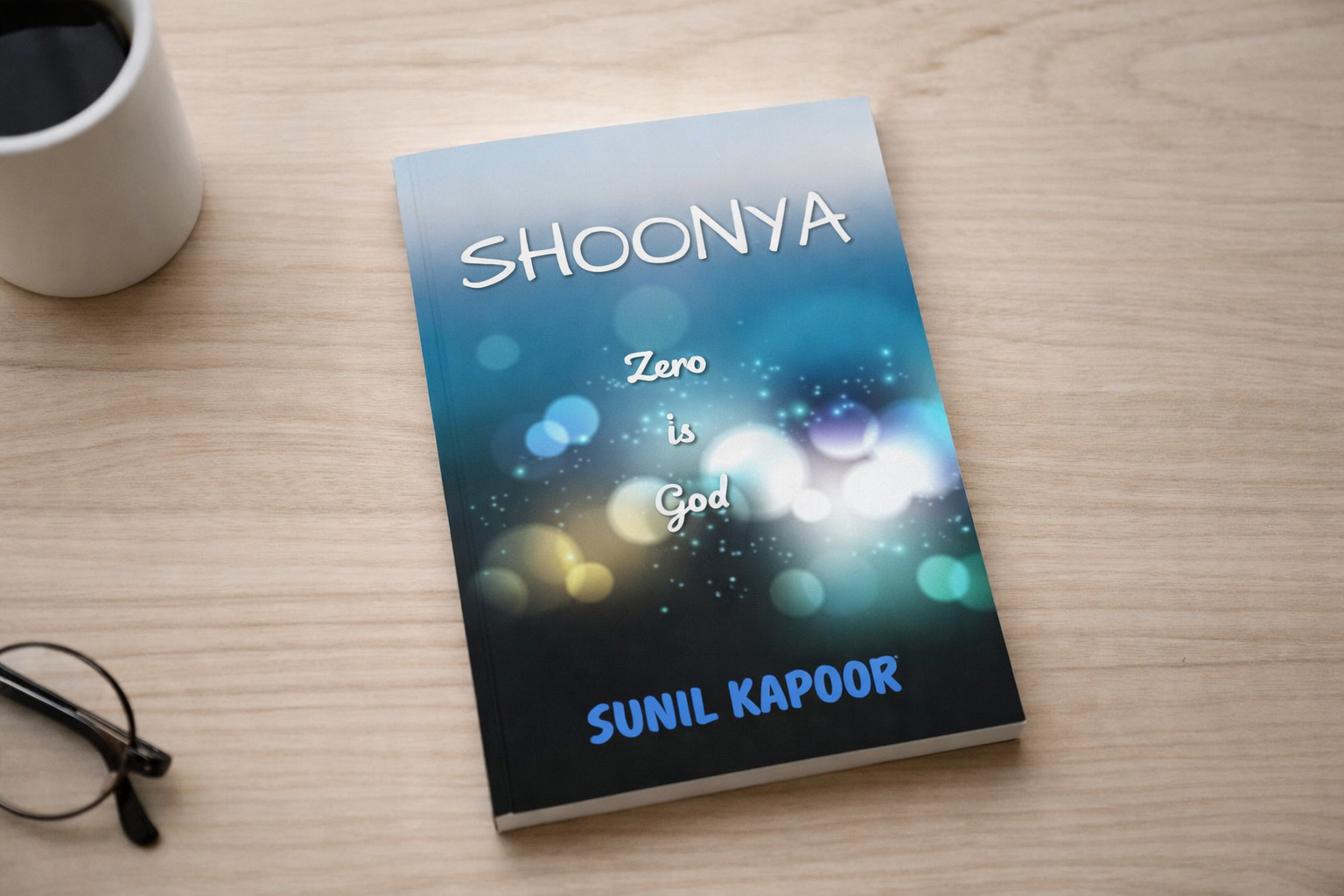
The emotional core
For all its discussions of zero, God, ions, bytes, and cosmic energy, the emotional heart of Shoonya is deeply human.
For me, the most affecting layer was the recurring tension between material success and existential hunger.
Peter moves through wealth, software success, global structures, and futuristic ambition, but the book keeps gently asking: what remains when achievement is stripped away? I kept thinking about the scenes where memory, parents, old belongings, illness, and mortality interrupt the grand theories. Those moments give the book its pulse.
There’s also a tenderness in how India is portrayed, not as an exotic spectacle, but as a living civilizational memory. The Kumbh passages, the references to sacred geographies, the idea of sound as creation, these are written with reverence. As an Indian reader, some of this reminded me of conversations I’ve heard elders have, where science and spirituality were never enemies to begin with.
And then there’s the title itself, Shoonya.
Zero here is not emptiness in the bleak sense. It is origin, possibility, divinity, reset. I wasn’t expecting that idea to feel so emotionally resonant, but by the later sections it genuinely did. The notion that “nothingness” can also be fullness stayed with me.
It’s the kind of book that makes you look at ordinary sunlight a little differently the next morning.
Who this book is for
This might not be for every reader, and I say that with warmth, not as a warning.
If you like tightly plotted commercial fiction where every chapter ends in suspense, this may feel too reflective for you.
But if you enjoy books where ideas matter as much as events, this will likely speak to you.
I would especially recommend Shoonya to:
- readers interested in spiritual fiction with philosophical depth
- people who enjoy science meeting mysticism
- readers of literary speculative ideas and metaphysical themes
- professionals in tech or energy who secretly enjoy existential questions
- anyone asking what progress means beyond consumption
I also think readers who enjoy authors and thinkers working at the edge of science, religion, and consciousness will find a lot to sit with here.
If you’re searching “Shoonya book summary,” “what’s it about,” or “is Shoonya worth reading,” my honest answer is yes, especially if you want a novel that values inquiry over easy resolution.
Final thoughts
I think Sunil Kapoor has written something unusual with Shoonya. It is part philosophical novel, part spiritual inquiry, part civilizational conversation, and part human story of identity and return.
What stayed with me most was not a single plot twist, but the way the book keeps circling one beautiful idea: the same force that powers stars, chips, rivers, chants, and human longing may not be separate after all.
That’s a difficult thing to write without sounding abstract, and while the book occasionally leans heavy on exposition, its sincerity carries it.
As an editor and longtime reader, I value books that attempt something risky. Shoonya absolutely does. It asks readers to sit between science and surrender, between future technology and ancient sound, between zero and God.
And honestly, some parts hit differently long after I closed it.
FAQs
Is Shoonya worth reading?
Yes, especially if you enjoy philosophical fiction, spirituality, and science based reflection.
Who should read Shoonya by Sunil Kapoor?
Readers interested in consciousness, energy, Indian philosophy, and future technology.
Is Shoonya more story driven or idea driven?
Definitely more idea driven, though Peter’s journey gives it a human narrative thread.
Should you read Shoonya in 2026?
I think so. Its themes around renewable energy, AI-like futures, and spiritual grounding feel very current.
With over 11 years of experience in the publishing industry, Priya Srivastava has become a trusted guide for hundreds of authors navigating the challenging path from manuscript to marketplace. As Editor-in-Chief of Deified Publications, she combines the precision of a publishing professional with the empathy of a mentor who truly understands the fears, hopes, and dreams of both first-time and seasoned writers.