
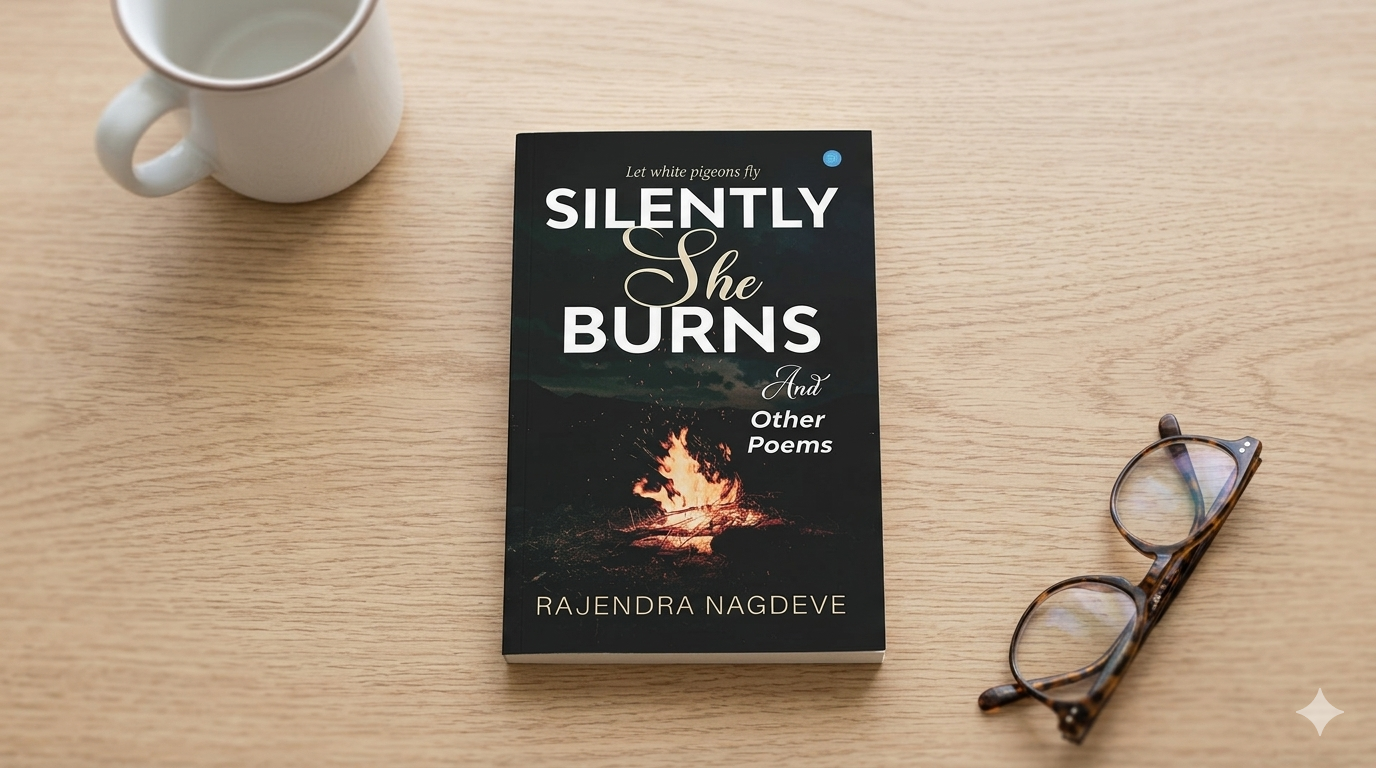
Rating:
⭐⭐⭐⭐ (4.3 out of 5)
A poetry collection that keeps returning to the body
I have spent more than fifteen years reading poetry, fiction, memoir, and everything in between, and every now and then a poetry collection arrives that does not ask for admiration first. It asks for witness.
That is exactly how Silently She Burns and Other Poems felt to me.
From the opening pieces like “Platform” and “Hospital Bed,” I had this sense that the poet is less interested in ornament and more interested in exposing the nerve beneath modern life. Crowded railway platforms, hospital machinery, disaster sites, burning riverbanks, haunted homes, summer streets, nameless fear in the sky, old trees shedding their memory, even a rickshaw puller scorched under the sun, all of it comes together as one long meditation on what it means to remain human in a world that often forgets humanity.
I found myself pausing often, not because the language is difficult, but because the images are blunt in a way that feels lived. A woman burning on the riverbank in “Silently She Burns.” The post disaster grief of “Over Bhuj on Twelfth February.” The suffocating urban violence of “Platform.” These are not decorative poems. They are poems that look directly at pain, social fracture, superstition, memory, class, war, and survival.
And honestly, in 2026, when conversations around equality, rationality, and social healing feel more urgent than ever, this collection lands with surprising force.
What the Book Is About: Humanity as the thread holding everything together
At its heart, Silently She Burns and Other Poems is a book about humanity under pressure.
The blurb mentions superstition, social stratification, inherited violence, the craving for peace, and the hope for a warless world. The poems themselves deepen that promise beautifully. Across the collection, the poet keeps returning to lives at the margins, tribal displacement, hospital corridors, women’s grief, urban crowding, war memories, labouring bodies, and the invisible burden people carry because society has normalized suffering.
Take “Platform.” What begins as the daily chaos of a railway station slowly becomes a larger portrait of migration, class, tribal uprooting, and the machinery of city life swallowing the vulnerable. There is a line of thought running beneath it: progress for whom?
Then “Hospital Bed” shifts the lens inward. The poem captures that helpless in-between space where machines, medicine, family anxiety, and mortality occupy the same room. I especially liked how the poem resists melodrama. It remains restrained and physical, almost clinical, which somehow makes the feeling stronger.
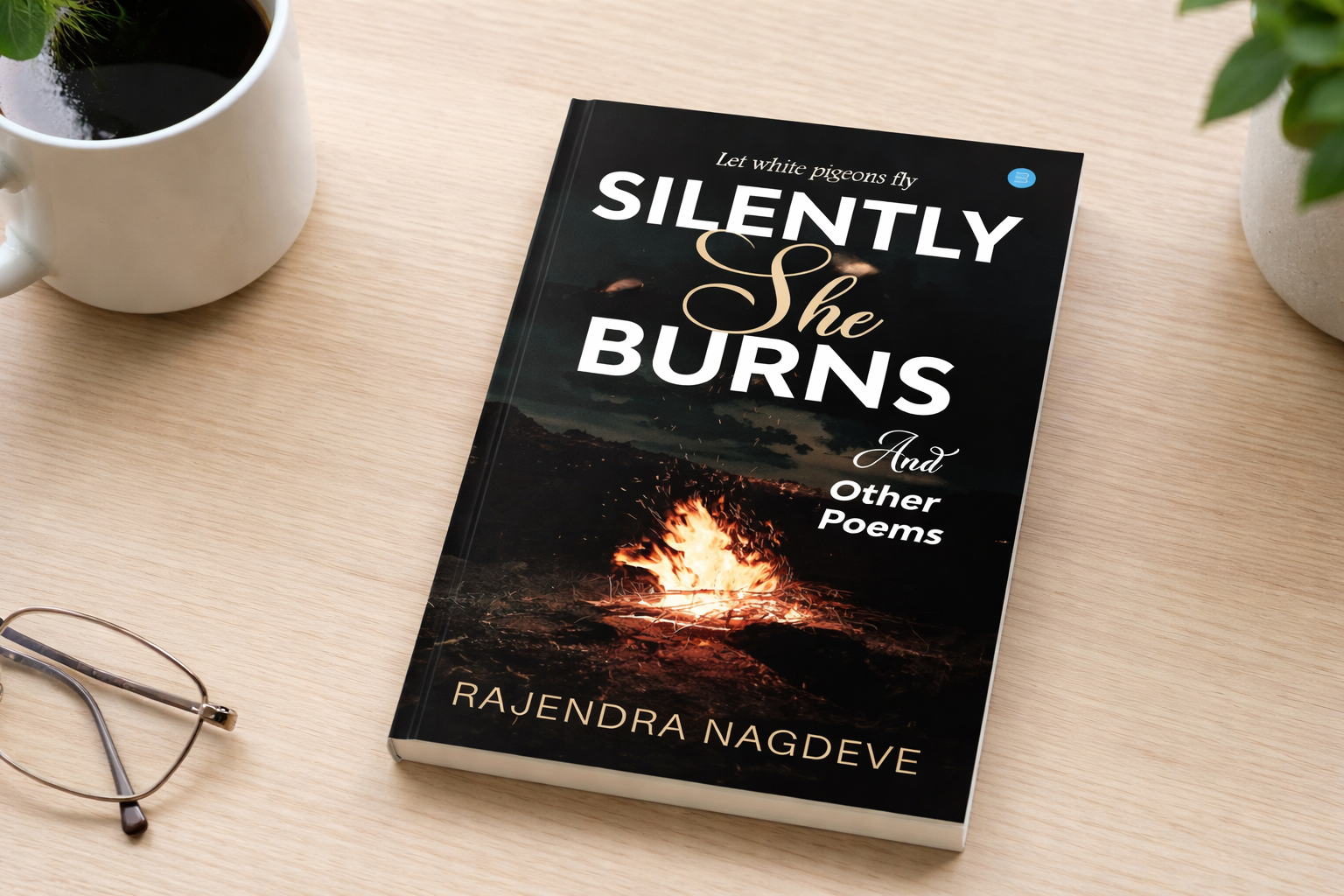
The title poem, “Silently She Burns,” might be the emotional anchor of the collection. It is about death, yes, but also abandonment, social indifference, memory, and the haunting repetition of suffering. The image of a child building sand mounds while a woman’s pyre burns nearby is one of those moments I kept thinking about long after finishing.
And then there are poems like “Home Coming,” where war, family, tenderness, and tragic irony intersect. As someone who has edited many emotionally driven manuscripts, I can say this poem understands contrast very well. The hope of return and the reality of telegram death notice create a wound that opens very late in the poem.
What Stood Out to Me: The poet’s eye for social images
What impressed me most in Silently She Burns and Other Poems Book Review terms is the poet’s ability to build social commentary through physical scenes.
A lot of socially conscious poetry can become abstract. This one usually stays rooted in image.
A platform.
A hospital bed.
A burnt riverbank.
A storm over a fishing village.
A haunted house full of inherited myths.
A rickshaw puller sweating under a merciless summer sun.
A nameless dread inside an airplane in “Neither; Nor.”
These are memorable because they begin with something ordinary and then open into a philosophical or political layer.
I especially admired poems like “Laws of Return,” “Guilt of Silence,” and “Name.” These pieces show the poet’s concern with caste, hierarchy, naming, public apathy, and the violence of social labeling. The poem “Name” in particular stayed with me because it asks a deceptively simple question: what does a name do to a human being once society loads it with history?
That’s not easy territory to write without sounding preachy, but here it works because the poet trusts imagery over explanation.
I also liked the way nature appears in this collection. It is not romanticized. In “Monsoon Seashore,” “Summer Day,” and “Old Tree,” nature is beautiful but also harsh, punishing, indifferent. This felt honest. Real landscapes do not exist only to comfort us.
If I had one mild critique, it would be that a few poems lean heavily on declarative social messaging after already establishing a strong image. Personally, I often prefer when the image is allowed to do the entire emotional work. But even there, the sincerity of the voice carries the poem through.
That slight unevenness is exactly why this feels like the work of a real poet wrestling with real concerns, not polished for effect.
The Emotional Core: grief, witness, and the refusal to look away
The emotional center of this book is grief, but not only personal grief.
It is civilizational grief.
Grief for the poor.
Grief for women.
Grief for the dead.
Grief for labouring bodies.
Grief for what reason and science still have not healed in society.
Grief for the violence we inherit and then normalize.
What moved me most is that the book never loses its belief in fraternity and rationality even while staring at bleakness.
In “Haunted House,” the metaphor of being trapped inside inherited myths and dead rituals felt especially relevant today. I’ve seen this tension in real life too, where highly educated people still remain emotionally imprisoned by ideas they never chose. The poem captures that contradiction with surprising tenderness.
Then in “Dream,” the poet moves toward surreal imagery, childhood residue, fear, symbols, and wishful reconstruction. It adds a psychological texture that balances the sharper social poems.
This is where the collection becomes more than issue-based poetry. It becomes about how external violence enters the private mind.
Some parts genuinely made me stop and reread. Not because they were obscure, but because they felt emotionally true.
Who This Book Is For: who should read it?
I think Silently She Burns and Other Poems is worth reading if you enjoy poetry that stands at the intersection of social conscience, urban realism, grief, and philosophical reflection.
This is especially for readers who like:
- socially aware Indian English poetry
- poems on inequality and justice
- city life and migration themes
- surreal social symbolism
- reflective nature poems with darker edges
- books that ask moral questions without spoon-feeding answers
If someone only wants lyrical romance poetry, this may not be the right fit.
But if you appreciate poets who look at Bhuj, railway platforms, hospital wards, haunted memory, labour, and public silence as poetic material, there is real value here.
Students of literature may also find it rewarding because the collection offers many entry points into discussions around urbanization, caste, rationalism, post disaster grief, and social ethics.
Final Thoughts: a sincere, image-rich collection with moral urgency
As Editor-in-Chief at Deified Publication, I read many books that have something important to say but struggle to embody it artistically.
This collection mostly succeeds because it keeps returning to human scenes.
That is what gives Silently She Burns and Other Poems its credibility.
The poet sees systems through people.
He sees history through bodies.
He sees philosophy through railway stations, hospital beds, summer roads, old trees, and haunted walls.
I really appreciate that.
No, every poem may not land equally for every reader. A few are more direct than subtle. But the emotional honesty, thematic consistency, and social imagination make this a deeply worthwhile poetry collection.
It left me with the feeling that the poet is not merely documenting suffering. He is asking what kind of world we continue to build when we accept suffering as normal.
That question matters.
Reader FAQ
Is Silently She Burns and Other Poems worth reading?
Yes, especially if you enjoy poetry rooted in social reality, human suffering, and moral reflection rather than purely romantic or abstract verse.
Who should read Silently She Burns and Other Poems?
Readers of Indian English poetry, socially aware literature, and reflective poems on equality, grief, and justice will connect strongly.
What is Silently She Burns and Other Poems about?
It is centered on humanity, social divisions, superstition, rationality, urban life, nature’s harshness, and the longing for a peaceful world.
Is this poetry collection emotionally heavy?
Yes, some poems hit hard, especially the ones around death, disaster, war, and public indifference.

With over 11 years of experience in the publishing industry, Priya Srivastava has become a trusted guide for hundreds of authors navigating the challenging path from manuscript to marketplace. As Editor-in-Chief of Deified Publications, she combines the precision of a publishing professional with the empathy of a mentor who truly understands the fears, hopes, and dreams of both first-time and seasoned writers.