

Rating:
⭐⭐⭐⭐ (4.4 out of 5)
This is the kind of technical book that respects the reader’s intelligence
As Priya Srivastava, Editor-in-Chief at Deified Publication, I read across genres all the time, and I genuinely enjoy when a serious technical book still manages to feel alive. Microgrids: Key Operational Strategies & Avenues for Grid Support Services by Prabodh Bajpai surprised me in that way.
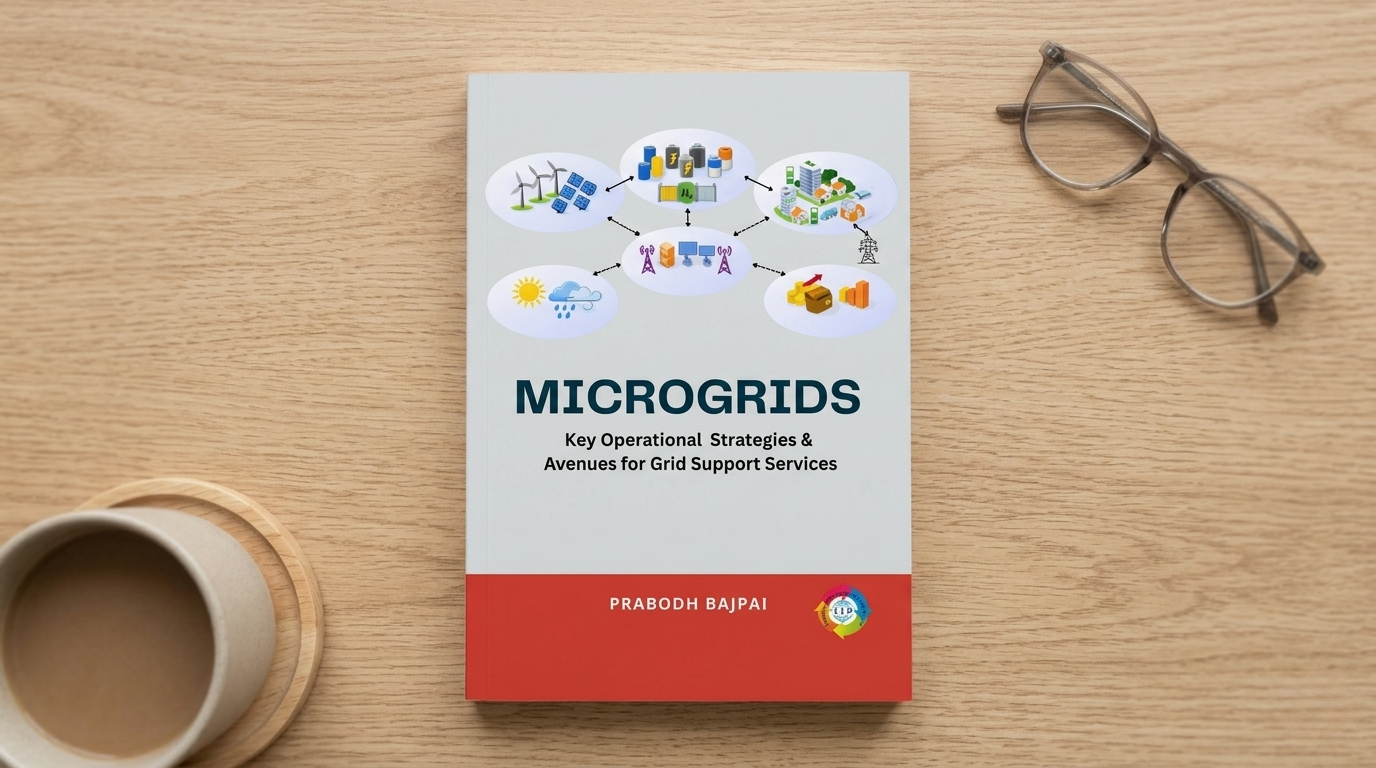
I say “surprised” because many engineering monographs are useful but emotionally flat. They give information, yes, but they rarely create momentum. This one does. From the cover itself, which visually maps renewable sources, storage, communication layers, and end-use systems into a single connected ecosystem, the intent is clear: this is not just about isolated hardware. It is about systems thinking.
And honestly, that stayed with me while reading.
What I appreciated most is that the book feels deeply rooted in real academic and applied work rather than abstract textbook theory. The foreword and preface make it clear that this monograph emerges from a SPARC-supported Indo-Australian research collaboration involving IIT Kanpur, the University of Queensland, and IIT Kharagpur. That matters because you can feel the seriousness of the research scaffolding behind the writing.
In my years reviewing books, especially nonfiction and research-led writing, I’ve learned that the most useful books do two things well: they organize complexity, and they help the reader see why the complexity matters. Microgrids does both.
In 2026, when energy resilience, decentralized power systems, EV integration, and renewable stability are no longer niche conversations but national priorities, this book feels timely in a very practical way.
What the Book Is About: A rigorous map of how modern microgrids actually function
At its core, Microgrids is a research monograph that explains how microgrid systems are designed, controlled, optimized, and leveraged to support the broader utility grid.
But what I liked is that it doesn’t stop at basic definitions.
The opening chapter builds the conceptual foundation really well, beginning with the evolution from traditional power systems to bidirectional, distributed, renewable-integrated smart grids. The classification sections are especially useful because they break microgrids down by control architecture, size, AC/DC topology, source mix, deployment scenario, location, and application. For students or early researchers, this alone is a strong reference section.
Then the book moves into what I think is its real strength: operational strategy.
The chapters on power sharing, droop control, energy management schemes, demand response, peer-to-peer trading, and ancillary services make the book far more than a static “what is a microgrid” text. It becomes a bridge between theory and grid-level implementation.
I especially liked the way Chapter 3 structures the four real operational states: grid-connected mode, islanding, stand-alone mode, and synchronized reconnection. That progression mirrors how actual microgrid resilience problems are experienced in the field.
For a serious reader wondering what this book summary really means in practice, this is essentially a roadmap from microgrid architecture to real-time service delivery.
What Stood Out to Me: The book’s strongest quality is how it connects control theory to grid services
What stood out most to me in this Microgrids book review is the way Prabodh Bajpai refuses to isolate technical design from system value.
A lot of engineering books explain architecture.
Fewer explain why the architecture matters at network scale.
This one repeatedly links operational strategies to actual grid support services, and that makes it much more useful.
For example, the discussion around dynamic operating envelopes, demand response, peer-to-peer energy trading, and frequency and voltage support gives the book a strong future-facing relevance.
I found the sections around DOE-enabled peer-to-peer energy trading especially interesting because this is where the book starts speaking directly to future electricity market design, not just microgrid hardware. That shift from electrical engineering into market and control coordination is where serious research becomes policy-relevant.
The visual architecture also helps. The figures listed across the book, from AC-DC hybrid microgrid structures to IEEE bus simulations and resiliency frameworks, are not decorative. They carry explanatory weight. Even the early figure showing the evolution from traditional to modern power systems immediately frames the larger transition story.
From an editorial perspective, the pacing is logical. Each chapter escalates from conceptual clarity to operational challenge to service opportunity.
If I had one honest critique, it’s that the writing occasionally leans heavily into formal academic phrasing, which may slow down industry professionals who are not actively working in optimization, control systems, or advanced power electronics. Some sections ask for patient reading.
But honestly, for a serious book in this category, that density is also part of its credibility.
The Emotional Core: Yes, even a technical book has one
This may sound strange, but I do think serious engineering books have an emotional core.
Here, it is resilience.
While reading the sections on islanding detection, stand-alone DC microgrids, synchronized reconnection, and resilient operation under contingency events, I kept thinking about real-world consequences: hospitals staying powered, campuses remaining functional, remote communities gaining reliability, distribution systems surviving disruptions.
That human layer matters.
I’ve seen in real life how conversations around clean energy often remain abstract until someone talks about outages, storm recovery, rural electrification, or the cost of instability. This book keeps bringing the reader back to those practical stakes.
The chapter on resilient operation and mobile microgrid placement hit especially strongly for me because it shows that microgrids are not merely an efficiency story. They are also about preparedness, survivability, and trust in infrastructure.
That’s where the book rises above being just an academic reference.
It becomes part of a much larger conversation about how future cities, campuses, industries, and remote regions will continue functioning under uncertainty.
I wasn’t expecting to feel that sense of urgency while reading a technical monograph, but some parts genuinely made me think about how fragile centralized systems still are.
Who This Book Is For: A serious, high-value read for focused readers
If you’re asking should you read Microgrids, I think the answer depends entirely on your relationship to energy systems.
This book is ideal for:
- PhD scholars and MTech students in electrical, sustainable, and power systems engineering
- researchers working on DERs, EMS, and smart grid control
- utility and DSO professionals exploring distributed grid support services
- policymakers and clean energy planners
- advanced industry practitioners working on resilience and local energy markets
It may also be valuable for faculty designing coursework around smart grids and distributed systems because the chapter progression is very teachable.
This might not be for casual nonfiction readers, and that’s perfectly okay. It is unapologetically serious.
But for the right audience, it is the kind of technical book that can genuinely become a desk reference.
Final Thoughts: Is Microgrids worth it?
So, is Microgrids by Prabodh Bajpai worth reading?
Yes, absolutely, if your work or research intersects with smart grids, decentralized energy systems, renewable integration, or resilience planning.
What I admired most is that it treats microgrids not as a fashionable clean-energy buzzword but as a technically rich, multi-layered system involving control, economics, infrastructure, and future service models.
As someone who has reviewed serious nonfiction for years, I think this book succeeds because it helps readers move from understanding components to thinking in systems.
And in 2026, that systems-level mindset is exactly what the energy sector needs.
Quick Reader FAQ
Is Microgrids worth reading for researchers?
Yes, especially for researchers in power systems, DER optimization, and smart grid resilience.
Who should read Microgrids by Prabodh Bajpai?
Graduate students, researchers, utility engineers, and energy policy professionals.
What is Microgrids about?
It covers microgrid classification, control strategies, energy management, operational modes, and grid support services.
Is it too technical for beginners?
For complete beginners, some sections may feel dense, but the early conceptual chapters are very accessible.

With over 11 years of experience in the publishing industry, Priya Srivastava has become a trusted guide for hundreds of authors navigating the challenging path from manuscript to marketplace. As Editor-in-Chief of Deified Publications, she combines the precision of a publishing professional with the empathy of a mentor who truly understands the fears, hopes, and dreams of both first-time and seasoned writers.