
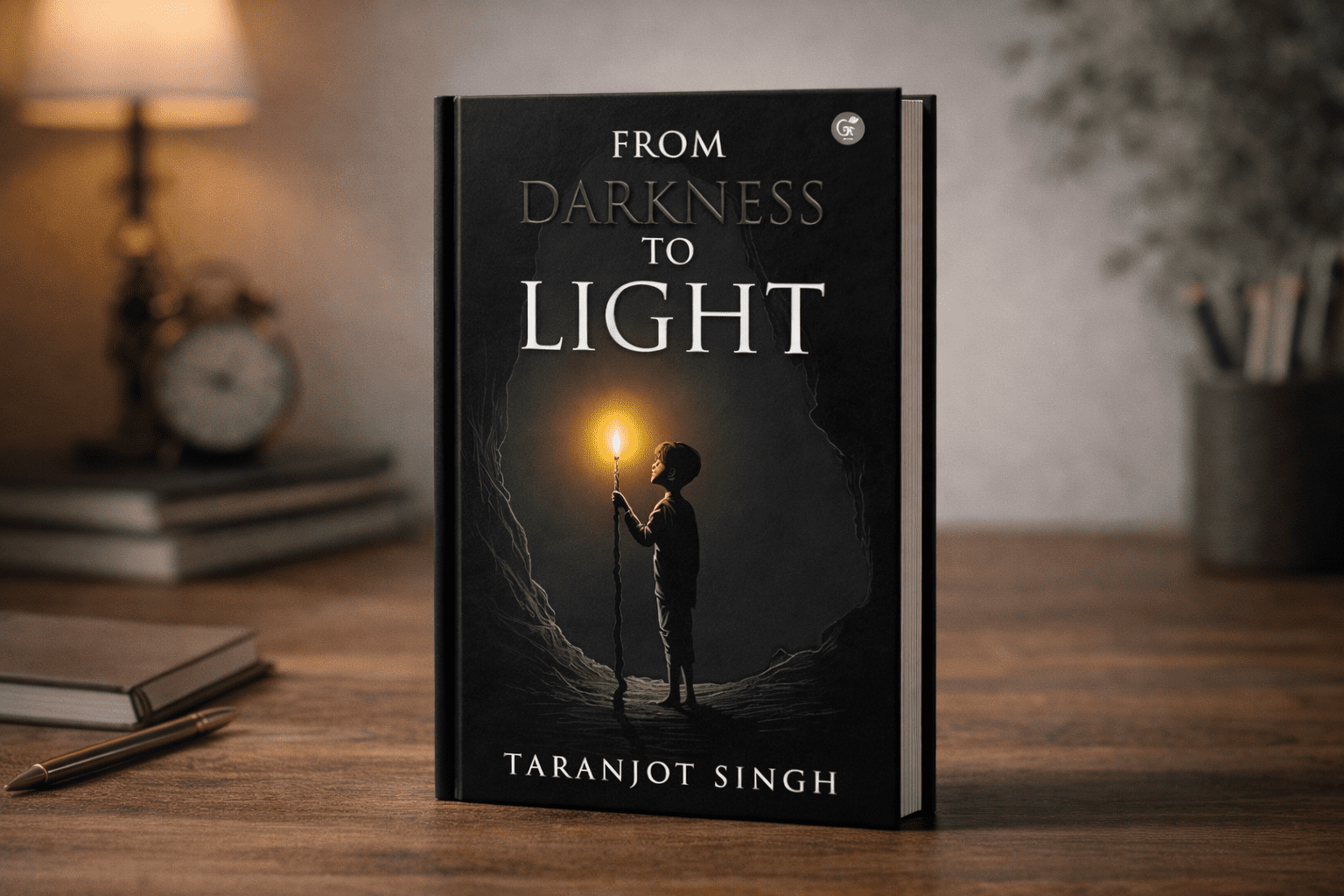
⭐ Rating: 4.3 out of 5
Some books speak loudly. This one speaks when it’s quiet
I picked up From Darkness to Light without much preparation. No expectations, no mental checklist of what poetry “should” be. I’ve read enough poetry collections to know that many of them try too hard to sound deep, or they hide behind complexity. This book didn’t do that. It felt simple on the surface, but not shallow. And that combination is harder to pull off than people think.
Right from the first few poems, I could sense that Taranjot Singh isn’t writing to impress anyone. He’s writing because he has something sitting inside him that needed to come out in words. Rhyming couplets, yes, but not forced. The rhymes don’t scream for attention. They flow, quietly, the way thoughts do when you’re alone with yourself.
I read parts of this book slowly. Not because it was difficult, but because some lines made me pause. Not in a dramatic way. More like the way you stop walking for a second when a memory crosses your mind unexpectedly.
Poetry rooted in everyday struggle, not fantasy
What stood out to me most is how grounded this book is. The themes are not abstract in a distant, poetic-cloud sense. They are very real. Unemployment. Self doubt. The ache of feeling left behind while others move forward. Childhood memories that feel warmer because adulthood feels heavy. These aren’t rare emotions. They’re shared by a lot of people, but not always spoken about openly.
There were poems where I could clearly feel the weight of uncertainty. That phase where you’re trying, failing, trying again, and wondering how long it’s acceptable to keep hoping. The book doesn’t pretend that hope is easy. It doesn’t say things magically get better. Instead, it acknowledges the darkness first. And that makes the light, when it appears, feel earned.
The rhyming couplets actually work here
I’ll be honest. Rhyming poetry can sometimes feel childish or predictable if not handled carefully. That was my initial hesitation. But here, the couplets feel intentional. They give the poems rhythm without turning them into slogans.
The rhyme scheme helps the emotions land gently. It makes the poems feel almost conversational, like someone talking to themselves late at night. Some couplets are soft and comforting, others are more direct, even slightly sharp. That variation keeps the reading experience alive.
You can tell the author respects the form, but doesn’t let the form control the emotion. When the message needs space, it gets space. When it needs simplicity, it stays simple.
Personal experiences without oversharing
One thing I appreciated deeply is that the book feels personal without becoming self indulgent. The poems are clearly shaped by the author’s life, but they’re written in a way that allows the reader to step inside them.
The unemployment poems, for example, don’t read like complaints. They read like honest reflections. The kind where you admit fear without dramatizing it. Anyone who has gone through job uncertainty, career confusion, or feeling underestimated will recognize themselves here.
And yet, the book never says, “This is my pain, look at it.” Instead, it says, “This happened, and this is how I kept going.” That difference matters.
Hope that doesn’t feel fake
A lot of motivational poetry fails because it jumps too quickly to optimism. This book doesn’t rush. The darkness is given its due time. The confusion is allowed to exist.
When hope appears in these poems, it feels quiet. Almost shy. Not the loud, chest thumping kind. More like a small voice reminding you that today ending doesn’t mean everything is over.
That’s why the title From Darkness to Light feels appropriate. Not because the book pretends the darkness disappears, but because it shows how light can exist alongside it.
The emotional range surprised me
I went into this expecting a consistent tone of resilience and motivation. What I got was more layered. There are poems that feel heavy, poems that feel warm, and poems that feel reflective rather than emotional.
The childhood themed pieces brought a certain softness to the collection. They reminded me of how memory works. How we don’t always miss events, but feelings. Safety. Simplicity. Being seen without effort.
The poems about self discovery felt quieter, almost meditative. They didn’t push conclusions. They asked questions and let them sit unanswered. That felt very human.
Why this book matters in practical life
This isn’t just a book you read for aesthetic pleasure. It has practical emotional value.
If you’re someone dealing with uncertainty, especially career related or personal identity related, this book offers comfort without advice overload. It doesn’t tell you what steps to take. It reminds you that your feelings are valid while you’re figuring things out.
For people who struggle to articulate what they’re feeling, poetry like this can act as a mirror. Sometimes you don’t need solutions. You need language. This book gives language to emotions many people carry silently.
It also works well as a book you return to. You don’t have to read it cover to cover in one sitting. You can open it randomly, read a poem, and close it again. That flexibility adds to its value.
About the author’s voice
Taranjot Singh writes with sincerity. That’s the word that keeps coming back to me. The poems don’t feel edited to please an audience. They feel like they were written first for the author himself, and then shared.
That honesty builds trust. Even when a poem didn’t fully resonate with me, I never felt manipulated. I felt like I was listening to someone who is still learning, still growing, still processing life in real time.
That ongoing sense of becoming gives the book its emotional credibility.
Who should read this book
This book is especially for readers who enjoy poetry that speaks about real life without hiding behind complexity. If you like emotional clarity, gentle resilience, and themes of inner strength, you’ll find a lot here.
If you’re going through a tough phase, this book won’t magically fix anything. But it might make you feel less alone. And sometimes that’s enough to keep going one more day.
If you prefer experimental or highly abstract poetry, this may feel too straightforward. But for readers looking for emotional connection rather than literary gymnastics, it fits well.
What could have been stronger
To be fair, some poems felt slightly similar in theme, especially around perseverance. A bit more variation in imagery could have elevated certain sections. There were moments where I wanted one or two poems to take a bigger emotional risk.
That said, none of this took away from the overall experience. It felt more like a natural outcome of writing from lived experience rather than a flaw.
Final thoughts
From Darkness to Light is a sincere, emotionally grounded poetry collection that understands struggle without glorifying it. It respects pain, but doesn’t worship it. It offers hope, but doesn’t sell it.
I finished the book feeling calmer, not energized. And that calm stayed with me longer than expected.
That, for me, is a sign of honest writing.
With over 11 years of experience in the publishing industry, Priya Srivastava has become a trusted guide for hundreds of authors navigating the challenging path from manuscript to marketplace. As Editor-in-Chief of Deified Publications, she combines the precision of a publishing professional with the empathy of a mentor who truly understands the fears, hopes, and dreams of both first-time and seasoned writers.