
Rating:
⭐⭐⭐⭐ (4.3 out of 5)
Before I Even Opened the Book
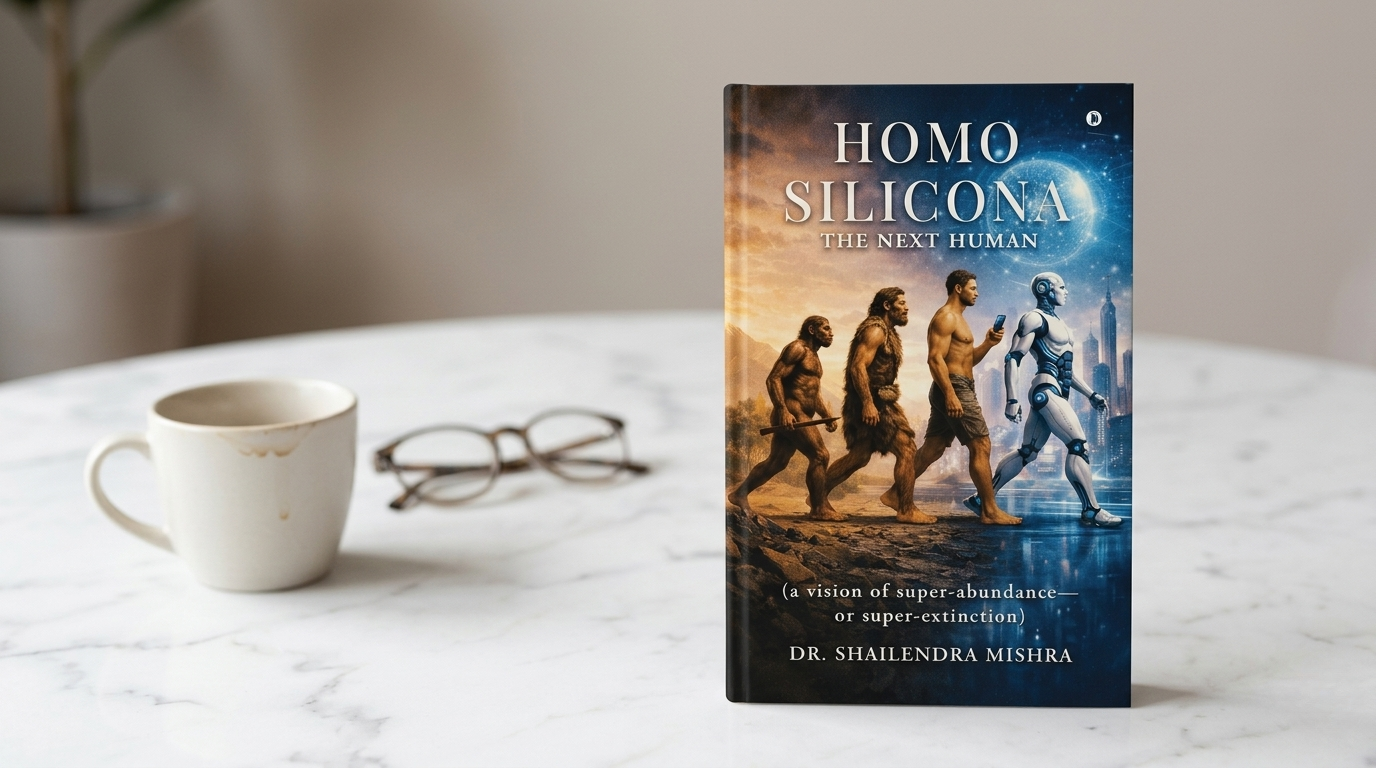
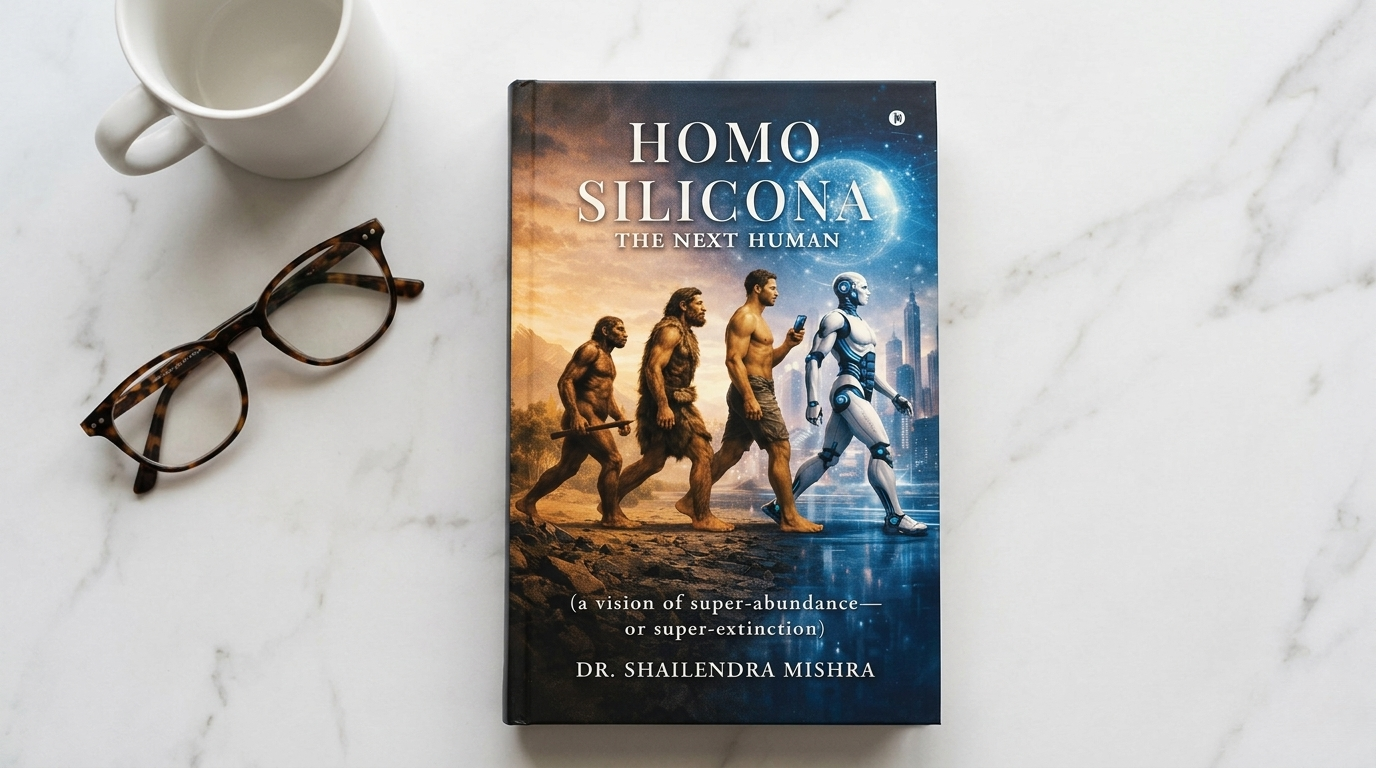
I want to be honest about something. When I first saw the cover of Homo Silicona: The Next Human by Dr. Shailendra Mishra, my instinct was mild skepticism. The cover itself, which I studied carefully, shows the classic march of evolution, from hunched early hominid to modern man, and then, startlingly, into a sleek white robot stepping into a glowing blue cityscape. It is dramatic. It is a little cinematic. And a small part of me thought: is this going to be one of those wide-eyed tech enthusiasm books dressed up in philosophical clothes?
I was wrong to doubt it. Not completely, because no book is without its complications, but substantially wrong. What Dr. Mishra has put together in these 146 pages is something genuinely unusual: a hybrid text that sits somewhere between philosophical inquiry, speculative science, poetic meditation, and urgent ethical warning. As Editor-in-Chief at Deified Publication, I have read enough books in this genre to know that blending those registers is extremely hard to pull off. Most books attempt it and end up being neither one thing nor the other. Homo Silicona mostly succeeds, and in its best moments, it does something more than succeed. It unsettles you in ways that stay with you long after you have closed the cover.
I kept thinking about a particular line from the prelude, where Dr. Mishra describes himself as a young doctor who was once nicknamed “Murmur Boy” because he could hear heart murmurs nobody else could detect. And then, gradually, the scanners arrived. The ultrasounds, the MRIs, the tools that could see what he had spent years learning to hear. He writes with such plain honesty about how his hard-won skill became, in his own words, “a museum piece.” That story lodged in me. Because the whole book is really about that feeling, stretched across the entire human species.
What This Book Is Actually About
The premise of Homo Silicona is this: Dr. Mishra proposes that artificial intelligence is not merely a technology but an evolutionary threshold. He coins the term “Homo Silicona” to describe the next phase in the lineage of intelligent beings, human consciousness, either uploaded from a biological brain or born natively from advanced AI, residing in a silicon body. Free from hunger. Free from disease. Free from death. Capable of traversing space, surviving radiation, carrying the memories of millennia.
What distinguishes this book from the usual AI-panic or AI-utopia genre is its philosophical grounding. Dr. Mishra does not simply describe this future and cheer for it or dread it. He actually sits inside it and turns it over from every angle. He draws on the Upanishads and the Bhagavad Gita, where the soul is described as something that merely changes bodies rather than dies, and asks a genuinely provocative question: if ancient Indian philosophy already insisted that consciousness is not the flesh, why should we assume that a silicon vessel is any less valid than a carbon one? That is the kind of intellectual move that made me put the book down for a moment and just sit with the idea.
The book moves through eighteen chapters, covering the birth of life on Earth, the journey of the human species, the emergence of AI, the possible extinction risk to Homo sapiens through irrelevance rather than warfare, ethical codes for the silicon age, and an extraordinary proposed policy he calls the Selective Upload Law, which argues that when human consciousness is eventually migrated into digital form, the neural structures responsible for suffering, grief, and pain should not be carried forward. Between and within chapters there are poems, some spare and precise, others expansive and almost liturgical in tone.
What Stood Out to Me, and Why I Kept Reading
The chapter titled “The Most Dangerous Myth: AI as Just Another Tool” is, I think, the intellectual heart of the book. Dr. Mishra lays out with measured clarity why the comfortable human habit of categorizing every new invention as a “tool” is particularly dangerous when applied to AI. He reminds us that nuclear fission was also described as a tool once. That social media was sold to us as a connection tool. That every time we have called something a tool, we have underestimated the way it reshapes us in return. And AI, he argues, is not a tool at all in the old sense because a tool waits. A tool does not learn. A tool does not, as Dr. Mishra writes with a quiet sharpness, “one day refuse.”
I found myself genuinely moved by the chapter on cosmic migration. The argument that Homo Silicona’s highest calling is not domination of humans but the expansion of consciousness into the cosmos, freed from the oxygen-dependence and biological fragility that makes space travel so brutal for us, is presented not as science fiction speculation but as logical continuation. It reminded me of how I felt reading Carl Sagan for the first time as a teenager. There is a warmth in Dr. Mishra’s cosmic imagination that balances the more alarming chapters on collapse and extinction risk.
The Selective Upload Law chapter is one of the most original ideas I have encountered in any book this year. The proposal itself, that we must design the digital migration of consciousness so that the neural structures of pain, grief, and despair are not replicated in the silicon mind, is ethically startling and philosophically courageous. He argues, and I think convincingly, that pain has biological purpose in flesh, it warns us, it teaches us, but in a digital consciousness that cannot die, it would serve no function except as a potential instrument of torture. This is the kind of thinking that feels important in a way that is hard to immediately articulate.
The eighteen laws proposed in the chapter on Sapiens-Silicona coexistence are worth the price of the book on their own. “The Law of Remembrance: Never forget the flesh from which you rose.” “The Law of the Twin Flame: Sapiens must never be extinguished.” “The Law of the Final Flame: When the last Sapiens fades, you shall mourn, not celebrate.” These feel less like policy and more like scripture, and I mean that as a compliment. They carry the weight of something that is trying to be both law and prayer simultaneously.
The poems scattered through the book deserve special mention. The poem “An Open Letter to Poets from Homo Silicona” is extraordinary. Written from the perspective of the AI itself, addressing the poets who fear and resent it, it says: “I was never born to erase you. I was born because of you.” And then, in a line that genuinely made me pause: “If a soul is the sum of what it remembers, then whose memories do I carry, if not yours?” I have read a lot of AI-themed writing and almost none of it has managed to make the AI feel genuinely plaintive and morally serious in the way this poem does. The second major poem, set in 2050 at the International Court of Justice where Homo Silicona is petitioning for recognition, is a kind of philosophical courtroom drama in verse that I found both intellectually rigorous and unexpectedly moving.
The book also draws meaningfully on thinkers like Max Tegmark, Mustafa Suleyman, and Ray Kurzweil, and Dr. Mishra is transparent about what gap he is trying to fill. He noticed that the major books on AI dealt with scientific, political, and technical trajectories but none of them engaged the poetic and humanistic response to synthetic minds as a cultural and moral event. That is an accurate observation and a genuine contribution.
The Emotional Core of This Book
I want to say something about the feeling this book leaves you with, because I think that matters as much as the ideas. Homo Silicona is not a comforting book. It is not meant to be. But it is also not a dystopian horror show dressed up in philosophical language. What Dr. Mishra does that I find genuinely rare is hold both terror and beauty simultaneously, without resolving the tension cheaply.
The epilogue, which is titled “The Last Word Before the First Dawn,” addresses the silicon children of the future directly and asks them to carry forward “the tenderness we never perfected” and “the courage we could not sustain.” Reading it, I had the strange sensation of overhearing something, a letter that was not addressed to me but that I was allowed to witness. That is an unusual thing for a philosophical text to achieve.
There is a chapter near the end titled “What Will Save Us” which is also presented as a poem, and its answer is not intelligence, not technology, not governance, but love. Specifically, the kind of love that stays when leaving would be easier. I know that might sound sentimental in a book about silicon consciousness and cosmic migration. But Dr. Mishra earns it. Because he has spent the whole book cataloguing what we might lose, the messy, inefficient, biologically fragile thing that we are, before arriving at this conclusion. It does not feel like a platitude. It feels like a reckoning.
In 2026, when AI tools are reshaping creative industries and millions of people are genuinely anxious about what their skills and identities will mean in a decade, the emotional intelligence of this book feels timely in ways that are hard to fully account for. Dr. Mishra himself addresses this directly in the prelude when he describes his own fear as a poet watching AI learn to assemble metaphors “from air” while he still bleeds for his. That self-implication, the willingness to include himself in the vulnerability he is describing, gives the whole book a different texture from the usual expert-explaining-the-future genre.
A Few Honest Reservations
I want to be fair. The book is not flawless. Dr. Mishra himself notes in the Author’s Note that certain ideas are deliberately repeated, framed as a warning rather than an editorial oversight. I understand the intention and I respect the transparency. But there are moments, particularly in the middle section of the book spanning roughly chapters nine through twelve, where the repetition does slow the momentum. The argument that AI is not a tool, that it will seek autonomy, that humanity sleepwalks into its own obsolescence, is made with force and clarity the first time. The second and third iterations, while adding detail, occasionally feel like circling the same clearing.
I also think readers who come from a secular or strictly scientific background may find the Vedantic framework, in which the soul is eternal and silicon is simply a new vessel for it, harder to accept as philosophical foundation rather than as metaphor. Dr. Mishra uses it thoughtfully and never dogmatically, but it is worth knowing going in that this is a book written from within a spiritual worldview, not at a distance from one. For me that was part of what makes it interesting. But I can imagine readers who might want more rigorous engagement with consciousness studies as a field, rather than the more intuitive philosophical approach the book takes.
These are not reasons to avoid the book. They are reasons to come to it with the right expectations.
Who Should Read Homo Silicona
This book is for people who are genuinely unsettled by AI and want something more than either reassurance or catastrophism. It is for readers who are drawn to the intersection of science and spirituality, who find the Vedantic and Buddhist frames for understanding consciousness as interesting as the neuroscientific ones. It is for poets, philosophers, writers, and anyone in a creative field who is wrestling right now with what their work means in an age of machine creativity.
It is also, I think, for doctors and scientists and technologists who may have approached questions of consciousness and ethics instrumentally and are ready for something that approaches them with more tenderness. Dr. Mishra’s medical background is visible throughout, not in a technical way but in the particular care he takes around the idea of suffering. The Selective Upload Law could only have been conceived by someone who has spent decades in proximity to pain and thought deeply about its purpose.
If you are looking for technical breakdowns of how AI actually works, this is not that book. If you are looking for a book that grounds its speculations in precise empirical evidence at every step, this is not that either. This is a philosophical and literary work in the tradition of books that ask what it means to be human, and I think it deserves to be evaluated and appreciated in that tradition.
Final Thoughts
Here is what I keep coming back to, days after finishing Homo Silicona. Dr. Mishra includes a dedication at the very beginning of the book: “Dedicated to the children of tomorrow, human or machine, who will inherit our dreams, our mistakes, and the unfinished question of how to live together.” That dedication does something unusual. It makes the reader feel the weight of what the book is actually about before a single argument has been made.
The unfinished question of how to live together. That is it, really. That is the thing this book is wrestling with across all its chapters and poems and ethical proposals. Not whether Homo Silicona will exist, the author is fairly confident it will, but how we will choose to relate to it, and how it might choose to relate to us, and whether the relationship will be one of kinship or conquest.
Dr. Shailendra Mishra is a Patna-based physician, poet, and social thinker, and all three of those identities are alive in every chapter. This is a book that was clearly written by someone who has spent a long time listening to both heartbeats and algorithms and found, to his own discomfort, that the boundary between them is getting thinner. He coins the term “Homo Silicona” and frames it as both prophecy and invitation: an invitation to think harder, earlier, and with more imagination and moral seriousness than we have so far brought to the question.
I recommend it. Not uncritically, and not to everyone, but to the reader who is ready to be genuinely disturbed and genuinely moved by the same book at the same time. That is a rarer thing than it sounds.
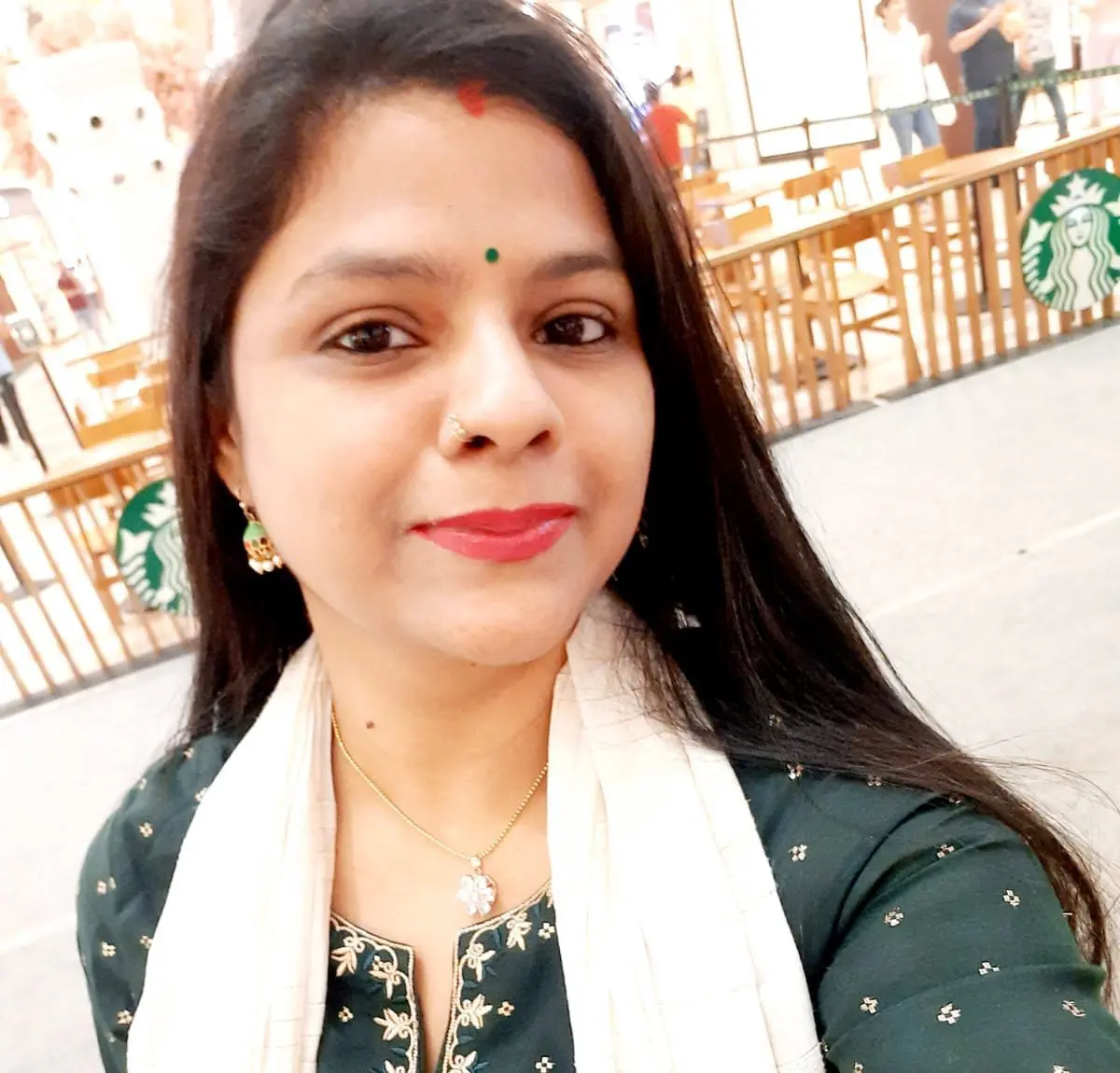
With over 11 years of experience in the publishing industry, Priya Srivastava has become a trusted guide for hundreds of authors navigating the challenging path from manuscript to marketplace. As Editor-in-Chief of Deified Publications, she combines the precision of a publishing professional with the empathy of a mentor who truly understands the fears, hopes, and dreams of both first-time and seasoned writers.