
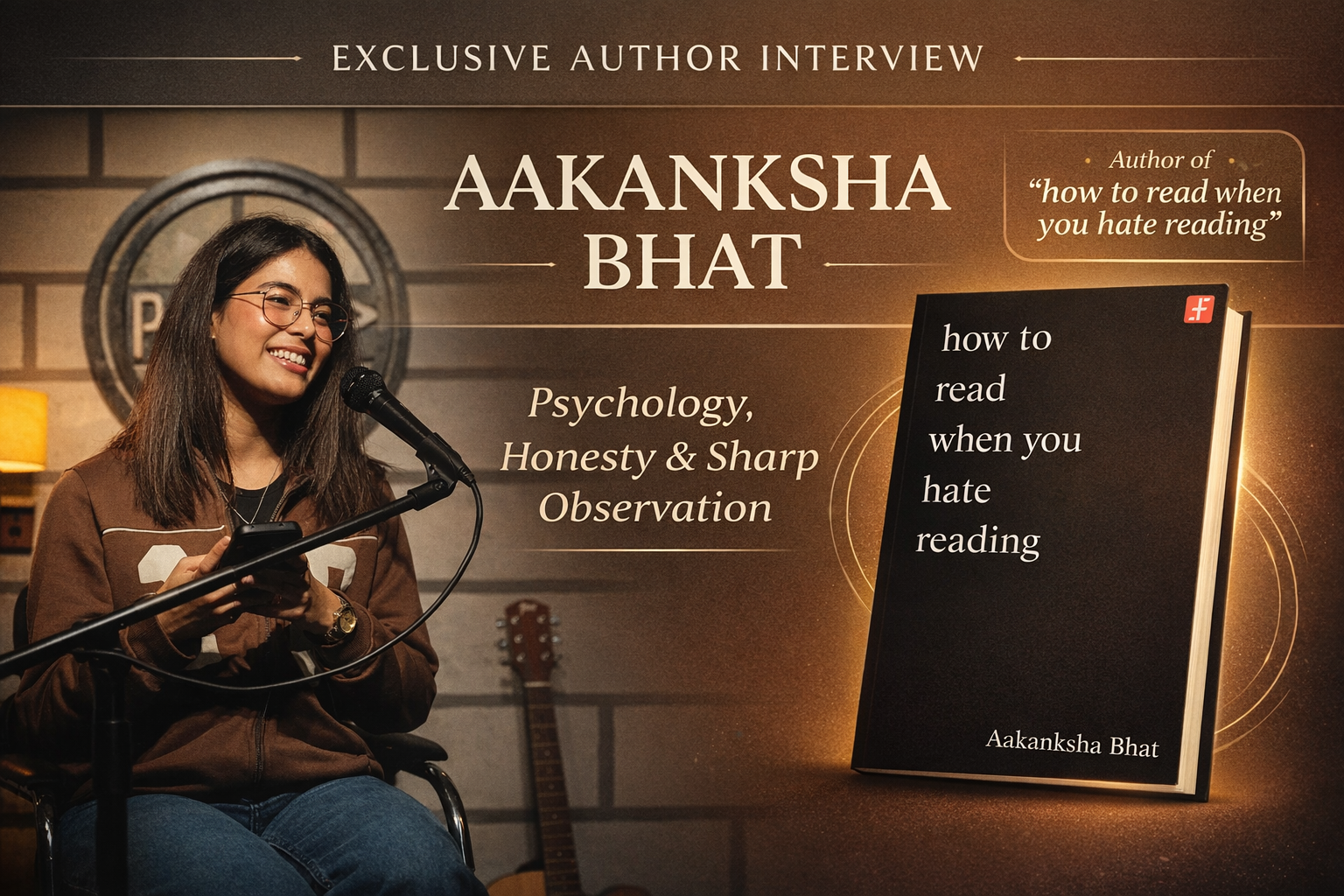
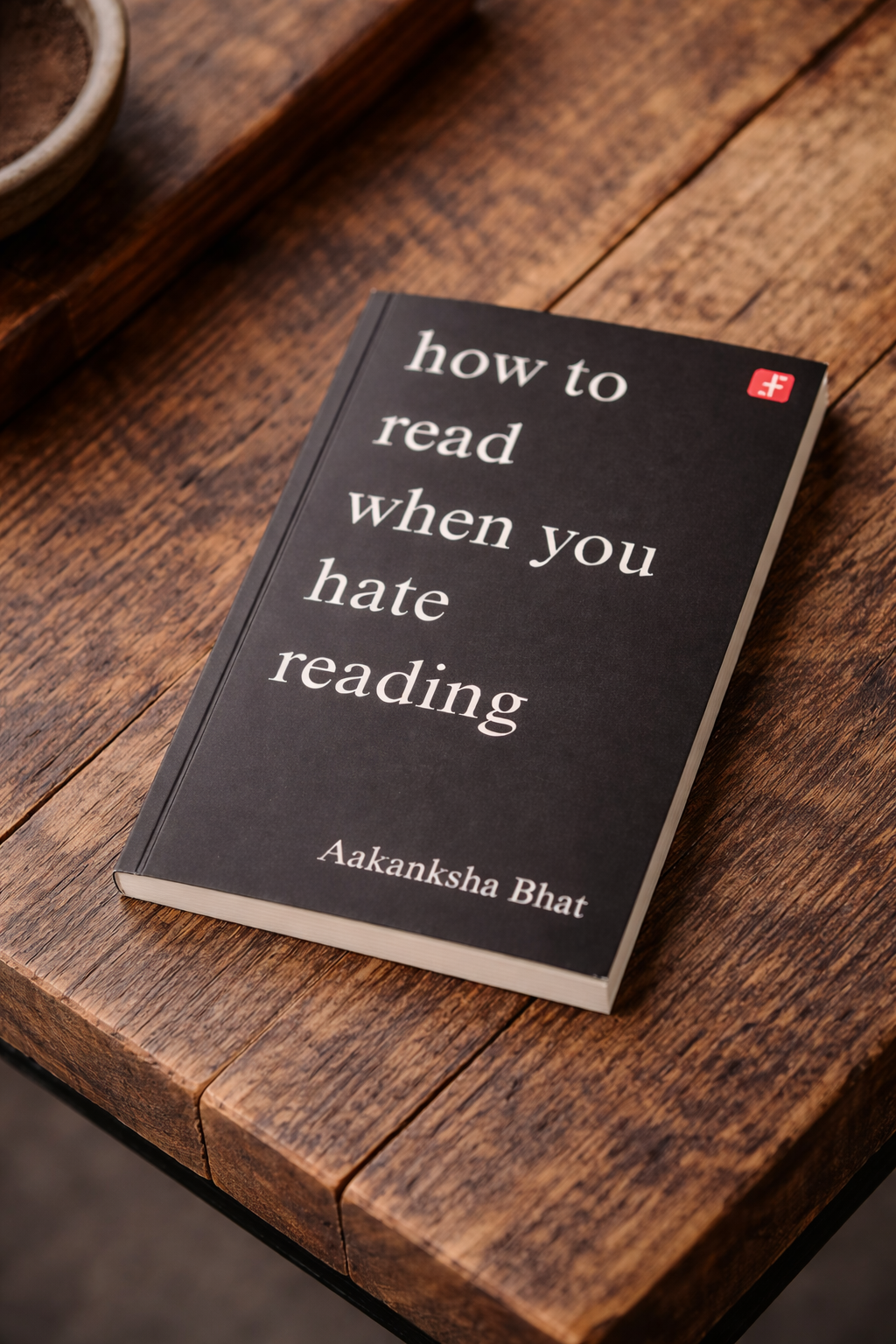
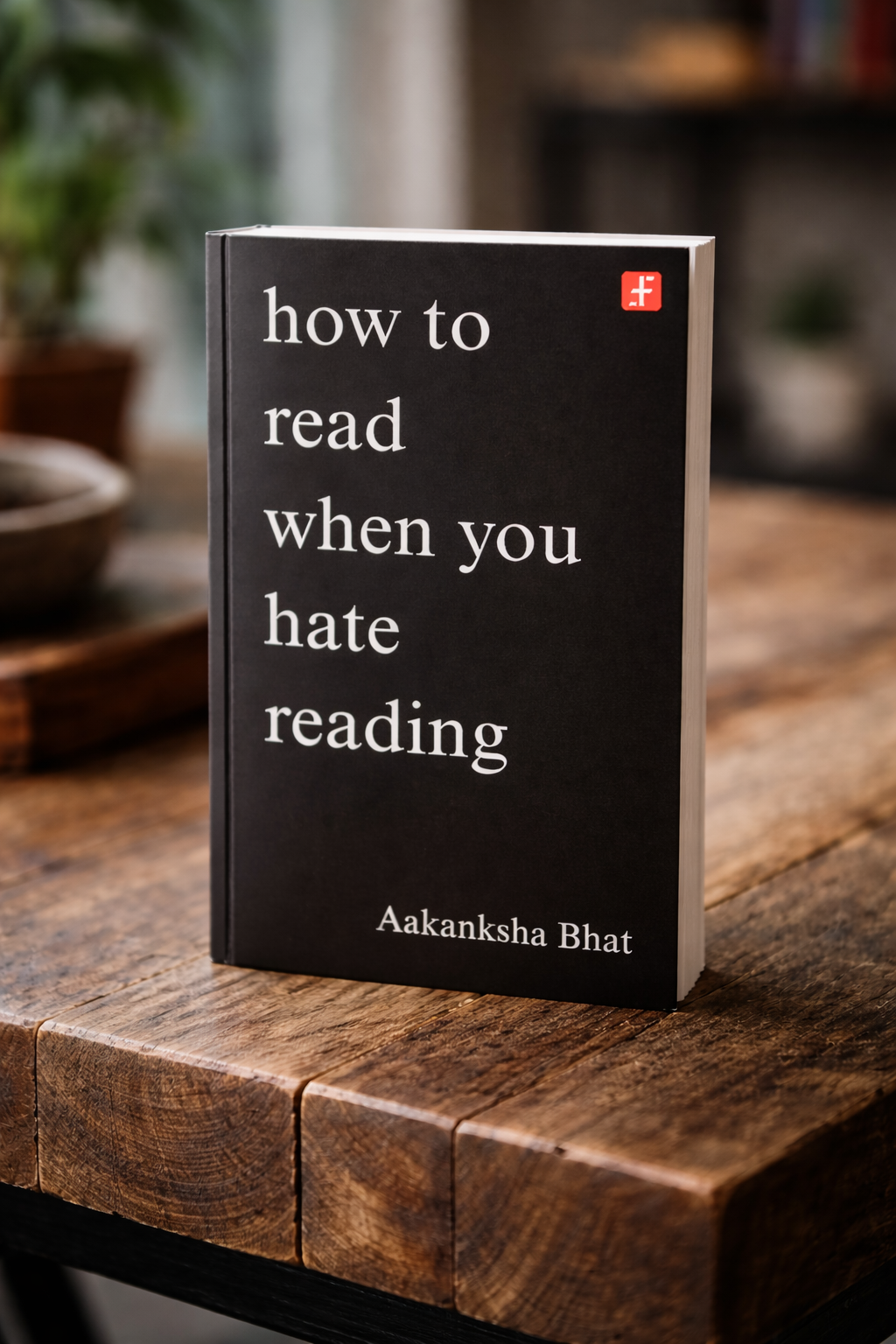
Editor’s Note: I sat down with Aakanksha Bhat, author of the provocative new psychology book “How to Read When You Hate Reading,” expecting a typical author interview. What I got instead was a raw, unfiltered conversation about overthinking, adolescent chaos, and why pretending to have your life together is the most exhausting performance of all. This interview has been lightly edited for clarity, but I’ve kept Aakanksha’s voice exactly as it is: sharp, self-aware, and refreshingly honest.
Priya Srivastava: Aakanksha, I have to start with the obvious question. Your book is called “how to read when you hate reading” but it’s not really about reading at all, is it?
Aakanksha Bhat: No, not even close. Reading is just the easiest metaphor for everything your brain resists starting, focusing, finishing. I could have called it “how to do anything when your brain is a dramatic mess” but that doesn’t exactly roll off the tongue. The title is a trick, honestly. People think they’re picking up a productivity hack book, and then they get slapped with cognitive inertia and affective forecasting errors. By the time they realize what’s happening, they’re already reading about themselves.
PS: And that seems intentional. You’re very direct in the book, almost confrontational at times. There’s this moment early on where you literally tell readers “you’re not saying no, you’re saying not yet, a very polite refusal.” That’s not the kind of hand holding most self help books offer.
AB: Because most self help books lie. They pretend you don’t already know what to do, when the truth is you absolutely do. You’ve read the articles, watched the videos, saved the Instagram infographics. The problem isn’t lack of information. The problem is that knowing something and doing something are completely different operations, and your brain has figured out how to feel productive without actually producing anything. I’m not interested in lying to people. I’m interested in showing them the exact mechanism that keeps them stuck, and letting them decide what to do with that information.
PS: You write a lot about your own experiences throughout the book. There’s a section where you describe convincing yourself you were being productive while essentially doing nothing. How much of this book is you working through your own patterns?
AB: All of it. Every single page. I’m not writing from some elevated position where I’ve figured everything out. I’m writing from the position of someone who catches herself mid spiral and thinks “oh god, I’m doing it again.” The scene where I describe sitting down to work, then fixing my desk, then reading one article, then another, then feeling organized enough to stop? That’s Tuesday for me. Sometimes Wednesday too. The only difference is now I can name what’s happening. I can see cognitive inertia in real time. Does that stop me from doing it? Not always. But at least I’m not lying to myself about it anymore.
PS: Let’s talk about your age for a moment. You’re still in school while writing about psychology, behavior patterns, social influence. Some might say you’re too young to be writing about these topics with such authority. What would you say to that?
AB: I’d say they’re probably right, and I don’t care. Authority in psychology usually means you’ve spent years studying other people. I’ve spent years living inside my own head, watching my friends navigate the same chaos, observing how we all perform normalcy while internally spiraling. That’s a different kind of authority. I’m not a psychologist. I’m a teenager with a functioning frontal lobe and a journal habit. I notice things. I write them down. I connect patterns. And apparently, those patterns resonate with people who are way older than me, which tells me something important that the mechanisms of self sabotage don’t really change with age. You just get better at justifying them.
PS: Your writing style is very distinctive. Sarcastic, self aware, occasionally brutal. Where does that voice come from?
AB: Honestly? Exhaustion. I’m tired of the performance. I’m tired of everyone pretending they have it together. I’m tired of the polished, filtered, aesthetically pleasing version of life that social media sells us. My voice comes from the part of me that watches all of this and thinks “this is ridiculous.” I write the way I think. I think in tangents. I argue with myself. I catch my own contradictions mid sentence. That’s how the book sounds because that’s how being human actually sounds when you’re not editing yourself for an audience.
PS: You mentioned social media. There’s an entire section in the book about normative social influence, about how we edit ourselves to fit in. You perform at open mics, you’re fairly visible in creative circles. How do you navigate that tension between authenticity and performance?
AB: Badly, most of the time. Look, every open mic performance is a performance. I’m choosing which poem to read, how to deliver it, what persona to project. But I try to choose pieces that feel true even if they’re uncomfortable. The difference between performing and pretending is whether you recognize what you’re doing. I know when I’m code switching. I know when I’m softening my opinions to avoid friction. The book has a whole section on this because I live this. I edit my thoughts in group chats. I laugh at jokes I don’t find funny. I nod along to maintain social harmony. The awareness doesn’t always stop me from doing it, but it keeps me honest about why I’m doing it.
PS: There’s a character in your book named Ansh who realizes his thoughts aren’t entirely his own. That section felt particularly personal. Was that you?
AB: That section is everyone. Ansh isn’t a character, he’s a mirror. Every reader who’s ever pretended to like a song because everyone else did, or agreed with an opinion to avoid awkwardness, or laughed when they didn’t get the joke, that’s Ansh. That’s also me. I’ve spent hours cataloging the tiny ways I bend myself to fit social expectations. The clothes I choose, the words I edit out of sentences, the parts of my personality I dial up or down depending on who’s in the room. It’s strategic. It’s survival. And it’s absolutely exhausting when you start noticing how much of your mental energy goes into maintaining the performance.
PS: Your book touches on some heavy psychological concepts, cognitive distortion loops, ego depletion, metacognitive awareness, but you make them accessible. How did you approach translating complex psychology into language that doesn’t alienate readers?
AB: I refused to be boring. That was rule number one. Psychology gets a reputation for being dry because academics write like they’re trying to impress other academics. I’m trying to explain why you scrolled Instagram for forty minutes when you sat down to study. That requires different language. I use analogies that land. I write in the second person so it feels direct. I add humor because if you’re going to read about your own dysfunction, you might as well laugh at it. The concepts are complex, but the experience of them is universal. Everyone knows what it feels like to catastrophize. I just give it a name and show you the mechanism.
PS: You also write poetry, paint, skateboard, compete in athletics. How do all of these feed into your writing?
AB: They’re all forms of thinking. Poetry teaches compression, how to say the maximum with minimum words. Painting teaches observation, how to see what’s actually there instead of what you expect to see. Skateboarding teaches failure, literally. You fall. You get up. You try again. You learn that your body remembers patterns your mind hasn’t consciously processed. Athletics teach discipline, but also the gap between wanting something and actually doing the work to get it. All of that shows up in the book. The section on activation energy? That’s skateboarding. The part about performance versus resilience? That’s athletics. The entire writing style? That’s poetry refusing to waste words.
PS: There’s this line in your bio: “Thought begins where comfort collapses and I choose to live right there.” That’s a pretty intense way to describe your relationship with thinking.
AB: It’s accurate though. Comfortable thinking is lazy thinking. It’s recycling opinions you’ve already formed, confirming beliefs you already hold, staying in patterns that feel safe. Real thought happens when something doesn’t fit, when you’re confused or uncomfortable or forced to reconcile contradictions. I’m drawn to that space. Between doubt and clarity. Between knowing and not knowing. That’s where interesting things happen. That’s where you actually learn something about yourself instead of just performing self awareness.
PS: Your book ends with a question to the reader. You ask what they’ll choose to do differently. That’s an interesting choice, to leave it open ended rather than prescriptive.
AB: Because I genuinely don’t know what they should do. I can show you the patterns. I can name the mechanisms. I can hold up the mirror. But I can’t tell you how to live your life. That would be dishonest. I’m still figuring out my own life. I still get stuck. I still procrastinate. I still perform instead of being resilient. The question at the end isn’t rhetorical. It’s the only honest question I can ask. Now that you see how your mind works, what are you going to do with that information? I’m asking myself the same thing every day.
PS: You’re obviously very self aware, maybe hyperaware. Is that exhausting?
AB: Absolutely. Awareness is not the blessing everyone thinks it is. It’s expensive. It costs energy. You can see your patterns, name your behaviors, understand your motivations, and still end up doing the same thing because awareness doesn’t automatically equal change. Sometimes it just means you feel guilty with more precision. I write about this in the book. The gap between knowing and doing. Metacognitive awareness sounds impressive until you’re lying awake at 2 AM fully aware that you’re catastrophizing but unable to stop yourself from doing it. Awareness is the beginning, not the solution.
PS: What do you want readers to take away from this book?
AB: Permission to be a mess. Not in a cute, aesthetic way. In a real, human, functional mess way. You’re going to procrastinate. You’re going to catastrophize. You’re going to perform for social acceptance while your internal world is chaos. You’re going to feel confident right before you fail and exhausted right after you succeed. All of that is normal. It’s not a personality flaw. It’s not a lack of discipline. It’s how human brains work under pressure with limited resources and too many demands. The book doesn’t fix you because you’re not broken. It just shows you the mechanism so you can stop blaming yourself for being human.
PS: You mention open mics several times. What’s the difference between performing your poetry and sharing your writing in a book?
AB: Control, mostly. At an open mic, I can read the room. I can adjust my delivery, make eye contact, feel the energy shift. A book just sits there. It can’t defend itself. It can’t clarify. It says what it says and readers interpret it however they want. That’s terrifying and also freeing. I don’t have to perform the book. It exists independently of me now. People will love it or hate it or misunderstand it completely, and I have zero control over that. Open mics feel safer because I’m there. The book is me sending my thoughts into the world and hoping they land somewhere useful.
PS: There’s a rawness to your writing that feels almost vulnerable. Was that difficult to maintain?
AB: It was the only way to write it honestly. I could have hidden behind academic language or formal distance, but that would have been another performance. The whole point of the book is to stop performing. So I had to write it the way I actually think, which includes contradictions, tangents, sarcasm, self doubt, all of it. Vulnerability wasn’t a choice. It was a requirement. If I’m asking readers to look at their own mess, I have to be willing to show mine first.
PS: You’re a young author entering a space dominated by established psychologists and self help gurus. Does that intimidate you?
AB: It should, probably. But here’s the thing, those established voices are often speaking to people who’ve already made it through adolescence, who have careers and mortgages and adult problems. I’m speaking to the people still inside the chaos. The ones whose brains are still developing. The ones navigating school and social pressure and the performance of normalcy while everything feels unstable. That’s a different conversation. I’m not competing with the gurus. I’m filling a gap they don’t even see because they’re too far removed from it.
PS: What’s next for you? Are you working on anything new?
AB: Always. I can’t not write. Poetry, journaling, essays, observations. I’m constantly processing. Whether that becomes another book, I don’t know yet. Right now I’m just paying attention. Watching patterns. Noticing things. Asking uncomfortable questions. Thought begins where comfort collapses, right? I’m just staying in that space and seeing what emerges.
PS: Last question. If someone picks up your book and only remembers one thing from it, what would you want that to be?
AB: That awareness is not the same as change, but it’s the first step toward honesty. You can see yourself clearly, understand your patterns, name your behaviors, and still be a mess. That’s okay. Being a mess with awareness is different from being a mess in denial. One gives you options. The other just keeps you stuck. Start with seeing. The rest comes later, if it comes at all.
PS: Aakanksha, thank you. This has been one of the most honest author conversations I’ve had in years.
AB: Thank you for not asking me to perform. This was actually fun.

With over 11 years of experience in the publishing industry, Priya Srivastava has become a trusted guide for hundreds of authors navigating the challenging path from manuscript to marketplace. As Editor-in-Chief of Deified Publications, she combines the precision of a publishing professional with the empathy of a mentor who truly understands the fears, hopes, and dreams of both first-time and seasoned writers.