
Rating: ⭐⭐⭐⭐ (4.3 out of 5)
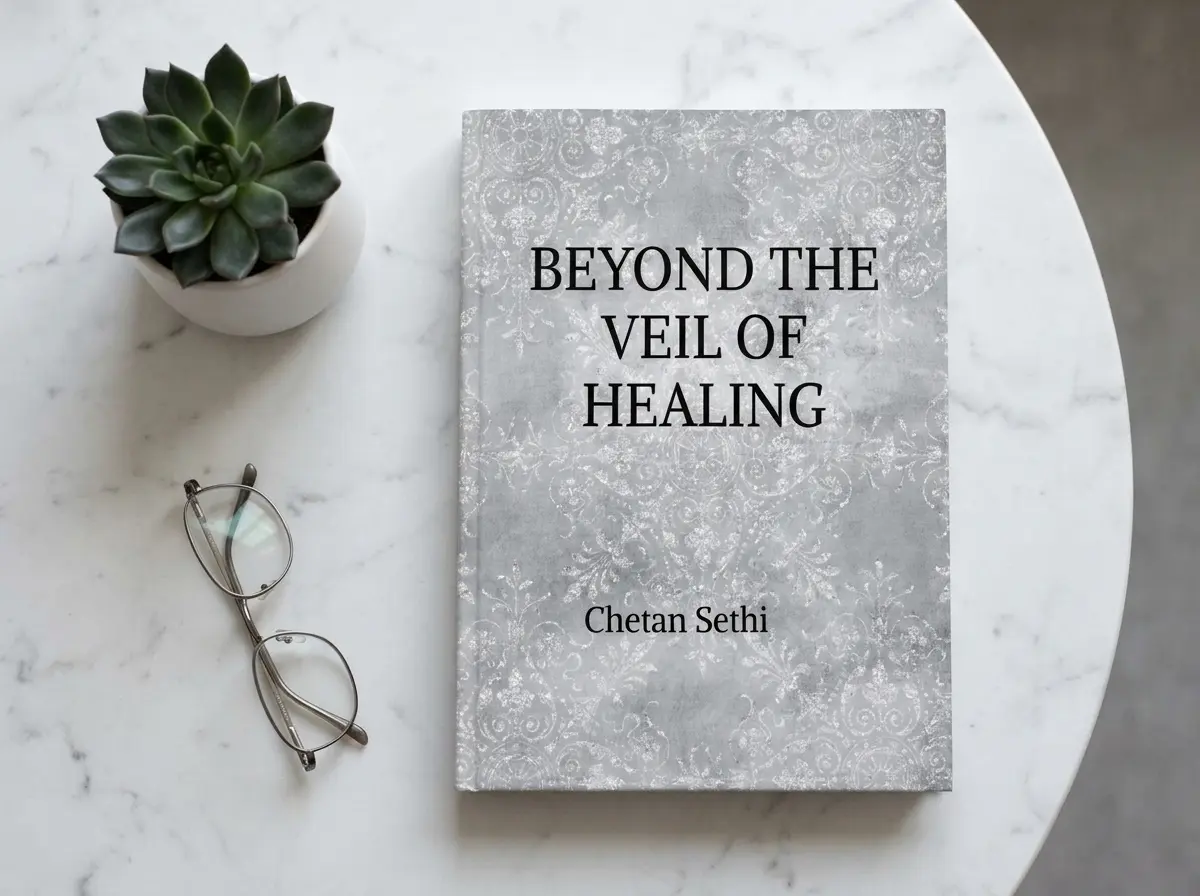
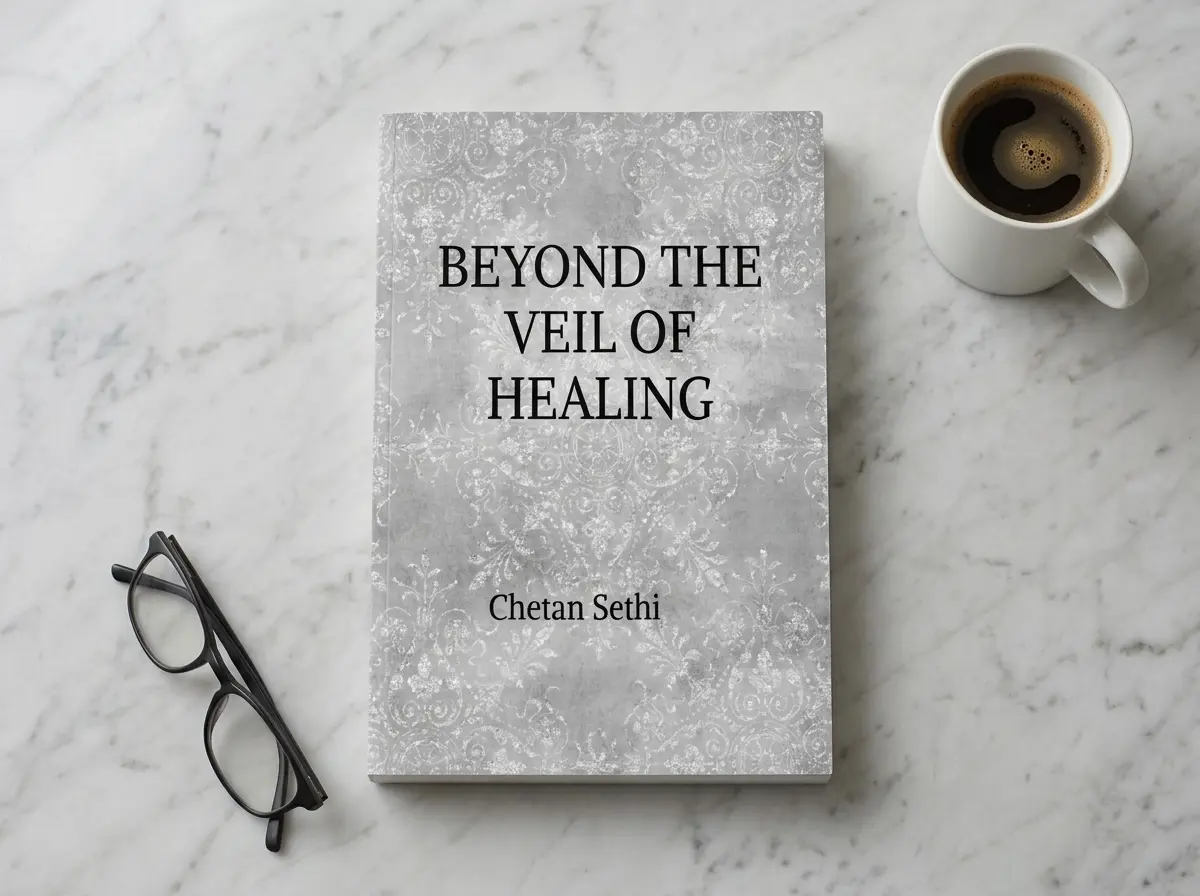
I’ll be honest with you. When Beyond the Veil of Healing by Chetan Sethi landed on my desk, I almost set it aside for the weekend pile. The cover is understated, grey and ornate, the kind that doesn’t shout at you from across a room. And the physical book itself is noticeably larger in dimension than your standard wellness title, which caught me off guard when I first picked it up. It’s a proper, substantial volume, the kind you need to settle into properly rather than hold with one hand on the metro. But that, I think, is fitting. Because what Chetan Sethi is asking of you inside these pages is not small. He’s not offering a weekend fix or a five-step shortcut to feeling better. He’s inviting you to look at everything you’ve been quietly carrying, and to actually put it down, with intention, with awareness, with care.
As the Editor-in-Chief at Deified Publication, I read a lot of wellness and self-help books across the year, and I’ll say plainly that many of them cover the same ground in the same voice. Beyond the Veil of Healing is different in ways I kept noticing as I read. It’s not trying to be clinical. It’s not trying to be trendy. It reads more like a conversation with someone who has thought very deeply about what it means to hurt, and what it might mean to truly heal, not just manage.
What This Book Is Actually About
At its core, Beyond the Veil of Healing is a guide to understanding yourself as more than a physical body with symptoms to be treated. Chetan Sethi builds his framework around the idea that our emotions are not just passing moods or mental noise. They are, as he writes early in the book, vibrant currents of energy flowing both within us and through the unseen spaces that surround us. That’s a bold claim to make in the first chapter, and I appreciated that he doesn’t just assert it and move on. He takes you through it carefully, drawing from yogic concepts like prana, from Traditional Chinese Medicine’s understanding of Qi, from modern psychoneuroimmunology, and from the heart’s measurable electromagnetic field, which, the book notes, can extend several feet beyond the body itself.
The book moves through a rich table of contents that I found genuinely well-structured. You begin with the hidden currents within you, move through awakening emotional wisdom, ancient rituals for modern healing, the subtle energy body, sensing and balancing energy, emotional release and transformation, and eventually arrive at chapters on integration into daily life and awakening to conscious living. The final chapter, Beyond the Veil: The Journey Continues, closes things in a way that feels like an open door rather than a conclusion. There are also personal stories of real people woven throughout, which I’ll come back to, because those are where the book really breathes.
What Stood Out to Me
The thing I kept returning to was how carefully Chetan Sethi handles anger. There’s a passage early in the book, in the chapter on emotions as energy, where he describes anger not as an outburst to be controlled but as an electrifying current that charges the nervous system, pulses through muscle fibers, and seeks expression. He then says that when this energy is suppressed, it congeals and ferments as heaviness in the chest or a tightness that suffocates spirit and clarity. I’ve seen this in people I know. I’ve maybe felt it myself. The way he writes it, you stop thinking about anger as a character flaw and start understanding it as something that needs to move, not be silenced.
He does something similar with sadness, describing it as a slower, more somber energy that settles in the heartspace and needs introspection and release, rather than resolution. Reading those passages back to back made me think about how differently we tend to treat those two emotions in daily life. We rush to resolve anger and we rush to escape sadness, and the book very gently suggests that both of those instincts may be making things worse.
The stories in the book are its warmest element. There’s Mira, a young woman with chronic anxiety whose tightness and incessant worry turned out to be volatile energy trapped at the solar plexus. Her release came through somatic practices, breathwork, meditative sensing, and the book describes this transformation with real tenderness. Then there is Arun, a businessman with chronic migraines that neither medication nor lifestyle changes could fully resolve. His pain, it turned out, was rooted in a deep internal conflict between his desires and his sense of duty, and it was only when he began attending to the emotional and spiritual dimensions of his suffering, through guided meditation and breathwork, that his migraines lessened and his body found ease. I kept thinking about this one for a while after, because I know people like Arun. I think most of us do.
The chapters on ritual healing also surprised me. Chetan Sethi is thoughtful about cultural specificity without being preachy about it. He draws from indigenous ceremonies in the Americas, from Hindu pujas, from Sufi mysticism, from a woman in New York who created a personal altar of candles and a poem her mother cherished after losing her to grief. There is also the story of Thomas, a veteran whose healing came through an indigenous sweat lodge ceremony, which the book describes with real reverence. These aren’t tourism of other people’s traditions. They feel like evidence that the human need for ritual is universal, and that the form can be deeply personal.
In 2026, when so many people are managing stress as a baseline condition rather than an occasional interruption, this message feels timely in a grounded way. The book doesn’t panic about modernity. It just says, gently, that ancient practices still work when you understand what they’re actually for.
The Emotional Core
What Chetan Sethi is really writing about, underneath all the frameworks and the stories, is the experience of feeling disconnected from yourself and the possibility of coming back. There’s a section on what he calls the language of the soul, where he describes emotions as coded messages from a deeper consciousness, not enemies to manage but signals to translate. That framing, for me, was the emotional centre of the book. He talks about how our cultural conditioning trains us to push away fear with logic, shun sadness with distraction, and mask anger with forced smiles, and how this silencing creates what he calls the emotional veil. Reading that, I felt something I can only describe as recognition. It’s the kind of recognition that’s a little uncomfortable because it’s accurate.
The closing chapters on empowerment hit differently from most wellness books I’ve read. Instead of promising transformation, the book promises companionship through transformation. There’s a moment near the end, around page 268, where Sethi writes that healing is not a distant goal or an external event, but an ongoing, intimate dialogue with yourself. I wrote that line down. It felt true in a way that wasn’t trying to be inspirational. It just was.
I’ll note that some readers who prefer more strictly evidence-based approaches may find the sections on auras, meridians, and energy fields a little difficult to hold alongside the neuroscience passages. Sethi does his best to bridge them, and I think he does it with genuine intellectual care, but the book asks you to hold some degree of openness to frameworks that conventional medicine hasn’t fully validated. That’s not a critique so much as a note for the right reader to self-select.
Who This Book Is For
Honestly, I think this book is for anyone who has ever felt that something was wrong that no doctor’s report could quite explain. It’s for people who have done the external work, changed their diet, started exercising, perhaps even begun therapy, and still feel like something is unresolved in a place they can’t quite point to. It’s for people who are spiritually curious without being dogmatic, who can sit with the idea that emotions are energy and take what resonates without needing it to be scientifically proven at every step. It would also be meaningful for practitioners, healers, therapists, yoga teachers, anyone who works with human wellbeing and wants a text that integrates ancient wisdom with modern psychological understanding in a generous, non-academic way.
If you tend toward the strictly rational and find energetic frameworks frustrating, you may find certain sections require some patience. But even then, the stories alone are worth the read. They are written with warmth, and they are real in the way that good stories always feel real, whether or not they are literally documented.
Final Thoughts
I came to Beyond the Veil of Healing without high expectations and left it feeling like I’d been in a long, honest conversation with someone who genuinely cares about the people they write for. Chetan Sethi doesn’t perform wisdom. He shares it in the way someone does when they’ve arrived at something through real inquiry rather than research alone. The book is generous in scope, covering energy bodies, chakras, meridians, emotional release techniques, ritual healing from multiple cultures, mind-body-spirit integration, and conscious living, and yet it never feels like it’s showing off. It feels like it’s trying to help.
The physical book itself, in its larger-than-usual dimensions, somehow suits this. It’s not a pocket companion you glance at on a commute. It’s a book you sit with, maybe with tea, maybe more than once. And I think that’s exactly what Chetan Sethi intended.
FAQs
Is Beyond the Veil of Healing worth reading?
Yes, I think it is, particularly if you are someone who feels that conventional approaches to wellness haven’t addressed everything you’re carrying. Chetan Sethi brings together emotional intelligence, ancient healing traditions, and practical guidance in a way that feels considered and honest rather than formulaic. It’s not a light read, but it’s a meaningful one.
What is Beyond the Veil of Healing about, in simple terms?
At its simplest, it’s a book about how healing goes deeper than fixing symptoms. Chetan Sethi argues that our emotions are forms of energy that shape our physical, mental, and spiritual wellbeing, and that lasting healing requires us to address what’s happening beneath the surface, in the patterns and blocks we often can’t see or name. The book teaches readers how to do that through awareness, ancient practices, breathwork, ritual, and self-inquiry.
Who should read this book?
This book is well-suited for people on a conscious healing journey who are open to integrating emotional and energetic frameworks with their existing practices. It works well for those interested in yoga, meditation, breathwork, chakra healing, or Ayurvedic approaches, and also for therapists and wellness practitioners looking for a text that bridges spiritual and psychological perspectives with real warmth and depth.
Is Beyond the Veil of Healing a spiritual book or a self-help book?
It’s honestly both, and I mean that as a compliment. It doesn’t sit neatly in either category. It draws from spiritual traditions across multiple cultures without asking you to adopt any single one, and it offers practical guidance without reducing healing to a checklist. If you tend to find purely spiritual books vague and purely self-help books too mechanical, this one might be what you’ve been looking for.

With over 11 years of experience in the publishing industry, Priya Srivastava has become a trusted guide for hundreds of authors navigating the challenging path from manuscript to marketplace. As Editor-in-Chief of Deified Publications, she combines the precision of a publishing professional with the empathy of a mentor who truly understands the fears, hopes, and dreams of both first-time and seasoned writers.