
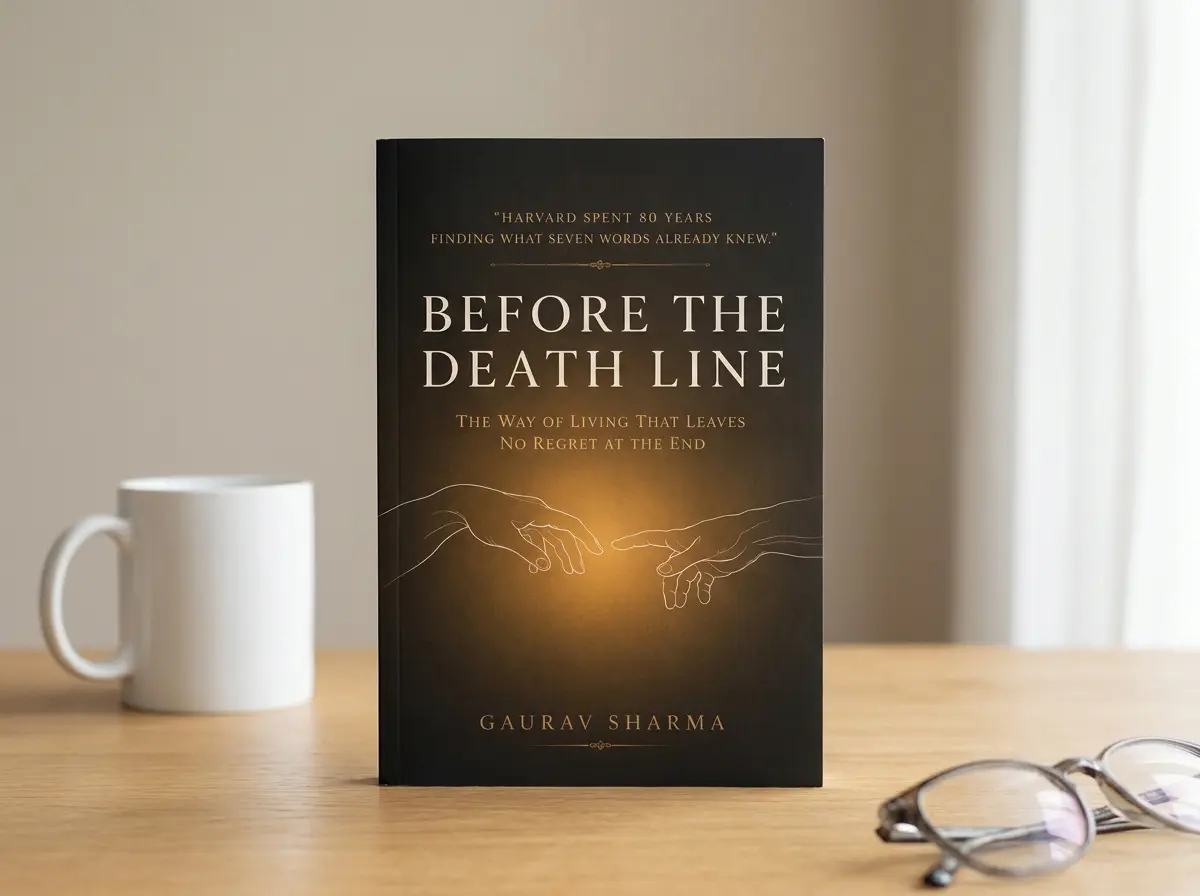
Rating: ⭐⭐⭐⭐ (4.3 out of 5)
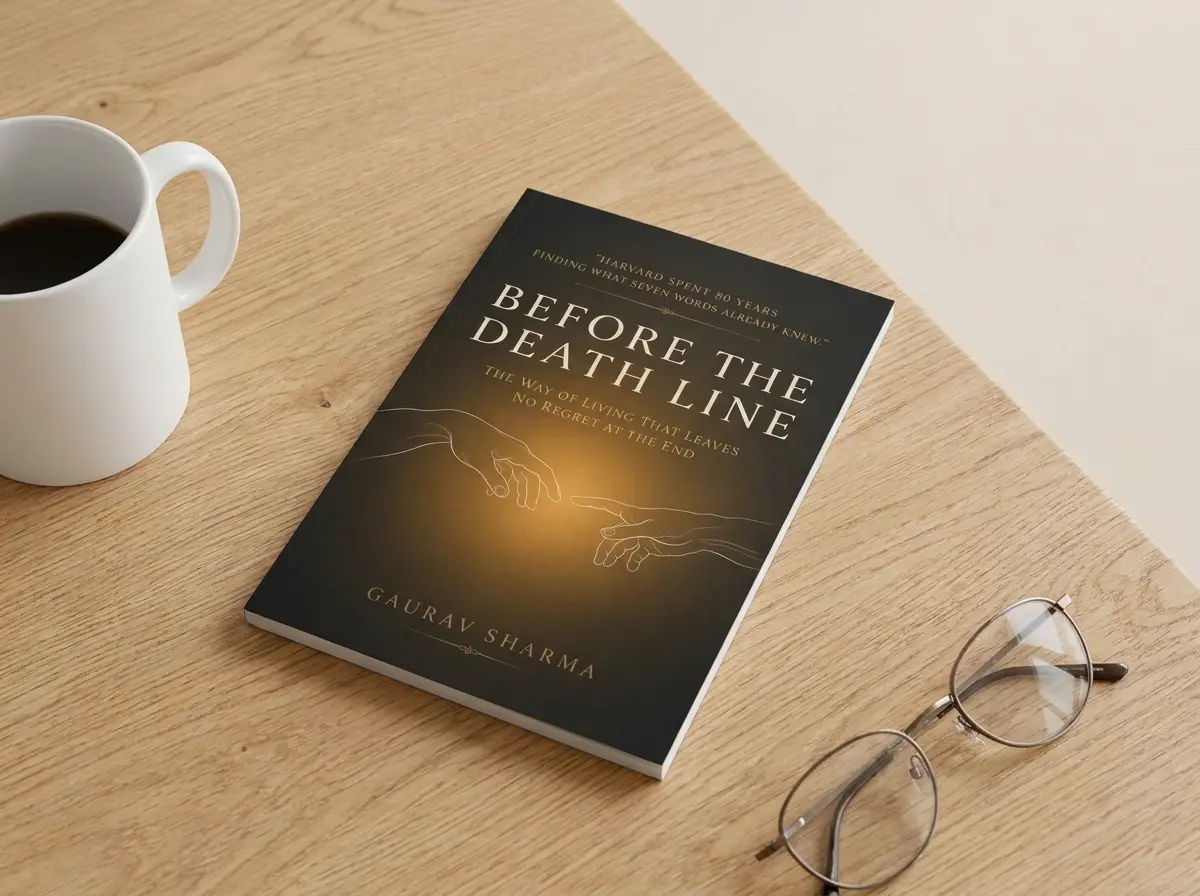
I have been reading books for the better part of fifteen years now, and I can usually tell within the first few pages whether a writer is talking to me or performing for me. Before the Death Line by Gaurav Sharma talks to you. It sits across from you like someone who has seen a thing he cannot un-see and needs you to see it too. I picked it up half expecting another self-help book with a clever title, and I was wrong about that. As Editor-in-Chief at Deified Publication, I read a lot of writing that tries to teach people how to live, and most of it fails for the same reason. It speaks from a lecture hall. This book speaks from a dark room beside a dying mother, and you feel that difference immediately.
What got me early on was how honest the author is about what he does not know. There is a line where he says the book does not claim to hold the final truth, and that the honesty is the whole strength of it. I read that and thought, okay, I trust this person a little more now. That is rare in this genre. Most books in this space promise you the answer to everything. Gaurav Sharma promises you one thing, and he keeps circling back to it until you cannot look away.
What the Book Is About
The book opens with the Harvard study, the one that began in 1938 and followed 268 young men for eighty years. Dr. Robert Waldinger, the study’s director, took it to a TED stage in 2015 and told the world what all that data added up to. Good relationships keep us happier and healthier. That is it. The people who were most satisfied in their relationships at fifty turned out to be the healthiest at eighty. The author does not treat this as a warm little fact. He treats it as a wound. Because if science has spent eighty years confirming what we already feel in our bones, then why do we keep destroying the very relationships that hold us up?
That is the question the book is built around. Sharma, who writes under the name GaSha, argues that the research told us what makes a good life, but never told us why we wreck it, or how to stop. So he builds his own answer from the ground up. His foundation is a single fact that no one can argue with, that every human being shares 99.9 percent of their DNA. From there he sketches out what he calls a geometry of living. It is not a religion, not renunciation, not the inward gaze of Ikigai. It is a way of staying fully inside your ordinary, working, exhausting life without losing the people in it.
What Stood Out to Me
The characters are what make this book land, and I mean that. Sharma keeps returning to a sugarcane juice maker on his street. This man works from dawn until late night at his iron crusher, and when the day ends he does not go home to a soft bed. He spreads a worn cloth on his wooden worktable and sleeps in the open air, no blanket, a mosquito coil burning beside him. The author used to wonder why anyone would live like a penance. Then he understands. The man is loving his family in the only language available to him. He is earning. That reframing sat with me for days after I read it, because I have walked past a hundred men like him and never once thought about it that way.
Then there is Sunita, born into a family where the script was already written before she arrived. Study until marriage, marry the man the family chooses, produce children, manage the household. She was brilliant. She wanted to study further, to build something of her own. She married at twenty-two, and by thirty she had everything the script promised and was completely, desperately miserable. Sharma calls this the Rigid Law Circle, the inherited rule-book that gives you belonging but crushes the individual. And against her he sets Ravi Sharma, twenty-nine, a decent IT job in Noida, who lights a cigarette at 2:14 in the morning and posts a glossy photo captioned Living life on my own terms. Ravi has freedom and no belonging. Sunita has belonging and no freedom. Between the two of them the author draws the whole modern trap.
The Emotional Core
If you read nothing else in this book, read the chapter about Dr. Ramesh Chandra. He is a scientist who spent fifty years proving that he mattered. Thirty-two patents, international conferences, a laboratory named after him, a Wikipedia page, awards catching the afternoon light in his study. By every measure a man can be measured by, he built an important life. He dies at seventy-eight, his family around him, and his daughter takes his hand and asks, Papa, any regrets. He is silent for a long time. Then the small things come back. The evening he snapped at his brother and never apologized. The years his wife ate dinner alone. A friend who once needed money, and how grudgingly he had given it.
None of these are large enough to be called sins, the author writes, but all of them are large enough to return at the end. And then Dr. Chandra whispers his last word. Rishtey. Bas rishtey. Just relationships. His eyes close. His daughter holds his hand long after he is gone, not because she was told to, but because in that final moment her father had finally shown up, fully, without his awards, without the careful distance he had kept for fifty years. Honestly, I teared up a bit here, and I do not say that about many books. It works because Sharma earns it. He does not rush you to the tears. He lets the whole life pile up first, then knocks it over with one Hindi word.
The book closes on a Hindi poem in the epilogue, built around a mother’s last words to her son. Beta, family mat tootne dena. Son, do not let the family break. There is something about switching into Hindi right at the end that hit me in a place English could not reach. It reminded me of my own grandmother, of the things people say when there is no time left to say them carefully.
Who This Book Is For
I want to be fair here, because this book will not be for everyone. Sharma writes in a very particular rhythm, short declarative lines stacked one after another, circling the same idea from many angles. When it works, it feels like a drumbeat. When it does not, some readers may find it repetitive, and there were a couple of stretches in the middle framework chapters where I felt the geometry metaphor was doing more work than it could carry. If you want a tidy step-by-step program with worksheets, this is not that book. It is more like sitting with a thoughtful friend at 2 a.m. who keeps saying the same true thing in slightly different words until you finally hear it.
But if you are a working professional who feels the years slipping, an exhausted parent, or someone tired of borrowed answers from other traditions, this will speak to you. It is written for the ordinary embedded life, not the monastery. I would hand it to anyone who has ever let a small grudge harden into years of silence with a sibling or a parent. Which, if we are being honest, is most of us.
Final Thoughts
Before the Death Line is not a perfect book, and I think the author would be the first to agree, given how openly he admits its limits. But it does something I did not expect. It made me want to call people. It made me think about the friend I owe a message to, the relative I have been avoiding, the small repairs I keep telling myself I will get to later. In my years reviewing books, the ones that change your behavior even a little are far rarer than the ones that simply entertain you for an afternoon. This one changed mine, at least for a week, and maybe that is the point of it. In 2026, when so much of our attention is pulled toward performance and personal brand and living on our own terms, a book that gently asks whether you loved well feels timely in a way I did not see coming. It is a small book with a heavy question inside it, and I am glad I read it.
Frequently Asked Questions
Is Before the Death Line worth reading?
Yes, with one caveat. If you connect with reflective, philosophical writing about relationships and mortality, this book gives you something the blurb cannot, which is a genuine shift in how you look at the people around you. If you prefer fast plots or practical checklists, the meditative style may test your patience. For the right reader it is easily worth the few hours it asks for.
What is Before the Death Line about?
It uses the famous 80-year Harvard happiness study as a starting point and asks why we keep destroying the relationships that science says keep us happy. Gaurav Sharma then builds an original philosophy, grounded in the fact that all humans share 99.9 percent of their DNA, about how to live a full, engaged, honest life without losing the people who matter.
Who should read this book?
Working professionals, tired parents, and anyone carrying an unspoken grudge or an unhealed relationship. It is written for ordinary busy lives, not for people planning to retreat from the world. If you have ever wondered whether you are spending your one life on the right things, this book is talking directly to you.
Is Before the Death Line a religious or spiritual book?
No. Sharma is clear that this is not another religion and not renunciation. He builds his argument from a biological fact rather than from belief, and he openly admits the book does not claim the ultimate truth. That honesty is one of its strongest qualities.

With over 11 years of experience in the publishing industry, Priya Srivastava has become a trusted guide for hundreds of authors navigating the challenging path from manuscript to marketplace. As Editor-in-Chief of Deified Publications, she combines the precision of a publishing professional with the empathy of a mentor who truly understands the fears, hopes, and dreams of both first-time and seasoned writers.