
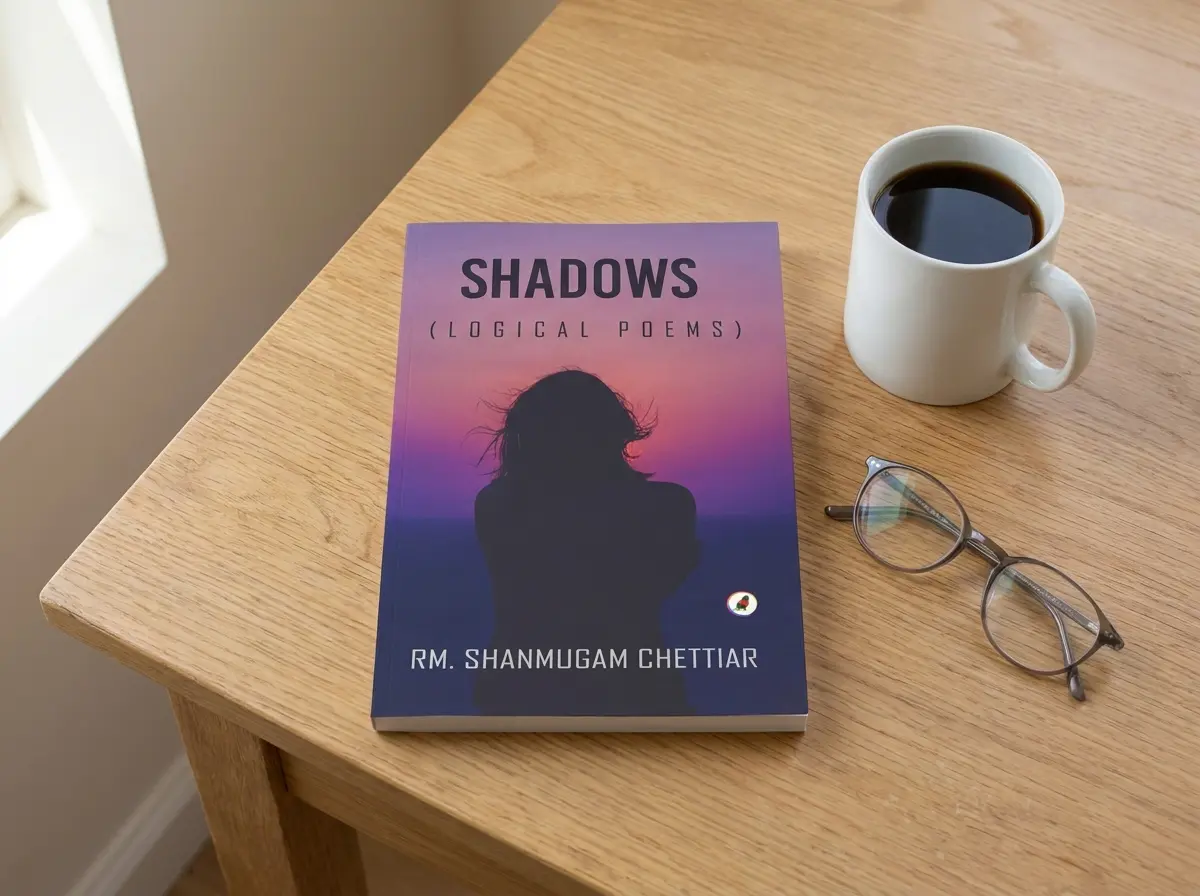
Rating: ⭐⭐⭐⭐ (4.3 out of 5)
A novel gives you characters to follow. A memoir offers memories to walk through. Poetry asks something different. It asks whether a handful of words can make you stop, rethink your assumptions, or see an ordinary thing from another angle.
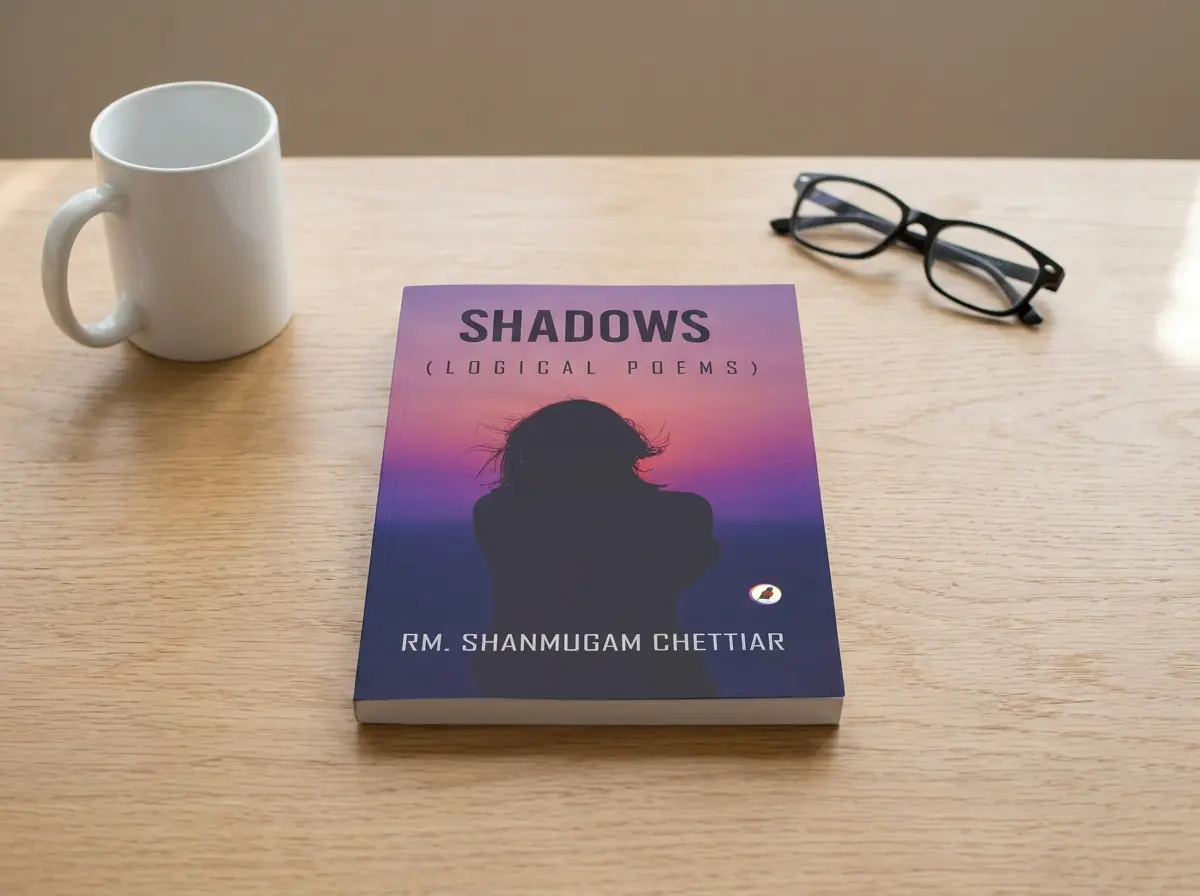
That was my experience with Shadows (Logical Poems) by RM. Shanmugam Chettiar.
This is not a collection built around romance or lyrical beauty. It is built around ideas. Some are philosophical, some social, some deeply personal, and many are surprisingly practical. Even before reaching the poems themselves, the foreword explains that the author has written thousands of poems over decades and has organized this collection around logical themes that touch family, society, morality, literature, science, and everyday life. That description turned out to be remarkably accurate.
While reading, I often felt as though I wasn’t listening to a poet trying to impress readers. Instead, I was listening to an elderly thinker sharing observations gathered over an entire lifetime. Sometimes I agreed immediately. Sometimes I disagreed. A few poems even made me smile because of how unexpectedly blunt they were. That, to me, is always more interesting than poetry that simply sounds beautiful.
What Shadows Is About
Unlike many poetry collections that revolve around a single emotion, Shadows spreads itself across almost every aspect of human existence. The book contains hundreds of logical poems arranged into sections covering general life, family, society, abstract ideas, and miscellaneous reflections. Some poems are only four lines long, while others extend into several pages, yet almost every one tries to answer a question rather than merely express a feeling.
The title poem immediately introduces the author’s style. “Shadows” uses the metaphor of women as shadows that men pursue but never truly possess. Whether readers agree with that metaphor or not, it sets the tone for a book that prefers symbolism over storytelling.
From there, the collection moves rapidly across morality, ambition, self awareness, politics, death, relationships, aging, faith, environmental responsibility, social inequality, and even scientific thinking. The remarkable part is that these subjects rarely feel disconnected. The author seems fascinated by one central question. Why do human beings behave the way they do?
That curiosity becomes the heartbeat of the entire collection.
What Stood Out to Me
One thing became clear very early. RM. Shanmugam Chettiar is less interested in decorating language than in sharpening ideas.
Take “An Uneven Lot.” At first glance, it appears to describe physical imbalance, uneven hands, uneven eyes, uneven ears. But gradually it becomes obvious that the imbalance is moral rather than physical. We eagerly seek praise while ignoring criticism. We notice beauty more readily than poverty. The final observation about selfishness loosening the very fabric of society feels remarkably relevant today.
I also liked “Show Is Not A Measure.” It is only a few lines long, yet it quietly questions how easily people confuse visible affection with genuine gratitude. The comparison using animals is simple enough for anyone to understand, but the idea underneath remains surprisingly mature.
Then comes one of my personal favourites, “The Path Is Fear Ridden.” This poem stretches over multiple pages and reads almost like a conversation between hope and anxiety. The speaker continues moving forward despite uncertainty, predators, disappointments, broken expectations, and unanswered questions. There is one recurring feeling throughout the poem that I found deeply relatable. Life rarely becomes completely safe before we begin living it. We move because we have no alternative except movement itself.
Another poem that stayed in my mind was “With Peace.” It argues that genuine peace begins with knowing ourselves, recognizing our own dishonesty, manipulation, weaknesses, and failures before judging anyone else. The conclusion does not promise success or greatness. Instead, it hopes for something much simpler, dying without guilt. I found that ending unexpectedly moving because it replaces achievement with integrity.
One of the strongest long poems in the collection is “Winter Is Cold.” Rather than describing weather, winter becomes a metaphor for old age. The poem reflects on fading desires, disappearing ambitions, growing detachment, lost relationships, and eventually accepting mortality. I appreciated that the author never presents aging as purely tragic. Instead, he treats acceptance as a kind of wisdom earned through experience.
Several poems reveal the author’s practical outlook on ethics. “The Revelations of Great Men” refuses to celebrate generosity when it is convenient or philanthropy built upon unfair wealth. Greatness, according to the poem, cannot be manufactured through appearances alone. I found this refreshing because it questions public virtue instead of automatically praising it.
I smiled while reading “The Headlight.” The image is beautifully simple. A car’s headlights illuminate only a short distance, yet that limited visibility is enough to complete an entire journey. The author compares faith to that headlight. We do not need to see our whole future before taking the next step. Sometimes thirty yards of clarity are enough. That metaphor is one of the most memorable in the book.
Even the shortest poems often contain surprisingly rich observations. “Life Is A Cry” reduces different human ambitions into different forms of crying. Ego cries. Desire cries. Motherhood cries. Humanity cries. The poem leaves readers wondering whether striving itself is simply another form of longing.
There are also poems that reveal the author’s lighter side. “Every Cat Had A Day” plays with familiar expressions while reminding readers that fortune changes constantly. “Below A Beggar” asks uncomfortable questions about dignity. “To Know The Past” reflects on history’s influence upon identity. “An Umbrella Tree” transforms environmental concern into a moral responsibility instead of merely discussing ecology. These pieces may be short, but they never feel careless.
As the collection progresses into family and society, the perspective becomes more personal. “The Funeral” presents an observation that feels painfully real. Life continues around death. People organise, arrange, discuss, and move forward while the person at the centre of it all is absent. It is an uncomfortable thought, yet an honest one.
I was equally intrigued by “Male Parental Hierarchy.” Rather than discussing gender only through familiar arguments, the poem questions how generations of women lose recognition within patriarchal family structures. Whether readers agree entirely or not, it certainly offers an angle that is uncommon in poetry.
The social poems continue asking difficult questions. “Pseudo Air,” “Writer: A Must?,” “The Undeserving Humiliation,” “Laws For Weaklings,” “The Minority Government,” “Racial Supremacy,” and “The Kith And The Kin” collectively examine power, injustice, reputation, prejudice, and social identity. None of these poems pretend society is simple, and that honesty gives the collection considerable depth.
Toward the later sections, the poems become increasingly philosophical. “Gain and Loss,” “Denotation and Connotation,” “Have Hues A Role?,” “No Truth Is Universal,” “The Maker Is Not To Blame,” “Honesty Verses Loyalty,” and “The Endangered Tribes” shift the discussion from society toward abstract thinking. These poems ask readers to reconsider ideas that many people accept without much reflection.
Finally, the miscellaneous section closes with pieces like “Darwin and Lincoln” and “New Year: Significance,” showing that the author’s interests stretch from science and history to literature and everyday human optimism.
The Emotional Core
Although the subtitle calls these Logical Poems, I don’t think logic is the entire story.
Underneath the reasoning sits a man reflecting on decades of experience.
- There is disappointment here.
- There is hope.
- There is humour.
- There is skepticism.
- There is compassion.
- Sometimes all of those appear within the same poem.
One feeling returned again and again while I was reading. The author is less interested in telling readers what to think than encouraging them to examine themselves first. Many poems begin with society but end with the reader. That shift gives the collection its emotional weight.
I also appreciated that the poems are willing to sound unfashionable at times. They are not trying to satisfy current literary trends. They simply present convictions shaped over many decades. Whether readers agree or disagree, that honesty makes the voice feel authentic.
A Small Critique
If I had one reservation, it would be that the sheer number of poems can occasionally feel overwhelming.
Because there are hundreds of pieces, some ideas naturally overlap. Self awareness, morality, fear, human weakness, and philosophical reflection return frequently. A slightly more selective collection might have created even greater impact.
There are also moments where the language prioritizes the message over poetic rhythm. Readers who prefer highly lyrical poetry filled with elaborate imagery may find this collection more direct than they expect.
For me, though, those qualities never became major weaknesses because the author’s intention is clearly different. He is writing logical reflections first and poetic expressions second.
Who Should Read This Book?
I think Shadows will appeal most to readers who enjoy reflecting on life rather than following narratives.
If you enjoy philosophy expressed through poetry, if you appreciate short pieces that can be read one at a time, or if you like writers who question accepted beliefs instead of repeating them, this collection deserves your attention.
Readers looking for romantic poetry or highly decorative language may not connect with every page. That is perfectly fine. Not every poetry collection needs to satisfy every audience.
This one feels particularly suited to mature readers, teachers, students of literature, discussion groups, and anyone who enjoys thinking about ethics, society, family, and human behaviour from multiple perspectives.
Final Thoughts
After finishing Shadows, I came away with respect for RM. Shanmugam Chettiar’s consistency more than anything else.
Across hundreds of poems, he keeps returning to one simple belief. Human beings improve not by pretending to be perfect but by questioning themselves honestly.
As someone who reviews books professionally at Deified Publication, I value works that leave readers with genuine conversations rather than temporary excitement. This collection did exactly that. I did not agree with every conclusion, and I don’t think readers need to. In fact, disagreement may be part of the reading experience the author hopes to create.
Some poems will make you nod immediately. Others may send you back to read them again because they challenge an assumption you never noticed before. That is where Shadows finds its greatest strength.
It is not trying to entertain every reader. It is trying to make readers think more carefully about themselves and the world around them. For me, that makes it a rewarding collection.
If you’d like a complimentary digital copy of this book, feel free to contact the author directly at [email protected] or via WhatsApp at +919080455850.

With over 11 years of experience in the publishing industry, Priya Srivastava has become a trusted guide for hundreds of authors navigating the challenging path from manuscript to marketplace. As Editor-in-Chief of Deified Publications, she combines the precision of a publishing professional with the empathy of a mentor who truly understands the fears, hopes, and dreams of both first-time and seasoned writers.