
Rating:
⭐⭐⭐⭐ (4.3 out of 5)
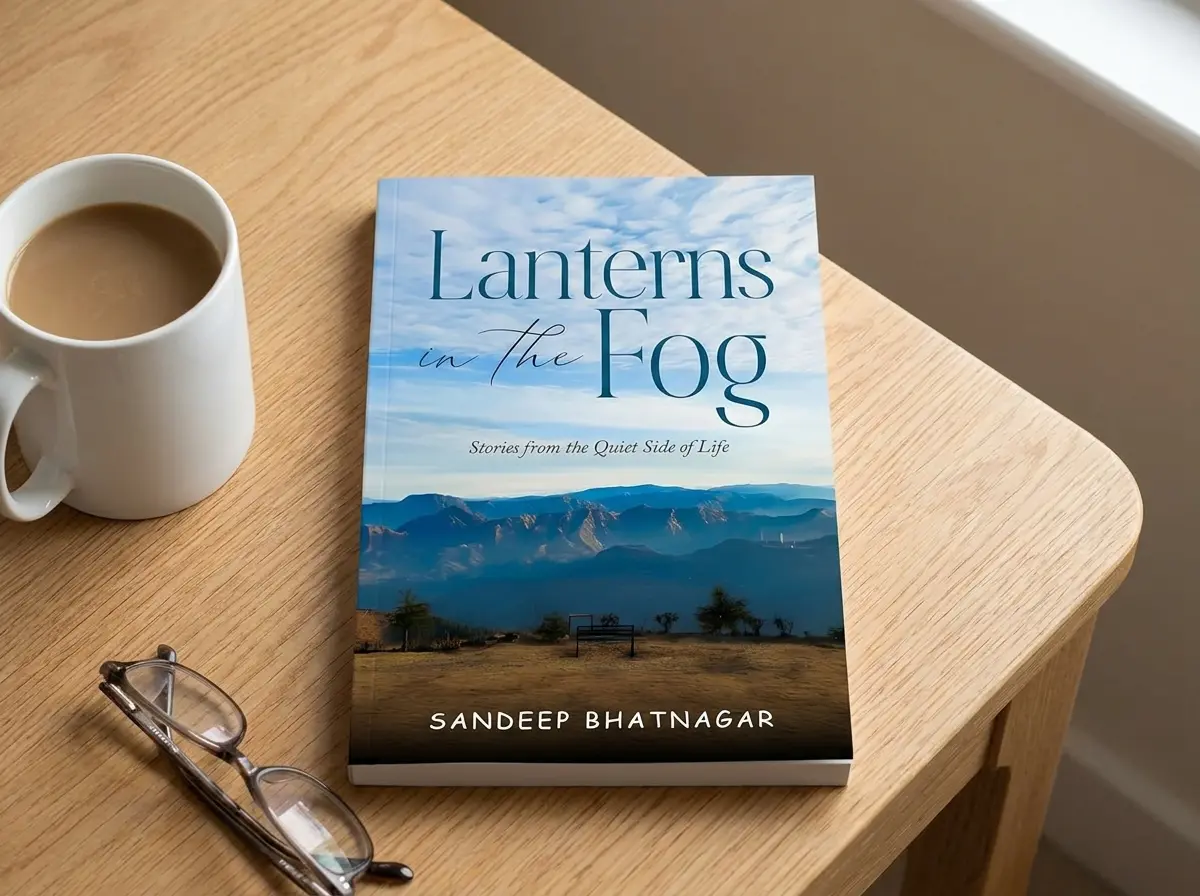
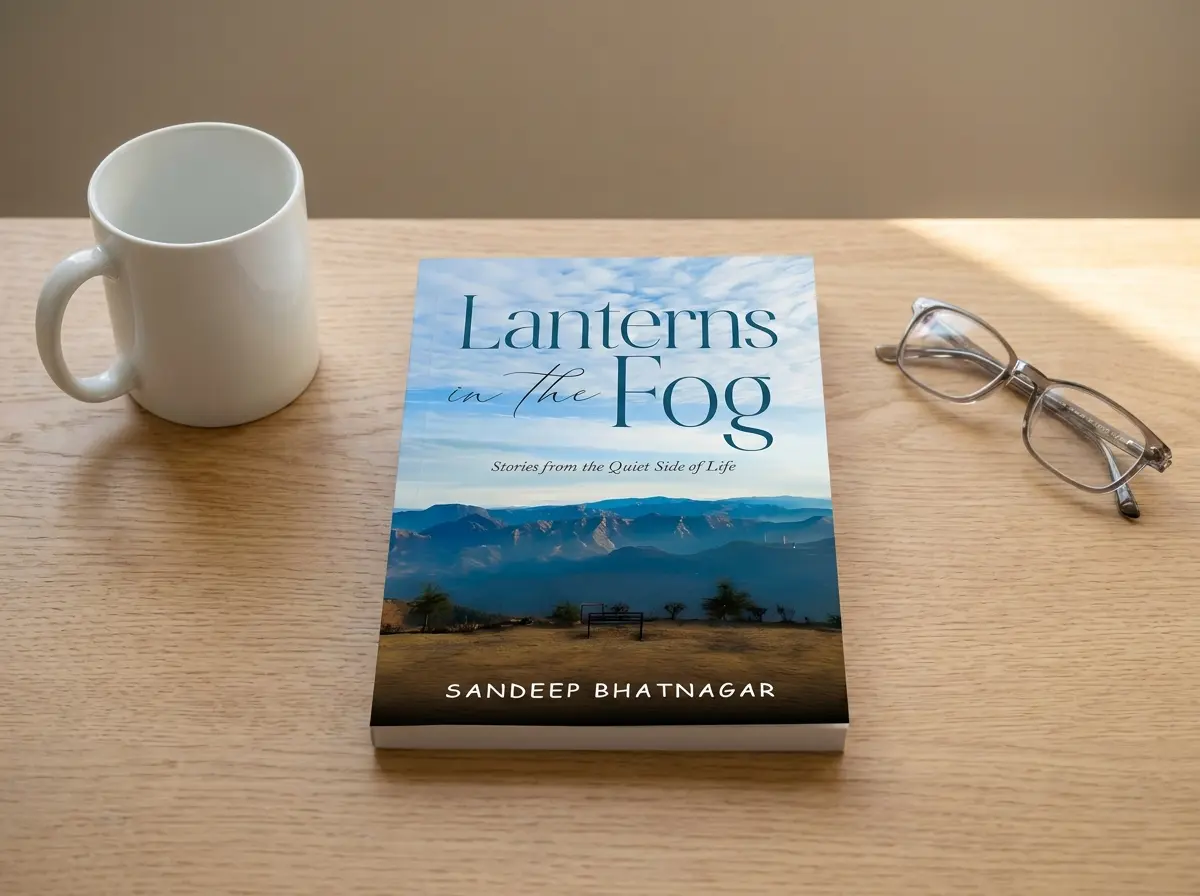
I’ve been reading and editing books for over fifteen years now, and every so often something lands on my desk that makes me sit back and go very still. Lanterns in the Fog: Stories from the Quiet Side of Life by Sandeep Bhatnagar did exactly that. I wasn’t expecting to feel this way about a short story collection, honestly. I picked it up thinking it would be pleasant, maybe a little sentimental, and I’d be done in a weekend. Instead I found myself rereading passages at odd hours, texting a line to a friend, and thinking about one particular retired gentleman and his five-rupee coin for days afterward.
This is the kind of book that doesn’t announce itself loudly. It arrives like a familiar neighbour, unhurried, slightly weathered, carrying stories that belong to everyone and no one in particular. In 2026, when we are all so deeply fatigued by noise, by spectacle, by content designed to overstimulate, Sandeep Bhatnagar’s collection feels almost radical in its restraint. No fireworks, as the blurb itself says. Only lanterns in the fog. That line, I think, is the most honest description a book has ever given of itself.
What Is This Book Actually About?
Lanterns in the Fog is a collection of ten short stories, each grounded in Indian life across different communities, generations, and moral landscapes. The stories range from the warmly comic to the genuinely heartbreaking, from a retired man’s unlikely friendship with a surly presswala in Chandigarh, to a ghostly story about a soldier who appears to care for his dying mother weeks after his own death at the border. There is a story about what it truly means to do good versus simply performing goodness. There is a fable about a curious sparrow named Garu who descends from the sky to study human society across three social classes. There are tales of soldiers, of widows, of pregnant employees in struggling startups, of young men who have to choose between their own curse and an innocent child’s life.
What holds these very different stories together is a consistent, deeply felt moral intelligence. Sandeep Bhatnagar, who writes with the gravity and warmth of someone who has spent considerable time observing people rather than performing for them, is interested in a single question across all ten pieces: what does it cost a human being to be good, and what does it feel like when they finally manage it? That’s a big question dressed in small clothes, and the book answers it differently each time.
What Stood Out to Me
I want to talk about the story called “5 Rupees Friend” because it stopped me completely. The narrator, a freshly retired man, becomes the reluctant laundry-runner of his household and develops a grudging transactional relationship with a stone-faced presswala who barely acknowledges his existence. Then one day the bill comes to Rs. 205, there’s a shortage of change, and the presswala extends a small credit. Three weeks later, the narrator returns with the five rupees. The presswala refuses it at first, says he doesn’t remember, and then finally accepts it with confusion bordering on suspicion. And then, the next visit, the man greets him with a full warm “Namaste Bauji!” and an actual smile. That’s it. That’s the whole story. And I found it quietly devastating in the best way, because I’ve seen this happen in real life, this moment when a small act of honesty unlocks a person who had no reason to trust the world. The writing here is funny and self-deprecating and precise. Bhatnagar describes the previous relationship as conducting exchanges “like spies after an exchange in Bond movies,” and I laughed out loud at that.
Then there is “The Twelfth Month,” which I think is the most structurally elegant piece in the collection. A pregnant employee at a struggling startup suspects she is about to be let go when the company hits financial trouble. The silence around her grows. Files are reassigned. Her nameplate disappears from the door. She comes in early on Monday to clear out her desk before anyone arrives. And then her founder calls her to a meeting where she discovers that the entire team, including the founder himself, has each agreed to work one month without pay so that she can receive her full maternity salary. The scene where the youngest member of the team stands up nervously and reads out the plan is one that I kept thinking about for days. Komal’s response, insisting that she take the twelfth unpaid month herself rather than be the recipient of everyone’s sacrifice, is the kind of fictional moment that feels more true than most things I read in the news. It hit differently than I expected.
The story called “Two Garlands” also got me. A new husband watches his bride garland two framed photographs every morning, and eventually asks her to explain. The story she tells, about two different men who each died saving her life with the exact same prayer on their lips, is told with a control and a patience that I genuinely admired from a craft perspective. The repetition of those final words, “Bhagwan, isse bacha le” and then years later “Rabba, esnu bacha le,” is a structural choice that works on you slowly, the way grief actually works. And then the story ends with a line that I think will stay with anyone who reads it: “Blood is not what makes a father. Sacrifice does.”
I should also mention “Koi Baat Nahin,” which is one of the funniest and most human pieces in the book. The narrator accidentally scratches a luxury car in a temple parking lot and then wages an internal war between his cowardice and his conscience, cataloguing every rationalisation he almost makes with gleeful self-awareness. “God’s CCTV works 24/7,” he tells himself. When he finally confesses to the car’s owner, the owner just says “Koi baat nahin” and walks away. That’s it. The narrator is shattered by grace. It’s a small story but it lands with real weight because it is written by someone who clearly knows exactly how petty and how redeemable ordinary people are.
The closing story, “The Sparrow Who Did Not Wear Shoes,” is a departure in form, a fable in which a curious sparrow named Garu is sent by his Aviary Republic to study human beings across three social classes: the ultra-rich penthouse dwellers, the struggling middle-class family, and the rural poor. It’s playful and satirical in a way that the other stories are not, and it functions as a kind of social commentary in bird form. The observation that the rich family “had everything except warmth” and communicated “through gentle nods and Alexa commands” is sharp and funny. The ending, where Garu concludes that “Humans are also birds who have forgotten how to fly,” is the kind of aphorism that works because it’s earned by everything that came before it. I’m not sure it’s the strongest story in the collection purely on its own, but as a closing piece it works well.
The Emotional Core
What I wasn’t prepared for was how much this book would make me think about my own relationship to small gestures. Not grand sacrifices, not dramatic moral stands, but small things: paying back a five-rupee debt when you could have let it go, owning a scratch in a parking lot before anyone sees you, asking about someone else’s dreams for once instead of talking about your own. The stories in Lanterns in the Fog don’t moralize, which is what makes them land. Bhatnagar is not lecturing you. He is showing you people at the exact moment they decide who they want to be, and then showing you what happens next. Sometimes what happens next is cosmic and unexplainable, as in “When Promises Transcend Death,” where a soldier who has already died appears to his ailing mother and cares for her until she passes peacefully. Sometimes what happens next is just a warm “Namaste Bauji” from a man who once ignored your existence.
I found myself tearing up a bit during “Account Closed,” which traces a debt of friendship and sacrifice across two generations of military families. There’s a moment where Rajbir, old and broken with guilt, sends his son Rajdeep off to rescue his dead friend’s daughter from a blizzard in Leh, and he says, “And if you don’t bring her back, don’t you come back at all.” That line. I had to put the book down for a minute. The way that story resolves, with the tricolour and the whispered “Account closed,” is not manipulative in the way war stories sometimes are. It feels earned.
A Few Honest Thoughts
I want to be fair here, because I think this book deserves honest engagement rather than empty praise. Some of the stories carry a quality of earnestness that occasionally tips into sentimentality, particularly in “The Weight of One Life” and “When Promises Transcend Death,” where the supernatural elements are presented with such certainty that the reader doesn’t quite get to sit in the ambiguity. I found myself wanting those stories to withhold just a little more, to let me wonder. Also, the writing is sometimes uneven in its register, moving between formal and colloquial in ways that feel slightly ungainly in a few passages. But I want to be clear: these are minor reservations about a collection that is doing something genuinely valuable.
One thing I want to mention separately, because it moved me considerably as someone who cares deeply about access to literature: this book has been released simultaneously in print, as a free digital download for persons with visual impairments, in Braille for visually impaired children, and in Indian Sign Language for the hearing impaired. The initial Braille copies and ISL videos have been gifted to special schools. That decision, taken by Sandeep Bhatnagar, is itself a kind of lantern in the fog. It speaks of a writer who actually means what his stories say about humanity. In 2026, when conversations about inclusive access to culture are still mostly theoretical, this is a concrete, meaningful act.
Who Should Read This Book?
If you are the kind of reader who finds long novels exhausting right now but still wants fiction that does real emotional work, Lanterns in the Fog is genuinely good for you. Each story can be read in a single sitting, some in fifteen minutes, and they are paced for that kind of reading. If you grew up in India or live in India, you will recognise these communities and these small moral dramas immediately. But I think international readers will find plenty here too, because the emotional territory, guilt, redemption, small kindness, complicated love, is entirely universal. If you are a fan of writers like R.K. Narayan or Ruskin Bond who worked in the space between the comic and the serious without ever being cynical, you will find Sandeep Bhatnagar a worthy addition to that tradition. He is not writing on that level yet, I want to be honest about that, but he is pointing in the right direction with genuine feeling and craft.
The book is available on Amazon, Flipkart, the White Falcon Publications website, Faqir Chand and Sons in Khan Market New Delhi, Capital Book Depot in Sector 17 Chandigarh, and Browser in Sector 8 Chandigarh. The digital edition is available for free download for persons with visual impairments.
Final Thoughts
I’m Priya Srivastava, Editor-in-Chief at Deified Publication, and I read a lot of books in a year. Many of them are technically accomplished. Fewer of them make me feel the way Lanterns in the Fog made me feel, which is something like the sensation of sitting with someone older and wiser who is not trying to impress you, only trying to tell you something true. Sandeep Bhatnagar writes about ordinary people with the conviction that their quiet struggles and small triumphs deserve to be witnessed, documented, and felt. In that conviction, he is absolutely right. This is a book worth your time, worth gifting, and worth sitting with.
FAQs
Is Lanterns in the Fog worth reading?
Yes, I think it is, particularly if you enjoy short fiction that carries genuine emotional weight without being heavy-handed. It’s the kind of book that earns its feelings rather than manufacturing them. The stories are rooted in recognisable Indian life but speak to universal human experiences of guilt, love, sacrifice, and redemption. Some stories are stronger than others, as is true of any collection, but the best of them, “5 Rupees Friend,” “The Twelfth Month,” “Two Garlands,” and “Account Closed,” are genuinely memorable.
Who should read Lanterns in the Fog by Sandeep Bhatnagar?
Readers who enjoy Indian short fiction, fans of writers like R.K. Narayan and Ruskin Bond, anyone who wants stories about ordinary moral life rather than grand dramatic plots. It’s also ideal for readers who find themselves short on time or attention but still want fiction that matters. Each story is self-contained and readable in a single sitting. The book has also been made available in Braille and Indian Sign Language, and as a free digital download for visually impaired readers, which makes it accessible to a very wide audience.
What is Lanterns in the Fog about in simple terms?
It’s a collection of ten short stories about ordinary Indian people facing quiet moral choices: whether to pay back a small debt when you could get away with not doing so, whether to do good for the right reasons or the wrong ones, how sacrifice and love persist beyond death, what it means to truly belong to a community. The stories span social classes, generations, and settings from a Chandigarh neighbourhood to a Leh blizzard to a sparrow’s eye view of human society. Together they form a portrait of what it means to be human in India, or perhaps just anywhere.
How does Lanterns in the Fog compare to other Indian short story collections?
It sits in the tradition of Indian writing that takes the interior lives of ordinary people seriously without condescending to them or sentimentalising them excessively. Readers who enjoyed Sudha Murty’s collections will find familiar warmth here, though Bhatnagar’s humour is sharper and his social commentary more layered. The collection is uneven, as debut collections tend to be, but its best stories stand alongside anything being written in this space in India right now.

With over 11 years of experience in the publishing industry, Priya Srivastava has become a trusted guide for hundreds of authors navigating the challenging path from manuscript to marketplace. As Editor-in-Chief of Deified Publications, she combines the precision of a publishing professional with the empathy of a mentor who truly understands the fears, hopes, and dreams of both first-time and seasoned writers.