
Rating:
⭐⭐⭐⭐1/2 (4.5 out of 5)
I closed Sikkim in my Love Story and sat there for a while. Not in a dramatic way, just… thinking. You know that feeling when a book doesn’t give you a clean emotional exit? It leaves a few threads loose inside you.
In my years at Deified Publication, I’ve read all kinds of books about love. Some are loud, some try very hard to impress. This one felt different. It doesn’t shout. It just… shows people as they are. Messy, loving, flawed, sometimes selfish, sometimes incredibly tender.
And I think that’s what stayed with me the most. Not one big story, but many small lives stitched together.
What the Book Is About
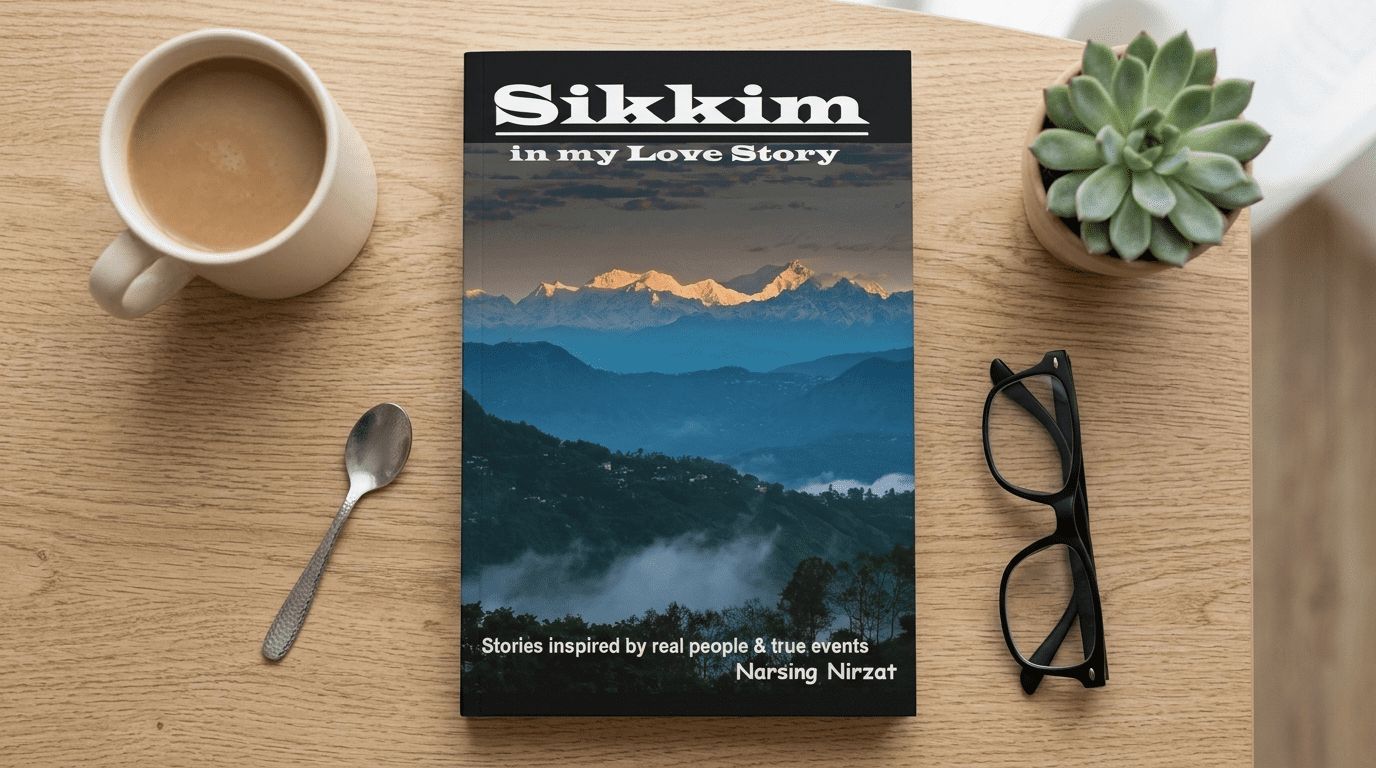
Sikkim in my Love Story by Narsing Nirzat is not a single continuous novel. It is a collection of interconnected stories, many of which feel rooted in real incidents and real people. The subtitle says these are inspired by true events, and honestly, as you read, that starts to feel very believable.
The book moves between two very different worlds. One is older, almost traditional Sikkim, where customs, community decisions, and survival shape relationships. The other is a more modern setting with characters like Reshamda, Sayden, and Priyanka, where life feels freer but also more unstable.
There’s one story involving Dasang, Phoory, and Khitoo that stayed with me. It revolves around love, power, and a deeply uncomfortable arrangement that comes out of cultural norms and personal greed. At first, you might judge the situation quickly. I did. But as the story unfolds, you begin to understand how tradition and circumstance can push people into choices that feel both wrong and inevitable.
Then there’s the modern phase of life narrative set around Gangtok, where friendships, attraction, alcohol, and loneliness blend into something very human. It doesn’t try to moralize. It just shows how people drift, connect, and sometimes lose themselves.
The stories also carry a strong sense of place. Gangtok, Lachung, village life, monasteries, old markets, even political tensions from the 1970s. These are not just backdrops. They shape everything.
What Stood Out to Me
I think what impressed me most in this Sikkim in my Love Story book review is how grounded everything feels.
Narsing Nirzat does not try to make his characters heroic. In fact, many of them are deeply flawed. Dasang, for example, is not someone you immediately like. He is controlling, driven by desire, and at times quite harsh. But then there are moments where he softens, where you see hesitation, fear, even a kind of vulnerability.
Phoory is another character that lingered with me. There is a line where she speaks about being “sold” through a cultural exchange, and you feel the quiet pain behind it. She adapts, survives, even finds some form of emotional balance, but you can sense that something inside her has been permanently altered.
And Khitoo. His journey from helplessness to pleading for his family back is honestly heartbreaking. There’s a scene where he goes down on his knees asking for his wife and son. I paused there. I’ve seen that kind of desperation in real life. Not in the same context, but the emotion felt very real.
From a craft perspective, the structure is interesting. Since this is a collection, the pacing shifts from story to story. Some parts move quickly, almost like memories being recalled. Others slow down and linger on emotion. It’s not perfectly even, but it feels natural, like someone narrating lived experiences rather than constructing a polished plot.
Another thing I noticed is how the author blends history into the narrative. The political unrest in 1973 and 1974, the mention of monarchy, the shift toward democracy, even older governance systems like Dzumsa. These are not heavy info dumps. They come in quietly, through the lives of characters.
As someone who reads a lot of Indian regional literature, I could sense authenticity here. The cultural details, the social norms, even the uncomfortable parts like polyandry or shared household structures, they don’t feel inserted for shock value. They feel lived.
The Emotional Core
If I had to describe the emotional core of Sikkim in my Love Story, I would say it’s about how people deal with love when life is not simple.
This is not the kind of book where love solves everything. Sometimes love complicates things. Sometimes it becomes a burden. Sometimes it’s just… not enough.
There’s also a strong undercurrent of loss. Not just loss of people, but loss of time, of places, of ways of living. The descriptions of old Gangtok, the mention of places that no longer exist, it made me think about how quickly everything changes.
The modern stories carry a different kind of emptiness. Characters drinking, joking, flirting, but you can feel a kind of restlessness underneath. Like they’re trying to fill something but not really succeeding.
And then there’s that ending note with Reshamda. I won’t spoil it fully, but it left me with a heavy feeling. Not dramatic. Just… quiet sadness. The kind that doesn’t go away quickly.
Honestly, some parts hit harder than I expected.
Who This Book Is For
If you’re looking for a neatly structured romantic novel, this might not be for you.
But if you like stories that feel real, slightly uneven, sometimes uncomfortable, and deeply human, then I think you should read Sikkim in my Love Story.
This book will appeal to:
- Readers who enjoy regional Indian stories with cultural depth
- People who like character driven narratives rather than plot heavy ones
- Anyone curious about Sikkim’s social and historical layers
- Readers who don’t mind moral ambiguity
At the same time, I’ll say this honestly. Some readers might find parts of the book slow or even a bit unsettling. Especially the traditional practices and the way relationships are handled. It’s not always easy to agree with what’s happening.
But maybe that’s the point.
Final Thoughts
As Editor in Chief at Deified Publication, I often ask myself one simple question after finishing a book. Did it feel honest?
With Sikkim in my Love Story, I think the answer is yes.
It’s not perfect. The transitions between stories can feel abrupt at times. Some sections could have been developed a bit more. And if you prefer a strong central plot, you might feel slightly disconnected.
But there is sincerity here. And that matters more than polish sometimes.
Narsing Nirzat has written something that feels close to lived experience. Not idealized, not overly dramatic, just real people navigating love, tradition, change, and loss.
I kept thinking about these characters even after I finished reading. And honestly, that’s usually a good sign.
FAQ
Is Sikkim in my Love Story worth reading?
I think yes, especially if you enjoy realistic stories rooted in culture and human relationships. It may not be for everyone, but it stays with you.
What is Sikkim in my Love Story about?
It is a collection of stories inspired by real characters and events, set across different timelines in Sikkim, focusing on love, society, and personal struggles.
Who should read Sikkim in my Love Story?
Readers who enjoy character driven stories, Indian regional narratives, and emotionally grounded writing will likely appreciate it.
Is this book based on true events?
The author indicates that many stories are inspired by real people and situations, which adds to the authenticity of the narrative.

With over 11 years of experience in the publishing industry, Priya Srivastava has become a trusted guide for hundreds of authors navigating the challenging path from manuscript to marketplace. As Editor-in-Chief of Deified Publications, she combines the precision of a publishing professional with the empathy of a mentor who truly understands the fears, hopes, and dreams of both first-time and seasoned writers.