
Rating:
⭐⭐⭐⭐ (4.2 out of 5)
A Collage of Knowledge
Some books are meant to tell a story. Some are meant to answer a question. And then there are books like Factbook.com (Vol. 6): A Collage of Knowledge by Manoj Sinha, which feel like opening an old cupboard full of curiosities where every shelf surprises you with something different.
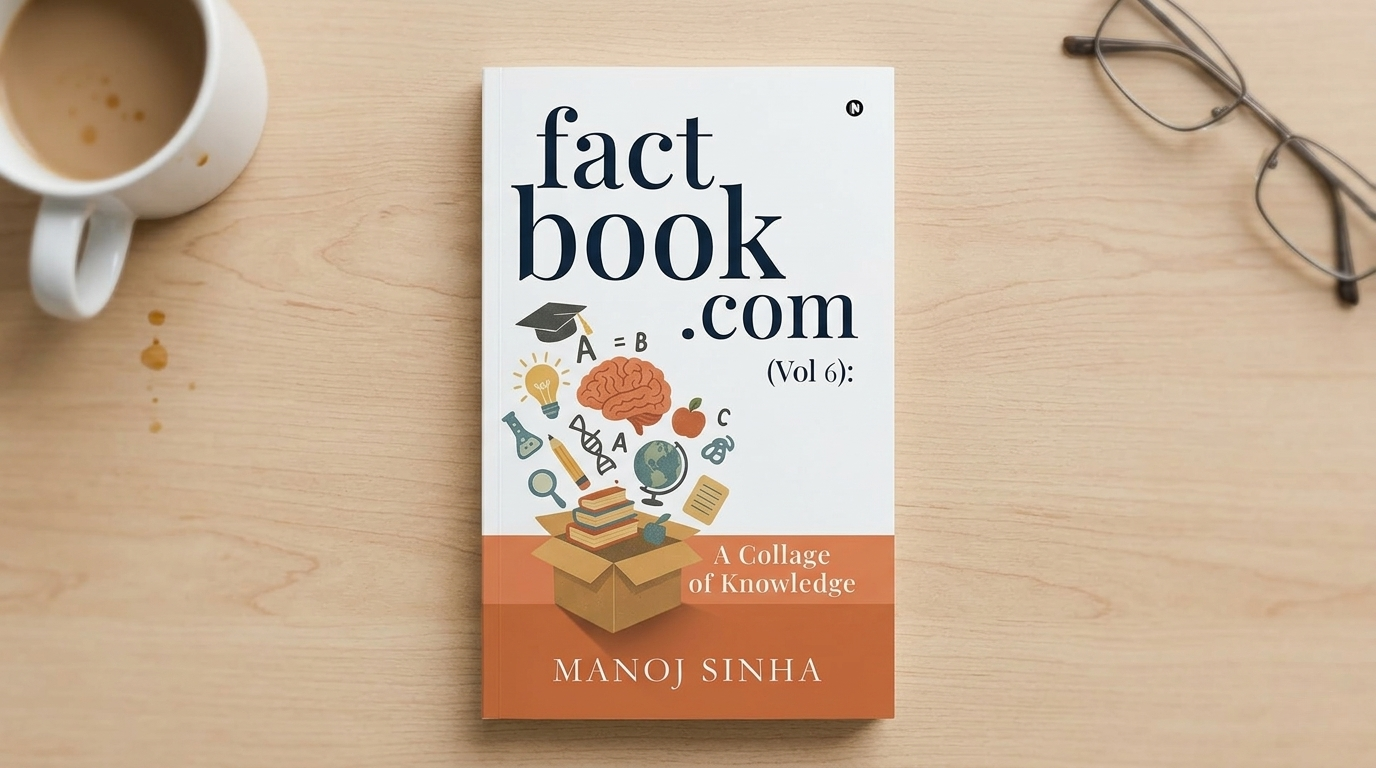
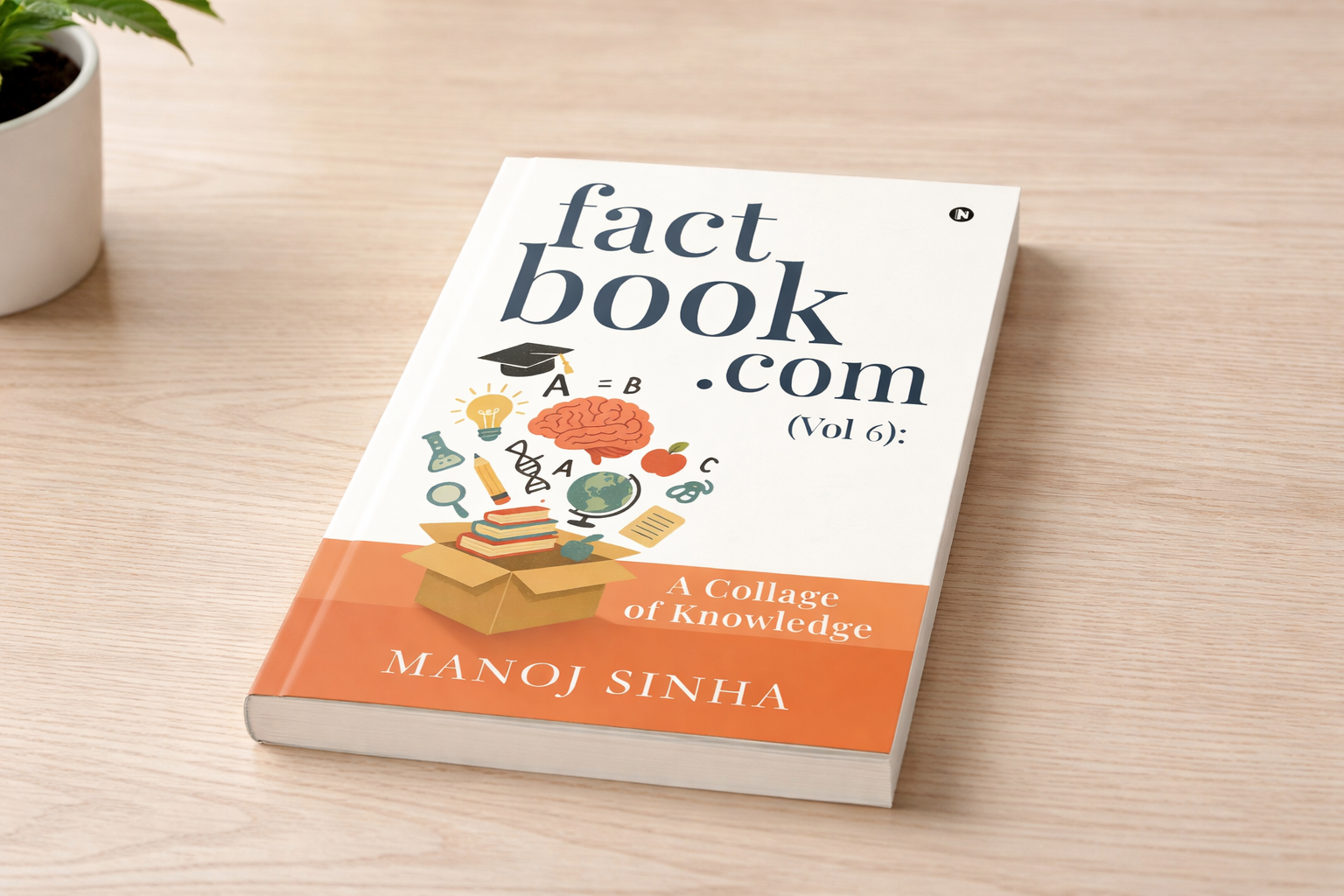
That was my first feeling looking at this book, even from the cover itself. There’s something wonderfully inviting about the open box spilling out books, a globe, a brain, equations, a DNA strand, stars, and science symbols. Before you even begin reading, the visual language already tells you what this book wants to be: not a linear narrative, but a gathering of ideas.
In my years as Editor in Chief at Deified Publication, I’ve read enough knowledge based books to know when a concept is merely informational and when it actually sparks wonder. What immediately stood out here is that Manoj Sinha does not seem interested in facts as dry data. He seems interested in how facts connect memory, history, science, news, and human curiosity.
And honestly, that made me smile. It reminded me of childhood evenings spent flipping through encyclopedias without any plan, moving from planets to pyramids to forgotten kings in a single sitting.
That same spirit lives inside this volume.
What the Book Is About
At heart, Factbook.com (Vol. 6): A Collage of Knowledge feels exactly like its subtitle promises: a collage.
The book gathers together prominent news stories from the previous year and lets readers revisit them with the context and narratives attached. I really like this idea because news often disappears too fast. We read headlines, react, and move on. But books like this preserve the mood of a year.
In 2026, that feels especially valuable because our attention spans are so fragmented. A curated knowledge volume gives permanence to what would otherwise become digital dust.
But the book does not stop at news recap.
What I found especially interesting from the concept is how it jumps from current affairs into science and civilization. One chapter looks at the body’s internal clock, which instantly makes the subject feel personal. Every reader has felt their sleep cycle shift, their body react to time zones, stress, sunrise, or routine. Pairing that with the invention of mechanical clocks creates a lovely contrast between biology and human innovation.
Then the book widens its scope even more.
There’s a special chapter on the world above the earth, which I imagine readers of all ages will enjoy because space still has that ability to make us pause and feel small in the best way.
And then it moves again into stars, the Indus Valley Civilization, and Agra’s historical past.
That breadth is what defines the reading experience here.
This is not a single topic nonfiction book. It is built for readers who enjoy intellectual variety.
What Stood Out to Me
The biggest strength of Factbook.com Vol. 6 is its sense of movement between disciplines.
A lot of fact based books can feel compartmentalized. Science in one corner, history in another, current affairs somewhere else. But the very idea of calling it a collage suggests that Manoj Sinha wants readers to experience knowledge as interconnected.
I genuinely appreciate that.
The cover reinforces this beautifully. The graduation cap, the DNA strand, the brain, the globe, the equations, the books rising from a box, all of it creates the feeling that learning is something alive and layered.
I also think the decision to revisit prominent news from the previous year adds emotional texture. Facts become attached to memory. You are not just learning what happened, you are remembering where you were when it happened.
That makes information more human.
The chapter on internal clocks especially stood out to me as a concept. I’ve always loved books that connect everyday bodily experience with larger scientific ideas. Something as ordinary as waking up before your alarm suddenly opens into biology, neuroscience, and the history of how humans tried to measure time outside themselves.
That’s the kind of transition that keeps a reader engaged.
The historical sections on the Indus Valley Civilization and Agra also seem particularly promising because they ground knowledge in place. I think readers often connect more deeply when history is attached to physical spaces they know, have visited, or dream of visiting.
The Emotional Core
This may sound unusual for a fact based book review, but I think the emotional center here is curiosity itself.
There’s a childlike pleasure in books that allow you to wander from one idea to another.
I felt that strongly even from the structure suggested by the blurb and cover.
One moment you are in the present, revisiting last year’s news. The next, you are inside the rhythms of the human body. Then suddenly you are above the earth looking at stars. After that, you are in the ruins of the Indus Valley or tracing the layered past of Agra.
That movement creates a kind of intellectual joy.
It reminded me of school library periods where I would pick one book and somehow end up reading five because one idea kept leading to another.
I think Manoj Sinha understands that learning is often most memorable when it feels associative rather than rigid.
The emotional satisfaction comes from that freedom.
At the same time, I should be honest: books built as collages can sometimes feel less immersive than single theme nonfiction. Some readers may wish for deeper continuity between chapters. If someone prefers long form sustained argument or a tightly focused subject, this might feel a little scattered.
But for the right reader, that very variety is the charm.
Who This Book Is For
I think Factbook.com (Vol. 6): A Collage of Knowledge is perfect for readers who love browsing knowledge rather than consuming it in a straight line.
Students will probably enjoy it because it moves across subjects without feeling textbook like.
General readers who enjoy quiz books, encyclopedic reading, science magazines, and history snippets will also find a lot to love here.
I can also see parents gifting this to teenagers who are naturally curious but easily bored by conventional nonfiction.
The mix of news, science, space, ancient civilization, and historical cities makes it accessible across age groups.
That said, if you are looking for a deep dive into only astronomy, only history, or only science, this might not fully satisfy that craving.
This book seems designed more for breadth than singular depth.
And honestly, that’s okay. Not every book needs to do one thing.
Final Thoughts
As Priya Srivastava, and as someone who has spent years reading books that try to make knowledge approachable, I found Factbook.com (Vol. 6): A Collage of Knowledge genuinely refreshing in concept.
What I like most is its refusal to limit curiosity.
It lets news sit beside biology, science beside civilization, stars beside city history.
That openness feels deeply human because that is how real curiosity works. We rarely think in neat categories.
In 2026, when information is endless but attention is fractured, a book like this offers something meaningful: a way to reconnect scattered facts into a memorable reading experience.
I think this is the kind of book that sits on your desk, gets opened at random, and still teaches you something new every time.
FAQ
Is Factbook.com (Vol. 6) worth reading?
Yes, especially if you enjoy books that mix current affairs, science, history, and space in one readable volume.
Who should read this book?
Students, quiz lovers, curious general readers, and anyone who likes knowledge books with variety.
Is it good for young readers?
I think so. The broad topic range makes it engaging for teens and young adults.
Does the book focus only on news?
No, it also covers science, body clocks, stars, Indus Valley sites, and Agra’s history.

With over 11 years of experience in the publishing industry, Priya Srivastava has become a trusted guide for hundreds of authors navigating the challenging path from manuscript to marketplace. As Editor-in-Chief of Deified Publications, she combines the precision of a publishing professional with the empathy of a mentor who truly understands the fears, hopes, and dreams of both first-time and seasoned writers.