
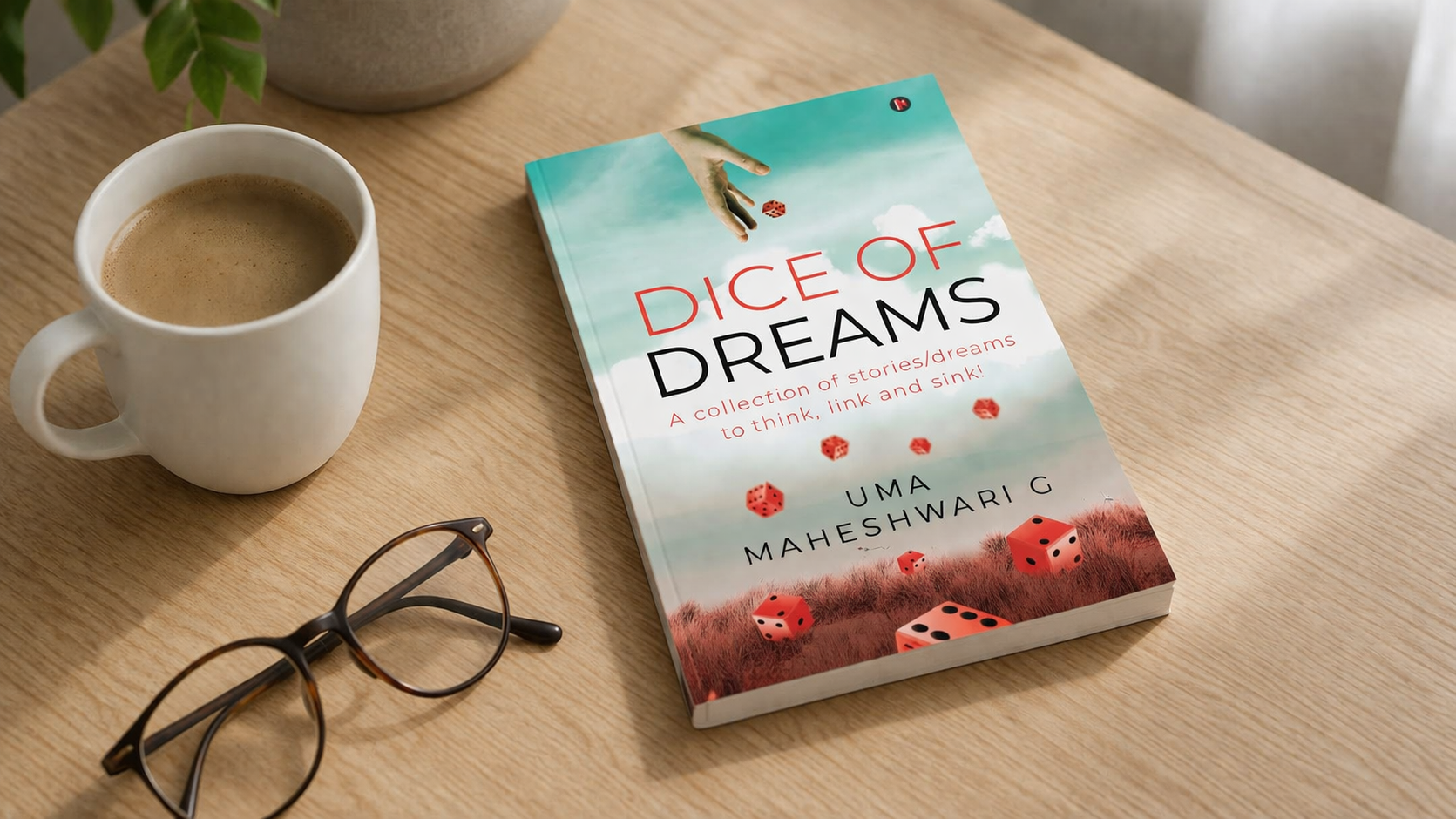
Rating:
⭐⭐⭐⭐ (4.5 out of 5)
I’ll be honest, when I first picked up Dice of Dreams, I thought I knew what I was getting into. A collection of stories. Different characters. Different situations. Something you read one piece at a time and move on.
But somewhere between Vinay standing on that balcony counting down his life… and Keerthi painting emotions she never fully speaks… I paused.
Not because something shocking happened.
But because something felt too real.
In my years of reading and reviewing books, I’ve come across many story collections. Some are entertaining. Some are clever. But every once in a while, you find one that doesn’t just tell stories, it quietly asks you questions you were avoiding.
This one does that.
And it doesn’t rush you.
What the Book Is About? not just stories, but fragments of people
At its core, Dice of Dreams by Uma Maheshwari G is a collection of short stories, yes. The contents clearly show different titles, different plots, different settings. You move from love to loss, from personal ambition to inner conflict, from city life to emotional isolation.
But calling it just a “collection” still feels incomplete.
Because the stories are not random. They are connected by something subtle. Not plot, but emotion.
There is this recurring idea of identity. Who we think we are versus who we actually become.
Take the story Love at Last Sight. On the surface, it looks like a love story between Vinay and Keerthi. But as it unfolds, it becomes something else. You see a man who has achieved success, built a company, fought through life, yet somehow feels emotionally disconnected. And then comes Keerthi, not as a typical romantic interest, but as someone who reflects him back to himself.
Her paintings are not just art. They are interpretation. Almost like she understands him in ways he doesn’t understand himself.
And then there’s that birthday scene. Simple, almost quiet. A cake. Candles. Tears.
Honestly, I wasn’t expecting that moment to hit the way it did.
Then there are other stories like A Story to be Deleted, Battles Within, The Game of Life. Each one shifts tone, but the underlying thread remains. People trying to make sense of their choices. People carrying something unspoken.
Also, I liked how the author includes poems before stories. At first, I wasn’t sure why. But later, when I went back and reread them after finishing the story, they felt like keys. Small hints you don’t fully understand until later.
That was a nice touch.
What Stood Out to Me? the small details that linger
There are a few things that stayed with me even after I closed the book.
1. The emotional restraint
This book doesn’t shout. It doesn’t try to impress you with dramatic twists or heavy dialogue. Instead, it stays simple. Almost too simple at times. But that simplicity allows emotions to come through naturally.
Like the way Vinay reacts to Keerthi’s paintings. He doesn’t deliver big speeches. He just… feels overwhelmed. Numb. Silent. And somehow, that felt more honest than anything else.
2. The idea of connection without clarity
One thing I kept noticing was how relationships in this book are not clearly defined. Vinay and Keerthi, for example. It is not exactly friendship. Not exactly love. Something in between.
And I think many people will relate to that. Those relationships in life that don’t fit into neat categories.
3. The real-life texture
The street selling sequence surprised me. Two people stepping out of their comfort zones, trying to sell coconut drinks, struggling, sweating, learning. It felt grounded.
It reminded me of how life teaches lessons in unexpected ways. Not in boardrooms or classrooms, but in random, uncomfortable situations.
4. The pacing
Now, this is where I’ll be a little honest. Some parts felt slightly stretched. Not in a bad way, but there are moments where the narrative slows down a lot. Especially in introspective sections.
For some readers, that might feel a bit heavy. But for others, it might actually be the point.
I personally didn’t mind it, but I did notice it.
The Emotional Core – what stays after the last page
If I had to describe what this book leaves you with, I’d say this.
A kind of lingering quiet.
Not sadness exactly. Not happiness either. Something in between.
There is a strong undercurrent of loneliness in many stories. Even when characters are together, there is a distance. A gap that is never fully closed.
And then there are moments of unexpected warmth. Like the elderly couple who help Vinay and Keerthi. Or the simple act of someone remembering a birthday after years.
These moments don’t feel grand. But they matter.
Also, the questions the book raises stay with you.
What does success actually mean?
Why do we keep chasing things that don’t make us happy?
How often do we truly understand the people in front of us?
In 2026, when everything feels fast, distracted, and constantly noisy, a book like this feels… different.
It doesn’t give answers.
It just makes you sit with the questions.
And honestly, I think that’s more valuable.
Who This Book Is For? and who it may not be
I think this book will connect deeply with a certain kind of reader.
If you enjoy stories that focus more on emotions than plot, you’ll likely appreciate this.
If you’ve ever felt a little out of place in your own life, or questioned your path, or struggled to understand your relationships, there’s something here for you.
Also, if you like reading something in small parts, one story at a time, this works well. You don’t have to rush through it.
But I’ll also say this.
If you’re looking for fast-paced storytelling, strong plot twists, or clear resolutions, this might not fully satisfy you. The book leans more towards reflection than action.
And that’s okay. It knows what it is.
Final Thoughts – what I’ll remember
I don’t think Dice of Dreams is trying to impress anyone.
It feels like a very personal book. Almost like the author sat down and wrote what she had been observing, feeling, questioning for a long time.
And that honesty shows.
There are moments where the writing could have been tighter. A few places where editing might have sharpened the impact. But those are small things.
What matters more is how the book made me pause.
And in a world where most things just pass by quickly, that pause is rare.
As someone who has spent years around books, manuscripts, and stories, I can say this with certainty.
Some books entertain you.
Some books impress you.
And then there are books like this one.
They sit with you quietly. And days later, you find yourself thinking about a scene, a line, a feeling.
This is one of those.
FAQ
Is Dice of Dreams worth reading?
Yes, especially if you enjoy reflective, emotional storytelling. It is not fast or flashy, but it stays with you.
What is Dice of Dreams about?
It is a collection of stories connected by themes of identity, relationships, success, and inner conflict. Each story explores different human experiences.
Who should read Dice of Dreams?
Readers who like introspective fiction, character-driven narratives, and stories that focus on emotions rather than plot.
Is Dice of Dreams based on real life?
Some stories are inspired by real-life incidents, while others are fictional. The book even includes a reader challenge to guess which is which.

With over 11 years of experience in the publishing industry, Priya Srivastava has become a trusted guide for hundreds of authors navigating the challenging path from manuscript to marketplace. As Editor-in-Chief of Deified Publications, she combines the precision of a publishing professional with the empathy of a mentor who truly understands the fears, hopes, and dreams of both first-time and seasoned writers.