
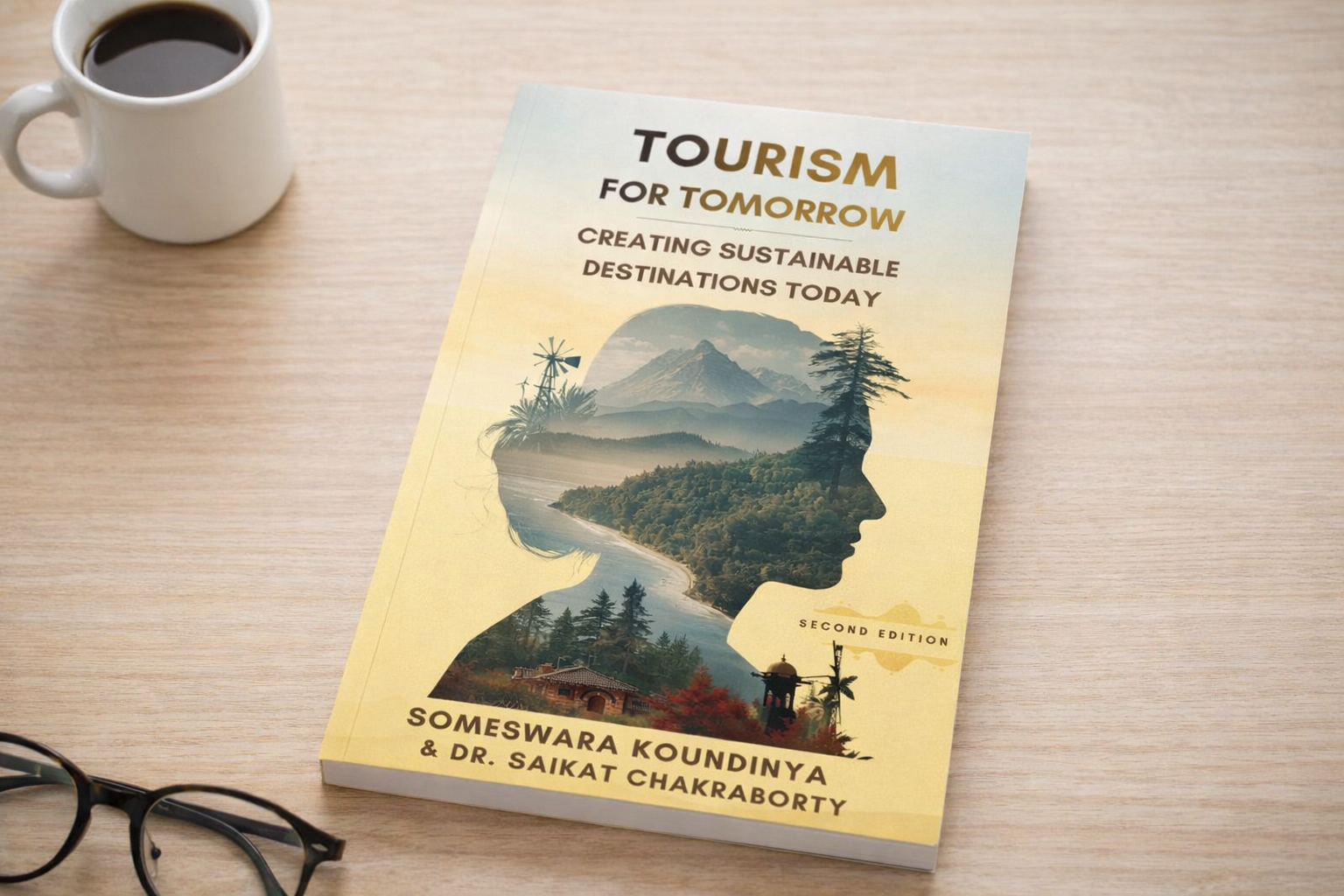
Rating:
⭐⭐⭐⭐ (4.3 out of 5)
I have been reading books for a long time now. More than fifteen years of reviewing novels, essays, and non fiction as Editor in Chief at Deified Publication. And I will admit something honestly. Most books about sustainability or policy tend to sound very technical. Important, yes. But often distant from everyday life.
But every now and then a book manages to do something different. It takes a subject that feels academic and suddenly makes it personal.
While reading Tourism for Tomorrow: Creating Sustainable Destinations Today by Someswara Koundinya and Dr. Saikat Chakraborty, I kept thinking about one simple moment from my own life. A few years ago I visited a beautiful hill town that locals told me had changed completely. The mountains were still there, the rivers still flowed, but something invisible had shifted. Too many hotels, too many cars, too many visitors arriving faster than the place could breathe.
Standing there I remember wondering something quietly to myself.
When does tourism stop being celebration and start becoming pressure?
This book wrestles with exactly that question.
And it does so with surprising clarity and thoughtfulness.
What the Book Is About
At its heart, Tourism for Tomorrow is about the fragile relationship between travelers and the places they visit.
The book begins by stepping far back in time and asking a deceptively simple question. Why do human beings travel at all?
The early chapters look at travel not as leisure but as survival. Humans migrated across continents thousands of years ago, not because of curiosity but necessity. Later journeys like the Silk Road transformed not just trade but culture, belief systems, and knowledge exchange.
The authors slowly move forward through history. Exploration, pilgrimage routes, the Grand Tour in Europe, the Industrial Revolution, and finally the explosion of mass tourism in the twentieth century.
At first, travel feels like liberation. Railways shrink distance. Steamships connect continents. Airplanes open the skies. Holidays become accessible to ordinary families.
But scale changes everything.
Destinations that once welcomed travelers slowly begin to struggle under the weight of too many visitors. Beaches grow crowded. Historic towns transform into performance spaces designed mainly for tourists. Local traditions reshape themselves to match visitor expectations.
The book describes tourism not simply as movement but as pressure.
One metaphor from the early sections stayed in my mind for days. The authors compare a destination to a glass filled with water. Each visitor is another drop. At first the system absorbs it easily. New cafés open. Jobs appear. Energy flows into the place.
Then the rhythm changes.
More drops arrive than the system can comfortably hold. The surface tension grows. The glass still looks stable from the outside, but inside the pressure builds. Eventually one final drop causes the spill.
The powerful point the authors make is this. Overflow does not happen suddenly. It is the result of a long chain of invisible decisions.
That metaphor alone captures the entire philosophy of the book.
What Stood Out to Me
One thing I genuinely appreciated about Tourism for Tomorrow is the way it combines storytelling with systems thinking.
Many sustainability books focus purely on statistics. Others rely heavily on emotional appeals. This one attempts something more balanced.
For instance, the authors introduce structured frameworks like the ECOSAFE model and the Sustainable Infrastructure Multiplier Effect model. These are essentially tools for understanding how tourism destinations grow and how they maintain balance.
But the explanations never feel overly abstract because they are constantly tied to real places.
The table of contents reveals a fascinating global range of case studies. Bhutan, Kerala, Malaysia, Nepal, Costa Rica, Assam, Kenya, Singapore, Thailand, Venice, Vietnam, Scotland, Slovenia and many others appear throughout the chapters.
Each destination represents a different challenge. Some struggle with overcrowding. Others experiment with community led tourism. Some are learning how digital platforms reshape traveler behavior.
Reading through these sections, I felt like the authors were not trying to preach one single solution. Instead they were mapping patterns.
What works in Bhutan may not work in Venice. What protects the Sundarbans may not apply to urban Singapore.
That nuance matters.
Another detail that caught my attention is how the book talks about social media and modern travel culture. Influencers, hashtags, and travel platforms have changed how people choose destinations. Beautiful waterfalls, sacred rituals, and remote forests suddenly become global attractions overnight.
And once a place goes viral online, the pressure on local ecosystems can rise dramatically.
That observation felt very accurate to me. I have seen small villages become crowded tourist hotspots in just a few years.
The Emotional Core
At first glance, Tourism for Tomorrow might seem like a policy book. But the emotional thread running through it is actually about belonging.
Places are not empty landscapes waiting for visitors. They are homes. Communities. Histories that evolved slowly over generations.
When tourism grows too fast, something delicate can break.
Locals may feel pushed out of neighborhoods where prices suddenly rise. Cultural traditions sometimes transform into performances staged for tourists rather than living practices.
At the same time travelers themselves begin to feel something is missing. Destinations become crowded, commercial, and strangely similar to one another.
One passage in the early chapters struck me deeply. The authors describe how global tourism can create identical experiences across continents. The same cafés, the same photo spots, the same hashtags repeated everywhere.
Convenience wins. Authenticity slowly slips away.
That idea stayed with me.
Travel is supposed to reveal differences in the world. But if every destination begins to look the same, what exactly are we discovering?
The book argues that sustainability is not about stopping travel. It is about managing pressure so that both visitors and communities continue to belong.
That perspective feels both practical and hopeful.
Who This Book Is For
I think Tourism for Tomorrow by Someswara Koundinya and Dr. Saikat Chakraborty will appeal to several different types of readers.
Students studying tourism management or sustainability will likely find the frameworks and case studies extremely valuable. The structure of the book suggests it could easily become a reference text in universities.
Policy makers and destination planners might also benefit from the models discussed here. The ECOSAFE framework, in particular, seems designed to help cities and regions measure tourism capacity more intelligently.
But interestingly, the book is not limited to professionals.
Anyone who loves travel might find themselves reflecting on their own role in the tourism system. I certainly did while reading.
Because the truth is this. Every traveler contributes to the rhythm of a destination. Sometimes gently, sometimes heavily.
Understanding that responsibility changes how we move through the world.
Final Thoughts
After finishing Tourism for Tomorrow: Creating Sustainable Destinations Today, I kept returning to the glass of water metaphor.
It is simple but powerful.
Destinations are living systems. They contain communities, landscapes, traditions, and memories. Tourism adds energy and opportunity, but also pressure.
If the flow is balanced, the system thrives. If it becomes overwhelming, displacement begins long before anyone notices the spill.
What I appreciate about this book is that it refuses to frame tourism as purely good or purely harmful. Instead it treats it as a complex relationship that must be carefully managed.
In 2026, when global travel continues to expand faster than ever, this conversation feels urgent.
As someone who has spent years reading and reviewing books about culture and society, I found this one particularly thoughtful. It does not shout its message. Instead it lays out patterns, examples, and frameworks that slowly reshape how you think about travel itself.
And honestly, that is the best kind of nonfiction.
The kind that quietly changes the way you see the world.

With over 11 years of experience in the publishing industry, Priya Srivastava has become a trusted guide for hundreds of authors navigating the challenging path from manuscript to marketplace. As Editor-in-Chief of Deified Publications, she combines the precision of a publishing professional with the empathy of a mentor who truly understands the fears, hopes, and dreams of both first-time and seasoned writers.