

Rating:
⭐⭐⭐⭐ (4.2 out of 5)
I have always had a soft corner for war stories that are not just about battles, but about people. The ones where history is not a chapter in a textbook but something that bleeds into everyday life. When I picked up The Story of a Doctor during WWII: Prisoner of War in Germany by Anirban De, I expected a war memoir. What I found was something larger, sometimes messy, sometimes overwhelming, but deeply sincere.
As Priya Srivastava, and as someone who has been reading and reviewing books for over fifteen years at Deified Publication, I have seen many historical novels and war narratives. Some focus only on strategy. Some drown in romance. This one tries to hold both in the same breath. And honestly, that ambition moved me.
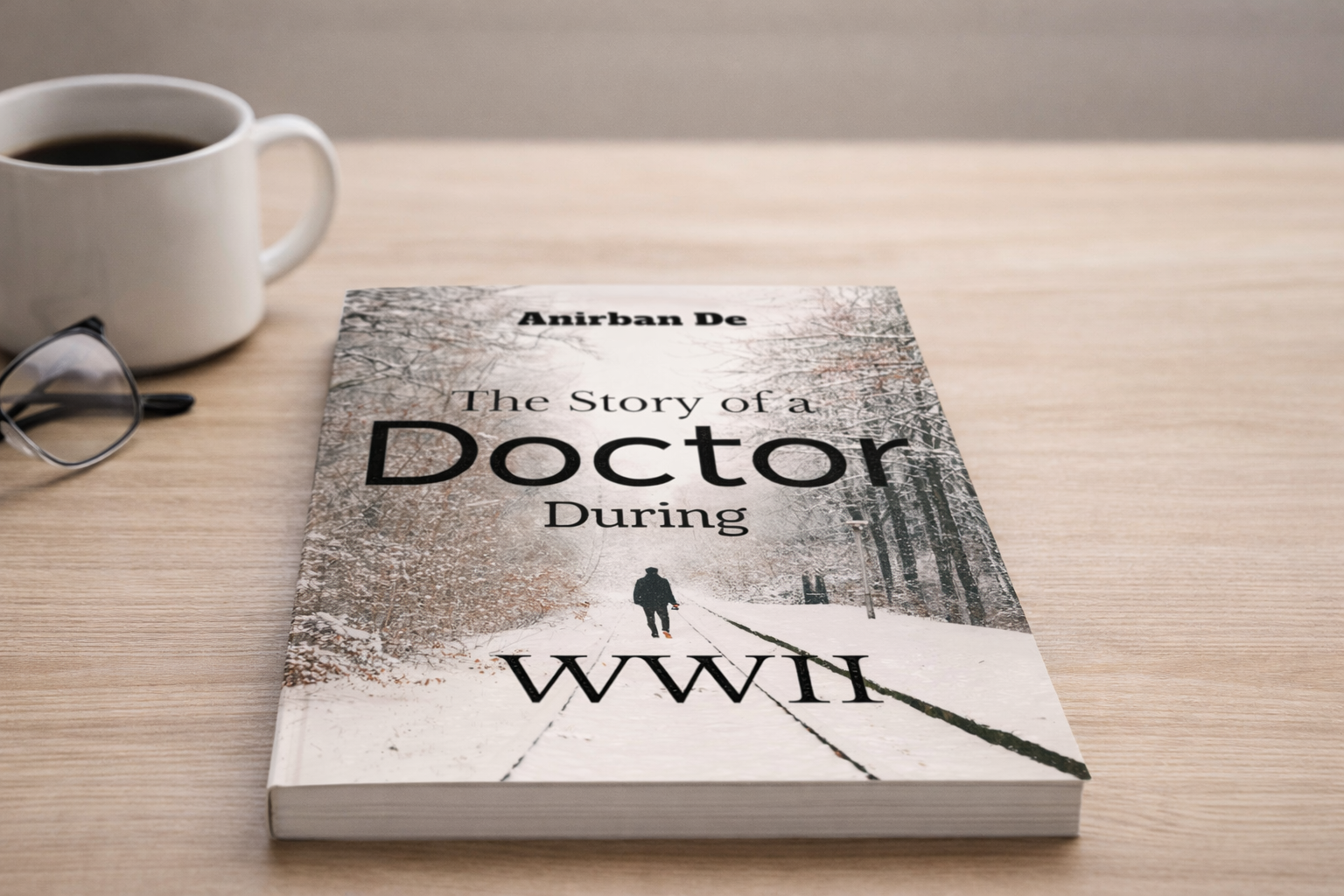
The cover itself sets the tone. A lone figure walking on a snow covered path, trees arching overhead like silent witnesses. The title bold, almost stark. It prepares you for isolation. For endurance. For memory.
And that is exactly what the book feels like.
What the Book Is About
At its heart, The Story of a Doctor during WWII traces the life of a man born on 1st March 1915 in Hooghly, near Calcutta. He is named Shyam Chand Seal. The narrative does not begin with the Second World War. It begins earlier, with what the author calls The Great War. We are taken through the assassination of Archduke Franz Ferdinand in Sarajevo, the July Crisis, the alliances of Triple Entente and Triple Alliance, the Schlieffen Plan, the invasion of Belgium, the trench warfare, the entry of the United States, and finally the Treaty of Versailles.
Some readers might wonder why such detailed historical groundwork is laid out. I did too, at first. But as I read on, I realized that Anirban De wants us to understand that this doctor’s fate is shaped by forces long before he is even born. The Treaty of Versailles, with its stripping of German territory, reparations, and demilitarization, becomes not just a historical event but a seed of future conflict.
Then we move into the doctor’s childhood. His calm temperament. His closeness to his mother. The Bengali medium school. His Headmaster Mr. Prafulla Chandra Chatterjee. The morning prayers singing Rishi Ramakrishna. His love for football and hockey. He is a midfielder. That small detail made me smile. It humanizes him immediately.
The Durga Puja scenes are written with such specificity. Mahasasthi. Puspanjali. The bronze platter filled with fruits, flowers, bel leaves, sandalwood paste. The Brahmin volunteers closing doors and curtains as bhog is offered. I could almost smell the incense. I grew up attending Durga Puja pandals myself, and I felt a strange nostalgia reading those pages.
But the story does not stay in innocence for long.
Because of rigid social customs and dogmatic traditions, the family leaves their native land and moves to Calcutta. Struggle becomes a recurring word. After medical college, Shyam Chand joins the British Army in 1940. He travels to Port Elizabeth in South Africa. Then to Tobruk.
The Battle of Tobruk is where the narrative tightens. The British Army is defeated by the Germans. They are captured. The doctor becomes a prisoner of war in Germany. And this is where the brutality of the war becomes personal.
Anirban De does not shy away from depicting the harsh treatment of POWs. There are descriptions of exploitation, starvation, humiliation. Alongside this, he weaves in the mass murder of Jews, the invasion of the Soviet Union, the barbarism inflicted on Soviet women, and later the vengeance taken by the Red Army on the Germans. The scope is wide. Sometimes almost too wide.
And then there is the love story.
It begins in Calcutta before the war. Expressed through poems. The blurb calls them rhetorical and erotic. The separation during war intensifies their longing. The pain of distance. The burning appetite of love. I found these passages uneven at times, but undeniably heartfelt. The return journey after the war is described as painstaking, both physically and emotionally.
There are also sweeping historical moments woven in. The Bengal Famine. India’s struggle for Independence. The attack on Pearl Harbour. Hiroshima and Nagasaki. A grand banquet with King George VI and the Queen. It is almost as if the author wanted to capture the entire emotional and political climate of the era within one life story.
What Stood Out to Me
The sincerity.
In my years reviewing books, I have learned that polish can be manufactured. Sincerity cannot. Anirban De writes in a voice that feels earnest. Sometimes raw. The preface itself mentions that he has collected information from various sources and tried to explain everything concisely so readers understand transparently. That transparency shows.
The Durga Puja chapter stayed with me. There is something about describing rituals in detail that anchors a story in place. When the mother arrives in a red fringed sari carrying puja ingredients in a bronze platter, it made the character feel real. Not symbolic. Real.
The historical sections are thorough. We get the alliances, the mobilizations, the Treaty of Brest Litovsk, the abdication of Kaiser Wilhelm, the armistices, the detailed clauses of the Treaty of Versailles. It almost reads like a history lesson at times. I will be honest here. The density of information may feel heavy for some readers. But for others who appreciate context, it adds weight.
The love poems are another layer. They attempt to balance the horror of war with the intimacy of longing. I am not sure every metaphor landed perfectly, but I could feel the emotional urgency behind them.
The portrayal of the POW experience is stark. Not sensational. Stark. The helplessness. The humiliation. The waiting. It made me think about how many such stories remain untold.
The Emotional Core
For me, the emotional core of The Story of a Doctor during WWII lies in endurance.
This is a man shaped by colonial India, rigid caste systems, migration, medical training, global war, captivity, and separation from love. And yet, he survives.
There is a particular stillness in the way his childhood is described. The river near his house flowing incessantly. The flower plants in front and back of the home. That image contrasts sharply with the trenches of Europe and the prison camps in Germany.
I kept thinking about how ordinary boys are pulled into extraordinary horrors because of political decisions made far away. The assassination in Sarajevo. The Treaty of Versailles. The invasion of Poland. These are dates in history books. But for Shyam Chand, they become chains around his wrists.
The inclusion of the Bengal Famine adds another layer of grief. War is not only fought on battlefields. It starves people in villages.
And then, love persists. Even in captivity. Even in absence.
Some parts hit differently because they are not written with literary finesse, but with emotional urgency. And sometimes that matters more.
Who This Book Is For
If you are looking for a tightly plotted, minimalist war novel, this might not be for you.
If you appreciate expansive historical narratives that blend personal story with global events, you may find this book meaningful.
Readers interested in Indian perspectives during World War II will especially value this. We often read about European or American soldiers. An Indian doctor in the British Army, traveling from Calcutta to Africa to Europe, becoming a POW in Germany, that is a perspective not commonly foregrounded.
If you enjoy historical context, detailed treaty discussions, and cultural depictions like Durga Puja rituals, you will likely appreciate the texture here.
Final Thoughts
The Story of a Doctor during WWII is ambitious. It tries to hold the world within one life. Sometimes that ambition stretches the narrative thin. Sometimes it enriches it.
As an editor, I would have liked slightly tighter pacing in the historical sections. But as a reader, I was touched by the honesty.
Anirban De does not pretend to be detached. He writes with admiration for his protagonist. The acknowledgment dedicating the book to his mother and maternal uncle adds a personal touch that I found endearing.
In 2026, when we are again surrounded by global uncertainty, reading about past wars feels both heavy and necessary. It reminds us how fragile peace is.
I closed the book thinking about that lone figure on the snowy path from the cover. Walking forward. Not because he is unafraid. But because he must.
FAQ
Is The Story of a Doctor during WWII worth reading?
If you are interested in historical war narratives from an Indian perspective, yes. It combines personal story with detailed historical context.
What is The Story of a Doctor during WWII about?
It follows an Indian doctor who joins the British Army, fights in Tobruk, becomes a prisoner of war in Germany, and endures separation from his love.
Should you read Anirban De’s book if you like romance?
There is a poetic love story woven through the war narrative. It is emotional and intense, though the historical content remains central.
Is it historically detailed?
Very much so. The book includes extensive information about WWI, WWII, the Treaty of Versailles, and global political events.

With over 11 years of experience in the publishing industry, Priya Srivastava has become a trusted guide for hundreds of authors navigating the challenging path from manuscript to marketplace. As Editor-in-Chief of Deified Publications, she combines the precision of a publishing professional with the empathy of a mentor who truly understands the fears, hopes, and dreams of both first-time and seasoned writers.