
Rating:
⭐⭐⭐⭐ (4.3 out of 5)
There are some books that you close and move on from. And then there are some that sit beside you for a while. They don’t shout. They don’t beg for attention. They just… stay.
Ballad of the Universe by Abhilash Fraizer felt like that to me.
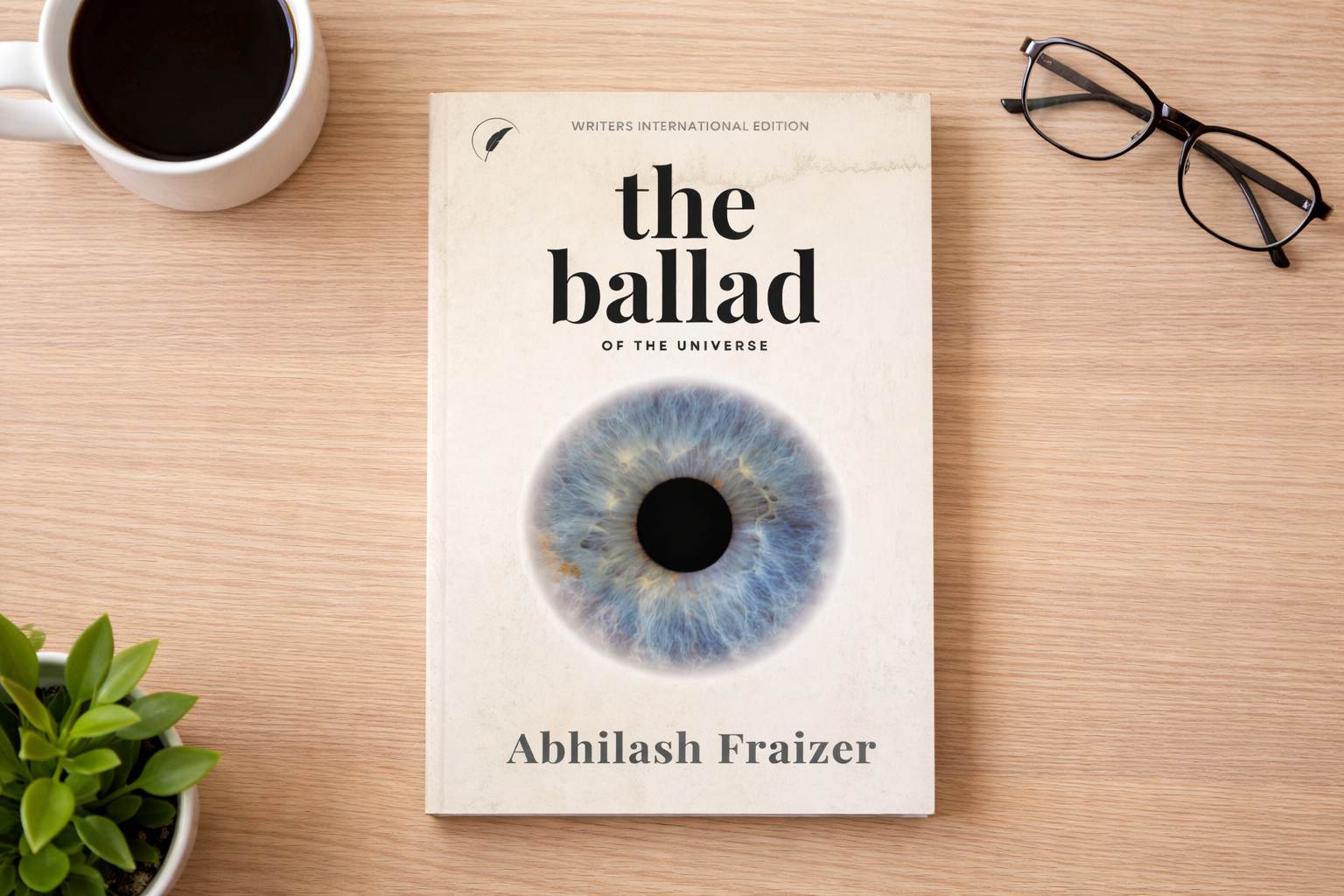
When I first looked at the cover, that large, almost cosmic eye staring back, I had this strange feeling. It felt less like a book cover and more like something watching me. The title too, Ballad of the Universe, is ambitious. As an editor at Deified Publication, I’ve seen many poetic titles that promise transcendence and deliver confusion. So yes, I approached this one with caution.
But within the first few pages, especially that opening scene in Kanyakumari with the moon hiding behind clouds and Bharath standing on the rocks ready to surrender himself to the sea, I felt something shift. The writing isn’t in a hurry. It lingers. Sometimes almost too much. But it lingers with intention.
And I found myself listening, almost like Bharath himself.
What the Book Is About
If you’re searching for a straightforward plot summary of Ballad of the Universe, you won’t quite get that experience. This is not a plot driven novel in the conventional sense. It’s more of an internal journey.
At its heart, the story follows Bharath, a gifted musician raised and trained under a mysterious Master who invented something called Cosmic Music. Bharath’s life has been entirely shaped by this Master. Discipline. Devotion. Listening to the smallest sound in nature. Learning to find music in rain, in rustling leaves, in waves, in silence.
And then, on the eve of his public debut, just when his years of sacrifice are about to culminate, his Master forbids him from ever singing again.
That single command fractures Bharath’s world.
When the Master disappears and later dies, Bharath is left in a prison of obedience. He cannot sing because his Master’s last word was a prohibition. And for him, loyalty is absolute. That internal conflict, between devotion and freedom, becomes the core tension of the novel.
There’s also Niranjana, his love, who wants him to come to London, to embrace opportunity, to live. She represents another possible life. A practical one. A global one. A future filled with concerts and recognition.
But Bharath is torn. Between love and music. Between obedience and selfhood. Between past and possibility.
The story then moves into his exile in a remote tribal hamlet in Idukki, where he tries to sever himself from music, from memory, from everything that defined him.
But of course, you can’t amputate your own soul.
What Stood Out to Me
First, the concept of Cosmic Music.
In my fifteen years of reading across genres, I’ve encountered musicians, artists, tortured geniuses. But the way Abhilash Fraizer writes about Cosmic Music is unusual. It isn’t performance based. It’s almost spiritual discipline.
The description of learning to listen to dew drops, to bubbles forming in water, to the soul of sound itself, stayed with me. There’s a passage where Bharath explains how billions of sounds converge in a moment of cosmic trance. I actually paused there. I had to reread it. Not because it was confusing, but because it demanded attention.
Fraizer clearly has a philosophical bent. You can feel that this novel has been fermenting in him for decades, which we learn from the preface. The idea that this began in 1992 and evolved over time gives the book a certain density. It carries years of thinking.
I also appreciated the emotional layering of Bharath. He isn’t simply stubborn. He isn’t simply tragic. He’s conflicted in a very human way. I’ve seen this in real life too. Artists who feel indebted to mentors. Who feel that to outgrow their teachers is betrayal.
That question the novel keeps nudging at: is obedience noble, or is it fear disguised as loyalty?
Then there’s Renju, the tribal boy. Honestly, Renju softened the novel for me. The bond between Bharath and Renju, especially that moment when Bharath asks him, almost desperately, whether anyone has forbidden him to sing, hit me hard.
That scene felt like a mirror. A free boy standing before a caged man.
It’s in these quieter relational moments that the book breathes.
That said, I’ll be honest about something. At times, the prose leans heavily into poetic description. The metaphors are abundant. The moon is never just the moon. The sea is never just the sea. As an editor, I sometimes wondered if a bit of restraint would have made the emotional moments sharper.
But maybe that lushness is the point. This is a novel that believes in abundance of language.

The Emotional Core
Under all the philosophy, under the cosmic metaphors, this is a story about confinement.
Confinement to a promise. To a word. To a version of yourself.
And in 2026, when so many young creatives are torn between parental expectations, mentors’ influence, and their own calling, this message feels painfully relevant.
I kept thinking about how many Bharaths are out there. People who have built their identity entirely around someone else’s approval. And when that figure vanishes, they don’t know how to exist independently.
There’s also something quietly devastating about Niranjana’s role. She loves him, perhaps more practically than he deserves. She offers him London, possibility, a shared life. And he refuses, not because he doesn’t care, but because he cannot break the chain around his heart.
There’s a line in the novel where Bharath reflects that the greatest agony is losing one’s purpose. That sentence stayed with me long after I closed the book.
Because when purpose is externally given, it can also be externally taken away.
And then what remains?
Who This Book Is For
Let me be clear. Ballad of the Universe is not for readers who want fast paced twists or dramatic external action.
This is for readers who enjoy reflective fiction. Who don’t mind pausing. Who are willing to sit with dense prose and philosophical musings.
If you love novels where nature almost becomes a character, you’ll likely appreciate this. If you enjoy stories about art, discipline, mentorship, and existential searching, this might resonate deeply.
If you prefer minimalism and tight, clipped sentences, you may find it a bit elaborate.
Is Ballad of the Universe worth it? I think for the right reader, absolutely. But you have to meet it halfway. It won’t entertain you. It will ask you to listen.
Final Thoughts
As someone who reads manuscripts daily, I can usually sense when a book is written quickly versus when it has lived inside the author for years.
With Abhilash Fraizer, you feel the long gestation. The novel carries memory. It carries unanswered questions. It carries grief.
It’s imperfect in places. A little indulgent in imagery sometimes. But it is sincere. And sincerity counts for a lot.
Ballad of the Universe Book Review is not about hype. It’s about resonance. This novel asks a simple but haunting question: what happens when the very thing that gave your life meaning becomes forbidden?
And honestly, I kept thinking about that even days later.
At Deified Publication, I value stories that try to say something real, even if they stumble a little along the way. This one tries. And often, it succeeds.
FAQ
Is Ballad of the Universe worth reading?
If you enjoy philosophical fiction centered on art, mentorship, and identity, yes. It requires patience, but it rewards reflection.
Who should read Ballad of the Universe?
Readers interested in literary fiction, music themed novels, and stories about inner conflict will likely connect with it.
What is Ballad of the Universe about?
It follows Bharath, a musician forbidden by his Master to sing, as he grapples with devotion, freedom, love, and purpose.
Is Abhilash Fraizer known for similar themes?
Given his background in poetry and philosophical writing, it’s clear he leans toward reflective, spiritually tinged narratives.

With over 11 years of experience in the publishing industry, Priya Srivastava has become a trusted guide for hundreds of authors navigating the challenging path from manuscript to marketplace. As Editor-in-Chief of Deified Publications, she combines the precision of a publishing professional with the empathy of a mentor who truly understands the fears, hopes, and dreams of both first-time and seasoned writers.