
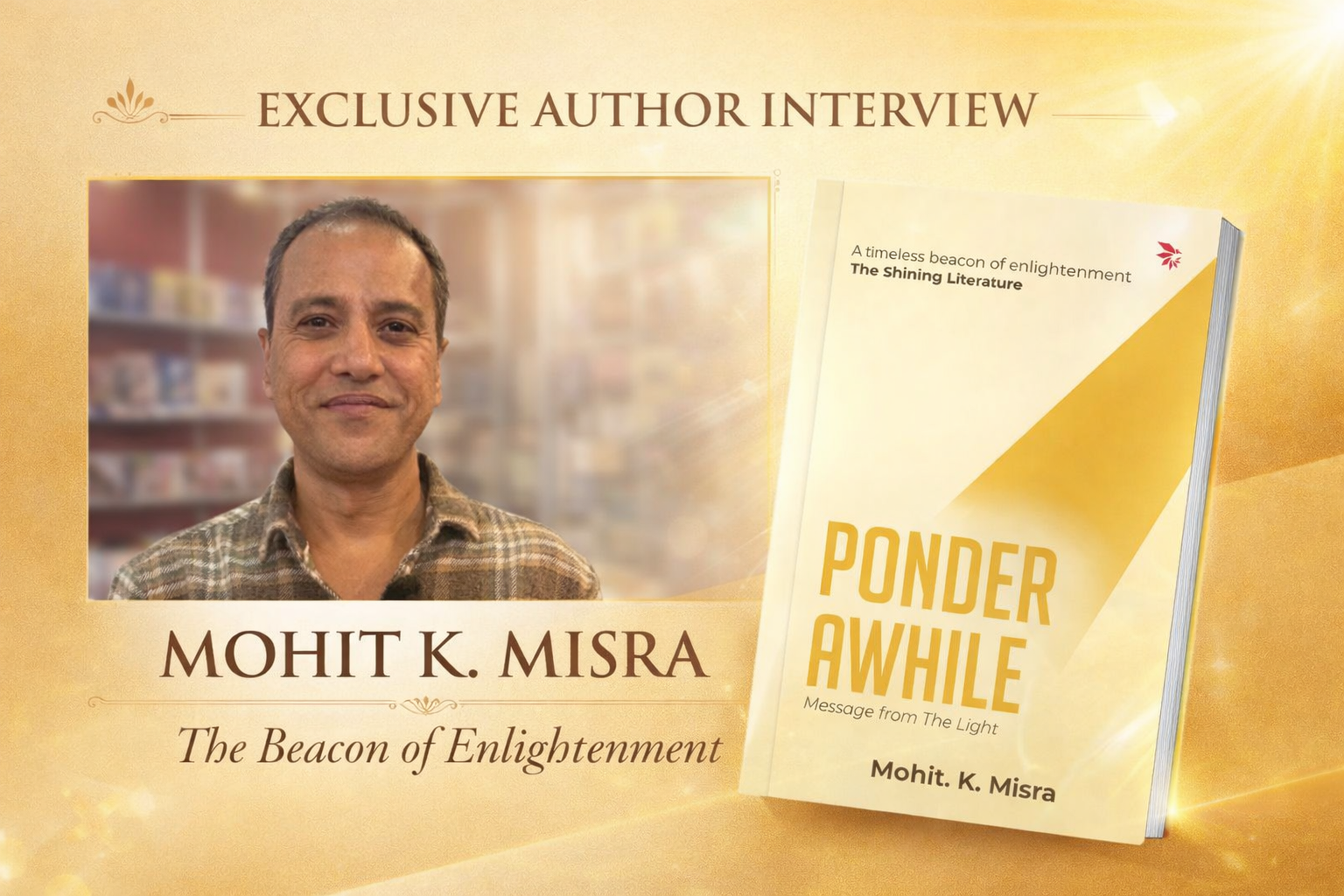
A talk with the award-winning poet whose awakening came in the middle of the Atlantic Ocean
Interview by Priya Srivastava, Editor-in-Chief, Deified Publications
Some stories sound like fiction until you meet the person who lived them. Mohit K. Misra’s story is one of those. An atheist from a deeply religious family, a mechanical engineer who became a sailor, a man who found God in the middle of the Atlantic Ocean and started writing poetry at 30. Over a decade, he nurtured those poems into Ponder Awhile, an award-winning collection that has topped charts and touched hearts worldwide.
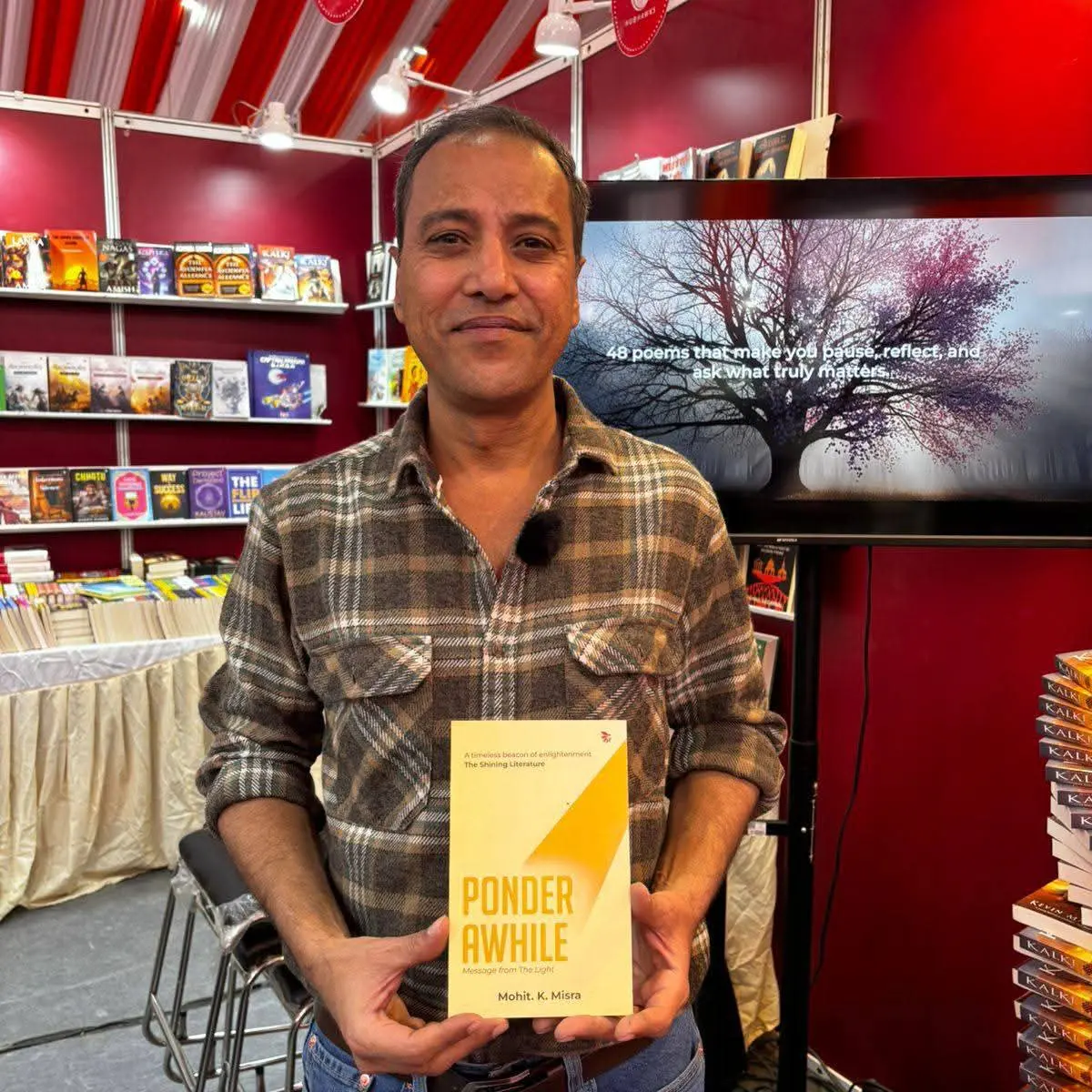
When I sat down with Mohit at a book fair, surrounded by shelves of literature, I expected to meet a spiritual teacher. What I found was something rarer: a man who doesn’t claim to have all the answers but has learned to ask the right questions. His poetry doesn’t preach. It invites you to pause, reflect, and discover your own Light.
The Awakening in the Atlantic
Priya Srivastava: Mohit, your journey is extraordinary. You grew up with a Parsi priest grandfather and Brahmin family from Allahabad, yet you became an atheist. Then, in the middle of the Atlantic Ocean, divinity struck. Tell me about that moment.
Mohit K. Misra: It wasn’t a single moment, Priya. It was a series of moments that built into something I couldn’t ignore anymore.
I was working as a sailor, spending months at sea. When you’re out there, in the middle of the ocean, surrounded by water in every direction, you feel very small. The vastness is humbling. There’s no noise except the engine, the waves, the wind. No distractions. Just you and infinity.
One night, I was on deck during my watch. The sky was impossibly clear, stars everywhere. The water was calm, reflecting the moon. And suddenly, I felt this overwhelming presence. Not threatening. Just there. Like the universe was acknowledging me and I was acknowledging it back.
I’d spent years rejecting the religiosity I grew up with. All the rituals, the prayers, the rules. I thought spirituality was just elaborate superstition. But that night, I realized I’d been rejecting the packaging, not the truth inside it.
That’s when everything changed.
PS: You say you received signs to write poetry. What did those signs look like?
MK: They were quiet nudges at first. I’d wake up with lines in my head. Full phrases, sometimes entire verses, just there when I opened my eyes. At first, I thought I was remembering something I’d read. But the lines were mine. They were speaking to experiences I’d lived, questions I’d asked.
Then I started noticing patterns. I’d think about a particular question, something about existence or suffering, and within days, I’d encounter something that offered perspective. A conversation, a book passage, an experience at sea. It felt like the universe was responding.
So I started writing. Not because I wanted to be a poet. Because I felt compelled to capture what was being revealed to me.
PS: You started writing at 30. That’s later than most poets. Did starting late feel like a disadvantage?
MK: Not at all. Starting at 30 meant I had lived first. I’d experienced doubt, struggle, loneliness, joy, wonder. I’d worked in the practical world, dealt with real problems, known real people.
Poetry isn’t about clever words. It’s about truth. And truth comes from experience. If I’d started writing at 20, I would have written what I thought poetry should sound like. At 30, I wrote what I actually had to say.
Plus, those years of being an atheist were crucial. They taught me to question everything, to not accept easy answers. That skepticism made my eventual spirituality deeper, more examined, more honest.
Nurturing Poetry Over a Decade
PS: You nurtured and polished this collection over ten years before publishing. That’s extraordinary patience. Why did it take so long?
MK: Because I wanted to get it right. These weren’t just poems. They were messages. If I was going to share them, they needed to be clear, true, and helpful.
Some of the poems I wrote in the first year made it into the book. Others took five revisions over eight years before they felt finished. I’d write a poem, set it aside, live more life, then come back and realize what was missing.
Poetry about spirituality is particularly tricky. It’s so easy to sound preachy or vague. I wanted every poem to be grounded in real experience, real questions, real struggles. That takes time to distill.
PS: During that decade of nurturing the manuscript, what kept you going?
MK: The conviction that these poems needed to exist. Not for my ego. But because I knew, somewhere, there were people asking the same questions I’d asked. Feeling the same confusion, the same longing for meaning.
I also had this deep trust that the timing would be right. The Light that prompted me to write would also guide me to publish when the time came.
And honestly, the process of refining the poems was its own spiritual practice. Each revision was a meditation. Each cut was letting go of ego. Each final version was a small enlightenment.
Award-Winning Recognition
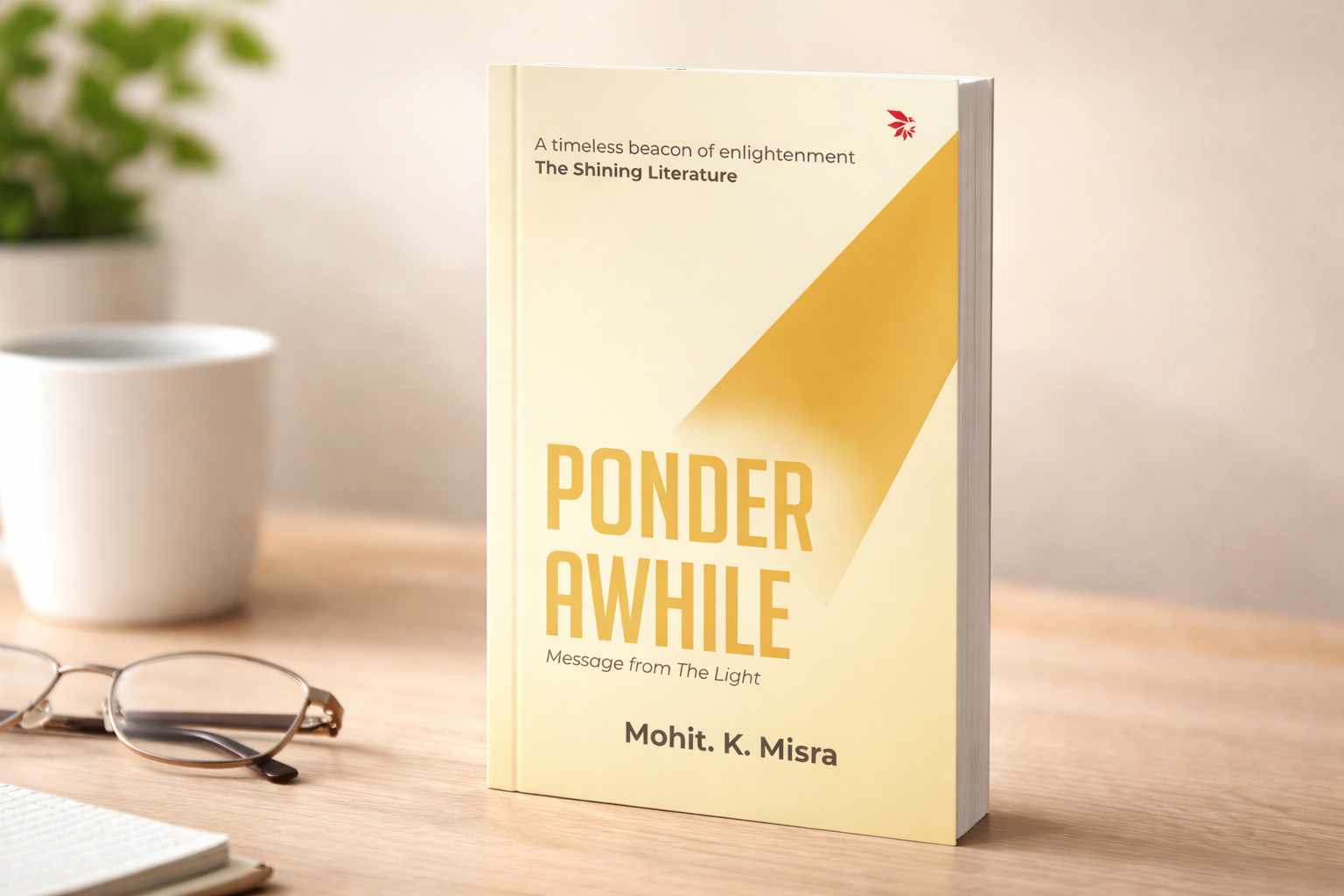
PS: Ponder Awhile has achieved remarkable recognition. USA Book News Finalist in Spirituality, ranked number 1 in multiple categories across several years. How did those accolades feel after such a long, solitary journey?
MK: Validating, but not in the way you might expect. The awards didn’t make me feel like I’d succeeded. They made me feel like the message was reaching the people who needed it.
When you spend ten years writing in relative isolation, you wonder sometimes if what you’re creating matters to anyone but you. The recognition said, yes, this resonates. Yes, these questions are universal. Yes, people need space to ponder.
But the real validation came from individual readers. The emails from people saying a particular poem helped them through grief. The messages from atheists saying the book opened them to possibility. The notes from religious people saying the poems helped them see beyond dogma.
That’s what mattered. The awards just amplified the reach.
PS: You’ve been ranked number 1 in Poetry, Body Mind and Spirit, Religious Books, Philosophy. That’s crossing a lot of categories. What does that tell you about the book?
MK: That the Light transcends categories. These poems aren’t trying to be spiritual or philosophical or poetic. They’re trying to be true. And truth doesn’t fit neatly into sections.
A poem about nature is also a poem about God. A poem about human behavior is also a poem about self-discovery. Everything connects when you’re looking at it from a place of wholeness.
I think readers responded to that integration. The book doesn’t separate spirituality from everyday life. It finds the sacred in the ordinary and the ordinary in the sacred.
The 48 Poems That Make You Pause
PS: The book contains exactly 48 poems. Is that number significant?
MK: Forty-eight is the number that felt complete. Not too few that I couldn’t explore the range of questions I needed to ask. Not too many that it became overwhelming.
Each poem is meant to be a pause point. You read one, you sit with it, you let it work on you. Forty-eight felt like enough pauses to take a real journey without exhausting the reader.
PS: The subtitle is “Message From The Light.” What is that message?
MK: The message is simple but profound: You are not separate from the Light. You are made of it. Your job isn’t to find it somewhere external. Your job is to remember it within yourself.
Every poem is a different facet of that central truth. Some ask questions about God. Some explore nature. Some examine human behavior. But they all point back to the same reality that there is a Light at the core of existence, and it’s accessible to everyone.
PS: You describe the book as both a meditation on existence and an invitation. What are you inviting readers to do?
MK: To pause. To reflect. To ask their own questions instead of just accepting the answers they’ve been given.
We live in a world of noise, constant distraction, surface-level everything. Ponder Awhile is an invitation to go deeper. To spend time with the big questions. Who am I? Why am I here? What really matters?
I’m not offering definitive answers. I’m offering companionship in the questioning. My poems are my exploration. Readers bring their own exploration. Together, we’re all seeking the same Light.
From Atheism to Spirituality
PS: Your journey from atheism to spirituality is central to the book. Do you think atheism was a necessary part of your spiritual path?
MK: Absolutely. Atheism cleared away all the inherited beliefs, all the unexamined assumptions. It forced me to start from zero.
When I eventually experienced the divine, it wasn’t because someone told me it existed. It was direct, personal, undeniable. That makes my spirituality more solid, more real, because it’s mine. I didn’t inherit it or adopt it. I discovered it.
I think a lot of spiritual seekers would benefit from a period of healthy skepticism. Question everything. Reject what doesn’t resonate. Only accept what you personally verify. That leads to authentic spirituality, not borrowed religion.
PS: Your background is fascinating. Parsi priest grandfather, Brahmin family from Allahabad. How did growing up in that religious diversity shape you?
MK: It showed me early that there are many paths to truth. My grandfather practiced Zoroastrianism. My father’s family practiced Hinduism. Both were deeply devout. Both found meaning, peace, connection through their traditions.
As a child, I saw the similarities beneath the differences. The rituals were different, but the reverence was the same. The prayers were different, but the seeking was the same.
That prepared me to write poetry that doesn’t belong to any single religion. The Light I write about, it’s in the fire temple and in the Ganges and in the church and in the mosque and in the heart of the atheist standing on a ship in the middle of the ocean.
PS: Allahabad, now Prayagraj, is such a spiritually significant city. Did growing up hearing about it influence you?
MK: Deeply. Even as an atheist, I couldn’t deny the power of place. Allahabad, where three rivers meet, has been a pilgrimage site for thousands of years. Millions of people have sought enlightenment there.
That collective seeking creates something. You can feel it. Even skeptics feel it.
So when I eventually had my own awakening, I understood it in the context of a long lineage of seekers. I wasn’t inventing something new. I was joining a very old conversation.
Universal Truths Beyond Religion
PS: You mention that your poems explore universal truths that transcend religious boundaries. In our divided world, how important is that transcendence?
MK: It’s everything. Religion has become so politicized, so tribal. People use it to divide rather than unite. My Hindu versus your Muslim. My Christian versus your atheist.
But the Light doesn’t care about labels. Truth doesn’t belong to any tradition. Love doesn’t require a specific prayer.
My poems deliberately avoid religious jargon. I don’t use language that belongs to Hinduism or Zoroastrianism or any other tradition. I use the language of human experience. Nature. Questions. Wonder. Struggle.
That way, anyone can enter. You don’t need to believe anything in advance. You just need to be willing to pause and reflect.
PS: The book explores themes like nature, self-discovery, finding inner peace. Why these specific themes?
MK: Because they’re the doorways to the Light.
Nature shows you that you’re part of something vast and intelligent. Self-discovery reveals the Light within. Inner peace is what happens when you stop resisting and start trusting.
These aren’t abstract concepts. They’re practical paths. Anyone, anywhere, can look at nature. Anyone can turn inward. Anyone can cultivate peace.
That accessibility was important to me. I didn’t want to write poetry that requires expertise or initiation. I wanted to write poetry that meets people exactly where they are.
The Sailor Poet
PS: You’re a mechanical engineer who became a sailor. How does that practical background influence your spiritual poetry?
MK: It keeps me grounded. Engineers solve problems. Sailors navigate real challenges. That practical mindset prevents me from floating off into vague abstraction.
Every poem has to work. It has to offer something useful, something you can apply. Even when I’m writing about mystical experiences, I’m thinking, how does this help someone live better?
Also, sailing teaches you about systems, about how everything connects. A ship is a complex system where every part matters. The ocean is an even larger system where weather, currents, tides all interact.
Spirituality is the same. We’re all part of an interconnected system. Understanding that practically, not just theoretically, gives depth to the poetry.
PS: The ocean appears in your work. What does the sea represent to you?
MK: The ocean is the perfect metaphor for the divine. It’s vast, powerful, mysterious. It can be calm or violent. It gives life and takes life. You can’t control it. You can only learn to work with it.
Being at sea also strips away illusions. There’s no pretending out there. The ocean doesn’t care about your ego, your status, your beliefs. It just is. And you either respect it or you suffer.
That humility, that acceptance of something greater than yourself, that’s the foundation of spirituality. The ocean taught me that before any poem did.
The Craft of Spiritual Poetry
PS: How do you write about spiritual experiences without sounding preach or vague?
MK: By staying specific and honest. I write about actual moments, actual questions, actual struggles. Not “one should seek the Light.” But “I was afraid in the dark and then I noticed the stars.”
Spiritual poetry fails when it makes grand pronouncements. It succeeds when it shares vulnerable truth.
I also revise ruthlessly. If a line sounds like something I’ve heard before, I cut it. If a line sounds impressive but empty, I cut it. I keep only what rings true to lived experience.
PS: Do you have a writing practice?
MK: I write when the poems come. I don’t force it. These aren’t poems I construct. They’re poems I receive.
But I stay available. I keep paper nearby. I pay attention to the quiet moments when truth tends to speak. Early morning. Late night. During meditation. Those are when the poems arrive.
Then the work begins. That first draft is inspiration. The next ten drafts are perspiration. That’s where craft comes in.
PS: Is there a poem in Ponder Awhile that was the hardest to write?
MK: There’s one about the death of ego. Writing it felt like a small death itself. I had to confront every way I still cling to false identity, every way I resist surrendering to the Light.
That poem took three years to finish because I couldn’t write it until I’d actually lived the transformation it describes. Poetry about spiritual concepts is easy. Poetry about spiritual experience requires you to have the experience first.
Connecting With Readers
PS: Your book has reached readers around the world. What responses have touched you most?
MK: I received an email from a woman who’d lost her daughter. She said reading the book helped her find peace, helped her trust that her daughter’s light continues in a form she can’t see but can feel.
That broke me open. That’s why these poems exist. Not for awards or rankings. For that grieving mother finding solace.
I’ve heard from atheists who said the book opened them to possibility without requiring them to adopt religion. From religious people who said it helped them see the essence beneath the rituals. From young people searching for meaning in a confusing world.
Each message reminds me that we’re all asking the same questions. The details differ, but the longing is universal.
PS: What do you hope readers take from Ponder Awhile?
MK: Permission to pause. Permission to question. Permission to seek.
We’re taught to have answers, to be certain, to keep moving. This book says, slow down. Sit with not knowing. Ask deeper questions.
And I hope readers discover that the Light they’re seeking isn’t far away. It’s not at the end of some long spiritual journey. It’s already within them, waiting to be remembered.
The Quick Round
PS: Let’s do some quick questions. Favorite spiritual text?
MK: The Tao Te Ching. So simple, so profound, so universal.
PS: Favorite place to write?
MK: Near water. Ocean, river, lake. Water reminds me of the flow I’m trying to capture in words.
PS: One word to describe your poetry?
MK: Inviting. I want readers to feel welcome, not intimidated.
PS: Best lesson the ocean taught you?
MK: Surrender isn’t giving up. It’s working with forces larger than yourself.
PS: What keeps you humble?
MK: Remembering I’m just a messenger. The poems came through me, not from me.
Looking Forward
PS: Are there more poems, more books in you?
MK: Always. The Light keeps revealing. The questions keep deepening.
I’m working on ideas for a second collection, perhaps something more focused on practical spirituality. How do you live these truths in daily life? How do you stay connected to Light while dealing with bills, relationships, work?
But I won’t rush. If it takes another decade to get it right, that’s fine. Quality over speed.
PS: What advice would you give someone experiencing their own spiritual awakening?
MK: Trust it. Even if it doesn’t make sense. Even if it contradicts what you’ve been taught. Your direct experience of truth is more reliable than anyone else’s description of it.
And be patient. Awakening isn’t a single moment. It’s a process. You’ll have insights and then doubts. Moments of clarity and then confusion. That’s normal. Keep going.
Write about it. Talk about it. Create something from it. Your awakening isn’t just for you. It’s part of the larger awakening of humanity.
Final Reflections
PS: Before we close, what would you say to someone holding your book, about to read the first poem?
MK: I’d say, these poems are seeds. They won’t grow unless you give them time and space.
Don’t rush through the collection. Read one poem. Sit with it. Let it work on you. Ask what it’s pointing toward. Notice what it stirs in you.
The poems are my questions, but your answers will be your own. My Light and your Light, they’re connected. These words are just bridges between us.
And remember, you don’t have to believe anything I say. Just be willing to pause. To ponder. To consider that maybe, just maybe, you’re more than you think you are. That maybe the Light you’ve been seeking has been seeking you right back.
That’s all spirituality is. Mutual recognition. The Light in me honoring the Light in you.
PS: Mohit, thank you. For your courage in sharing your journey, for your patience in crafting these poems, and for offering us all an invitation to pause and ponder what truly matters.
MK: Thank you, Priya. For understanding that poetry isn’t about answers. It’s about better questions. And thank you to everyone who takes time to ponder awhile. In a world of noise, silence is revolutionary. In a time of certainty, questioning is brave. May we all find the Light we seek.
Ponder Awhile: Message From The Light by Mohit K. Misra is an award-winning collection of 48 poems encouraging readers to pause and reflect on life’s deeper meanings. Born from the author’s journey from atheism to spiritual awakening, the poems explore universal truths about God, nature, human behavior, and self-discovery, transcending religious boundaries to offer solace in shared human experience.
This interview has been edited for clarity while maintaining the authentic voice of the conversation.

With over 11 years of experience in the publishing industry, Priya Srivastava has become a trusted guide for hundreds of authors navigating the challenging path from manuscript to marketplace. As Editor-in-Chief of Deified Publications, she combines the precision of a publishing professional with the empathy of a mentor who truly understands the fears, hopes, and dreams of both first-time and seasoned writers.