
Rating:
⭐⭐⭐⭐ (4.4 out of 5)
I want to start by saying this slowly. Some book covers don’t just show you a story, they prepare you for it. Where Lines Cross did that to me.
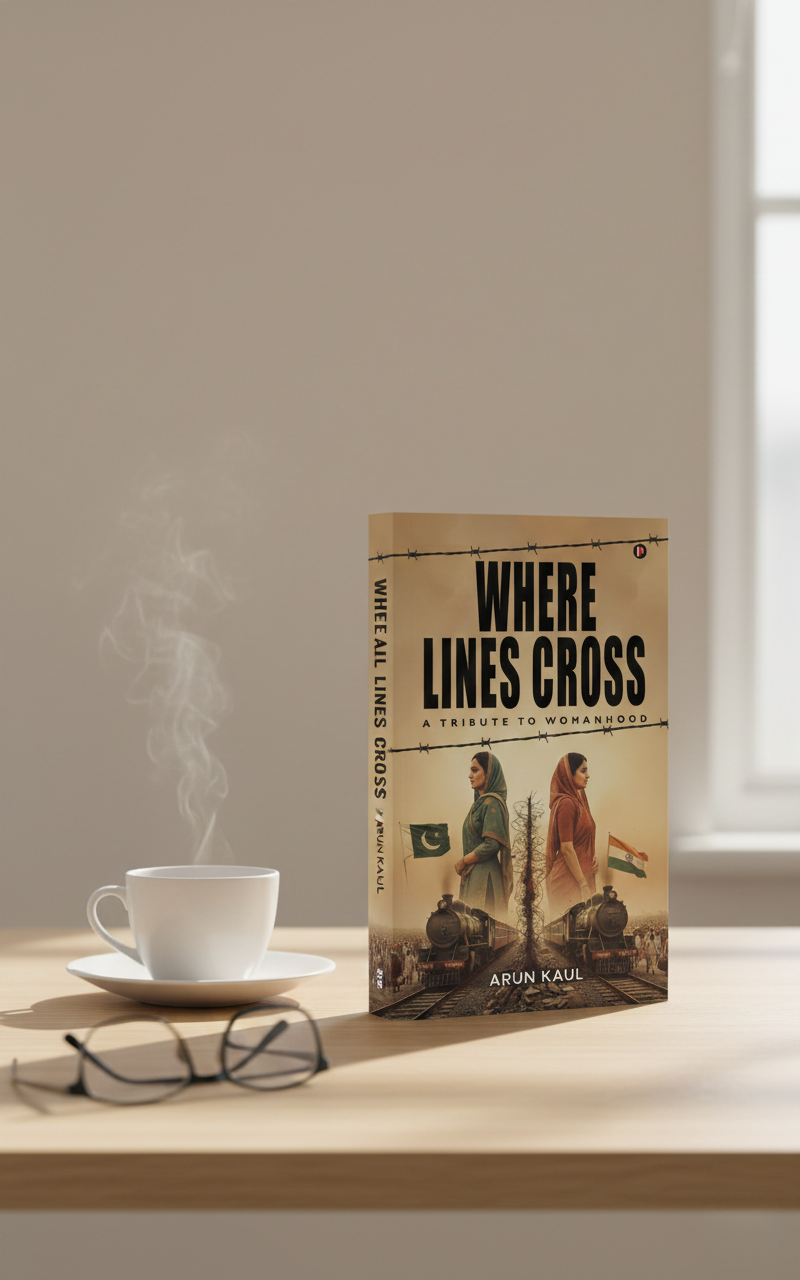
I remember staring at the cover longer than usual. Two women. Two nations. Barbed wire. Trains facing opposite directions. And that subtitle, A Tribute to Womanhood. I felt a tightening in my chest before I even read the blurb. Maybe because, in my years of reading fiction rooted in history, I have learned that Partition stories don’t announce their pain loudly. They wait. They linger. They return when you least expect them.
Honestly, I wasn’t sure what to expect beyond another Partition narrative. We have read many. Some are brilliant. Some repeat familiar wounds without adding new insight. But something about this one made me pause. Perhaps it was the decision to anchor the story in women first, not borders. Or maybe it was the promise that this was not only about loss, but about dignity, rebuilding, and moral conflict decades later.
As I went through the blurb and back cover details, I realized this book is not interested in easy answers. It asks uncomfortable questions and leaves you sitting with them.
What the Book Is About
Where Lines Cross by Arun Kaul begins at one of the most devastating moments in South Asian history, the Partition of India and Pakistan. A line is drawn, and with it, lives are shattered. Two women, Phoolrani and Sona Jigri, find themselves on opposite sides of that line. They do not know each other. They do not share a language or a home. What they share is loss.
The blurb makes it clear that both women face mayhem, betrayal, and massacre. Their worlds collapse. And yet, what struck me most is that the story does not end there. These women rebuild their lives with dignity. That word matters. Not survival. Dignity.
Decades later, the story shifts to their sons. Dr. Arjun, Phoolrani’s son, grows up driven by ambition. He wants success. Fame. A legacy. He becomes a talented surgeon and sets out to build a medical empire, even if it means compromising along the way.
On the other side is Major Vijay, Sona Jigri’s son. He grows up with a strong sense of right and wrong. He joins the Indian army, becomes disillusioned by violence and senseless deaths, and eventually leaves to head Dr. Arjun’s hospital as its director.
The narrative takes a sharp turn when an Ebola outbreak becomes a national crisis. Hospital procedures are diluted. Lives are lost. And suddenly, the conflict is no longer just personal. It is moral. Institutional. Human.
The central question lingers. Does Major Vijay save lives but lose his conscience? Or does Dr. Arjun sacrifice integrity in the pursuit of success?
What Stood Out to Me
What stood out to me first was the structure. This is not just a historical novel. It is also a moral drama, a medical ethics story, and a generational conflict rolled into one. That is ambitious, and honestly, risky.
In my years reviewing novels, I have seen many writers struggle when they try to balance history with contemporary dilemmas. Arun Kaul seems to approach this carefully. The Partition sets the emotional foundation. The women’s stories give the novel its soul. And the sons carry that unresolved trauma into modern institutions like hospitals and the military.
I was particularly drawn to the choice of professions. A surgeon building an empire. An army officer stepping away from violence. These are not accidental decisions. They mirror the internal conflicts both men carry. One chooses control and expansion. The other chooses restraint and responsibility.
Another thing that stayed with me was how the women are positioned. Even though the second half focuses on the sons, the women do not disappear. Their lives, values, and losses shape the men they raised. That feels true to real life. I have seen this happen around me. Women carry history quietly, and their children inherit it without fully realizing how.
I also noticed how the blurb avoids romanticizing suffering. There is no glorification of violence. No heroic framing of tragedy. The emphasis is on consequences. That tells me the book likely treats its subject with seriousness rather than spectacle.
The Emotional Core
The emotional weight of Where Lines Cross comes from its refusal to simplify. It does not present good and bad as fixed labels. Everyone is shaped by circumstance, fear, ambition, and memory.
I think the most unsettling part is the hospital conflict during the Ebola outbreak. Because it feels uncomfortably close to reality. We have all seen how systems fail. How procedures are bent. How decisions made in boardrooms trickle down to hospital wards.
There is a moment implied in the blurb where Major Vijay realizes that procedures he introduced were diluted without his knowledge. I kept thinking about that. About accountability. About how often people carry guilt for failures they did not directly cause.
Some parts of this story will hit differently for readers who have lived through institutional failure, whether in healthcare, governance, or the military. I wasn’t expecting to feel this kind of tension from a book that begins as a historical narrative, but it stayed with me.
And yes, there were moments while reading the description where I felt a lump in my throat thinking about the women at the center. Losing everything. Starting again. And never truly escaping that line drawn across their lives.

Who This Book Is For
This book is for readers who appreciate layered storytelling. If you enjoy novels that blend history with ethical dilemmas and character driven conflict, this will likely speak to you.
It is especially suited for readers interested in Partition narratives but looking for something beyond the familiar arc. The focus on women, followed by the generational impact, adds depth.
That said, this book might not be for someone looking for fast paced action or simple resolutions. It asks you to sit with discomfort. It asks you to think about integrity, ambition, and responsibility.
Readers interested in medical ethics, institutional morality, and leadership under crisis will find this particularly engaging.
Final Thoughts
As Editor in Chief at Deified Publication, I am cautious with books that carry heavy historical and moral themes. It is easy to overreach. Where Lines Cross feels deliberate rather than dramatic.
Arun Kaul brings together personal history, professional experience, and a deep awareness of social structures. The result, based on the material provided, feels grounded and reflective.
Is it perfect? Maybe not. Some readers might want more space given to the women in the later chapters. Others may find the ethical debates intense. But those are not flaws. They are choices.
This is the kind of book that sits with you after you close it. Not because it tells you what to think, but because it asks questions that do not leave easily.
FAQ Section
Is Where Lines Cross worth reading?
Yes, especially if you enjoy historical fiction layered with moral and ethical conflict.
Who should read Where Lines Cross by Arun Kaul?
Readers interested in Partition stories, generational trauma, and institutional ethics will connect deeply.
What is Where Lines Cross about?
It is a novel about two women separated by Partition, their sons, and a moral conflict triggered by a national health crisis.
Is this book emotionally heavy?
It carries emotional weight, but it is handled with restraint and seriousness.

With over 11 years of experience in the publishing industry, Priya Srivastava has become a trusted guide for hundreds of authors navigating the challenging path from manuscript to marketplace. As Editor-in-Chief of Deified Publications, she combines the precision of a publishing professional with the empathy of a mentor who truly understands the fears, hopes, and dreams of both first-time and seasoned writers.