
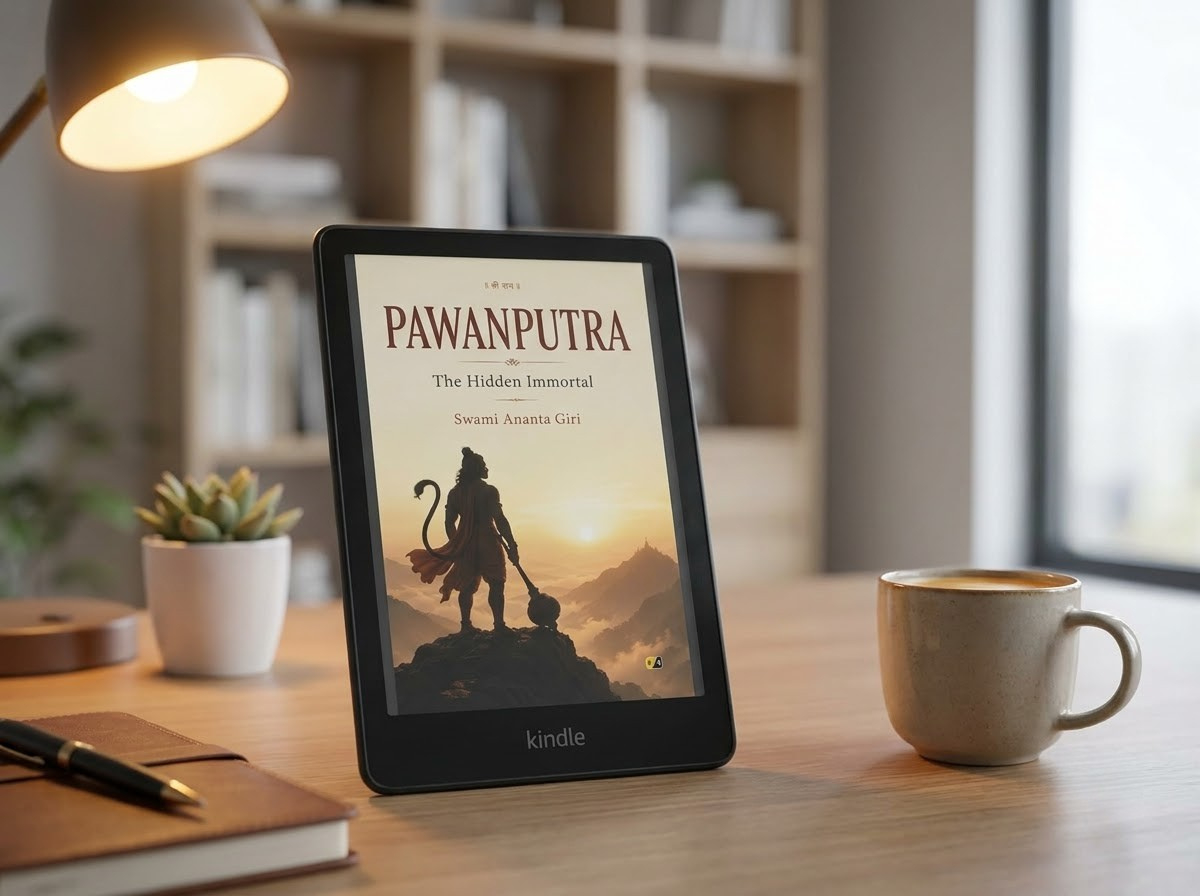
Rating: ⭐⭐⭐⭐ (4.2 out of 5)
I have been reading books professionally for over fifteen years, and every once in a while a text lands on my desk that makes me put down my pen and simply listen. Sitting at my desk with a hot cup of chai on a rainy morning, I picked up Pawanputra by Swami Ananta Giri expecting a standard mythological retelling. Most of us in India grow up with the basic tales of Hanuman crossing the vast ocean to reach Lanka, carrying an entire mountain of herbs on his shoulders, or burning down a kingdom with his flaming tail. We recite the verses of the Hanuman Chalisa almost on autopilot during Tuesday morning prayers without taking time to consider what individual words actually mean. My work as Editor-in-Chief at Deified Publication keeps me surrounded by endless stacks of spiritual commentaries, so I am naturally cautious when a new author approaches such well-trodden ground. Yet right from the beginning, this writing caught my attention because it focuses on moments that traditional retellings often gloss over, inviting us to look closely at the emotional human roots behind divine figures.
What immediately caught my interest was how the narrative establishes its baseline in human vulnerability long before any grand feats of strength occur. We are introduced to the backstory of Ahalya and her daughter Anjana in a way that feels surprisingly grounded and deeply felt. Instead of starting with spectacular divine battles, the narrative begins in the stillness of a broken home and a ruined ashram. That decision alone sets a distinct tone for everything that follows. It shows us that true devotion is not born in a vacuum of perfection, but rather forged inside real loss, grief, and long years of patient waiting. By establishing this intimate perspective early on, the author prepares the reader to see familiar sacred legends through a much more personal lens.
What Pawanputra Is About
For anyone looking for a clear book summary, this work provides a structured narrative that bridges ancient Puranic accounts with personal spiritual application. The text opens with the heavy legend of Ahalya and Maharishi Gautama, explaining how Indra used deception to enter the ashram and how Gautama issued a shattering curse. Ahalya was turned into stone to await the touch of Ram, while Indra was marked across his body. The narrative then shines light on an often overlooked detail, the abandoned child Anjana who was left alone in the silent ashram. Growing up in those ruins, young Anjana would lay her hand against her petrified mother every morning, finding the stone warm as if her mother had been weeping through the night. The author uses this tragic background to show how Anjana was shaped into a vessel capable of mothering Hanuman, the ultimate symbol of selfless love.
From there, the text moves into Hanuman’s childhood, detailing his legendary attempt to eat the sun and the moment Indra struck his jaw with a lightning bolt. When his father Vayu withdrew all breath from the universe in grief, the gods gathered to revive the child and bestow unique boons upon him. Brahma granted him safety from the Brahmastra, Shiva blessed him with immortality as a Chiranjeevi, and Surya offered to become his teacher. Later, after playful childhood pranks disrupted the meditations of forest sages, Hanuman received a gentle curse of forgetfulness, ensuring that his immense strength would remain hidden until needed in service to Ram. The middle chapters break down the etymology of his name, translate the Ashta Siddhis like Anima and Mahima, and analyze his relationship with astrological forces like Shani Dev during periods like Sade Sati. The final portion transitions toward yogic practice, explaining how Hanuman represents the movement of prana through the Sushumna nadi as described in texts like the Vigyana Bhairava Tantra.
Noticing the Craft, Style, and Character Details
As a reader who values narrative pacing and strong conceptual structure, I found many moments where the author’s craft really shines. Consider the scene detailing Hanuman’s education under the Sun God, Surya. Because Surya is constantly in motion across the sky, Hanuman could not sit still in a classroom. He chose to fly backwards through the atmosphere at the exact speed of the sun’s chariot, keeping his face perpetually turned toward his teacher while mastering the sixty-four traditional disciplines, known as the Chausath Kalas. That vivid mental image of flying backwards across the sky while absorbing ancient wisdom is stunningly captured. It demonstrates an inventive approach to storytelling that honors classic tradition while making the physical reality of the event feel vivid and alive.
Another fascinating stylistic choice occurs during the explanation of the eight supernatural powers, or Ashta Siddhis. The text does not merely list these abilities as abstract magical concepts. Instead, it anchors each power in a specific narrative scene from the Ramayana. For instance, the author illustrates Anima, the ability to shrink infinitely small, through Hanuman entering the heavily guarded fortress of Lanka unnoticed and later approaching Sita in the Ashoka grove as a tiny monkey so as not to alarm her. Conversely, Mahima, the power to expand without limits, is paired with his encounter with the sea serpent Surasa, where he expanded his body to match her giant mouth before quickly shrinking to the size of a thumb to escape. This method of linking philosophical terms with concrete narrative actions makes complex concepts easy to digest for everyday readers.
The Emotional Core and Spiritual Realizations
The true emotional center of this book lies in its exploration of humility and the complete absence of personal pride. In the third chapter, Swami Ananta Giri unpacks the linguistic roots of Hanuman’s name, contrasting the common physical definition of a marked jaw with a deeper interpretation where Hana means destroyed and Maan signifies ego. This linguistic breakdown frames Hanuman as the living symbol of an annihilated ego, a being who deflects all praise toward Ram and identifies simply as a servant when confronted by Ravana in Lanka. I found myself reflecting on how rare that kind of purity is, both in ancient epics and in our modern daily lives where personal recognition is so constantly sought.
There is a raw, emotional weight to the idea that Hanuman’s vast power returns to him only when he is working in the service of another person. The curse of forgetfulness placed on him by the forest sages was actually a protective gift from the universe, teaching that true strength is meant for loving service rather than public display. Reading about how his abilities lay dormant until someone reminded him of his purpose made me think about how many people carry hidden strength that only reveals itself when someone else needs help. It is a comforting thought, and one that gives the entire narrative a warm human heartbeat.
Who Should Read This Book and Who Might Want to Skip It
If you are deciding whether you should read this work, it helps to know what kind of reading experience you enjoy. This book will appeal immensely to spiritual seekers, devotees of Ram and Hanuman, and readers who love discovering the symbolic meanings behind ancient scriptural accounts. If you enjoyed Eknath Easwaran’s reflective translations or Devdutt Pattanaik’s accessible mythic analyses, you will likely find great value here. The commentary on the Hanuman Chalisa and the practical breakdown of astrological influences like Shani Dasha make it a very useful companion for daily devotional practice.
On the other hand, if you are looking for a purely academic historical treatise or a fast-paced fantasy adventure, this volume might not fit your expectations. My one genuine critique involves a sudden shift in tone during the third chapter. The author unexpectedly introduces nineteenth-century Western Theosophical terminology, referencing Helena Blavatsky, C.W. Leadbeater, and concepts like the Kama-rupa and Lower Quaternary to explain the destruction of the ego. While the comparison is intellectually interesting, introducing Blavatsky’s ideas right alongside classical Vedantic thought feels somewhat jarring and overly academic compared to the warm, devotional prose found everywhere else in the text. Readers who prefer a strictly traditional scriptural approach might find these brief Western esoteric tangents a bit out of place.
Final Thoughts and Recommendation
If you are wondering is it worth it to add another commentary to your bookshelf in 2026, my answer is a clear yes. Swami Ananta Giri has crafted a thoughtful, heart-centered work that honors traditional scriptures while offering personal insights gathered through years of dedicated sadhana. It balances detailed Puranic lore with clear explanation, making ancient wisdom feel accessible and directly applicable to daily life. This reader review leaves me with a deep appreciation for the care and reverence poured into every page, proving that classic stories still have new ways to touch our lives when told with sincerity.
FAQs
What is the main focus of Pawanputra by Swami Ananta Giri?
The main focus of the book is to present a complete spiritual portrait of Hanuman, covering his birth, childhood boons, education under Surya, and deep symbolic role in scripture. It combines traditional Puranic stories withverse-by-verse commentary on the Hanuman Chalisa, astrological connections, and yogic interpretations of breath and prana, showing how his presence can be experienced in daily spiritual practice.
Is this book suitable for beginners who know very little about Hindu mythology?
Yes, the book is written in clear, accessible language that welcomes both beginners and lifelong devotees. The author takes time to explain background contexts, Sanskrit terms, and scriptural storylines from the ground up, making it easy for anyone curious about Hanuman to follow along without feeling overwhelmed by dense academic jargon.
How does this book differ from other retellings of Hanuman’s life?
Unlike standard narrative retellings that focus solely on outer heroic feats, this work connects physical stories to inner spiritual meanings. It explores lesser-known traditions like the childhood of his mother Anjana, breaks down the linguistic and Theosophical meanings of his name, and presents a yogic framework where Hanuman represents the movement of vital breath through the human body.

With over 11 years of experience in the publishing industry, Priya Srivastava has become a trusted guide for hundreds of authors navigating the challenging path from manuscript to marketplace. As Editor-in-Chief of Deified Publications, she combines the precision of a publishing professional with the empathy of a mentor who truly understands the fears, hopes, and dreams of both first-time and seasoned writers.