
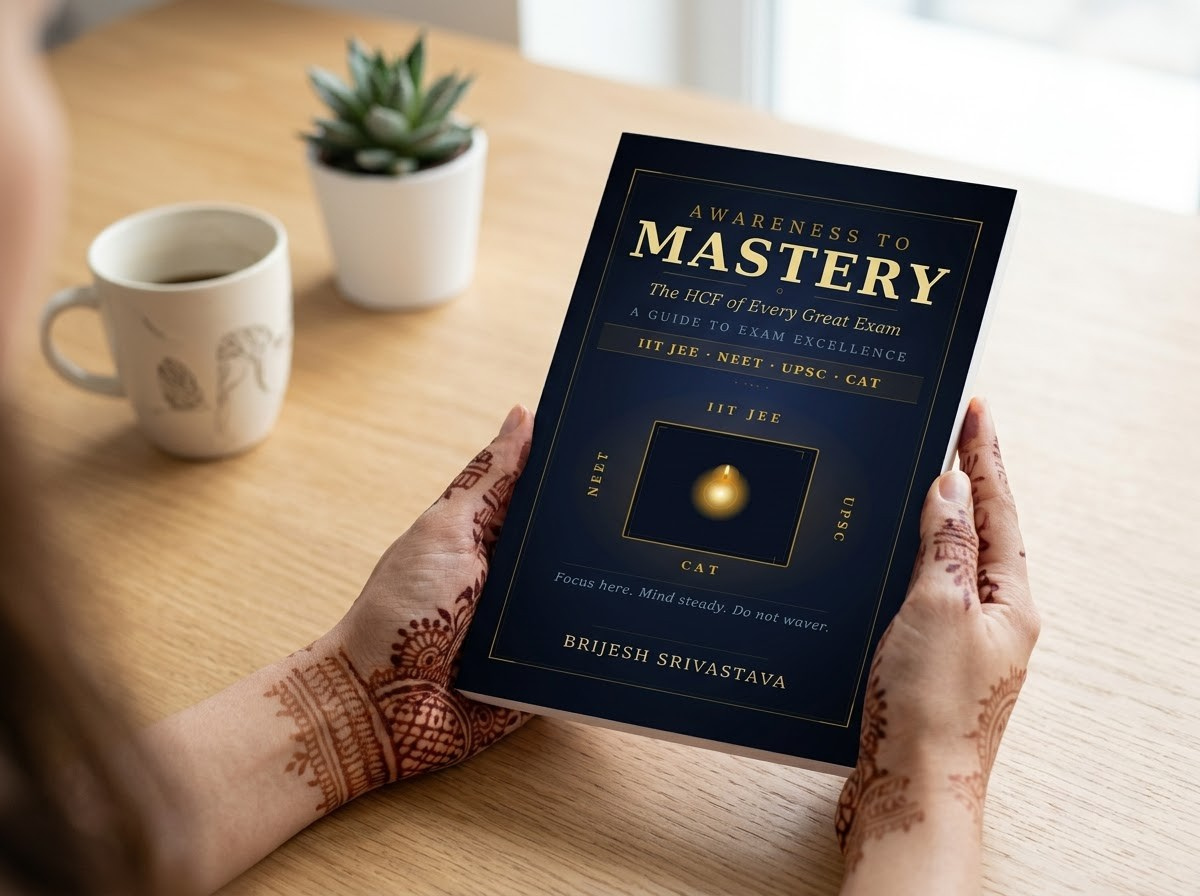
Rating: ⭐⭐⭐⭐ (4.2 out of 5)
I have often seen students count preparation in hours, as though six hours beside an open book automatically means six hours of learning. Anyone who has studied under pressure knows the truth is messier. The eyes move, pages turn, and the mind may be replaying a conversation from breakfast. After more than fifteen years of reading fiction, non-fiction, poetry, and books on learning, I have become wary of advice that simply asks people to work harder. This Awareness to Mastery Book Review begins with the relief I felt when Brijesh Srivastava asked a better question, what was your mind doing during those hours?
As Editor-in-Chief at Deified Publication, I read many books that promise better habits, sharper focus, or higher achievement. This one interested me because it does not pretend to replace subject knowledge. Its concern is the gap between preparation and performance, especially the awful moment when a student knows the material but cannot use it properly in the examination hall. I have seen this happen in real life, and perhaps you have too. A capable student misreads one instruction, spends too long on one problem, then carries that panic into everything that follows. The book treats this not as bad luck, but as a cognitive pattern that can be trained.
What the book is really about
If you are searching for a plain book summary or wondering what is it about, the central idea is simple. IIT JEE, NEET, UPSC, and CAT test different material, but they all demand attention, self-observation, logical control, and clear thinking under pressure. The author calls awareness their Highest Common Factor, borrowing the familiar mathematical term HCF. He then builds fifteen chapters around neuroscience, reflective practice, concentration, environmental observation, mathematical reasoning, examination strategy, and life after results. This is not a timetable manual, nor does it teach Physics, Biology, Polity, or Quantitative Ability. It is a training plan for the mind expected to use those subjects.
The opening story gives that plan a memorable shape. An ageing king sends his son to an old master, who strikes the prince with a wooden stick whenever his attention wanders. After months of being caught unaware, the prince begins noticing footsteps, changes in the air, and tiny signals around him. There is this moment where he catches the stick behind him while continuing to trim a hedge, and I could see exactly why the story was chosen. Later, the test moves into sleep and then to a real sword, making each stage about performance under greater pressure. The prince becomes the book’s recurring character and structural thread, not just a decorative fable.
Where the method and storytelling work best
The strongest craft decision in Awareness to Mastery is its movement from idea to application. A chapter introduces a cognitive principle, links it to examination behaviour, offers an exercise, and returns to the prince to show the same principle through action. One chapter contrasts two students who both score 68 percent on a mock test. The first checks the wrong answers and moves ahead, while the second asks whether each error came from knowledge, reading, strategy, or pressure. Six months later, their scores have separated because one student reviewed and the other reflected. It is a neat constructed example, but it captures a difference many learners miss.
The practical details are often excellent. The thinking notebook records not merely what went wrong, but why the wrong answer seemed correct at the time. Another exercise asks readers to classify mock test errors into knowledge, attention, strategy, execution, and fragile understanding. Before an examination, the student scans the full paper, identifies accessible questions and time traps, and uses a three minute rule when no progress is happening. These are small instructions, and that is why I believed them. Compared with Daniel Kahneman’s explanation of fast and deliberate thinking, this book is less analytical, but far more directly tied to Indian competitive examinations.
The personal history gives the advice warmth
Brijesh Srivastava does not write as someone who discovered concentration from a recent productivity trend. He traces the idea to childhood in Asanhari, where a Pandit ji asked him to focus on a point inside a rectangle, with his tongue touching the roof of his mouth and his mind held steady. Modern neuroscience later gave him terms such as neuroplasticity, metacognition, and the prefrontal cortex. I liked that the ancient practice is treated as a functional attention exercise rather than as ornament. The connection is repeated several times, yet it comes from lived memory, and that gives the scientific discussion a human centre.
Another lovely detail comes from Gorakhpur, where the young author listened to Javed bhaiya discuss biology and copied diagrams of the heart, cell, nephron, and digestive system beside his brother. Decades later, doctors sometimes assumed he worked in medicine because he used medical language accurately, though his career was in civil engineering. This reminded me of how children absorb a household’s interests before anyone calls it education. The emotional core of the book lies here, in the belief that attention changes what experience gives us. Knowledge is not presented as something poured into a student. It grows through curiosity, observation, and repeated contact.
How it may land on students and parents
I was not expecting to feel much emotion in a book about examination cognition, but the author’s note changed that. He describes himself as a kingmaker, someone who helped others reach their goals while remaining behind the curtain, and says writing is how he steps onto the stage. That admission adds vulnerability to an otherwise firm teaching voice. The later chapters also make room for the student whose result did not match the work invested. Instead of offering cheerful consolation, the book says the trained quality of mind still belongs to that student. Honestly, some parts hit differently when I thought of young people who treat one rank as a verdict on their entire life.
Parents are addressed throughout, and the advice is often sensible. The book asks them to measure the quality of attention rather than hours at the desk, to ask what a child learned from a mock test rather than demanding only the score, and to manage their own anxiety before exam day. One especially humane instruction is to tell the child, simply, that the parent will be there when they return. I think many families need to hear that affection should not become another source of pressure. The book also asks readers to protect sleep, since late night cramming can displace the consolidation that makes earlier study usable.
Who should read it, and who may want to skip it
This book will suit serious JEE, NEET, UPSC, and CAT aspirants who already have subject resources but struggle with distraction, careless errors, mock test anxiety, or uneven performance. It may also help parents who want to support preparation without turning the home into another coaching room. Teachers and working professionals could use the reflection notebook, error categories, and attention rituals too. The 2026 first edition feels particularly relevant in an age of engineered phone distraction. Still, it will not suit everyone. Readers seeking formula sheets, syllabus coverage, rank predictions, or instant shortcuts will find that the book asks for more practice than passive reading.
My mild criticism is that the core message is repeated more often than necessary. The prince, the point inside the rectangle, the neuroscience of attention, and the distinction between knowledge and awareness return across many chapters. Repetition can reinforce training, but at times I felt the book could trust the reader sooner and move with greater economy. Some scientific claims would also benefit from fuller source notes beside the main discussion, especially for readers who want to inspect the research closely. Even so, the structure remains clear, and the exercises prevent the material from becoming only motivational language.
My honest closing thoughts
So, should you read it, and is it worth it? I think the answer is yes if you are willing to use the notebook, morning attention practice, weekly audit, mock test categories, and full paper scan rather than merely agree with them. The author’s bookseller story makes the same point with a little sting. Sacred books wrapped lovingly in red cloth gather dust because respect has replaced use. Awareness to Mastery asks to be opened, argued with, revisited, and put into action. That expectation is demanding, but it is also honest about where change comes from.
My reader review comes down to this, the book notices a neglected part of exam preparation and gives it usable form. Its best insight is not that attention matters, since most students already know that vaguely. It shows what attention looks like before study, during a difficult question, after a mock test, and on the morning of the actual paper. I kept thinking about the prince catching the stick while his other hand continued trimming the hedge. That image captures the book’s ambition rather well. Preparation should become so integrated that clear response is no longer an instruction remembered at the last second, but part of how the student works.
FAQs
What is Awareness to Mastery about?
Awareness to Mastery is about training attention, self-observation, reflection, concentration, and clear decision making for competitive examinations. It applies these capacities to IIT JEE, NEET, UPSC, and CAT without teaching their subject content. The book combines neuroscience with Indian learning traditions and a recurring story about a prince trained by an old master. Each major concept leads into an exercise, such as a thinking notebook, an environmental scan, error classification, or a daily attention practice. Its central claim is that preparation works best when the mind using it has also been trained.
Does the book contain subject notes or exam shortcuts?
No, it does not provide subject notes, revision schedules, formula collections, or coaching recommendations. It assumes that readers will obtain syllabus instruction elsewhere. Its focus is the performance layer, including how to read questions precisely, identify assumptions, manage difficult moments, switch between sections, and learn from mock test errors. That makes it a companion to academic preparation rather than a substitute for it. Students who need immediate content help should choose a subject guide first, then consider this book for the cognitive habits surrounding that work.
Is this book useful for parents as well as students?
Yes, parents receive direct guidance throughout the book. They are encouraged to notice attention quality rather than counting desk hours, discuss lessons from mock tests, protect focused study sessions, and reduce emotional pressure near the examination. The advice does not ask parents to become amateur coaches. Instead, it asks them to create a supportive home where curiosity, sleep, reflection, and measured expectations are valued. I found these sections practical because they recognise that a student’s mental environment includes family conversations, not only books, teachers, and test papers.

With over 11 years of experience in the publishing industry, Priya Srivastava has become a trusted guide for hundreds of authors navigating the challenging path from manuscript to marketplace. As Editor-in-Chief of Deified Publications, she combines the precision of a publishing professional with the empathy of a mentor who truly understands the fears, hopes, and dreams of both first-time and seasoned writers.